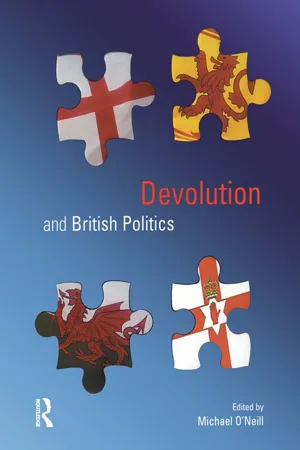
Devolution has transformed the British Polity in the last decade. Taking this profound change as its theme, Devolution and British Politics is an up-to date, comprehensive and effective review of the origins and development of the devolution process.Devolution in British Politics offers a de-centralised assessment of British politics and encourages critical thinking regarding contemporary political theory.
- 408 pages
- English
- ePUB (mobile friendly)
- Available on iOS & Android
eBook - ePub
Devolution and British Politics
About this book
Information
Part One
A KINGDOM UNITED
| 1 | State building and national integration in Britain |
FOUNDATIONS
The United Kingdom was not the political outcome of a grand political design to unite the peoples of the British Isles within a common realm. Rather, the British State was a contingent outcome of a cumulative process of political integration over centuries, primarily, though not exclusively, determined by English interests and statecraft. This was not hegemonic statecraft, the plain acknowledgement of superior English power used to justify outright conquest and military subjugation; it was expressed instead through the medium of diplomatic negotiation and embedded in bargains struck between the centre and territorial elites for mutual advantage. Territorial elites were assimilated within the national project, or at least compensated with state patronage and other opportunities for personal preferment. This process of national integration was instigated and implemented without reference to the common people. As such, it was hardly ‘the product of a compact, drafted and signed by its constituents’, but was rather ‘an agglomeration created by the expansion and contraction of territorial power in the course of a thousand years’.1
England was the dominant country of the British Isles following the Norman Conquest in 1066, unifying the former Saxon and Viking realms under a system of sound administration, a feudal polity ruled by a ruthless military caste. The process of state building enacted by England's political elite and broadly supported by their territorial counterparts gradually brought under English stewardship the government of the four nations who inhabit the islands of Great Britain and Ireland, promoting England's strategic and economic interests within and beyond the British Isles.2 The abiding concern of the English state after 1066 was to consolidate territorial security by neutralising the threats from its Celtic purlieus, preferably by bringing these turbulent neighbours under England's indirect influence or direct control. A key motivation here was to safeguard the interests of the culturally dominant and most populous British nation against what the political elite regarded as insidious threats from England's geographic hinterland, threatening political instability and, in later centuries, economic uncertainty. Security was a paramount concern, whether resisting incursions across England's land borders or deterring adjacent territories, especially Ireland, from becoming forward bases for invasion by other European powers.
Political integration was fuelled by dynastic ambition and sustained by a sense of ethnic superiority. It manifested, in turn, the cultural confidence that comes from military ascendancy and unchallenged economic dominance. Economics as much as realpolitik played a part in the making of the United Kingdom. Nor was the process of political integration a wholly one-sided affair, though it certainly privileged English interests above those of the others. The advantages accruing to vested interests in the smaller countries from participating in a common British market and monetary system grew in their appeal as a worldwide economy emerged. Attractive, too, were the opportunities available to non-English political and commercial elites from participating in the expansive English empire, and, for that matter, from having access to both the prestige and the material benefices of lucrative patronage in a larger, more powerful state.
In short, greed and hubris reciprocated by fear and resentment, and sustained by resigned acceptance of political realities, all played a far greater part in forging the union of British nations than any ethereal concern to establish a commonwealth embodying the highest political ideals. Even the more pragmatic objective of reconciling ancient enmities within an overarching British identity was not the principal objective of British political integration. The union state was, and it has remained, a project conferring much the greater advantage on its principal constituent. Political and material self-interest was discernible in the political culture of unionism. There was an implied assumption, powerfully disseminated by the usual agents of political socialisation, both official and informal, during the formative years of the Union, that the new and overarching British identity manifested, in reality, predominantly English cultural values and norms supposedly reflecting that nation's political virtues.
Self-interest, not least amongst the English elite, was a powerful incentive for integration and added strong cement to the Union. But this pragmatic and essentially uneven bargain cultivated, as we shall see below, residual resentments. These have persisted ever since, in time sowing seeds of discord that contributed to the Union's unravelling, though these seeds would be a long time germinating. Pique amongst territorial interests over assumed English dominance within the Union sustained the political challenge to the central authorities, giving significant momentum to home rule movements during succeeding centuries in every territorial constituent except England. The recent revival of territorial nationalism is merely the latest expression of residual antipathy to the political and cultural bargains that underpinned the union state from the outset.
The challenge to the union state for wholesale re-imagination of the Union began in Ireland during the latter part of the nineteenth century. The contemporary home rule movement is again, in large measure, merely the continuance of this visceral antipathy on the territorial margins of British society to the idea of English ascendancy over the Union. In order to understand how this renaissance in territorial identity came to pose a serious challenge to the cultural integrity and the institutional structure of the British state, we must examine the historical roots of territorial identity in these islands. For the principal causes of recent political turbulence lie in the foundations and the dynamics, in the political character, and the structural interactions of the constituent parts of the Union over some three centuries, and indeed in the cultural make-up of the union state.
CONSTITUENTS
England
The Anglo-French aristocracy consolidated England's diverse territorial polities and ethnic groups into a nascent ‘English’ state after the Norman Conquest of 1066.3 The defeated Anglo-Saxon realms and the Viking sphere of influence were subsumed within a feudal state dominated by a foreign military caste.4 There is no academic consensus about precisely when this state ceased to be an alien construct and became repatriated as ‘England’, eventually becoming the fount of native patriotism. By the thirteenth century, a manifest sense of Englishness was already expressed in a vernacular native language, and with it a growing sense of popular cultural identity took firm hold.5 An island kingdom surrounded by ‘less happy breeds’ became rooted in the popular imagination, shaping the cultural fabric of national life.6
More significant for ensuring turbulent relations with the other British nations was the fact that England's demographic supremacy and expansive commercial influence exerted a powerful centripetal pull. In time, robust military action and conquest brought about the incorporation of these neighbouring polities, if not quite their acquiescent accommodation within the powerful English state. Cultural assimilation facilitated political integration and by degrees ‘the idea of Englishness … came to be an integrating one, binding the other parts of the United Kingdom to the centre’. This metropolitan pull impacted, too, on the English regions in as much as ‘the heart of England lay in London and the south-east and it is there that power was centralized. England came to be ruled by a strong central government which left little room for provincial loyalties’.7 The social and cultural consequences of powerful metropolitan influence were quite apparent in the political relations of the islands even before formal changes in political arrangements – colonisation in Ireland, the annexation of Wales, a negotiated union of the two crowns8 and the subsequent Act of Union with Scotland – established the union state.9
The sequence of changes in the political relations between England and the other British nations merely confirmed that country's dominant position, the primacy of English interests, in the islands. Yet this cumulative assimilation in no way obliterated primordial political identity. Indeed, the very asymmetry of intra-British relations sustained a continuing sense of abiding territorial differences. The idea that the smaller British nations were each culturally distinctive in their own right was, in part, a predictable response to English political hegemony and commercial dominance. This mindset both encouraged, and to an extent legitimised, the efforts of territorial opinion formers and political elites to foster a sense of sub-British identity, of belonging to distinctive national communities who defined themselves against the ‘significant other’ of England. And although Celtic historians and the ideologists of territorial nationalism might contest the point, as sociologists have confirmed, all political identity is in some measure a constructed project – part of a reflexive process of inventing an ‘imagined community’ rooted in cultural distinctiveness. Accordingly, Celtic nationalism in Britain, manifested as a persistent challenge to the central locus of power in the British state, has, in no small measure, been a response to English hegemony.
Wales
Wales was a principality but never an independent state in the conventional meaning of that term. The English Crown appropriated land there in the thirteenth century and the Principality was annexed by Edward I after the defeat in 1283 of Llewelyn, the last Welsh prince. The process of integrating Wales into the English state was, nevertheless, a protracted one. The vestiges of independent legal, administrative and educational systems were incorporated into the fabric of English public administration only after the accession to the English throne of the native Welsh Tudor dynasty in 1485. It was only during the reign of Henry VIII that this union was formalised. Acts passed by the English Parliament proclaimed Wales to be already ‘incorporated, united and annexed to the realm of England’ (1536) and thereby permitted Welsh Members to sit at Westminster (1543). The incorporation of ‘the Dominion’ of Wales into the English state was a political fact long before it was formally acknowledged by the terms of the Wales and Berwick Act (1746).10
One notable consequence, indeed a significant vehicle for this process of political annexation and administrative assimilation, was the adoption of English as the official language. The decision of Elizabeth I to permit the translation of religious texts into the vernacular was intended to reinforce the popular appeal of the Protestant faith. But it ensured, too, that language thereafter was the defining essence of residual Welsh identity. The role of language as a conspicuous cultural referent in religious, political and judicial affairs in Wales after so much else that was culturally conspicuous had been lost, ensured that a discernible sense of Welsh national identity survived the incorporation of Wales into the English state. Moreover, political integration took place in a way that deliberately avoided giving offence to territorial sensibilities. For it was characteristic of the developing English state ‘to insist upon political unity but to rely upon local interlocutors and the mechanism of indirect rule for the administration of the peripheries’.11 Local administration and the operation of the justice system thus remained the preserve of territorial dignitaries.
At the same time, the lack of those autonomous national institutions preserved in Scotland after the Act of Union, and the absence, too, of a recent folk memory of independent statehood...
Table of contents
- Cover
- Half Title
- Title Page
- Copyright Page
- Dedication
- Table of Contents
- List of tables
- List of contributors
- Acknowledgements
- Introduction
- Part One A Kingdom United
- Part Two Re-Imagining Britain: The Politics of Identity
- Part Three Reforming the British State
- Part Four Reflecting on Constitutional Change
- Index
Trusted by 375,005 students
Access to over 1.5 million titles for a fair monthly price.
Study more efficiently using our study tools.
Frequently asked questions
Yes, you can cancel anytime from the Subscription tab in your account settings on the Perlego website. Your subscription will stay active until the end of your current billing period. Learn how to cancel your subscription
No, books cannot be downloaded as external files, such as PDFs, for use outside of Perlego. However, you can download books within the Perlego app for offline reading on mobile or tablet. Learn how to download books offline
Perlego offers two plans: Essential and Complete
- Essential is ideal for learners and professionals who enjoy exploring a wide range of subjects. Access the Essential Library with 800,000+ trusted titles and best-sellers across business, personal growth, and the humanities. Includes unlimited reading time and Standard Read Aloud voice.
- Complete: Perfect for advanced learners and researchers needing full, unrestricted access. Unlock 1.5M+ books across hundreds of subjects, including academic and specialized titles. The Complete Plan also includes advanced features like Premium Read Aloud and Research Assistant.
We are an online textbook subscription service, where you can get access to an entire online library for less than the price of a single book per month. With over 1.5 million books across 990+ topics, we’ve got you covered! Learn about our mission
Look out for the read-aloud symbol on your next book to see if you can listen to it. The read-aloud tool reads text aloud for you, highlighting the text as it is being read. You can pause it, speed it up and slow it down. Learn more about Read Aloud
Yes! You can use the Perlego app on both iOS and Android devices to read anytime, anywhere — even offline. Perfect for commutes or when you’re on the go.
Please note we cannot support devices running on iOS 13 and Android 7 or earlier. Learn more about using the app
Please note we cannot support devices running on iOS 13 and Android 7 or earlier. Learn more about using the app
Yes, you can access Devolution and British Politics by Michael O'Neill,Michael Oneill in PDF and/or ePUB format, as well as other popular books in Politics & International Relations & Constitutions. We have over 1.5 million books available in our catalogue for you to explore.