eBook - ePub
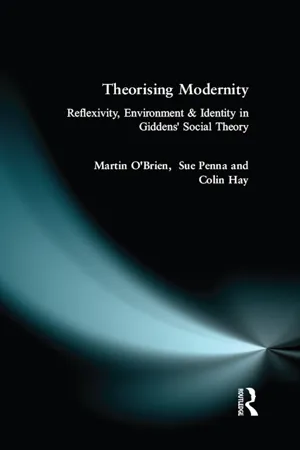
Theorising Modernity
Reflexivity, Environment & Identity in Giddens' Social Theory
- 240 pages
- English
- ePUB (mobile friendly)
- Available on iOS & Android
eBook - ePub
Theorising Modernity
Reflexivity, Environment & Identity in Giddens' Social Theory
About this book
What is modernity? Do we all experience modernity in the same way? How should we understand contemporary social change? This volume explores questions of modernity through critical engagements with the work of Anthony Giddens, focusing in particular on the relationships between his social theory and political sociology. Three substantive areas - reflexivity, environment and identity - are examined theoretically through the relationships between reflexivity and rationality, life politics and institutional power, and universalism and 'difference'.
As well as specifically addressing Giddens' reconstruction of sociology, the contributors also explore a wide variety of critical issues currently occupying centre stage in social theory. These include questions about the character of contemporary societies, the periodisation of social change, the processes of change by which societies are constantly made and remade by people, the relationships between the 'social' and the 'natural', the formation and maintenance of identities and matters of epistemology and methodology in social science.
Theorising Modernity will be of interest to undergraduate and postgraduate students of sociology, modern political thought, social geography and social policy and to social scientists trying to make sense of the modernity debate.
Martin O'Brien is Research at the University of Derby. Sue Penna is a Lecturer in Applied Social Science at Lancaster University. Colin Hay is a Lecturer in the Department of Political Science and International Studies at the University of Birmingham (UK), a Visiting Fellow of the Department of Political Science at the Massachusetts Institute of Technology (US) and Research Affiliate of the Centre for European Studies at Harvard University (US).
Information
CHAPTER 1
Theorising modernity: Reflexivity, identity and environment in Giddens’ social theory
Martin O’Brien
Anthony Giddens’ wide-ranging sociological project has been the subject of extensive assessment and evaluation (Held and Thompson 1989, Bryant and Jary 1990, Craib 1992 amongst others) and it is not my intention here to replicate what others have already said. My focus in this chapter is on the relationships between the theory of structuration and the ontology of modern society in Giddens’ opus. The former, comprising a detailed overhaul of sociology’s theoretical and methodological outlook, preoccupied Giddens’ writings from the early 1970s to the mid-1980s whilst the latter, comprising an attempt to establish the sociological uniqueness of the contemporary world, has occupied centre stage from the mid-1980s to the early 1990s. The publication of Beyond Left and Right in 1994 marks a further elaboration of the relationships between these two dimensions of Giddens’ sociological project, focusing on the policy consequences of the ontology and an attempt to recapture the normative high ground for an ethical-socialist politics.
The connection between theory and ontology is an important starting point for understanding Giddens’ work because he depicts structurationism as a theoretical ontology based on the idea that social life consists in its own (re)production through the skilled and knowledgeable enactment of practices by interacting individuals (Giddens, 1990b: 201–4). However, the theoretical and the ontological dimensions of structurationism need to be addressed differently because whilst the standpoint is initially developed as a theoretical ontology of social life as such it later comes to be applied specifically as a theoretical ontology of modern social life. The interposition of ‘modern’ is an important step because it implies that there is something ontologically – as well as theoretically – unique about ‘modernity’. In other words it involves the claim that the (re)production of modern social life is distinct or cut off from the (re)production of non-modern social life such that the theoretical and conceptual resources required to comprehend the modernity of the world needs must differ from those required to comprehend a world of non-modernity.
The different facets of Giddens’ work are closely connected so that the periodisations and distinctions proposed above are more a matter of emphasis than of shifts in standpoint. I do not claim that there has been any sort of epistemological or ontological ‘rupture’ in Giddens’ work but he has been so productive, and has cast his analytical net so widely, that it is necessary to distinguish the different philosophical strands of the structurationist view he proposes in order to have any chance at all of conveying its import. In this chapter I will provide a brief introduction to the development of structuration theory from the 1970s to the 1990s before presenting a critical assessment of some central concepts in Giddens’ recent sociological and political writings.
Structuration theory: a brief biography
Structuration theory draws on a wide range of sources, including structural functionalism, hermeneutics, Marxism, psychoanalysis, psychotherapy, ethno-methodology, poststructuralism and social and developmental psychology. It begins in a critical encounter with three sociological traditions (represented by Marx, Weber, and Durkheim) (Giddens 1971), is then clarified theoretically through a reappraisal of hermeneutic sociology (Giddens, 1976, 1979), before being schematised and related to a critical sociology of modern society (Giddens 1995[1981], 1984, 1985) and is still emerging. Giddens’ recent application of structurationism to questions of intimacy, identity and political theory has given rise to a series of novel theoretical insights into processes of globalisation, detraditionalisation and democratisation (Giddens 1990a, 1991, 1992, 1994a).
Initially, the contribution of the structurationist perspective to sociology consisted in the elaboration of a new approach to the structure-agency dichotomy in social theory, a dichotomy which underlay the ‘two sociologies’ problem in post-war social science. On one side of the divide stood the sociology of social structures, which specified the constraints and forces determining people’s actions. On the other side stood the phenomenological traditions that specified the mundane creation of an orderly world by interacting individuals. The two sociologies problem itself represented a dualism of structure and agency in the dominant schools of sociological thought: to what extent are human actions, beliefs and wants determined by external, structural forces that are independent of people’s will; and to what extent is the structuredness or orderliness of the world a product of people’s actions and interactions (see Dawe 1970)? Giddens’ response to this division in social theory was to reconfigure the terms of reference of the debate and to propose that structure and agency comprised not a dualism but a duality. The reconfiguration gave rise to the claim that, rather than being independent and opposed characteristics of social life, structure and agency were two sides of the same social process. Giddens’ classic formulation of the duality of structure concept appears in New Rules of Sociological Method: ‘social structures are both constituted by human agency and yet at the same time are the very medium of this constitution’ (1976: 121). The realisation or instantiation of structure in social interaction occurs not because agents consciously intend to reproduce specific properties of social structure but because, tacitly, they share robust mutual knowledges that enable them to achieve orderliness in their everyday encounters. The structure-agency dualism in sociology can be overcome by separating out what agents intend to achieve in their actions (purchase goods, declare their love, earn a living, and so on) from the unintended consequences of those actions (reproduce market relations, realise their gender and sexuality, reproduce class relations, and so on). These unintended consequences arise because agents tacitly share knowledge of how to exchange, how to court, how to labour, for example, in ways that are orderly and structured in their everyday relationships.
Structuration theory, then, originates in Giddens’ determination to revise radically English-speaking sociology, a revision initially centred in postwar debates about the significance of sociological classics. In doing so, however, Giddens also wished to retain important frames of reference established by sociology’s founding practitioners. Studies in Social and Political Theory (1977) – a collection of essays written between 1967 and 1976 – introduces many of the theoretical propositions upon which structuration theory later came to depend, at the same time as situating the emerging theory in relation to classical sociology. It is in these essays that Giddens defines his concern with the role of practical knowledge in social reproduction and with the relationships between social reproduction and social change. Here, also, Giddens situates structuration theory in relation to traditional and, as he acknowledges, familiar sociological problematics, for example, superseding functionalism whilst retaining its core theoretical tasks (1977: 121), debunking the myth of ‘the problem of order’ by recovering the radicalism of apparently conservative sociological sources (1977: 208–9) and developing a theory of suicide (1977: 297–321).
From the publication of New Rules of Sociological Method (1976) and Central Problems in Social Theory (1979) onwards, sociology’s traditional problems are themselves increasingly problematised. A Contemporary Critique of Historical Materialism (1995[1981]), for example, abandons the traditional lines of dispute over social change (evolutionary stages, historical modes of production, functional differentiation, etc.). Instead, Giddens develops a typology of social systems as non-evolutionary time–space relations (and the dissolution of the latter as constraints), and a categorisation of institutional clusters based on logics of signification, domination and legitimation (1981: 23, 29, 47). Whilst A Contemporary Critique, together with The Nation State and Violence (1985), are explicitly institutional analyses of modern nation states and their interconnections, nonetheless, both make extensive and explicit reference to the dependence of the institutional critique on the notion that social life comprises a set of practices whose reproduction constitutes interaction, institutions and structure (1976: 104). The Constitution of Society (1984) – which is the formal statement of the theory of structuration and lays the ground for the ontological emphasis that characterises Giddens’ recent writings – develops a sophisticated and complex analytical agenda. Here, Giddens attends to the task of outlining a wide range of concepts – rule and resource, regionalisation, routinisation, recursiveness, distanciation, locale and created environment, amongst many others – as well as exploring the relationships between sociology and human geography. The theory of structuration as outlined in The Constitution of Society proposes that the concept of ‘structure’ has no useful descriptive properties of its own since the structuredness of social life arises from the reproduction of routinised practices in interaction. This routinised reproduction of the conditions of action realises the structuring properties of social systems (1984: 25) in concrete terms, since such properties in themselves exist only in a ‘virtual’ sense unless and until instantiated in interaction.
Across the 1990s, the constitutive role of practice in social reproduction has come to occupy centre-stage in a new way in Giddens’ sociology of late modernity. Thus, The Consequences of Modernity (1990a) continues the institutional analysis referred to earlier but applied to new questions – in particular, political and moral questions – of trust, risk, environment and life politics. Equally importantly, however, the book also sketches an ontology of the self that forms the basis for the theory of identity developed in Modernity and Self-Identity (1991a). Ontologically, self-identity is grounded in relations of trust and security, risk and anxiety. In conditions of modernity, traditional parameters for fixing self-identity – such as kinship, locality or community – break-down: individuals encounter a much wider range of ambiguous social networks and institutions that represent an equally wide range of, often contradictory, personal choices. Individuals must place their trust not in well-tried, familiar kin or communal networks and institutions but in often untried and unfamiliar expert or global networks and institutions. The conditions and parameters of trust and risk spread far beyond the contexts of anyone’s personal experience. Amongst other things, the modern world is ‘post-traditional’ in the sense that individuals are exposed to and actively seek out multiple sources for establishing and maintaining a self-identity. The (late) modern self is an uncertain personal relationship with an indeterminate social world. Theoretically, self-identity comprises a ‘reflexive project’, one whose coherence must be worked at and striven for across many different social and institutional contexts. As Giddens puts it, the contemporary world is full of ‘clever people’ (1994a: 7): it is a world populated by skilled and knowledgeable individuals who are experienced and practised at moving between social contexts and using institutions as resources for sustaining security and stability in their everyday lives. The reflexivity of these individual-social-institutional mediations consists in their openness or susceptibility to continual revision in the light of new knowledge and information (1991a: 20).
Whilst Giddens’ work has ranged across many of the major traditions of sociological theory and whilst it has contributed theoretical insights into many different phenomena – from suicide to intimacy – structuration theory itself ‘is not intended to be a theory “of” anything in the sense of advancing generalisations about social reality’ (1990b: 204). It is, rather, a ‘conceptual investigation of the nature of human action, social institutions and the interrelations between action and institutions’ (1990b: 201). Defined in this way, the theory of structuration is said to comprise only one aspect of Giddens’ writings rather than the vehicle through which a major overhaul of sociology might be undertaken and a new conception of the contemporary world established. In my view, however, the terms of reference of the theory of structuration remain the only fixed points through which an assessment of Giddens’ sociology can be undertaken. For a commentator on Giddens, if not for Giddens himself, there is no way to grasp the significance of any of his work except as the elaboration of the theoretical ontology put forward under the guise of the theory of structuration. Understood in this way, Giddens’ theoretical journey from questions of suicide and class to questions of intimacy and identity can be seen as a programme of sociological analysis whose goal is to supersede the dualism of structure and agency across all of the major problematics of contemporary social science. In a programme of such magnitude it is hardly surprising that his work has been the object of widespread commentary and critique. There is now a veritable Giddens industry (of which the present volume may be considered as another of its products) but the industry would never have developed unless the programme had touched questions of fundamental significance to contemporary sociology. In the remainder of this chapter I will examine some of these questions, in particular, of modernity, environment and identity. I will show how Giddens has been able to reorient sociological questions of social change, but I will also note that the two sociologies problem – the dualism of agency and structure – continues to cast a shadow across the structurationist perspective.
Modernity
It might be suggested that the questions to which Giddens’ theoretical ontology has been addressed appear to have undergone a radical revision since he first proposed to revise sociological theory. On closer inspection, however, it is clear that Giddens’ recent work is a continuing engagement with tasks that he set for structuration theory in his reflections on Marx, Weber and Durkheim. This engagement is, after all, what Giddens set out to do:
To argue that it must be one of the main tasks of modern sociology to revert to some of the concerns which occupied its founders is not to propose a step which is wholly regressive: paradoxically, in taking up again the problems with which they were primarily concerned, we may hope ultimately to liberate ourselves from our present heavy dependence on the ideas which they formulated. (Giddens 1971: 247)
In particular, Giddens’ theoretical ontology can be understood as a detailed exposition and elaboration of a number of sociological positions introduced in Capitalism and Modern Social Theory, two of which are especially significant for my discussion. The first is Giddens’ critique of the ‘problem of order’ (to which I return, below). Here (1971: ix) Giddens proposes that the problem of ‘order’ as attributed to Durkheim and promulgated by Parsons, in particular, is a sociological myth. In reality, the Durkheimian problem is not order as such but its changing nature (see also 1977: 210–12, 251). The second is the rupture or ‘discontinuity’ between modernity and tradition with which Giddens opens the introduction to the book. Here (1971: xi), Giddens affirms Lord Acton’s dictum by claiming that: ‘In the modern era, men no longer accept the conditions of life into which they are born as necessarily given for all time, but attempt to impose their will upon reality in order to bend the future into a shape that conforms with their desires.’
In my view, these two connected propositions are the founding sociological statements of structuration theory, namely that: (ontologically) the contemporary world is uniquely modern, and (theoretically) the modern order is inherently transformational: all individuals (not only men) attempt to ‘bend the future’. I deal with each in turn.
Ontologically, to depict the contemporary world as a world different to its past is, ipso facto, to assert its modernity. Modernity, for Giddens, is precisely a historical condition of difference: a displacement of the past and its traditional, natural and metaphysical reference points. That this condition of difference has been accepted in sociological theory can hardly be contested. The contribution of Giddens’ structurationist perspective has been to pose the question of this difference as the central problematic of contemporary sociology: in what does the condition of modern difference consist? Or, in other words, what conditions the difference of modernity? Giddens responds that the modern world has become thoroughly reflexive: its modernity resides primarily in the internality of its referential systems. I make further comment on the concept of reflexivity below. Here, I note Giddens’ argument that whereas the status and power of premodern institutions was grounded in an appeal to ‘externally referential systems’ – the natural order, the sanctity of tradition or custom, or the dictates of a metaphysical entity – modern institutions orient to the world as a rationalised social relation among subjects and objects. Their status and power are grounded in an appeal to ‘internally referential systems’: accumulated or scientific expertise, procedural rationality or efficiency and, importantly, trust relations (1990a: 33–8, 79–111, 1991: 185, 147–8, 201). In turn, the rationalisation of the status and power of institutions is produced recursively in social conduct (1979: 65, 69 et passim). For Giddens, the modern world is different not primarily in the scale of its social systems, although this is an important feature, but in their malleability and multidimensionality (see below).
Theoretically, Giddens contends that modernity is inherently transformational: change is built into the social systems that make up modern society. The multidimensional modern world is a constant process of renewal and reproduction in which the potential for change is immanent to any and every interaction. Giddens’ concept of immanent change is derived from his reading of two Durkheimian themes. The first is the emphasis on the changing nature of order. The second is the conceptual stretching of Durkheim’s notion of ‘plasticity’. Giddens exemplifies the first theme by reference to language use: every utterance in ordinary language is the production of a new meaning but that production reproduces existing rules of language. The reproduction of the conditions for a meaningful world (as rules of language use) are, from the point of view of any such instance of reproduction, their novel or renewed production (in a new meaning, in new circumstances). The entry of newness into the world – here, the production of novel or transformed meanings – is an orderly phenomenon grounded in the structuring properties of social interaction. There is, for Giddens, no need to counterpose order (as stasis) to change (as chaos) as if they were dichotomous: the changing nature of a world that appears orderly is a consequence of the ways that agents draw upon and reconstitute the structuring properties of social interaction.
Whilst the concept of the duality of structure can be applied to any and all social formations, Giddens uses the theme of the changing nature of order to illuminate the differences between traditional and modern societies. According to Giddens, social reproduction in traditional societies is conditioned by ‘place’: not only is the individual’s day-to-day life largely bound to small spatial territories – in hamlets, villages and towns, for example – but individuals have only very limited access to distant persons and events. Experience and awareness are always spatially situated and institutions are grounded in local customs and habits. The world is ‘out there’, immutable, distant and intangible. Social reproduction in modern societies, by contrast, makes what was ‘out there’ immediately accessible to or immediately consequential for everyone: day-to-day awareness, experience and conduct take place in a globalised context where ‘place’ is only one amongst many points of social reference. Global production, trade and media bring the consequences of human actions to every corner of the world. Individuals are no longer bound by the habits and customs of place and their actions extend beyond any familiar territory they may occupy. Classic examples of these phenomena are the rise of global consumption, and the multi-cultural habits and customs on wh...
Table of contents
- Cover
- Half Title
- Title Page
- Copyright Page
- Table of Contents
- The contributors
- Acknowledgements
- Introduction
- CHAPTER 1 Theorising modernity: Reflexivity, identity and environment in Giddens’ social theory
- CHAPTER 2 Radical politics - Neither Left nor Right?
- CHAPTER 3 Beyond emancipation? The reflexivity of social movements
- CHAPTER 4 Exploring post-traditional orders: Individual reflexivity, ‘pure relations’ and duality of structure
- CHAPTER 5 Life politics, the environment and the limits of sociology
- CHAPTER 6 Criminality, social environments and late modernity
- CHAPTER 7 Modernity and the politics of identity
- CHAPTER 8 Theorising identity, difference and social divisions
- CHAPTER 9 A world of differences: What if it’s so? How will we know?
- CHAPTER 10 An interview with Anthony Giddens
- References
- Index of citations to the work of Anthony Giddens
- Author index
- Subject index
Trusted by 375,005 students
Access to over 1.5 million titles for a fair monthly price.
Study more efficiently using our study tools.
Frequently asked questions
Yes, you can cancel anytime from the Subscription tab in your account settings on the Perlego website. Your subscription will stay active until the end of your current billing period. Learn how to cancel your subscription
No, books cannot be downloaded as external files, such as PDFs, for use outside of Perlego. However, you can download books within the Perlego app for offline reading on mobile or tablet. Learn how to download books offline
Perlego offers two plans: Essential and Complete
- Essential is ideal for learners and professionals who enjoy exploring a wide range of subjects. Access the Essential Library with 800,000+ trusted titles and best-sellers across business, personal growth, and the humanities. Includes unlimited reading time and Standard Read Aloud voice.
- Complete: Perfect for advanced learners and researchers needing full, unrestricted access. Unlock 1.5M+ books across hundreds of subjects, including academic and specialized titles. The Complete Plan also includes advanced features like Premium Read Aloud and Research Assistant.
We are an online textbook subscription service, where you can get access to an entire online library for less than the price of a single book per month. With over 1.5 million books across 990+ topics, we’ve got you covered! Learn about our mission
Look out for the read-aloud symbol on your next book to see if you can listen to it. The read-aloud tool reads text aloud for you, highlighting the text as it is being read. You can pause it, speed it up and slow it down. Learn more about Read Aloud
Yes! You can use the Perlego app on both iOS and Android devices to read anytime, anywhere — even offline. Perfect for commutes or when you’re on the go.
Please note we cannot support devices running on iOS 13 and Android 7 or earlier. Learn more about using the app
Please note we cannot support devices running on iOS 13 and Android 7 or earlier. Learn more about using the app
Yes, you can access Theorising Modernity by Martin O'Brien,Sue (Lecturer In Applied Social Science, University Of Lancaster) Penna,Colin Hay,Sue Penna in PDF and/or ePUB format, as well as other popular books in Social Sciences & Political History & Theory. We have over 1.5 million books available in our catalogue for you to explore.