Early Medieval Europe 300–1050: A Guide for Studying and Teaching empowers students by providing them with the conceptual and methodological tools to investigate the period. Throughout the book, major research questions and historiographical debates are identified and guidance is given on how to engage with and evaluate key documentary sources as well as artistic and archaeological evidence. The book's aim is to engender confidence in creative and independent historical thought.
This second edition has been fully revised and expanded and now includes coverage of both Islamic and Byzantine history, surveying and critically examining the often radically different scholarly interpretations relating to them. Also new to this edition is an extensively updated and closely integrated companion website, which has been carefully designed to provide practical guidance to teachers and students, offering a wealth of reference materials and aids to mastering the period, and lighting the way for further exploration of written and non-written sources.
Accessibly written and containing over 70 carefully selected maps and images, Early Medieval Europe 300–1050 is an essential resource for students studying this period for the first time, as well as an invaluable aid to university teachers devising and delivering courses and modules on the period.
The intention of this book is to explore how far for the development of Europe, in political, religious, cultural, social, and economic terms, the period from 300 to 1050 was one of the most formative in its history. Fully to appreciate that, we need to consider not just Europe itself, but also its wider context. Europe was by no means an island, but was always closely connected to the lands to the east, bordering the Mediterranean Sea, and to the south, equally bordering that sea and extending to the fringes of the Sahara Desert. It is for that reason that this book, focused as it is first and foremost on Europe, also contains a chapter discussing the Arab conquests of the seventh century (Chapter 4).
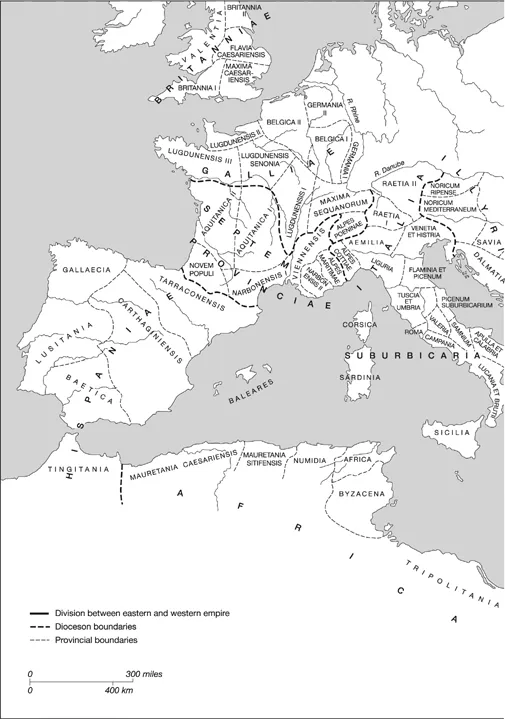
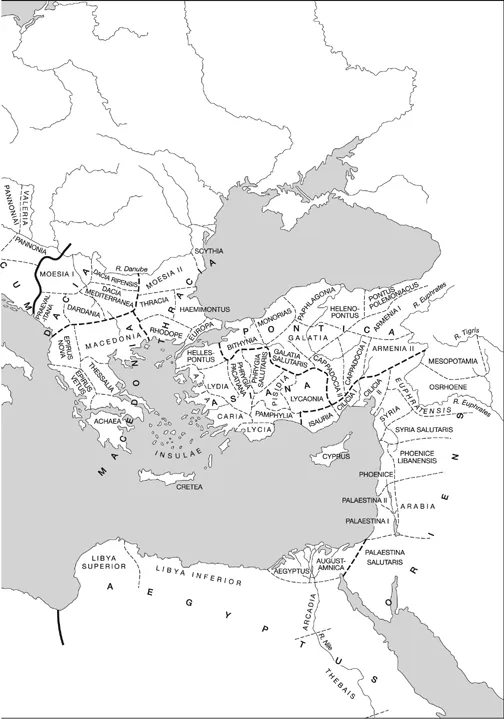
As regards the formative character of the period which it covers, consider, first, how in 300 Europe and the Middle East were dominated politically by the Roman Empire on the one hand, and the Persian Empire to the east. The former’s frontiers stretched from the Atlantic Ocean on the west to the Rivers Tigris and Euphrates on the east, from Hadrian’s Wall in the north, to the Atlas Mountains of North Africa in the south (Map 1.1).
The Persian Empire, which was at that time ruled by a dynasty called the Sasanids, adjoined it on the east, and extended eastwards, around the southern shores of the Caspian Sea and the northern shores of the Persian Gulf as far east as the mountains of the Hindu Kush (Paropamisus Range) and modern Afghanistan (Map 4.1).
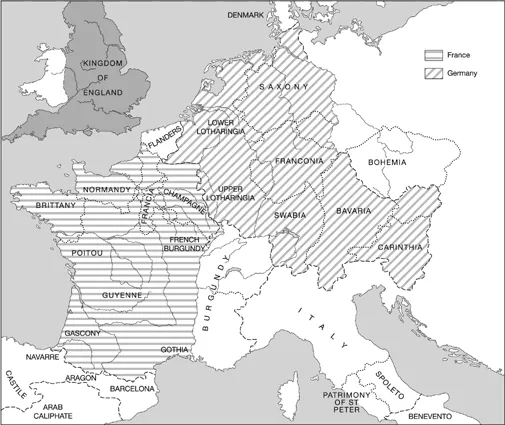
Now consider the situation in 1050, when the political map of Europe and the Middle East was very different. In place of the unitary might of the Roman Empire, the western section of which had come to an end in the late fifth century, a series of often very fragmented kingdoms had come into existence in Western Europe, and we can perhaps dimly perceive underlying this development the beginnings of modern political geography, with the kingdoms of France, England, and Germany, for example, already appearing in embryonic form (Map 1.2).
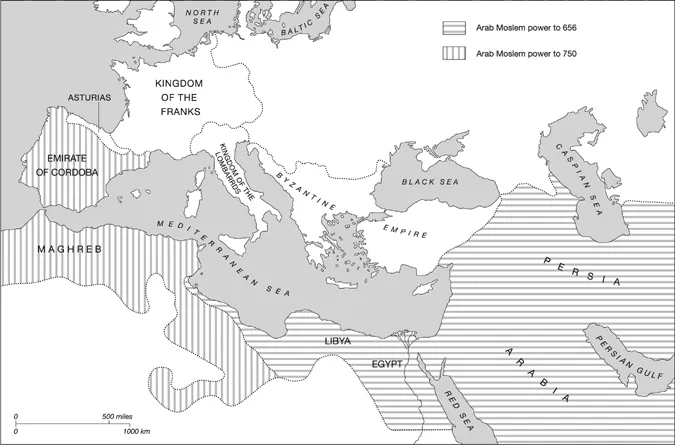
Developments in the eastern Mediterranean had been equally far-reaching. After the break-up of the Roman Empire in the West, the Roman Empire in the East continued to exist as an important state, with its centre in the great city of Constantinople (modern Istanbul); and, from the sixth century onwards, it is generally known to modern scholarship as the Byzantine Empire, and I shall follow that practice in this book. It was itself reduced in size when, following the rise of Islam in the early seventh century, Arab armies robbed it of the provinces of Syria, Egypt, Libya, Tripoli, and the remainder of North Africa, as well as destroying the Persian Empire and taking over its lands. In 711, Muslims from North Africa invaded Spain, where the Byzantine Empire still had a foothold, destroyed the kingdom of the Visigoths there, and subjected almost the whole of the Iberian peninsula to their rule. The Byzantine Empire was reduced to Asia Minor, the Balkans, and parts of Italy and the Mediterranean islands. Its eastern provinces and the whole of the former Persian Empire became part of the Arab caliphate, centred first at Damascus under the Umayyad caliphs (661–750) and then at Baghdad under the ‘Abbasid caliphs (Map 1.3; Map 3.1). These conquests laid the foundations for the spread of Islam, even though the speed of that spread remains a matter of debate.
Map 1.1The extent of the Roman Empire. The governmental units called provinces and dioceses are marked as in Late Roman documents.
Map 1.2Western Europe around 1000–50. What was to become France as we know it was divided into a series of duchies such as Flanders, Normandy, and Aquitaine, and Aquitaine itself was subdivided into Poitou, Guyenne, and Gascony; but nevertheless it was at least notionally under the rule of a king whose centre of power lay in the area around Paris, that is the Île de France, or ‘Francia’ as it was known and is marked on this map. Germany was also fragmented into duchies such as Saxony, Swabia, and Franconia, but nonetheless a clear political distinction was emerging between the western and eastern parts of Western Europe. To the east lay areas such as Bohemia whose status and connection to Germany were still fluid. To the south, lay the kingdom of Italy, also very fluid and occupying broadly northern Italy, with duchies such as Spoleto to the south, and also the ‘Patrimony of St Peter’, which was the pope’s lands, the nucleus of the future papal states. To the south-west of the Pyrenees, the Christian kingdoms and counties of Navarre, Aragon, and Barcelona (with Leon-Castile to the west of this map) were pressing against the Arab caliphate and emirates to the south.
Map 1.3Expansion of the Arab Muslims. The horizontal shading shows the expansion of Arab Muslim power down to 656, including the Byzantine provinces of the eastern and southern shores of the Mediterranean Sea and the Persian Empire. The vertical shading shows its expansion down to 750, including the kingdom of the Visigoths. Spain is now entirely under Muslim control, apart from the kingdom of Asturias in the north. The River Indus is almost the limit of Muslim power in the east, beyond the eastward extent of this map. Notice the rump to which the Byzantine Empire is reduced, consisting of Asia Minor and the Balkans, although the latter was fragmented by the incursions of Slavs.
The frontiers of the Byzantine Empire were certainly not unchanging after this, for much of its territory in Asia Minor was lost to the invading Seljuk Turks in the late eleventh century; but in essence the empire remained as a political force in the eastern Mediterranean down to 1453, when its principal city, Constantinople, was captured by those Turks, and the empire was destroyed. Similarly, the Arab caliphate experienced a process of disintegration beginning already in the late eighth century, so that by 1050 the caliph at Baghdad was no more than a figurehead, with his former lands divided into a series of effectively independent states, including in Egypt a line of rival caliphs, the Fāṭimids.
Nevertheless, the basic pattern was still one of incipient kingdoms in Western Europe, the Byzantine Empire seeking at least to dominate the eastern Mediterranean, and Muslim rulers in power over a vast area embracing North Africa, the Middle East, and the lands eastward to Afghanistan and Central Asia, and southwards to the Persian Gulf. The change from a unified pax Romana imposing a political and cultural unity on the lands around the Mediterranean Sea to a situation in which they were split between Christian states on the one hand and states embracing Muslim culture and political structures on the other was to dominate the subsequent centuries, very obviously in the period of the Crusades from around 1100, but arguably down to the present day. In the light of this sketch, we may well think that the events of this book’s period were potentially formative for Europe in subsequent centuries, and into the modern period, and we shall need to ponder their significance.
We may also be seeing crucially formative changes in the development of political institutions. In 300, Europe and the lands around the Mediterranean Sea were dominated by the institutions of the Roman Empire, the emperor or co-emperors at least notionally at its head, and the exercise of power in the hands of a paid civil service and a standing army. In the Persian Empire, a similar system prevailed. By 1050, although emperors still ruled in the Byzantine Empire, Western Europe was dominated by kings, their households, and their military followers. Although Roman writers knew of kings as the leaders of their barbarian allies or enemies, kingship as we know it may have begun in this period, including the shaping of its rituals, regalia, and ideology. Certainly, the 1953 coronation ceremony of Queen Elizabeth II of the United Kingdom had its roots in the ninth century, when the various rituals of the ceremony first appeared, notably in the inauguration ceremony of Charles the Bald, king of West Frankia (840–77), in broadly what is now France. Was the period of this book then one in which the political structures of Europe were shaped in broadly the form in which they were to remain for centuries to come?
Social and economic organisation may have been changed in this period in similarly radical ways. Although modern scholars have sometimes emphasised the European aristocracy’s continuity with the Roman world, the change in its character and structure was nevertheless striking, and many of its branches believed that they had originated in the course of this period, notably in the ninth century. In the Byzantine Empire, likewise, we need to ponder how continuous was the life of the aristocratic elite, and how far here too our period was one of long-lasting change.
The organisation of rural life no doubt owed something to the Roman past; but, by 1050, we may be seeing in many parts of Europe the manors, villages, and pattern of fields, in which rural life was to endure until the agricultural and industrial revolutions of the modern age. As for urban life, there has of course been a major transformation produced by modern industrialisation; but we may nevertheless be seeing the origins of the pattern of much modern urban development in this period, not least the concentration of cities in the valleys of the Rhine and adjacent rivers, and in north Italy, and the emergence already by 1050 of cities like London, York, Dublin, and Paris, as well as Muslim cities such as Córdoba in Spain. And we shall need to ponder the significance for the development of Europe as a whole of the vigorous, long-distance trading activity which may have grown up in the Muslim lands, with their close connections with the Mediterranean Sea on the one side, and the lands stretching eastwards to Central Asia on the other.
Most dramatic of all, however, was the change in religion. In 300, the Roman Empire was dominated by the paganism of the classical world, which had often absorbed and made its own the pagan cults of indigenous Celtic inhabitants. By 1050, Christianity, which had in 300 been a minority religion, until very recently the victim of campaigns of bloody persecution, had secured a monopoly as the religion of Europe, even in lands outside the former Roman Empire, like Ireland which had been converted to Christianity already in the fifth century, and Scandinavia which was converted by the early eleventh. Intolerant of other religions, Christianity had succeeded in crushing both classical paganism and Germanic, barbarian paganism, and it had become the defining characteristic of European civilisation. Europe was Christendom by 1050, and its eastern frontiers were frontiers against pagans beyond. Only in Spain was Christianity challenged, there by the religious and political power of Islam, following the conquest of Spain by Muslims from north Africa at the beginning of the eighth century. Indeed, the other great religious change of our period had been the rise of Islam, which by 1050 dominated the lands of the Arab caliphate in North Africa and the Middle East. The Muslim-Christian divide was a product of our period.
In the case of Christianity, its dominance was not just a matter of belief. It was also a matter of organisation and wealth. Some bishops were certainly already functioning as ‘prince-bishops’, and the popes had gone a long way to achieving a position of dominance in Western Europe at least. A similar pattern may have been evident in the Byzantine Empire, although there the position comparable to that of the pope was occupied rather by the Patriarch of Constantinople. Also, monasticism, originating in the Nile Valley in the fourth century, had risen to considerable prominence in the Christian lands, with a dense distribution of monasteries and an astonishing proportion of the productive land in their hands.
As for the learning, scholarship, and culture of Europe, this new dominance of Christianity may have proved seminal for the way in which the learning of the ancient world was transmitted across the centuries, fused with new Christian scholarship, in forms which were to shape European culture throughout the Middle Ages. This culture was largely founded on the Latin language in the West, and increasingly on the Greek language in the Byzantine Empire, as Roman classical culture had been. But our period also saw the rise of the vernacular languages. The very first texts in the ancestor-languages of French and German belong to the ninth century, as does one of the earliest texts in the Old Norse language of Scandinavia. The earliest texts in Old English belong to the eighth century, and that language came to be widely used in writing from the ninth century onwards. As for the Muslim lands, the rise of Arabic as a scholarly and literary language, the language of the Qu’rān and the commentaries on it, belongs firmly to our period.
In this book, we need to explore the case for the importance, or otherwise, of these changes. Modern scholars have refined our understanding of their nature and extent, and they have sometimes disputed their importance. We need to examine their findings in depth, and we need to be aware that we are everywhere surrounded by controversy and debate. We shall have to argue whatever case we choose to make – powerfully and vigorously. But there can be no doubt that, however we might want to answer the questions raised, however much we might want to finesse our answers and conclusions, we are looking at a period which is potentially a central one for understanding what Europe is and has been.
This period is, however, arguably crucial to our understanding of history more widely. We can study it for the joy of discovery, for the fascination of looking at a remote and often exotic period. But we should never forget that it has been of crucial and often sinister relevance to political ideas and ideologies up to the present day. The imperial robes of the emperor Napoleon were decorated with jewelled insects inspired by those found in the tomb of the fifth-century king Childeric; Napoleon’s predecessors who ruled France through the later middle ages and the early modern period believed that the oil used in their coronations was miraculously the same oil used to baptise their first Christian predecessor, Clovis, king of the Franks (c.481–c.511). The ideologues seeking to build a late medieval German nation drew on Roman writers of our period, and Hitler and his fascist colleagues used the history of Germanic peoples in and before our period as the basis of their ideology of the Aryan race. History, however remote, is never irrelevant and never neutral. This period has had more than its share in the shaping of European political ideology, and an understanding of it is crucial to appreciating how that developed.
Challenges to study
At first glance, the study of such a remote period can be daunting. There are few archives of records surviving, and there never were helpful documents such as censuses, or guides to popular feelings such as newspapers, which are the life-blood of the history of the modern period. In some parts of Europe, notably Scandinavia, there was little or no use of writing at all for most of the period. In the Middle East, evidence is extremely difficult to evaluate for the period of the origins of Islam and the Arab conquests; while in the Byzantine Empire there is a an almost complete lack of documentary sources. The volume of evidence is thus spectacularly less than that for modern centuries, when the problem for historians is often its sheer scale rather than its scarcity.
But that presents a challenge rather than a handicap, for it offers you the possibility of mastering a significant proportion of that evidence. And, given the remoteness of the period, it is rich and vivid. It includes unrivalled writers of history, such as the sixth-century Gregory of Tours, whose History of the Franks provides a rich picture of royal and aristocratic life in the area of modern France and western Germany, or the Ar...
Table of contents
Cover
Half Title
Title Page
Copyright Page
Dedication
Table of Contents
List of figures
List of maps
Preface
Companion website resources
Part I Introduction
Part II Empires and peoples
Part III Power and society
Part IV The economic foundation
Part V The Church’s triumph
General Conclusion
Sources
References
Image credits
Index
Trusted by 375,005 students
Access to over 1.5 million titles for a fair monthly price.
Study more efficiently using our study tools.
Frequently asked questions
Yes, you can cancel anytime from the Subscription tab in your account settings on the Perlego website. Your subscription will stay active until the end of your current billing period. Learn how to cancel your subscription
No, books cannot be downloaded as external files, such as PDFs, for use outside of Perlego. However, you can download books within the Perlego app for offline reading on mobile or tablet. Learn how to download books offline
Perlego offers two plans: Essential and Complete
Essential is ideal for learners and professionals who enjoy exploring a wide range of subjects. Access the Essential Library with 800,000+ trusted titles and best-sellers across business, personal growth, and the humanities. Includes unlimited reading time and Standard Read Aloud voice.
Complete: Perfect for advanced learners and researchers needing full, unrestricted access. Unlock 1.5M+ books across hundreds of subjects, including academic and specialized titles. The Complete Plan also includes advanced features like Premium Read Aloud and Research Assistant.
Both plans are available with monthly, semester, or annual billing cycles.
We are an online textbook subscription service, where you can get access to an entire online library for less than the price of a single book per month. With over 1.5 million books across 990+ topics, we’ve got you covered! Learn about our mission
Look out for the read-aloud symbol on your next book to see if you can listen to it. The read-aloud tool reads text aloud for you, highlighting the text as it is being read. You can pause it, speed it up and slow it down. Learn more about Read Aloud
Yes! You can use the Perlego app on both iOS and Android devices to read anytime, anywhere — even offline. Perfect for commutes or when you’re on the go. Please note we cannot support devices running on iOS 13 and Android 7 or earlier. Learn more about using the app
Yes, you can access Early Medieval Europe 300–1050 by David Rollason in PDF and/or ePUB format, as well as other popular books in Histoire & Enseignement de l'Histoire. We have over 1.5 million books available in our catalogue for you to explore.