eBook - ePub
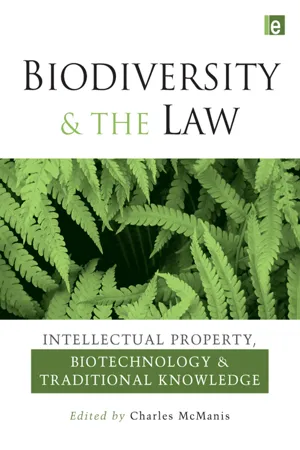
Biodiversity and the Law
Intellectual Property, Biotechnology and Traditional Knowledge
- 520 pages
- English
- ePUB (mobile friendly)
- Available on iOS & Android
eBook - ePub
Biodiversity and the Law
Intellectual Property, Biotechnology and Traditional Knowledge
About this book
How do we promote global economic development, while simultaneously preserving local biological and cultural diversity? This authoritative volume, written by leading legal experts and biological and social scientists from around the world, aims to address this question in all of its complexity. The first part of the book focuses on biodiversity and examines what we are losing, why and what is to be done. The second part addresses biotechnology and looks at whether it is part of the solution or part of the problem, or perhaps both. The third section examines traditional knowledge, explains what it is and how, if at all, it should be protected. The fourth and final part looks at ethnobotany and bioprospecting and offers practical lessons from the vast and diverse experiences of the contributors.
Chapter 1
Biodiversity, Biotechnology and Traditional Knowledge Protection: Law, Science and Practice
This volume addresses one of the great questions of our times – namely how to promote global economic development, while simultaneously preserving the local biological and cultural diversity of ‘this fragile earth, our island home’.1 The international debate over how to reconcile these two seemingly conflicting goals has increasingly focused on the interplay among three international agreements that have entered into force during the past 15 years.
The Convention on Biological Diversity (CBD 1992), which was opened for signature at the Earth Summit in Rio de Janeiro in 1992, seeks to promote the conservation, sustainable use, facilitated access to, and an equitable sharing of the benefits arising out the utilization of genetic resources.2 As a part of this larger objective, Article 8(j) of the CBD specifically calls upon its members to ‘respect, preserve and maintain knowledge, innovations and practices of indigenous and local communities embodying traditional lifestyles relevant for the conservation and sustainable use of biological diversity, and to promote their wider application with the approval and involvement of the holders of such knowledge, innovations and practices and encourage the sharing of benefits arising from the utilization of such knowledge, innovations and practices’.3 To date, over 187 countries (with the notable exception of the US) have ratified the CBD.4
The Agreement on Trade-Related Aspects of Intellectual Property Rights (the TRIPS Agreement 1994) is one of a bundle of agreements embodied in the larger 1994 Agreement Establishing the World Trade Organization (WTO), which currently has 149 members.5 The TRIPS Agreement seeks to stimulate international trade and economic development by setting international minimum standards for the protection and enforcement of intellectual property rights.6 As of 1 January, 2005, all but the least-developed members of the WTO were obligated to be in full compliance with TRIPS, including its controversial requirements governing patent and plant variety protection.7 Disputes over compliance with TRIPS obligations are subject to resolution through the larger WTO dispute settlement process, and multilateral trade sanctions may be authorized to enforce compliance.8
Finally, in 2001, the Conference of the Food and Agricultural Organization (FAO), adopted the new International Treaty on Plant Genetic Resources for Food and Agriculture (FAO International Treaty 2001),9 which was negotiated with the understanding that it would be in harmony with the Convention on Biological Diversity, and is similar to the CBD in its overall objectives to promote the conservation, sustainable use and equitable sharing of benefits arising out of the use of plant genetic resources for food and agriculture, as well as associated traditional agricultural knowledge, for sustainable use and food security. However, the FAO International Treaty also goes well beyond the CBD, in that it builds on an existing national and international system of ex situ germplasm collections of genetic resources for food and agriculture, namely the Consultative Group on International Agricultural Research (CGIAR),10 and creates a formal ‘Multilateral System’ – that is, a system of ‘common-pool goods’ – in 36 genera of crops and 29 genera of forages, guaranteeing both ‘facilitated’ (i.e. free or low-cost) access to these genetic resources, and a system for equitable sharing of the benefits derived from any commercialized product that incorporates materials from the Multilateral System.11 Having obtained the required number of adoptions, approvals and ratifications, the International Treaty entered into force on 29 June, 2004 and currently has 98 members, including the US.12
The often fractious but nevertheless productive international debate leading up to and generated by the adoption of these three treaties has produced a cascade of ‘thinking globally and acting locally’ to reconcile the goals of global economic development and the conservation, sustainable use, access to and an equitable sharing of the benefits arising from the use of biodiversity and associated traditional knowledge. In order to critically evaluate the best of this global thinking and its most important local instantiations to date, the Center for Interdisciplinary Studies and the Whitney R. Harris Institute for Global Legal Studies at Washington University School of Law in St Louis, in collaboration with the Washington University Department of Biology, the Donald Danforth Plant Sciences Center and the Missouri Botanical Garden, co-sponsored an international interdisciplinary academic conference on 4–6 April 2003, on the general topic, ‘Biodiversity, Biotechnology, and the Legal Protection of Traditional Knowledge’. The chapters of this volume are based on the key-note speeches, papers and written commentary presented at that conference. The oral presentations from that conference may be accessed at: http://law.wustl.edu/centeris/pastevents/biodivagendasp03video.html.
Five of the conference papers, including more extensive versions of four chapters appearing in this volume (namely Chapters 4, 18, 20 and 28), were published as a symposium volume of the Washington University Journal of Law and Policy, entitled ‘Biodiversity, Biotechnology, and the Legal Protection of Traditional Knowledge’, and can be accessed at: http://law.wustl.edu/Journal/17/index.html. As the title of this volume indicates, the chapters contained herein represent an interdisciplinary effort to address the law, science and practice of biodiversity, biotechnology and traditional knowledge protection. The format of the conference that produced these chapters was designed to promote ‘trialogue’ – a discussion or conversation in which three persons or groups participate. Specifically, as an academic exercise, the conference was designed to produce an interdisciplinary trialogue among experts representing the life sciences, the social sciences and the humanities (including, prominently, law). Equally important, however, the conference also produced a broader trialogue among academics, government policy makers and representatives from the private sector and various civil society organizations. Finally, and perhaps most importantly, the conference produced an international trialogue among spokespersons from biodiversity-rich developing countries and communities (including indigenous communities), non-profit research organizations involved in international botanical research collaborations in those countries and communities, and two of the international agencies most involved in the debate over how to protect traditional knowledge – namely, the World Trade Organization (WTO) and the World Intellectual Property Organization (WIPO).
Like the conference that gave rise to it, the volume is divided into four parts. Part I addresses the question: ‘Biodiversity: What are we losing and why – and what is to be done?’ Part II addresses the question: ‘Biotechnology: Part of the solution or part of the problem – or both?’ Part III, in turn, addresses the question: ‘Traditional knowledge: What is it and how, if at all, should it be protected?’ Part IV, entitled ‘Ethnobotany and bioprospecting: Thinking globally, acting locally’, explores a number of concrete efforts to provide legal protection for traditional knowledge through existing intellectual property mechanisms.
Before introducing the specific chapters contained in this volume, it is important to note some fundamental concepts and distinctions that are essential for understanding these chapters. First, biodiversity loss is to be understood broadly to include biocultural loss, as well as genetic resource loss as such. Social scientists warn that the same forces driving biological extinctions are also producing rampant cultural homogenization,13 a phenomenon that has been called an ‘extinction of experience’ – a ‘radical loss of direct contact and hands-on interaction with the surrounding environment that traditionally comes through subsistence and other daily life activities’.14 In a very real sense, the mounting protests over ‘biopiracy’,15 and globalization more generally, represent a visceral reaction to this systematic biocultural devaluation.
Second, biotechnology should likewise be understood broadly to include both medical and agricultural biotechnology, although, as we will see, the potential impact of these two fields of biotechnology on biodiversity loss, preservation and sustainable use are quite distinct. Medical researchers are generally more concerned with the loss of non-domesticated in situ biodiversity and related traditional medicinal knowledge, as both contribute starting points for further medical research.16 Agricultural researchers, by contrast, are more concerned with the loss of domesticated (i.e. agricultural) biodiversity, which is frequently preserved ex situ in national and international germplasm collections.17 Moreover, the overall impact of medical research and the resulting biotechnology on the preservation and sustainable use of biodiversity is more likely to be positive, as it tends to enhance the value of in situ biodiversity, while the overall impact of agricultural biotechnology is likely to be far more mixed, as agriculture itself is one of the most significant contributing causes of biodiversity loss.18
Third, it is important to note that traditional knowledge may likewise be divided into traditional medicinal knowledge and traditional agricultural knowledge, and that the law, science and practices necessary to preserve, sustainably use and promote the equitable sharing of benefits arising from these two different types of traditional knowledge may be quite different.19 Moreover, for the purposes of determining what forms of existing intellectual property protection might apply, traditional knowledge must also be divided into that which is widely (i.e. publicly) known, that which is collectively known by a particular community but not widely known by society as a whole, and that which is known only by selected members of a particular community, culture or society.20 Traditional medicinal knowledge, in particular, may be closely held by selected members of a community, rather than being collectively known and held by the community as a whole.21 Even collectively known traditional knowledge – such as collectively practised agricultural knowledge – may or may not be sufficiently widely known by, or readily accessible to, the rest of humanity to constitute a part of the public domain.22
To be sure, some traditional medicinal knowledge, such as traditional Ayurvedic and Chinese medicine, and much traditional agricultural knowledge, such as that embodied in the international germplasm collections of the CGIAR, which were placed under the auspices of the FAO in 1994 to be held in trust for the benefit of humanity,23 are so widely known and documented as to present distinctive (though not insurmountable) problems for the development of an international system of equitable benefit sharing.24 On the other hand, some collective community knowledge corresponds more closely to what in western cultural and legal terms might be called proprietary, or closely held know-how, and could thus be protected as collective proprietary know-how or shared with the rest of humanity, depending on the consensus (and cohesion) of the community that possesses it.25
Finally, it is important to understand the international legal and public policy mechanisms governing biodiversity, biotechnology and traditional knowledge protection, as well as the political dynamics that gave rise to them. For these mechanisms to be effective and widely viewed as legitimate, they must grow out of an international negotiating process in which all relevant stakeholders are represented, the bargaining power of the various stakeholders is perceived as more or less symmetrical, and the legal mechanisms themselves must be based on theoretically sound foundations and be capable of relatively low-cost implementation and administration as a practical matter.26
Fortunately, a growing international awareness of the link between the development of biotechnology and the preservation of genetic resources is creating precisely the necessary window of opportunity for such negotiations, as technology-rich industrialized countries, which are spearheading the development of biotechnology and international trade more generally, are conversely discovering that they are relatively biodiversity-poor, while developing countries, although technology-poor, are beginning to realize that they are the stewards of the bulk of the Earth’s biodiversity. It is thus no coincidence that during the last 15 years international negotiations have yielded the triad of multilateral agreements that will be of concern in this volume – namely the CBD, the TRIPS Agreement and the FAO International Treaty – in order to bolster the respective positions of the biodiversity-rich developing world and the technology-rich industrialized world, thus setting the stage for further international negotiations to hammer out a more comprehensive global bargain.
At first blush, these three international agreements hardly seem to offer a particularly apt example of symmetry in the bargaining power of the developing and industrialized worlds. In contrast to the binding and enforceable provisions of the TRIPS Agreement, the provisions of the CBD and the more recently adopted FAO International Treaty essentially amount to toothless declarations of good intentions, as no effective enforcement mechanism is specified in either of the latter two treaties,27 and much of the treaty language in the CBD, including that recognizing the need to protect traditional knowledge, is hortatory rather than mandatory.28 Toothless though the latter two treaties may be, however, the CBD has nevertheless stimulated a wave of national legislation having the effect (whether intended or unintended) of restricting, rather than facilitating, access to genetic resources in the developing world, pending the industrialized world’s adoption of meaningful benefit-sharing measures. One also senses that the negotiating strength of the developing and industrialized worlds is growing more symmetrical, rather than less, as north and south alike confront the unruly phenomenon of globalization and its discontents.
Following the currency crisis of 1997 and the subsequent teargas-beclouded collapse of the Third WTO Ministerial Conference in Seattle in 1999 amid...
Table of contents
- Cover
- Halftitle
- Title
- Copyright
- Contents
- List of Figures and Tables
- List of Chapter Authors and Conference Participants
- Acknowledgements
- List of Acronyms and Abbreviations
- 1. Biodiversity, Biotechnology and Traditional Knowledge Protection: Law, Science and Practice
- PART I. Biodiversity: What Are We Losing and Why – And What Is to Be Done?
- PART II. Biotechnology: Part of the Solution or Part of the Problem – Or Both?
- PART III. Traditional Knowledge: What Is It and How, If At All, Should It Be Protected?
- PART IV. Ethnobotany and Bioprospecting: Thinking Globally, Acting Locally
- Index
Trusted by 375,005 students
Access to over 1.5 million titles for a fair monthly price.
Study more efficiently using our study tools.
Frequently asked questions
Yes, you can cancel anytime from the Subscription tab in your account settings on the Perlego website. Your subscription will stay active until the end of your current billing period. Learn how to cancel your subscription
No, books cannot be downloaded as external files, such as PDFs, for use outside of Perlego. However, you can download books within the Perlego app for offline reading on mobile or tablet. Learn how to download books offline
Perlego offers two plans: Essential and Complete
- Essential is ideal for learners and professionals who enjoy exploring a wide range of subjects. Access the Essential Library with 800,000+ trusted titles and best-sellers across business, personal growth, and the humanities. Includes unlimited reading time and Standard Read Aloud voice.
- Complete: Perfect for advanced learners and researchers needing full, unrestricted access. Unlock 1.5M+ books across hundreds of subjects, including academic and specialized titles. The Complete Plan also includes advanced features like Premium Read Aloud and Research Assistant.
We are an online textbook subscription service, where you can get access to an entire online library for less than the price of a single book per month. With over 1.5 million books across 990+ topics, we’ve got you covered! Learn about our mission
Look out for the read-aloud symbol on your next book to see if you can listen to it. The read-aloud tool reads text aloud for you, highlighting the text as it is being read. You can pause it, speed it up and slow it down. Learn more about Read Aloud
Yes! You can use the Perlego app on both iOS and Android devices to read anytime, anywhere — even offline. Perfect for commutes or when you’re on the go.
Please note we cannot support devices running on iOS 13 and Android 7 or earlier. Learn more about using the app
Please note we cannot support devices running on iOS 13 and Android 7 or earlier. Learn more about using the app
Yes, you can access Biodiversity and the Law by Charles R. McManis in PDF and/or ePUB format, as well as other popular books in Law & Environmental Law. We have over 1.5 million books available in our catalogue for you to explore.