![]()
CHAPTER 1
THE NEW GLOBAL LANDSCAPE
DESPITE A CAREER DOMINATED BY PHOTOGRAPHY, I can safely say with my hand on my heart that I had never purchased a photography magazine. So when I accepted the position of editor of Professional Photographer, I was placing my head firmly into the lion’s mouth. Technique and equipment have always informed my work but have never dominated it, so the creators of these bastions of the “technophile” and “technique geek” were eager to question an outsider like me as to what I would do with the magazine as it stood. The first question I was regularly and persistently asked was, “What do you think defines a professional photographer?” It’s a good question, and in the world in which we now live-where anyone who owns a smart phone has the possibility to create high quality images-it is extremely relevant. It wasn’t a question that I rushed to answer, but after time and consideration I came to the conclusion that the most accurate and appropriate answer required that I divide the world of professional photography into three distinct areas.
The first is the high-end professional who works with a cross section of professional clients within one or across a wide spectrum of photographic genres. They are defined by a high quality client base, which in turn results in a strong financial reward for their work. The second is the general professional who also works with a cross section of professional clients within one or across a wide spectrum of photographic genres. They have a slightly less prestigious client base and therefore receive a lesser financial reward for their work. The general professional aspires to be a high-end professional. They usually come from a creative academic background and are informed by the work of their peers. Both of these areas are focused on creating, keeping, and enlarging their commercial client base. The third area is the domestic professional. They do not work for professional clients whose job it is to commission photography, but rather they work in the wedding, events, and domestic portrait market. This sector is most often self-taught, regionally focused, and dependent on constantly finding new clients, as the clients they have rarely recommission due to the nature of the reasons for their commissions. The domestic professional is an area that also appeals to the semi-professional, as they do not have to always be available for commission and much of the work is weekend based.
These are the three defined areas that broadly explain how I see the world of professional photography and photographers. Each one has different priorities, and each one requires specific industry understanding. However, I believe that there are two determining factors that are essential to the definition of the professional photographer in today’s global marketplace across all three of the areas I have outlined.
The first of these is the ability to create narrative through a series of images and within a single image. The second is the art of consistency, the ability to deliver the image or images the client requires time and time again. It is by understanding these definitions and then by building them into their creative practice, so that they are both recognized and understood by existing and potential clients, that the professional photographer can ensure photography is not dismissed as both easy and cheap.
The world of professional photography has both suffered and profited from the digital revolution. It is true to say that established professionals now have to reassess the foundations of their business as clients’ demands and expectations change. At the same time, young photographers have to establish themselves quickly and accurately to ensure that they begin with confidence and success within what is now a globally competitive marketplace. There is no longer time to grow: The long lunch has been replaced with the sandwich at the desk, personal mentoring with an automated e-mail response, and the role of an assistant with that of the digital producer. The traditional meeting place of the processing lab has been replaced with the online connections of Twitter, and international competition for commissions has been fired by the ease of photographic representation that the personal website offers. The digital revolution has taken an art form and placed it into the hands of the non-photographer, making the profession an everyday commodity. In short, the world has changed and the professional photographer has to change with it in order to survive.
HOW AND WHY IS THE NEW LANDSCAPE BEING FORMED?
There are days when a cool breeze can run through a mature and established landscape and other more turbulent days when a hurricane can sweep through that same landscape destroying all before it, laying bare everything that lacks a strong foundation. That hurricane creates a new landscape and new opportunities to build new structures with new materials, new ideas, and new concepts. It is created by a series of conditions and elements coming together at the same time to create an all-powerful and undeniable force for change. We may not want it to happen, and many may suffer from its arrival, but we cannot prevent it-we can only prepare to respond to its impact. The last decade has seen a hurricane drive through the photographic landscape: a digital hurricane that has created a new creative and commercial landscape for the photographer to navigate. This is the New Landscape. The digital hurricane has created a new photographic topography, and a new creative environment is being built. It is a landscape that is being built with the tools of lens-based media and online communication and by the digital natives and open-minded practitioners who are mastering those tools.
It would be a mistake to believe that photographic equipment is the central element of creativity, but the evolution of digital capture and the arrival of specific cameras along with the technological development of digital media platforms are the spine and foundations of the new landscape. These tools are allowing the new landscape to be formed and subsequently populated.
It is easy with the benefit of hindsight to look back at history and recognize turning points that, in the present, seem to mark a point of change. It is often a mistake to do so, but the development of technology allows us to do exactly that: to accurately pinpoint the arrival of a piece of equipment that takes on a cultural as well as a creative significance. From the invention of the Gutenberg Press in the mid-fifteenth century to the launch of the first home computer, the influence of technology on our ability to communicate has been intrinsic to the creative opportunities and social environment that enable us to tell our own stories and interpret those of others.
THE IMAGE HAS ALWAYS BEEN BOTH MOVING AND STILL
The evolution of the photographic process since its earliest days has seen the medium embrace different formats and present the opportunity to capture color, details, and movement at an ever-increasing level of quality. But despite these technological advancements photography has remained intrinsically a storytelling medium in which little has changed. Although photography was adopted by the masses early in its development, the role of the professional photographer remained exactly that, a profession. To be paid for the images you created was the preserve of the trained, the experienced, and, therefore, the professional. The mastery of light, darkrooms, and film were intrinsic to the process of the professional photographer. Photography came from chemistry and physics; it was not to be approached at a professional level without due consideration. Knowledge of professional photography was gained from hard to find books, the rare exhibition, and personal interaction with fellow photographers. Communication of photographic practice took place via learned treatise, printed cards, and the printed portfolio. The professional photographer was identified by the populace as: the high street photographer (of which every town had at least one), available for weddings and formal portraits; the news photographer who captured various levels of local criminality, political change, and daily events; the fashion photographer who lived a glamorous lifestyle of models and celebrity, and whose pictures appeared in glossy fashion magazines; the war photographer who risked his/her life in the battle zones of conflict; and the advertising photographer who created images of products to entice us to buy items we never realized we needed.
With the arrival of the digital hurricane this has all changed. Suddenly the promise of professional quality image capture became the so-called unique selling point of every new digital camera rushed onto the photographic retailer’s shelves. Photojournalists were some of the first to embrace the expensive, but limited in function, professional digital offerings. Excited by the promise of an increased speed of image transfer and reduced darkroom cost, their employers purchased these cameras for them. However, wary of the loss of quality-which early digital capture suggested-the majority of pros remained true to their analog past and present.
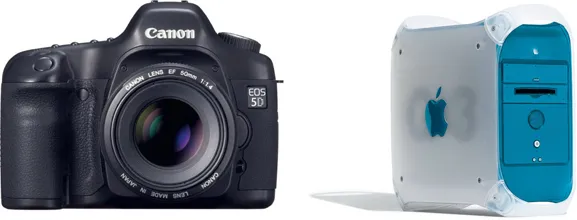
The Canon EOS 5D was the affordable catalyst for the digital capture revolution within professional photography, while the Apple Power Macintosh G3 brought the previously office-based computer into the home. Both are examples of technology transforming every aspect of the creative process.
As the number of megapixels increased, the cost of each new camera model decreased. Then in late 2005 Canon launched the EOS 5D. The 5D was a camera that revolutionized professional photographers’ opinions towards digital capture. With its full frame sensor it promised quality at half the price of its only full frame rival, the Canon EOS-1Ds Mark II. Clients were asking for digital images, and the 5D allowed photographers to meet those clients’ demands. Those who had previously worked with medium format had to learn a new way of seeing, and the 5D swiftly became a regular addition to any photographic assignment. Canon had done what Apple had previously done with its G3 computer-changed the way creatives thought about and produced images. The 5D had changed the way in which photographers told stories. It had brought democratization to photography by creating a product that could create images of high quality without the skill and training associated with analog film capture and printing. It had put the art of the professional into the hands of the enthusiast.
The world of cinematography–filmmaking–had traveled a similar road since its earliest days at the end of the nineteenth century. Its development was through evolution rather than revolution: first with sound, then color, and then various projection formats, even before the advent of video technology took its place alongside traditional filmmaking practice. These were all important changes for the medium, but filmmaking remained a film-based process throughout all these changes until, as with photography, digital capture became the dominant process. Like photography, filmmaking had been an expensive art form, requiring specialized equipment and knowledge. It was a closed shop to the untrained and financially non-supported, who battled with splice editing, roll up projection screens, and professional processing labs. Today filmmaking and moving image projection are digital processes as they are in photography.
This is where the accuracy of language becomes important. The fact is that the term “filmmaking” is no longer appropriate: film is no longer a factor in the creation of the moving image just as “photography” is an inappropriate term for the capture of the digital still image. (The Collins English Dictionary definition of “photography” is “the process of recording images on sensitized material by the action of light, X-rays, etc., and the chemical processing of this material to produce a print, slide, or cine film.” It is not a word that accurately describes digital capture.) We are now in an age in which the capturing of images is defined by digital code, and the only difference between the still and the moving image is the structure of that code.
Perhaps today it would be more accurate to describe ourselves as “image-makers” rather than “photographers” or “filmmakers.” However, I find myself having to use these arcane terms until there is a unanimous acceptance of this new terminology for our actual practice. Sometimes images will move, other times they will not. Either way this decision will be made by the image-maker based on their own personal aesthetic-the appropriateness of each format and the story they wish to tell. This concept is at the heart of the new landscape.
The concept of the image-maker may be relatively easy to accept, but a discussion over the use of the terms “video/videographer” and “film/filmmaker” to describe the creation of moving images presents more complex issues that need to be addressed. The use of the word “video” to describe the moving image is inaccurate and yet prevalent. It is a word commonly adopted to differentiate between digital and analog capture by equipment manufacturers and online posting software, as well as to appeal to the mass market that has embraced the idea of video filmmaking as an achievable and affordable endeavor. The frequently used word “film” is also inaccurate, as previously stated. Digital capture is not film, but the end result is a film-the Oxford English Dictionary defines the word “film” as a story or event recorded by a camera as a set of moving images and shown in a cinema or on a television screen-and is therefore an easily understood term by a film audience. The description of all of this work as “moving image” is accurate but less used, as it requires explanation through historical and technological context. I use the term “moving image” whenever possible to ensure accuracy of understanding. However, I also use the terms “film” and “filmmaker” in my practice and throughout this book as globally understood terms that most accurately describe the final output of the process of creating moving image and those practitioners creating it.
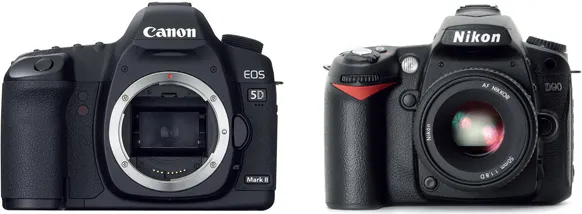
The Canon EOS 5D MKII kick-started the moving image revolution and saw filmmakers adopt a digital single lens reflex (DSLR) for the first time as a filmmaking camera. Excited by the opportunity to access an extensive range of affordable lenses, filmmakers pushed and extended the 5D MKII’s functionality far beyond the manufacturer’s expectations. The Nikon D90 was the first DSLR to feature moving image functionality, but it suffered from a lack of refinement in its filmmaking capture and was not universally adopted despite a positive response to its launch.
Digital capture has revolutionized the way in which we capture images, but the release of the Canon EOS 5D MK II helped to create the concept of the image-maker. It was not the first DSLR that featured HD video functionality (the Nikon D90 has that honor), but it ...