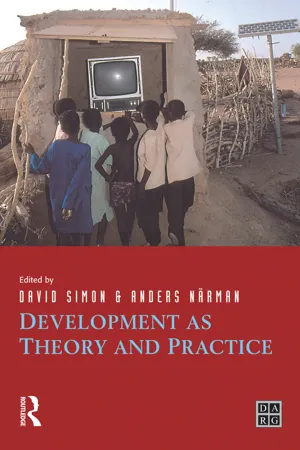
The first book in the DARG series,Development as Theory and Practice provides the only student textbook which addresses broad contemporary perspectives and debates on development and development cooperation. It introduces the notions of development and what it means from different perspectives i.e. from the point of view of academics in the wake of the New World Order, regional specialists detached from the field, Third World students of development, and development practitioners. The second part of the book focuses on development aid and examines the changing relationship between donors and recipients, and the effects of these relationships on the wider communities in these countries, and current re-evaluations of aid in principle and practice.
Development as Theory and Practice is an ideal course text for advanced undergraduate and postgraduate courses in development aid as part of degree programmes in Development Studies, Geography, Politics, Sociology and Anthropology. It will also be of interest to researchers and development practitioners and professionals.
eBook - ePub
Development as Theory and Practice
Current Perspectives on Development and Development Co-operation
- 294 pages
- English
- ePUB (mobile friendly)
- Available on iOS & Android
eBook - ePub
Development as Theory and Practice
Current Perspectives on Development and Development Co-operation
About this book
Information
Chapter 1
Introduction
Anders Närman and David Simon
From misery to development?
... we must embark on a bold new program for making the benefits of our scientific advances and industrial progress available for the improvement and growth of underdeveloped areas. More than half of the world are living in conditions approaching misery. Their food is inadequate. They are victims of disease. Their economic life is primitive and stagnant. Their poverty is a handicap and a threat both to them and to more prosperous areas. For the first time in history, humanity possesses the knowledge and skill to relieve the suffering of these people.
(Point Four, from President Truman's inaugural address in 1949, as quoted by Rist 1997: 71)
This was the confidence with which the rich world embarked on a massive programme of development assistance fifty years ago. Aid was intended to give the poor the impetus to help themselves out of their misery. In a retrospective reflection written shortly before the end of the century, the Development Assistance Committee (DAC), the main aid coordinating body of the Organisation for Economic Co-operation and Development, which represents the rich countries of the world, gives a somewhat contradictory picture. While focusing on some of the historic changes taking place in some parts of the Third World, it also notes that
These impressive strides have not been uniform. In some countries poverty is increasing and in many countries the poor have not shared in the positive global trends described above.
(OECD 1997:16)
The United Nations Development Programme (UNDP 1997: 2) has also recognised the overall global success of poverty reduction but calls it a scandal and an inexcusable failure of national, as well as international, policies that gross inequalities still exist:
The resulting disparity and the remaining backlog create and recreate human poverty, a continuing and perpetuating process that the poor constantly struggle to overcome.
(ibid.: 48)
To address the challenges ahead, donors are compelled
to sustain and increase the volume of official development assistance in order to reverse the growing marginalisation of the poor and achieve progress toward realistic goals of human development.
(OECD: 13)
Consequently, from a certain perspective, development assistance has been successful. Some parts of what we have come to call the Third World, or South, and certain social groups have improved their economic status and material well-being considerably (see Chapter 2). On the other hand, this aid has not created a sustainable process of development, built on the combined efforts of donors and the people of the poorer countries. Instead of making itself superfluous, development assistance is now needed more than ever. As will be seen below, new structures of aid dependency have arisen, virtually recolonising some parts of the Third World (see Chapters 2 and 7).
Similarly, development aid programmes have not been able to address the issue of equity, either between nations or within them. On the contrary, the positive processes of change taking place have been followed by the almost automatic exclusion of the many. According to Dube (1988: 114), modernisation has been able to make inequity legitimate, stating that 'around small islands of dazzling affluence there is a cheerless ocean of poverty and degradation'. In actual fact, as pointed out by Cassen (1986), aid is most efficient where it is least needed, and vice versa, from which it follows that aid is least efficient in Africa, at present the world's poorest continent. Under those conditions it seems even more difficult to comprehend the reasoning behind the currently fashionable idea that a neoliberal market economy will change the pattern positively. The World Bank (1994: 220) claims that African pessimism is supposedly unwarranted, as some light is now visible at the end of the tunnel. Nevertheless, this hope wanes somewhat when calculations by the Bank indicate that it will take forty years to bring Africa back to where it was in the mid-1970s! However, 'a sound development strategy and a dose of good luck can change the picture' (ibid.: 39). In the meantime, aid will set up safety nets for 'the truly poor or those likely to become impoverished' (ibid.: 218). The vision expressed by Truman has been followed by many more, and this process of envisioning development by donors is likely to continue well into the next century. A key question remains whether it is really possible to impose sustainable development for all, even if close co-operation is established among the parties involved.
One of the objectives of this book is to provide a critical reassessment of development thinking and development assistance policy and programmes in the light of current debates about sustainable development and the very mixed results achieved over the last fifty years since President Truman's famous speech. Although not desirable, it has become conventional for development theory to remain in the realm of academic debate and for development policy and practice to be the preserve of government agencies, NGOs and other development practitioners. While there clearly are exceptions, the deep-seated nature of this divorce has fuelled suspicion and a lack of communication between these different groups. This, in turn, has led to critiques of the 'irrelevance' of development studies as a discipline by practitioners (see below). Added to this, conventional academic practice has hitherto required the almost total depersonalisation of writing in the name of objectivity. For example, it was very much frowned upon until recently to write in anything other than the third person and other than in terms of 'scientific evidence'. Only in recent years have some authors begun to break the mould by writing in the first person, thereby making explicit aspects of their own experiences or positionality. To many, however, this practice remains reprehensible and lacking in rigour. We return to wider issues of subjectivity in development later in this chapter.
Evaluating development
In an overview of development assistance projects, Cassen (1986) offers the opinion that targets and objectives are generally met in a satisfactory manner. However, placed in a broader development perspective, the picture immediately becomes much more gloomy. A normative valueladen assessment of the outcomes of the interventions tends to change the picture substantially. Riddell (1987) makes the point that the complex realities of development cannot be solved by the oversimplified solutions derived from abstract theories. There is no simple or generalised formula for calculating whether aid has achieved desirable results or not. Each case must be assessed according to its particular circumstances. One difficulty in any evaluation of aid is that the available data and comprehensive experiences are often rather limited. A greater emphasis on evaluations - as is already occurring in many cases - could very well form an essential part of the learning process by aid agencies. However, at the same time, decontextualised experiences might not assist us much in future development efforts.
Somehow the positive glimmer of hope achieved by some individual projects and programmes is not necessarily inconsistent with an overall negative outcome (the 'totality' of development). The question that begs an answer is why follow-up evaluations of so many official development projects in the South tend to paint a favourable picture, when the global situation is still characterised by poverty, hunger and underdevelopment. Is it because:
- project evaluation takes place only in relation to the terms of reference set for individual projects, which may themselves be inappropriate?
- individual projects can at best make only a minute partial difference when placed in a broader context?
- various incremental changes, while individually positive, can combine in a counter-productive way, making the total effect reverse direction from that which is intended?
- many development projects are in themselves inappropriate or even negative in their overall impact?
- both symbolically and substantively, 'development' itself means such different things to different people and in different contexts (the latter may even be true for the same individual)?
- development practice, as well as evaluation, is based on some implicit vested interest?
We are faced, in large measure, with a situation in which what is not said might very well be more important than what is said. All the positive achievements tend to diminish in the face of gloomy development realities. Possibly the whole truth, as it affects the majority, is ignored in order to continue with an imagined partial improvement for a select group. In a book with the challenging title The Impossible Aid, Karlström (1996: 8) has described a dilemma that many of us share - the conflict between the heart and the brain. Too often in practice, the development practitioner finds him/herself trapped in a situation where - for political or other reasons - he/she is unable to do what he/she wants professionally. Alternatively, inspired by a notion of international solidarity, one finds oneself so preoccupied with 'doing good' that one is unable to put the socioeconomic effects of a particular aid intervention into their wider context.
Constructions of development
For as long as we can remember, the donor community has claimed to be very active, in terms of refining techniques and methodologies to make aid delivery more efficient. Nevertheless, the principal discussion in the donor community seems to have remained much the same over time; only the jargon and the meanings of key concepts have changed. Whatever is said can be turned into its dialectical opposite, opening the way for alternative interpretations. It is well known that development assistance is a tricky business, under constant scrutiny and critique by the tabloid press and extreme political factions on both the left and right. Donor responses to such attacks often lack substance and focus, as the aim of the adversaries is not to be constructive but to create confusion. With these frequent attacks it is understandable that serious and well-intended attempts to discuss certain development issues more constructively are dismissed in a similar manner.
On the other hand, many academics have great difficulty in explaining themselves in a generally understandable fashion. Concepts and meanings are expressed in as complicated a way as possible instead of trying to simplify matters. This forms part of an academic tradition in the social sciences. An academic discourse is not conducted primarily to create a more in-depth understanding but rather in an attempt to score certain points over an 'opponent'. Furthermore, it is quite obvious that different academic traditions, paradigms or ideologies lead to rather contradictory standpoints. In this we detect hardly any opening for improved practice. Chambers (1997: 33-35) characterises the two cultures of development professionals, i.e. the practitioner and the academic. While the former is preoccupied with action, the latter deals with understanding. Development workers might be too busy solving a single problem, without being able to relate this to complex wider realities, while researchers become too theoretical and ingrained in their own word plays to see the 'reality'.
It could still be assumed that a principal objective of development theory should be to inform development practice, such as development planning and development co-operation. More generally, it would represent an important component in the formulation of development strategies. That this has not always been so seems evident from various experiences. According to Hettne (1995: 11), development studies has never had any substantial political relevance. Coupled with the fact that, in cases where theories have been applied within development strategies, we find a number of failures in practice, this places development researchers in a dilemma. Still, as an academic discipline, development studies has been able to establish a theoretical base for continuous critical debate, but hardly any solutions to the original problems have been found. Instead, new ones have been added to the old ones (see Chapter 2).
From thirty years' experience of engaging with development policy and practitioners within the United Nations, Wolfe (1996: 2-3) adds another dimension to the dichotomy between development practitioners and researchers. His audience, comprising mainly politicians, planners and administrators, generally lacks the interest to discuss development theory. A questioning of the meaning of development might easily rock the boat and threaten international consensus. Instead, these development experts have devoted a chain of conferences to the formulation of declarations that will be translated into development priorities. To critical social scientists who connect the development process to existing conflicts of interest, the search for a harmonious development model often appears to be rather naive and idealistic. Thus the mere identification within development theory of the main national and international agents of development, as in themselves constituting a barrier to development, does not facilitate dialogue between researchers and practitioners.
From our own interactions with aid officials in the course of seminars and lectures as well as development projects, both of us have experienced difficulty in combining theoretical understanding with practical fieldwork. A rather advanced discussion of theory can be followed immediately by distinctly simplistic perceptions of development when turning to consider specific applied examples. Terminology and language use change according to circumstances. The comments by Hettne (1995) and Wolfe (1996) cited above stand in sharp contrast to a recent seminar discussion at the Swedish International Development Co-operation Agency's (Sida's) training centre in Sandö. To a direct question on what most influenced their work, policies and strategies, some representatives of official donors, as well as NGOs, answered confidently that it was a debate about development theory. Paradoxically, this, in itself, might very well be true. However, what practitioners listen to and absorb from an ongoing development discourse might be rather selective. When dealing with theory, the vocabulary and language are tota...
Table of contents
- Cover
- Half Title
- Title
- Copyright
- Contents
- List of Figures
- List of Tables
- List of Contributors
- Series preface
- 1 Introduction
- Section 1 Rethinking development
- Section 2 Reconstructing development assistance and development co-operation
- Conclusions
- Index
Trusted by 375,005 students
Access to over 1.5 million titles for a fair monthly price.
Study more efficiently using our study tools.
Frequently asked questions
Yes, you can cancel anytime from the Subscription tab in your account settings on the Perlego website. Your subscription will stay active until the end of your current billing period. Learn how to cancel your subscription
No, books cannot be downloaded as external files, such as PDFs, for use outside of Perlego. However, you can download books within the Perlego app for offline reading on mobile or tablet. Learn how to download books offline
Perlego offers two plans: Essential and Complete
- Essential is ideal for learners and professionals who enjoy exploring a wide range of subjects. Access the Essential Library with 800,000+ trusted titles and best-sellers across business, personal growth, and the humanities. Includes unlimited reading time and Standard Read Aloud voice.
- Complete: Perfect for advanced learners and researchers needing full, unrestricted access. Unlock 1.5M+ books across hundreds of subjects, including academic and specialized titles. The Complete Plan also includes advanced features like Premium Read Aloud and Research Assistant.
We are an online textbook subscription service, where you can get access to an entire online library for less than the price of a single book per month. With over 1.5 million books across 990+ topics, we’ve got you covered! Learn about our mission
Look out for the read-aloud symbol on your next book to see if you can listen to it. The read-aloud tool reads text aloud for you, highlighting the text as it is being read. You can pause it, speed it up and slow it down. Learn more about Read Aloud
Yes! You can use the Perlego app on both iOS and Android devices to read anytime, anywhere — even offline. Perfect for commutes or when you’re on the go.
Please note we cannot support devices running on iOS 13 and Android 7 or earlier. Learn more about using the app
Please note we cannot support devices running on iOS 13 and Android 7 or earlier. Learn more about using the app
Yes, you can access Development as Theory and Practice by David Simon,Anders Narman in PDF and/or ePUB format, as well as other popular books in Social Sciences & International Relations. We have over 1.5 million books available in our catalogue for you to explore.