In a wide array of social sciences, interest in emotion is flourishing. Psychologists, sociologists, anthropologists, communication scholars, and cognitive scientists are exploring human emotions in a variety of contexts. This book speaks to central issues raised by scholars in these disciplines through its review of leading cognitive appraisal theories of emotion, clarification of the nature of empathy, and exploration of how people identify and respond to the emotions hidden within the stories people tell.
Intrigue with the separateness and oneness of human existence and experience is evident throughout history. It appears in the teachings of all great religions, in the commentaries of philosophers, and in the perceptions of the most famous characters in classic literature. Perhaps it is this wonderment with human distinction and unity that has spawned interest in empathy as a pervasive human phenomena.
This book presents an initial examination of the role of cognitive appraisals in facilitating decoding accuracy and empathy. It compares the leading cognitive appraisal theories and addresses the relationships among appraisal information, empathy, and emotion decoding. Real-life descriptions of emotional experiences are used as the basis for a study examining the relationships between perceived appraisals and perspective-taking, and accurate decoding and empathy. Other studies probe the effects of specific appraisal information on decoding and emotional reactions, and address emotional reactivity to stories and delayed retention. Finally, specific applications are offered for parents, educators, social service employees, writers, advertisers, and people striving for personal well-being and healthy relationships.
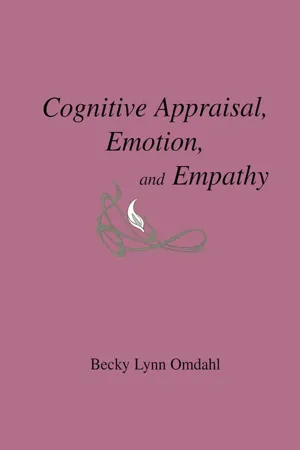
- 284 pages
- English
- ePUB (mobile friendly)
- Available on iOS & Android
eBook - ePub
Cognitive Appraisal, Emotion, and Empathy
About this book
Information
Publisher
Psychology PressYear
2014Print ISBN
9781138970984
9780805814798
Edition
1eBook ISBN
9781317780885
PART TWO
RESEARCH ADDRESSING COGNITIVE APPRAISAL, EMOTION, AND EMPATHY
CHAPTER FIVE
The Generation of Real-Life Descriptions and Examination of Three Sets of Cognitive Appraisals
Based on the story at the end of Chapter 4, we arrive at the outset of this chapter with two complex questions. First of all, did the grandson really feel sadness and shame due to specific appraisals? On a theoretical level, this question translates into: Are the emotions experienced by people elicited by the theoretically specified patterns of appraisals? Second, were our cognitive and emotional reactions to the story affected by appraisals? This encompasses the following theoretical question: Does sharing the storyteller’s appraisals engender accurate decoding of emotion and empathy?
The study reported in this chapter attempts to answer the first question, and the studies appearing in Chapters 6 and 7 address the second question. This chapter presents an exploration of the relationships between three sets of cognitive appraisals and specific emotional states. The sets of appraisals examined are those proposed by Scherer (1984a, 1988a), Smith and Ellsworth (1985, 1987), and Ellsworth and Smith (1988a, 1988b).
THE THEORIES
A review of the cognitive appraisal theories in chapter 3 led to the selection of Scherer’s early set of appraisals as the theory that presented the most well-supported, testable predictions for a variety of emotion stimuli. However, the strengths of Scherer’s (1988a) revised theory and of Smith and Ellsworth’s (1985, 1987; Ellsworth & Smith, 1988a, 1988b) set of appraisals were also applauded. The grounds for selecting Scherer (1984a) over these theories were that Scherer’s (1988a) set of predictions has not been widely tested, and Smith and Ellsworth have not set forth a comprehensive theory. In this study, the findings across four different studies (Smith & Ellsworth, 1985, 1987; Ellsworth & Smith, 1988a, 1988b) are integrated to provide a set of predictions attributed to Ellsworth and Smith.
Although the research presented in subsequent chapters required focus on one theory, this study presented an opportunity to empirically test and provide descriptive information about all three of these sets of cognitive appraisals. Therefore, this study compared the extent to which the predictions of these three sets were supported.
The relationships expected between appraisals and specific emotions for Scherer (1984a, 1988a) and Smith and Ellsworth (1985, 1987; Ellsworth & Smith, 1988a, 1988b) are presented in Tables 5.1 through 5.7. The emotions selected were anger, fear, happiness, sadness, disgust, shame, and surprise. The first six emotions were widely addressed by Scherer’s research, and surprise was added to this list as it usually appears in lists of primary emotions.
TABLE 5.1
Predictions Offered for Anger by Scherer (1984a, 1988a) and Ellsworth and Smith (1988b; Smith & Ellsworth, 1985, 1987)
Predictions Offered for Anger by Scherer (1984a, 1988a) and Ellsworth and Smith (1988b; Smith & Ellsworth, 1985, 1987)

Note. This table reflects the similarities of the dimensions proposed by Scherer (1984a, 1988a), and Ellsworth and Smith (1988a, 1988b) and the predictions for the emotion of anger. In the case of Scherer’ s theorizing, the six dimensions in the left column were refined by the dimensions appearing in the middle column. Several dimensions proposed by Ellsworth and Smith seem to be synonymous and have been identified as such by Scherer (1988a). Those dimensions appear on the same line as the dimension in Scherer’ s (1988a) theory that they seem to match. The predictions for anger appear under the “P.” A plus mark (+) means the appraisal should positively correlate with anger, a minus sign (−) indicates the appraisal should be negatively correlated with anger, and a zero (0) predicts no significant relationship.
TABLE 5.2
Predictions Offered for Fear by Scherer (1984a, 1988a) and Ellsworth and Smith (1988b; Smith & Ellsworth, 1985, 1987)
Predictions Offered for Fear by Scherer (1984a, 1988a) and Ellsworth and Smith (1988b; Smith & Ellsworth, 1985, 1987)

The predictions offered in Tables 5.1 through 5.7 served as the hypotheses for this study. A more detailed explication of these predictions was presented in Chapter 3. Readers may wish to consult pages addressing Scherer’s (1984a, 1988a) predictions, and pages explaining the previous research results from Ellsworth and Smith’s (1988a, 1988b; Smith & Ellsworth, 1985, 1987) studies.
Scherer’s (1984a) predictions presented in this table are very clearly presented in his theoretical works. However, it is readily apparent from the string of NP’s (not predicted) on the surprise table that Scherer (1984a) did not address surprise.
Unlike the clear predictions for Scherer (1984a), the predictions specified for Scherer (1988a) and for Ellsworth and Smith (1988a, 1988b; Smith & Ellsworth, 1985, 1987) should be regarded as much more tentative. Scherer (1988a) divided several of the emotions into low and high intensities (e.g., anxiety/worry and fear; irritation/cold anger and rage/hot anger; enjoyment/happiness and elation/joy; sadness/dejection and despair). The predictions recorded on this table were taken from the following labels in Scherer’s (1988a) sets of predictions: rage/hot anger, fear, enjoyment/happiness, sadness/dejection, disgust, and shame.
TABLE 5.3
Predictions Offered for Happiness by Scherer (1984a, 1988a) and Ellsworth and Smith (1988a; Smith & Ellsworth, 1985, 1987)
Predictions Offered for Happiness by Scherer (1984a, 1988a) and Ellsworth and Smith (1988a; Smith & Ellsworth, 1985, 1987)

Note. “NP” indicates that the theorist has not offered a prediction for the relationship between the appraisal and happiness.
The predictions for Ellsworth and Smith (1988a, 1988b; Smith & Ellsworth, 1985, 1987) were generated by averaging across the findings from previous studies. In no cases were there combinations of positive and negative significant findings, so the decisions were fairly straightforward. However, the number of research studies conducted by Ellsworth and Smith addressing the emotions differed. As indicated in Table 3.8, fear, anger, sadness, and disgust were addressed by multiple sets of experimental results, while shame and disgust were addressed by only one set of results. Surprise, appearing on Tables 3.6 and 3.7, was also measured in two different studies. It should be remembered that the predictions were based on either a collage of research findings or on a single research finding.
TABLE 5.4
Predictions Offered for Sadness by Scherer (1984a, 1988a) and Ellsworth and Smith (1988b; Smith & Ellsworth, 1985, 1987)
Predictions Offered for Sadness by Scherer (1984a, 1988a) and Ellsworth and Smith (1988b; Smith & Ellsworth, 1985, 1987)

In addition to exploring the predicted relationships between appraisals and emotional states, there are several other aspects of emotion research that warrant further descriptive research. One of these issues is the prevalence of emotion blends. The limited evidence available suggests that a very high proportion of emotional experiences involves blends. Blends are defined as the concomitant experience of two or more emotions. Smith and Ellsworth (1987) reported that 54.7% of their subjects reported emotional blends before a midterm exam, and 36.1% reported emotional blends following the exam.
Although Smith and Ellsworth (1987) provided evidence that blends are common, more descriptive research was needed on this subject. To my knowledge no studies have reported the frequency of all specific blends. By specific blends I mean the extent to which pairs of emotions cooccur (e.g., happiness and surprise; disgust and anger). Therefore, this study addressed the research questions: What proportion of storytellers report blends? What are the frequencies of the blends for all possible combinations of the emotions studied?
TABLE 5.5
Predictions Offered for Disgust by Scherer (1984a, 1988a) and Ellsworth and Smith (1988b; Smith & Ellsworth, 1985, 1987)
Predictions Offered for Disgust by Scherer (1984a, 1988a) and Ellsworth and Smith (1988b; Smith & Ellsworth, 1985, 1987)

Another issue that warrants investigation is the extent to which the appraisals are similarly rated. This involves conducting factor analyses to determine which appraisals cluster together. Smith and Ellsworth (1985, 1987) performed factor analytic procedures as the basis for determining the number of dimensions they addressed in subsequent analyses. To my knowledge, no factor analyses have been conducted on items designed to measure the appraisals proposed by Scherer (1984a, 1988a). In addition to exploring the relationships that emerge among items reflecting the primary stimulus checks (viz., novelty, pleasantness, goal conduciveness, etc.), it will be interesting to see whether the subchecks proposed by Scherer (1988a) fall in groupings together. Thus, the study also addressed the question: Which appraisal items for each of the three sets factor together?
The following methods described were used to explore the relationships between appraisals and emotions, the prevalence of blends, and the extent to which appraisal dimensions factor together. These methods were primarily designed to generate high-quality stories for later research on decoding accuracy and empathy.
TABLE 5.6
Predictions Of...
Predictions Of...
Table of contents
- Cover Page
- Half Title page
- Title Page
- Copyright Page
- Dedication
- Contents
- Acknowledgments
- Part One A Theoretical Overview: Cognitive Appraisal, Emotion, and Empathy
- Part Two Research Addressing Cognitive Appraisal, Emotion, and Empathy
- Part Three Summary, Theoretical Extensions, and Applications
- References
- Author Index
- Subject Index
Trusted by 375,005 students
Access to over 1.5 million titles for a fair monthly price.
Study more efficiently using our study tools.
Frequently asked questions
Yes, you can cancel anytime from the Subscription tab in your account settings on the Perlego website. Your subscription will stay active until the end of your current billing period. Learn how to cancel your subscription
No, books cannot be downloaded as external files, such as PDFs, for use outside of Perlego. However, you can download books within the Perlego app for offline reading on mobile or tablet. Learn how to download books offline
Perlego offers two plans: Essential and Complete
- Essential is ideal for learners and professionals who enjoy exploring a wide range of subjects. Access the Essential Library with 800,000+ trusted titles and best-sellers across business, personal growth, and the humanities. Includes unlimited reading time and Standard Read Aloud voice.
- Complete: Perfect for advanced learners and researchers needing full, unrestricted access. Unlock 1.5M+ books across hundreds of subjects, including academic and specialized titles. The Complete Plan also includes advanced features like Premium Read Aloud and Research Assistant.
We are an online textbook subscription service, where you can get access to an entire online library for less than the price of a single book per month. With over 1.5 million books across 990+ topics, we’ve got you covered! Learn about our mission
Look out for the read-aloud symbol on your next book to see if you can listen to it. The read-aloud tool reads text aloud for you, highlighting the text as it is being read. You can pause it, speed it up and slow it down. Learn more about Read Aloud
Yes! You can use the Perlego app on both iOS and Android devices to read anytime, anywhere — even offline. Perfect for commutes or when you’re on the go.
Please note we cannot support devices running on iOS 13 and Android 7 or earlier. Learn more about using the app
Please note we cannot support devices running on iOS 13 and Android 7 or earlier. Learn more about using the app
Yes, you can access Cognitive Appraisal, Emotion, and Empathy by Becky Lynn Omdahl in PDF and/or ePUB format, as well as other popular books in Psychology & History & Theory in Psychology. We have over 1.5 million books available in our catalogue for you to explore.