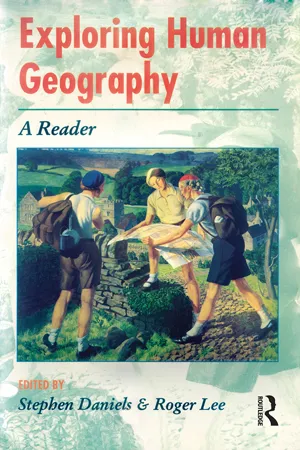
A lively and stimulating resource for all first year students of human geography, this introductory Reader comprises key published writings from the main fields of human geography. Because the subject is both broad and necessarily only loosely defined, a principal aim of this book is to present a view of the subject which is theoretically informed and yet recognises that any view is partial, contingent and subject to change.
The extracts selected are accessible and raise issues of method and theory as well as fact. The editors have chosen articles that not only represent main currents in the present flow of academic geography but which are also responsive to developments outside of the discipline. Their selection contains a mixture of established and recent writings and each section features a contextualizing introduction and detailed suggestions for further reading.
- 512 pages
- English
- ePUB (mobile friendly)
- Available on iOS & Android
eBook - ePub
About this book
Section One

Making and Breaking Geographies
Editors’ introduction
Perhaps the most important question to ask before studying any subject is why it is worth studying. So, why geography? One answer is that geography matters (Massey, 1984). In exploring why it matters in a little more detail, we can begin to chart a course through geography that both highlights its intellectual and practical significance and shows how it offers particular interpretations of the world, at the same time as it is shaped by the world that it tries to imagine and understand.
Why geography matters
A long-standing preoccupation of geography has been to examine the influence of location on social practice. Indeed, for Abler et al. (1971) a concern for what, in the title of their book, they call ‘spatial organization’ represents ‘the geographer’s view of the world’. Well-known examples of work in this genre include the concern of studies of industrial location for the profitability of production, or studies of central places for the effectiveness of markets in the distribution of goods and services. Such work assesses the significance of the spatial arrangement of phenomena for the ways in which they work. It demonstrates that in influential but largely instrumental ways the geographies of social processes condition the locational organization of our daily lives.
But geography matters in a deeper sense too: as well as shaping the spatial organization of our lives it forms a fundamental constituent of them. For one thing, human life is predicated on the dynamic and often conflict-ridden relationships between nature, culture and society. For another – and as many of the readings in this section demonstrate – the networks of social relationships through which we define an identity, find the means of emotional and material support and make our living (in the broadest sense of the term) take place in and through their often highly differentiated geographies. It is for such reasons that the geographical constitution of social life rarely takes place without a struggle over what kind of geography is acceptable. We focus more fully on this struggle in Section Two. In this section, our concern is with the ways in which both the discipline of geography and the practice of geography on the ground are socially constructed and so form an integral part of social practice.
Human life is inherently social and so is shaped at particular times and particular places by the prevailing sets of social relations into which we are born. For Norbert Elias (1978) this sociability of human life is central to social understanding. Elias disputes the distinction between individuals and society – for him the one is constituted through the other – and speaks instead of people and relationships. He argues that people are necessarily caught up in a dynamic interweaving of relationships, what he calls ‘figurations’, and uses the example of games to illustrate the power of this idea. A game can have no independent existence beyond the relationships of the individuals participating in it but, at the same time, the game cannot be reduced to the mere summation of the individual players. It is rather a dynamic process driven by the constantly formed and re-formed relationships between players. It is structured by the changing balance of power between them, but this balance may be closely affected by the particular circumstances in which the game is played (as, for example, when an ‘outsider’ wins in a knock-out competition).
In such ways, then, people both shape and are shaped by the society into which they are born. And such relations do not just happen, they are the consequences (both intended and unintended) of the struggle to create a social environment amenable to a particular way of life. In such struggles, relations of power (expressed, for example, through gender relations such as patriarchy, or through racism or colonialism) may be dominant but they are not necessarily determinant as they may be challenged. Thus, although the contemporary world is dominated by the social relations of capitalism, it has, according to some historical geographers and economic historians (see, for example, Wallerstein, 1974; Braudel, 1982; Blaut, 1992), taken over five hundred years of world history to achieve this dominance, which is still not entirely secure and even less completely accepted. Furthermore, the emergence of capitalism has been beset by markedly uneven development in both time and space. Nevertheless, capitalism imposes a particularly unambiguous set of values (associated primarily with profitability and accumulation) upon the way in which social life may be constructed; it has also facilitated a tendency to globalization (the construction of geographies articulated at a global scale) held in check from time to time by the actions of nation states attempting to retain control over processes operating increasingly at a supranational level.
Thus the geographies of our own lives are both shaped and evaluated according to the requirements of a capitalism. And as a result of the global extent and operation of contemporary capitalist geographies, geographically distant places may be evaluated and compared in terms of their contribution to the maintenance and expansion of such geographies. Western Europe and North America, for example, come to be evaluated against the productive capacity of South-East Asia. The survival and trajectory of particular places are, therefore, caught up in the dynamics of an expansionary but highly selective and discriminating geography of capitalist growth. It is in such a context of globally prevalent capitalist social relations that we engage in making the historical geographies of our own lives. The particular characteristics of these geographies – the nature and level of their development, and the economies, polities and cultures made through the practical and moral experiences of their construction – provide the conditions through which we engage with the prevailing social relations, to adapt to them and to try to make an accommodation with them, to reform them, or even to overthrow them.
What is especially important here is the tension between our ability to construct – albeit not without a struggle – a particular set of social relations through which we may choose to live bur lives, and the prior existence of a previously constructed set of social relations which may be so powerfully established that the scope for change is extremely limited. This tension is caught particularly well in the immensely rich insistence of Karl Marx that people make their own histories but not necessarily under conditions of their own choosing. In stressing the struggle involved in making histories, this view rejects any notion of determinism and reflects a concern and respect for difference. However, Marx might have added that histories may be made only within and through the construction of geographies – as the work of David Harvey (1982,1989) and others has sought to demonstrate – and so these geographies are themselves contested social constructs; our lives are constituted in part by our engagement with them or against them.
And here we can see that the distinction that we have made between the way in which geography both organizes and constitutes our lives becomes blurred. An example may help to make this point a little more clear. At the time of writing, a debate over the structure and location of shopping centres in and around European towns pits two very different kinds of geographical organization against each other with implications not merely for the geography of retailing but for the nature of social life. On the one hand, a geography based upon large-scale property investment offers high returns on green-field out-of-town sites but relies on the car for access and is destructive of long-established town centres as centres of retail trade and as supposed loci of democratic social interaction. And on the other, a geography based on the smaller-scale reshaping of the built environment of the town centres themselves reduces the scope for profitable investment and ease of provision for (motorized) access but supposedly enhances or preserves a notion and practice of the town centre or the high street as a place of public meeting and interaction. The outcome of this debate will clearly shape our lives in instrumental ways but it will also constitute them through the alternative notions of sociability and interaction implied in these different views of the built environment.
If geography matters in such ways, how do geographers go about studying it? Before introducing the individual readings in Section One–which offer specific answers to this question – we must briefly explore some of the ways in which geographers working in and on the socially constructed world have set about its study and outline some of the ideas that they have brought to bear upon it.
Imagining geographies
Geographers have long been concerned with what we might call the geographical ‘logic’ of human activity-the ways in which such activity may be understood and geographically ordered and constrained. But this concern has been prone to a kind of reductionism and naturalization: for example, both geographical space itself and the ways in which people relate to it have been regarded at various times in the development of the discipline as unproblematic and given. The region and regional geography, spatial science and the notion of geography as a passive container of powerful economic and social processes are examples of reductive approaches to geographical space, while environmental determinism, economic rationality, behaviouralism and structuralism are examples of ways in which geographers have simplified social practice.
The net effect of such reductive imaginings is that the notion of geography as a complex set of processes of formative differentiation – through which human beings construct their histories and geographies in places already distinguished and differentiated by a historical geography of social practice – becomes irrelevant. We thereby overlook the intimate, formative linkages between people, society, place and time and so may forget that ‘spaces are extraordinarily complex’ (Rose, 1993, p. 155). To take the cases of spatial science and economic rationality for example (see Gregory, 1994), we are sometimes asked to believe that ail people ultimately conform (must conform) to a physically derived, universal logic of economic rationality which works itself out across a geometrical surface devoid of social-meaning other than the pre-given notions of the economic and of social physics. In such ways, narrowly founded formulations of the world come to be translated into universal and abstract constructions of the world – an approach which is inherently a-geographical.
But if we contest such a view by insisting upon the recognition of social difference we open up the danger of an interpretation of others from the perspective only of the self; of assuming a self-centred normality and an abnormal ‘other’. Such a danger is not only apparent but institutionally reinforced in certain curricula – for example, the National Curriculum in England and Wales for students up to the age of 16. Here self and home are placed at the centre of a geographical universe which is explored as if it revolves around the home location defined predominantly in terms of a centred family and nationality and a decentred other, rather than as one element in a global network of links which serve to sustain social life. And yet, as we have argued above, precisely because human life is social, the spatiality of our lives is clearly structured by prevailing relations of power stretched over space and associated notions of normality, progress and regress which we have to accept (willingly or unwillingly, consciously or unconsciously), reject or, in the process of constructing our own geographies, struggle to change. It is around this tension between individual creativity and identity and the social relations which are at one and the same time both vital to and a constraint upon human life that human geographies are made – both as a discipline in the mind and as social practice on the ground. And in studying geography we should recognize, therefore, that the way in which we and therefore it views the world is itself socially produced.
Over twenty years ago, David Harvey (1974) asked ‘What kind of geography for what kind of public policy?’. He argued that the ways in which we make or break alternative disciplinary constructions of geography as a means of investigating the world and of recommending geographies of change is highly political; it cannot help but reflect particular kinds of social and scientific understanding or advocacy. As a discipline, geography is never innocent or value free, it is always loaded with political, social, moral and environmental significance. Our images and models of the world are made in part through the ways in which we look at it, and so particular constructions of the discipline of geography can be very powerful in pre-conditioning and shaping our understanding of the geographies in which social life is produced. The example of the contested geographies of retail investment shows how alternative views or models of the world shape the assessment and evaluation of – and the preferences for – alternative geographies on the ground.
But the flow of ...
Table of contents
- Cover Page
- Half Title page
- Title Page
- Copyright Page
- Contents
- Acknowledgements
- Introduction
- 1 Making and Breaking Geographies
- 1 ‘Monument and Myth' Reprinted in full from: Annals of the Association of American Geographers 69, 362–81 (1979)
- 2 ‘Sow What You Know: The Struggle for Social Reproduction in Rural Sudan' Excerpts from: Annals of the Association of American Geographers 81, 488–514 (1991)
- 3 ‘The Industrial Revolution and the Regional Geography of England' Reprinted in full from Transactions of the Institute of British Geographers NS 9, 145–67 (1984)
- 4 Preface to ‘Wrecking a Region' Excerpts from: R. Hudson, Wrecking a Region: State Policies, Party Politics and Regional Charge in North East England. London: Pion (1989)
- 5 ‘The Informational Economy and the New International Division of Labor' Reprinted in full from: M. Carnoy, M. Castells, S. S. Cohen and F. H. Cardoso (eds), The New Global Economy in the Information Age: Reflections on our Changing World, Chapter 2. University Park: Pennsylvania State University Press (1989)
- 6 ‘The Shock of Modernity: Petroleum, Protest, and Fast Capitalism in an Industrializing Society' Excerpts from: A. Pred and M. J. Watts, Reworking Modernity: Capitalisms and Symbolic Discontent, Chapter 2. New Brunswick, NJ: Rutgers University Press (1992)
- 2 What Difference Does Geography Make?
- 7 Neo-Marshallian Nodes in Global Networks' Reprinted from: International Journal of Urban and Regional Research 16, 571–87 (1992)
- 8 ‘The Production of Service Space' Excerpts from: Environment and Planning D: Society and Space 12, 453–75 (1994)
- 9 ‘The “Magic of the Mail”: An Analysis of Form, Function, and Meaning in the Contemporary Retail Built Environment' Excerpts from: Annals of the Association of American Geographers 83, 18–47 (1993)
- 10 ‘Economies of Signs and Space' Excerpts from: S. Lash and J. Urry, Economies of Signs and Space, pp. 198–203. London: Sage (1994)
- 3 Geographical Identities
- 11 ‘A Global Sense of Place' Reprinted in full from: Marxism Today (June 1991)
- 12 ‘Social Landscapes: Continuity and Change' Reprinted in full from: R. J. Johnston (ed.), The Challenge for Geography, pp. 54–75. Oxford: Basil Blackwell (1993)
- 13 ‘Landscape with Figures: Home and Community in English Society' Excerpts from: J. Mitchell and A. Oakley (eds). The Rights and Wrongs of Women, Chapter 4. Harmondsworth: Penguin Books (1977)
- 14 ‘Outsiders in Society and Space' Reprinted in full from: K. Anderson and F. Gale (eds), Inventing Places: Studies in Cultural Geography, Chapter 7. Melbourne: Longman Cheshire (1992)
- 15 ‘Street Life: The Politics of Carnival' Reprinted in full from: Environment and Planning D: Society and Space 6, 213–27 (1988)
- 16 ‘City of Quartz' Excerpt from: M. Davis, City of Quartz. London: Verso (1991)
- 4 Geographical Representations
- 17 ‘Geography's Empire: Histories of Geographical Knowledge' Reprinted in full, save for one illustration, from: Environment and Planning D: Society and Space 10, 23–40 (1992)
- 18 ‘Geopolitics and Discourse: Practical Geopolitical Reasoning in American Foreign Policy' Reprinted in full from: Political Geography 11, 190–204 (1992)
- 19 ‘Maps, Knowledge, and Power' Excerpts from: D. Cosgrove and S. Daniels (eds), The Iconography of Landscape. Cambridge: Cambridge University Press (1988)
- 20 ‘Mapping the Modern City: Alan Sillitoe's Nottingham Novels' Excerpts from: Transactions of the Institute of British Geographers NS 18, 460–480 (1993)
- 21 ‘Contested Global Visions: One-World, Whole-Earth, and the Apollo Space Photographs' Excerpts from: Annals of the Association of American Geographers 84, 270–94 (1994)
- 5 Re-Visioning Human Geography
- 22 ‘Between Space and Time: Reflections on the Geographical Imagination' Reprinted in full from: Annals of the Association of Geographers 80, 418–34 (1990)
- 23 ‘To Claim the High Ground: Geography for the End of the Century' Reprinted in full from: Transactions of the Institute of British Geographers NS 12, 327–36 (1987)
- 24 ‘Towards a Feminist Historiography of Geography' Reprinted in full from: Transactions of the Institute of British Geographers NS 16, 95–104 (1991)
- Index
Trusted by 375,005 students
Access to over 1.5 million titles for a fair monthly price.
Study more efficiently using our study tools.
Frequently asked questions
Yes, you can cancel anytime from the Subscription tab in your account settings on the Perlego website. Your subscription will stay active until the end of your current billing period. Learn how to cancel your subscription
No, books cannot be downloaded as external files, such as PDFs, for use outside of Perlego. However, you can download books within the Perlego app for offline reading on mobile or tablet. Learn how to download books offline
Perlego offers two plans: Essential and Complete
- Essential is ideal for learners and professionals who enjoy exploring a wide range of subjects. Access the Essential Library with 800,000+ trusted titles and best-sellers across business, personal growth, and the humanities. Includes unlimited reading time and Standard Read Aloud voice.
- Complete: Perfect for advanced learners and researchers needing full, unrestricted access. Unlock 1.5M+ books across hundreds of subjects, including academic and specialized titles. The Complete Plan also includes advanced features like Premium Read Aloud and Research Assistant.
We are an online textbook subscription service, where you can get access to an entire online library for less than the price of a single book per month. With over 1.5 million books across 990+ topics, we’ve got you covered! Learn about our mission
Look out for the read-aloud symbol on your next book to see if you can listen to it. The read-aloud tool reads text aloud for you, highlighting the text as it is being read. You can pause it, speed it up and slow it down. Learn more about Read Aloud
Yes! You can use the Perlego app on both iOS and Android devices to read anytime, anywhere — even offline. Perfect for commutes or when you’re on the go.
Please note we cannot support devices running on iOS 13 and Android 7 or earlier. Learn more about using the app
Please note we cannot support devices running on iOS 13 and Android 7 or earlier. Learn more about using the app
Yes, you can access Exploring Human Geography by Stephen Daniels,Roger Lee in PDF and/or ePUB format, as well as other popular books in Social Sciences & Geography. We have over 1.5 million books available in our catalogue for you to explore.