- 304 pages
- English
- ePUB (mobile friendly)
- Available on iOS & Android
eBook - ePub
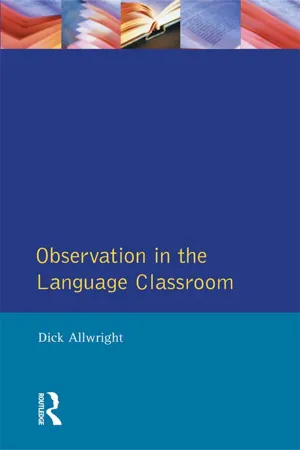
Observation in the Language Classroom
About this book
This book provides an account of classroom observation in a historical and educational perspective. Drawing on extracts from classic studies in this field, Dick Allwright reviews the development of research and experiment since the 1970's. The book thus not only provides a background to recent research, but also identifies areas for future development. Stress is laid on the link to be made between practice and research and it is argued that policy-making. either at classroom or institutional level, is heavily dependent on descriptive accounts of classroom reality.
Information
1 Observation ‘arrives’ in language teaching research
The role of observation in methodological comparisons
It has not always been considered necessary for research on classroom language learning and teaching to include classroom observation as an integral research tool, and of course in some areas of research, such as aptitude testing, there is no obvious reason why classroom observation should be involved anyway. In the 1960s, however, attention turned away from aptitude, which had indeed been an important focus of attention in the previous decade, thanks to the pioneering work in the USA of Carroll and Sapon (1959). Attention in the 1960s turned towards methods. It became especially important to find out, at least in the USA, what method was the most effective. This concern with effectiveness was not prompted by purely pedagogic motives, however, rather it was part of the general reaction to the first success, in 1957, of the Soviet Union’s space programme. Sputnik came as a great and unwelcome surprise to the US government, and had the not entirely predictable but no doubt altogether welcome effect of making greatly increased funding available for education in general and for language education in particular, via the National Defense Education Act of 1958.
With the extra funding came extra responsibility for spending it wisely, for making sure that it meant maximum effectiveness. At the time the best bet for effectiveness was clearly to be found in the work of the psychologists and linguists who had been responsible for the success of the wartime military language programmes. Their work had been grounded in behaviourism, and it was behaviourism that underlay the new effort to produce language teaching materials suitable for state schools and colleges. The simple label ‘behaviourist’ was not applied to them, however, the term ‘audiolingual’ being much more descriptive, bearing clearly the intended emphasis on listening and speaking rather than on reading and writing. This was an emphasis that could be derived from behaviourist thinking, and thinking within linguistics, on the primacy of speech, but it was also an emphasis that fitted exactly the perceived capabilities of the newly invented language laboratory, which the extra monies now made a viable proposition for very many educational institutions. With advanced educational technology in support the ‘audiolingual revolution’ made a great impact, and ‘audiolingualism’ was adopted very widely in the USA (as might be expected, other parts of the world were not so quick to put their faith in the ‘new’).
The move from an emphasis on aptitude to one on method can now be seen as altogether understandable, not only for the more or less straightforwardly political and even commercial reasons given above, but also for the ‘internal’ reason that the natural outcome of aptitude work is selectivity. In an elitist system, as in military education, good aptitude tests make it possible to select for teaching only those who are considered most capable of successful learning. For universal public education in a democracy such elitism is, in principle, and on principle, unacceptable, and therefore some alternative route to success must be found. At a time of increasing optimism about the capabilities of science and technology, as in the late fifties and early sixties, the appeal of a methodological solution combining the science of behaviourist psychology and linguistics with the new technology of the language laboratory was no doubt compelling.
But the scientific and technological spirit of the times, applied to the crisis of confidence engendered by Sputnik, brought with it the additional concern of accountability. It was not enough to be doing what was scientifically and technologically the most sensible and promising thing to do. It was also necessary to establish ’scientifically’ that improved results were obtainable. This meant devising empirical studies to prove, hopefully, that the ‘new’ was indeed to be preferred to the ‘old’. Interestingly the first appears to have been Keating’s 1963 ‘study of the Effectiveness of Language Laboratories’, suggesting that the initial focus was on the technology rather than on the method as such. Keating’s report was surprisingly negative, however, which only increased the pressure on the proponents of audiolingualism to demonstrate their case empirically. Scherer and Wertheimer took up the challenge at the university level, in Colorado, but their 1964 report was also discouraging. Although it was clear from their results that audiolingualism promoted the audiolingual skills, while the ‘traditional’ method promoted, naturally enough, the skills of reading and writing, they were unable to demonstrate any overall superiority for the audiolingual method after two years of teaching. Since they had great difficulty in keeping their two learning groups distinct over the two years, these results are not in fact so easy to interpret, however. In addition, since observational records were not kept of the actual teaching involved, it is not possible to determine whether or not the teaching itself was distinctly different for the two groups of learners. At this point observation had clearly not ‘arrived’.
Systematic classroom observation was however included as a design feature in the very large-scale experiment that began just as the Colorado team published its report. The Pennsylvania Project team set out quite unashamedly to demonstrate the superiority of the new audiolingual approach in the public school setting. This preliminary bias was admitted in the team’s final report, published in 1970, by which time methodological thinking had already moved on and found new reasons in favour of traditional ways of teaching modern languages (brought up to date in the light of a new enthusiasm, initiated by Chomsky’s 1959 attack on Skinner’s ‘Verbal Behaviour’, for cognitive psychology). For more of the background to the study, and for a first extract from contemporary documents, we can turn to Clark’s 1969 paper in a special issue of the Modern Language Journal devoted to the Pennsylvania Project: ‘The Pennsylvania Project and the “Audio-Lingual vs. Traditional” Question’.
The Pennsylvania Project had as its major focus the in-field comparison of three different foreign language teaching methods for beginning and intermediate French and German classes at the high-school level: 1) ‘traditional’; 2) ‘functional skills’ (essentially the ‘audio-lingual’ approach as broadly defined within the profession); and 3) ‘functional skills plus grammar’ (similar to the ‘functional skills’ approach but specifying the use of grammatical explanations by the teacher as a supplement to the regular audiolingual procedures). Since there has been a considerable history of controversy between proponents of traditional and audio-lingual techniques on the relative merits of these approaches, results of this large-scale study were eagerly awaited by the profession. The reported major conclusion that after two years of ‘traditional,’ ‘functional skills,’ and ‘functional skills plus grammar’ instruction there were no significant differences in student achievement in listening comprehension, speaking, and writing – and slight superiority of the ‘traditional’ group in reading – was a rather disheartening outcome for the many persons who had placed their faith and developmental effort in the audio-lingual approach. While relatively modest student performance in reading and writing might have been anticipated following one or even two years of audio-lingual instruction, the lack of superiority in speaking and listening comprehension shown by audio-lingual students in the Pennsylvania study was difficult to accept both in light of teachers’ on-going experiences with this method, and in view of the results of two other in-field research studies in the area: one comparing audio-lingual and eclectic methods for beginning college French (Creore and Hanzeli 1960), and another contrasting audio-lingual and traditional methods for first and second-year college German (Scherer and Wertheimer 1964). In both of these investigations, the control groups were found equal or superior to the audio-lingual classes on measures of reading comprehension and writing, but the audiolingually trained students surpassed the control groups on tests of listening comprehension and speaking ability, usually with quite large mean differences in test score.It is the intent of the next few pages to arrive at some estimation of the accuracy and import of the Pennsylvania Project findings as they relate to the ‘audio-lingual vs. traditional’ question. Valette (1969) and Marxheimer (1969) have also commented on various aspects of this study, with particular attention to the classroom texts and language laboratory procedures used in the project.At the outset of the discussion, it should be emphasized that no experimental study - especially one which uses the real-life school situation as its laboratory - is faultless in the sense that it does not allow at least some adverse commentary on various aspects of its design or execution: furthermore, when findings of a particular study run counter to the sentiment or expectations of a large segment of the profession, that study is often subjected to much more detailed examination and criticism than would be an investigation having more readily accepted results. The researchers on the Pennsylvania Project should be warmly praised for having undertaken a large-scale study attempting to provide empirical data on the relative merits of basic instructional procedures which have been more often accepted on faith than critically and carefully evaluated. If various shortcomings of the Pennsylvania Project can be identified, this should not be considered as a justification to dismiss the entire investigation as fruitless or insignificant or to close the door to continuing investigations in the area.Description of the study
At the beginning of the study, a panel of prominent foreign language educators was assembled by the project staff to assist in developing close descriptions of and rationales for three language teaching methodologies: ‘traditional,’ ‘functional skills,’ and ‘functional skills plus grammar’ (I, pp. 18–25). From a total of 58 high schools participating in the study, 61 beginning French classes and 43 beginning German classes were assigned to one of the three teaching methods. Since it was not considered desirable to have different methods ‘competing’ in a single school building, only one method was used in any given school. School equipment and teacher preferences were also usually taken into account in making the assignments.Before the beginning of the fall, 1965 school term, the project staff held teacher workshops to explain the purpose of the study and to alert the teachers to their responsibilities toward the study. Detailed instructional guides were also developed to help teachers adhere to the pedagogical strategy and laboratory system to which they were assigned.Classroom instruction under each of the three teaching methods was carried out during the 1965–66 school year and perio...
Table of contents
- Cover
- Half Title
- Title Page
- Copyright Page
- Table of Contents
- Acknowledgements
- Quoted material
- Preface
- Introduction
- 1 Observation ‘arrives’ in language teaching research
- 2 Observation ‘arrives’ as a feedback tool in teacher training
- 3 Second thoughts
- 4 First alternatives to Flanders
- 5 Classroom observation and second language acquisition
- 6 Classroom observation – retrospective, introspective and prospective
- Further reading
- Bibliography
- Index
Trusted by 375,005 students
Access to over 1.5 million titles for a fair monthly price.
Study more efficiently using our study tools.
Frequently asked questions
Yes, you can cancel anytime from the Subscription tab in your account settings on the Perlego website. Your subscription will stay active until the end of your current billing period. Learn how to cancel your subscription
No, books cannot be downloaded as external files, such as PDFs, for use outside of Perlego. However, you can download books within the Perlego app for offline reading on mobile or tablet. Learn how to download books offline
Perlego offers two plans: Essential and Complete
- Essential is ideal for learners and professionals who enjoy exploring a wide range of subjects. Access the Essential Library with 800,000+ trusted titles and best-sellers across business, personal growth, and the humanities. Includes unlimited reading time and Standard Read Aloud voice.
- Complete: Perfect for advanced learners and researchers needing full, unrestricted access. Unlock 1.5M+ books across hundreds of subjects, including academic and specialized titles. The Complete Plan also includes advanced features like Premium Read Aloud and Research Assistant.
We are an online textbook subscription service, where you can get access to an entire online library for less than the price of a single book per month. With over 1.5 million books across 990+ topics, we’ve got you covered! Learn about our mission
Look out for the read-aloud symbol on your next book to see if you can listen to it. The read-aloud tool reads text aloud for you, highlighting the text as it is being read. You can pause it, speed it up and slow it down. Learn more about Read Aloud
Yes! You can use the Perlego app on both iOS and Android devices to read anytime, anywhere — even offline. Perfect for commutes or when you’re on the go.
Please note we cannot support devices running on iOS 13 and Android 7 or earlier. Learn more about using the app
Please note we cannot support devices running on iOS 13 and Android 7 or earlier. Learn more about using the app
Yes, you can access Observation in the Language Classroom by Dick Allwright in PDF and/or ePUB format, as well as other popular books in Languages & Linguistics & Linguistics. We have over 1.5 million books available in our catalogue for you to explore.