- 392 pages
- English
- ePUB (mobile friendly)
- Available on iOS & Android
eBook - ePub
Resource and Environmental Management
About this book
This book does an exceptional job in giving an understanding of change, complexity, uncertainty and conflict as well as their linkages, including awareness of strategies, methods and techniques to handle them relative to resource and environmental management. The text enhances the reader's capacity to conduct practice and conduct research in resource and environmental management.
Information
Chapter 1
Change, Complexity, Uncertainty and Conflict
1.1 Introduction
Change, complexity, uncertainty and conflict are encountered in many aspects of life. They are often central in resource and environmental management. They can create opportunities, as well as problems, for analysts, planners, managers, decision makers and members of the public. Two challenges are to recognize their importance and to determine how to function in their presence. Another challenge is to know how to become an agent for positive change.
This chapter begins by outlining an experience that reflects all four of these elements. It also shows how they can affect individuals, and how such individuals are often connected, willingly or unwillingly, to a larger global system which has implications for their life styles and livelihoods. The case study is followed by sections which in turn consider key aspects of each element: change, complexity, uncertainty and conflict. Subsequent chapters focus on various concepts, strategies, methods and techniques which resource and environmental planners are using, or could use more effectively. The over-riding purpose is to familiarize you, the reader, with the strengths, weaknesses, opportunities and threats associated with alternative ways of addressing change, complexity, uncertainty and conflict.
1.2 Arsenic contamination of groundwater in Bangladesh and India
One of the world’s potentially most serious environmental problems exists in Bangladesh and India, as a result of use of arsenic-contaminated groundwater for both domestic and agricultural purposes. More than 90 million people in these two countries are at risk from arsenic poisoning. Ironically, this problem has occurred from conscious decisions to avoid using relatively plentiful but contaminated surface water sources, and instead to use groundwater which was considered to be safe for human consumption.
In the year 2000, the population of Bangladesh was between 140 and 145 million people, with 75–80% living in rural areas. In terms of rainfall, the country has distinct seasonal patterns, due to heavy monsoon rains followed by much drier weather. In the wet season, there is abundant surface water. However, epidemic levels of faecal bacteria in surface water led to a decision to use groundwater supplies. Supported by overseas aid programmes, during the 1950s tube wells began to be drilled throughout the country. The Department of Public Health and Engineering has reported that 856,000 tube wells have since been drilled in rural areas. By 1999, 97% of Bangladeshis relied on tube-well water for drinking and cooking, while surface water sources continued to be the main source for washing, bathing and other domestic uses.
Box 1.1 Arsenic contamination of groundwater
Bangladesh is grappling with the largest mass poisoning of a population in history because groundwater used for drinking has been contaminated with naturally occurring inorganic arsenic. It is estimated that … between 35 and 77 million are at risk of drinking contaminated water. The scale of this environmental disaster is greater than any seen before;.…
Source: Smith, Lingus and Rahman, 2000: 1093.
Recent sampling from the tube wells has shown that many water samples exceed the World Health Organization’s recommended maximum permissible limit (0.05 mg/l) for arsenic in drinking water. Since the mid 1990s the effects of arsenic poisoning have been documented, with many deaths being reported as at least partially attributable to this. Naidu and Skinner (1999: 407) explained that by 1999 it was estimated that hospitals and clinics had documented arsenicosis in about 40% of the total population. In other words, about 60 million people in Bangladesh were vulnerable.
In West Bengal, India, contamination of surface water supplies also led to decisions to turn to groundwater for consumptive uses and for irrigation water. In India, newspaper reports have documented contamination of groundwater by arsenic in West Bengal since the early 1970s, but the first major scientific study was not published until 1984. Now, tube-well water in eight districts exceeds the World Health Organization’s recommended limits, and it is believed that over 30 million people in West Bengal may be exposed to toxic levels of arsenic. For districts in West Bengal, groundwater is the source of water for virtually 100% of the rural population and for 60% of the urban people. Thus, between Bangladesh and West Bengal, about 90 million people are vulnerable to arsenic toxicity. Arsenic contamination of groundwater has been confirmed in many regions of Bangladesh and eastern India, and has caused serious health problems (Rahman, 1997; Yokota et al., 1997). Figures 1.1 and 1.2 show the damage to feet and hands of arsenic victims from a village in the Chapai Nawalganj area, near the city of Rajshahi in western Bangladesh.
Concern also exists because, in rural areas, groundwater is also used as a source of irrigation water. Thus, not only are people in Bangladesh and West Bengal being exposed to arsenic poisoning through drinking water, but they also are being exposed through consuming food which has been irrigated by groundwater containing arsenic. However, the take up rate of arsenic by different types of crops is not yet well understood, so there is uncertainty about the level of vulnerability through consumption of food (vegetables, meat) exposed to contaminated water.

Figure 1.1 Symptoms of arsenic poisoning in soles of feet, male, Bangladesh (Hamidur Rahman)
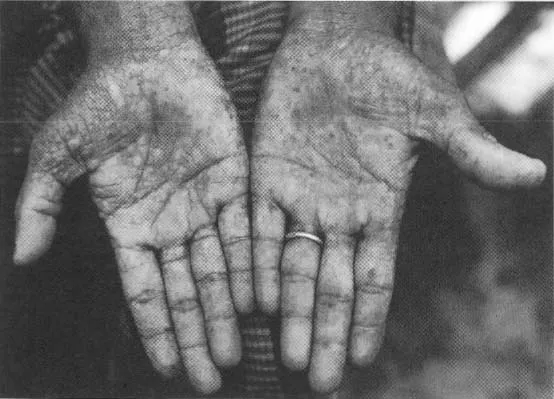
Figure 1.2 Symptoms of arsenic poisoning in hands, female, Bangladesh (Hamidur Rahman)
1.2.1 Much uncertainty and complexity
While the magnitude of the problem has become clearer, much uncertainty concerning the problem of arsenic toxicity exists. Naidu and Skinner (1999: 408–9) have reported that, at an international conference of scientists in Dhaka during 1998, it was concluded that: (1) the original source of the arsenic appearing in groundwater was unclear; (2) the extent of contamination following long-term irrigation with arsenic-tainted groundwater was not understood; (3) the extent of ingestion of arsenic from local food sources, resulting from irrigation using water already contaminated with arsenic, was unclear; (4) the possible significance of additional exposure pathways for arsenic from contaminated groundwater through animals to humans (such as through consumption of milk, meat and other products) had not been investigated systematically; and (5) strategies to minimize exposure to arsenic poisoning for the people of Bangladesh and India were not well developed or available. Thus, much basic research still needs to be completed before the causes of the problem, and possible solutions, will be systematically identified. At the same time, innovative work was underway in Australia to develop low-end technologies to remove arsenic from groundwater (Khoe and Emett, 1999).
1.2.2 Village-level investigations
A research project by a combined team from Japan (Asia Arsenic Network, Research Group for Applied Geology) and Bangladesh (Department of Occupational and Environmental Health, National Institute of Preventive and Social Medicine, as well as the Department of Geology and Mining at the University of Rajshahi) is being conducted in a village in west Bangladesh. The team discovered that in 1983 the first patient with skin infections caused by arsenic was recorded in India, and about 10 years later the first instance was recorded in Bangladesh. The Asia Arsenic Network combined with other Bangladeshi experts and started its joint research project in December 1996. The team subsequently confirmed that groundwater had been contaminated in a large region of Bangladesh, and discovered that many incidences existed in the village of Samta, Jessore District. The team reported that: “we were truly shocked to see many patients suffering with skin problems in the village”.
Subsequently, the Samta Village Project was started in 1997 with emphases on three aspects: (1) research, (2) countermeasures and (3) community participation. The ongoing work includes surveys of well water, groundwater and geological characteristics; medical surveys; an applied anthropological survey; and a life-style survey. Measurements of all the wells in the village of Samta during March 1997 revealed that arsenic contamination was above 0.05 mg/l, which is the permissible limit in Bangladesh, in 90% of the wells. Of 135 people examined, 23 had symptoms which suggested skin cancer. In April and May 1998, detailed research was conducted on groundwater and geological features, and it was discovered that arsenic, with relatively high concentrations, was stored in upper clay layers. Drilling of deeper wells could avoid the arsenic-bearing clays, but the expense associated with drilling for deeper wells is prohibitive for most villagers. During February 1998, all families were surveyed, and it was found that patients showing symptoms of arsenic poisoning were often from low-income families. The work is continuing, and further information can be obtained from the coordinator of the project in Bangladesh: Dr M Hamidur Rahman, Department of Geology and Mining, University of Rajshahi, Rajshahi 6205, Bangladesh, Fax: 880-721-750064 or 880-721-772006.
1.2.3 Implications
Given that the switch from reliance on surface water to groundwater on the Indian subcontinent was supported and aided by international or overseas donor agencies, it is not implausible to suggest that donor agencies share some responsibility for the serious problems associated with arsenic-contaminated water in Bangladesh and India. An obvious question is in what way should international or overseas donor agencies respond? In order to reach an informed and considered decision, overseas donor agencies and water specialists need to consider the moral and other issues arising from such a problem, and the type of response that is appropriate.
Other implications can be identified from the arsenic contamination situation regarding the core themes in this book. Thus:
• Change. planners and managers encounter changing conditions, needs and expectations. What might have been acceptable at one time period may not be accepted at a later time period.
• Complexity. the ramifications of interactions of human activity with the natural environment are often difficult to understand and predict. Cause-and-effect patterns are difficult to determine due to multiple variables and pathways of interaction. Solving one problem may cause a new problem.
• Uncertainty. planners and managers have to make decisions without complete information or understanding of the ecosystems for which their decisions have consequences.
• Conflict. different, and often conflicting, values and perspectives are usually involved in resource allocation and use decisions. Such differences frequently reflect different “world views”, needs and expectations.
In the remainder of this chapter,...
Table of contents
- Cover
- Half Title
- Title Page
- Copyright Page
- Table of Contents
- List of figures
- List of tables
- List of guest authors
- Preface to the Second Edition
- Preface to the First Edition
- Acknowledgements
- Chapter 1 Change, complexity, uncertainty and conflict
- Chapter 2 Turbulence and planning
- Chapter 3 Looking to the future
- Chapter 4 Sustainability
- Chapter 5 Ecosystem approach
- Chapter 6 Learning organizations and adaptive environmental management
- Chapter 7 Assessing alternatives
- Chapter 8 Partnerships and Stakeholders
- Chapter 9 Local knowledge systems
- Chapter 10 Gender and development
- Chapter 11 Alternative dispute resolution
- Chapter 12 Implementation
- Chapter 13 Monitoring and evaluation
- Chapter 14 Managing for environmental justice
- Index
Trusted by 375,005 students
Access to over 1.5 million titles for a fair monthly price.
Study more efficiently using our study tools.
Frequently asked questions
Yes, you can cancel anytime from the Subscription tab in your account settings on the Perlego website. Your subscription will stay active until the end of your current billing period. Learn how to cancel your subscription
No, books cannot be downloaded as external files, such as PDFs, for use outside of Perlego. However, you can download books within the Perlego app for offline reading on mobile or tablet. Learn how to download books offline
Perlego offers two plans: Essential and Complete
- Essential is ideal for learners and professionals who enjoy exploring a wide range of subjects. Access the Essential Library with 800,000+ trusted titles and best-sellers across business, personal growth, and the humanities. Includes unlimited reading time and Standard Read Aloud voice.
- Complete: Perfect for advanced learners and researchers needing full, unrestricted access. Unlock 1.5M+ books across hundreds of subjects, including academic and specialized titles. The Complete Plan also includes advanced features like Premium Read Aloud and Research Assistant.
We are an online textbook subscription service, where you can get access to an entire online library for less than the price of a single book per month. With over 1.5 million books across 990+ topics, we’ve got you covered! Learn about our mission
Look out for the read-aloud symbol on your next book to see if you can listen to it. The read-aloud tool reads text aloud for you, highlighting the text as it is being read. You can pause it, speed it up and slow it down. Learn more about Read Aloud
Yes! You can use the Perlego app on both iOS and Android devices to read anytime, anywhere — even offline. Perfect for commutes or when you’re on the go.
Please note we cannot support devices running on iOS 13 and Android 7 or earlier. Learn more about using the app
Please note we cannot support devices running on iOS 13 and Android 7 or earlier. Learn more about using the app
Yes, you can access Resource and Environmental Management by Bruce Mitchell in PDF and/or ePUB format, as well as other popular books in Biological Sciences & Ecology. We have over 1.5 million books available in our catalogue for you to explore.