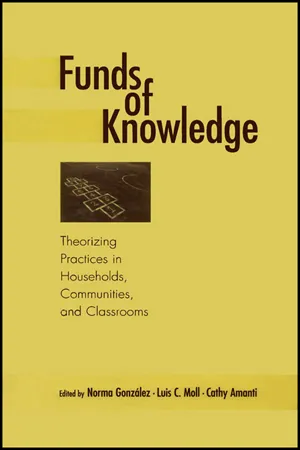
The concept of "funds of knowledge" is based on a simple premise: people are competent and have knowledge, and their life experiences have given them that knowledge. The claim in this book is that first-hand research experiences with families allow one to document this competence and knowledge, and that such engagement provides many possibilities for positive pedagogical actions.
Drawing from both Vygotskian and neo-sociocultural perspectives in designing a methodology that views the everyday practices of language and action as constructing knowledge, the funds of knowledge approach facilitates a systematic and powerful way to represent communities in terms of the resources they possess and how to harness them for classroom teaching.
This book accomplishes three objectives: It gives readers the basic methodology and techniques followed in the contributors' funds of knowledge research; it extends the boundaries of what these researchers have done; and it explores the applications to classroom practice that can result from teachers knowing the communities in which they work.
In a time when national educational discourses focus on system reform and wholesale replicability across school sites, this book offers a counter-perspective stating that instruction must be linked to students' lives, and that details of effective pedagogy should be linked to local histories and community contexts. This approach should not be confused with parent participation programs, although that is often a fortuitous consequence of the work described. It is also not an attempt to teach parents "how to do school" although that could certainly be an outcome if the parents so desired. Instead, the funds of knowledge approach attempts to accomplish something that may be even more challenging: to alter the perceptions of working-class or poor communities by viewing their households primarily in terms of their strengths and resources, their defining pedagogical characteristics.
Funds of Knowledge: Theorizing Practices in Households, Communities, and Classrooms is a critically important volume for all teachers and teachers-to-be, and for researchers and graduate students of language, culture, and education.
eBook - ePub
Funds of Knowledge
Theorizing Practices in Households, Communities, and Classrooms
- 320 pages
- English
- ePUB (mobile friendly)
- Available on iOS & Android
eBook - ePub
Funds of Knowledge
Theorizing Practices in Households, Communities, and Classrooms
About this book
Information
Chapter 1
Introduction: Theorizing Practices*
Norma González
University of Utah
Luis Moll
University of Arizona
Cathy Amanti
Tucson Unified School District
The problem with many empirical data, empirically presented, is that they can be flat and uninteresting, a documentary of detail which does not connect with urgent issues. On the other hand, the ‘big ideas’ are empty of people, feeling and experience. In my view well-grounded and illuminating analytic points flow only from bringing concepts into a relationship with the messiness of ordinary life, somehow recorded.
—Paul Willis (2000, p. xi)
In this introduction, we present a brief description of how we have brought our theoretical concepts into this sort of relationship with the “messiness of ordinary life.” These are the everyday practices that we attempt to theorize, practices that are at times emergent, perhaps counterintuitive, and sometimes opaque. Yet these practices do not emerge from nowhere; they are formed and transformed within sociohistorical circumstances. Practices are also constructed by and through discourses, the ways of knowing that populate our streams of talk. The lives of ordinary people, their everyday activities, and what has led them to the place they find themselves are the bases for our theorizing of practices. It is in the richness of telling these stories that we can find not only evocative human drama, but social analysis that emerges from its organic roots. Because this work has been a collaborative endeavor, we have relied on an interdisciplinary perspective. We have not always operated within a unified paradigm, although there are foundational premises that we have accepted as axiomatic, such as the power of social relationships in the construction of knowledge. The following section describes the emergent nature of jointly negotiating the process. Because we like to think of ourselves as engaged in a conversation, we present here the give-and-take of multiple perspectives, starting with the anthropological view.
THE ANTHROPOLOGIST’S VIEW (NORMA GONZÁLEZ)
We like to make much of the fact that in this project we are all learners: teachers as learners, researchers as learners, students as learners, communities of learners, and so forth. Actually, when I look back on the years that we carried out this work, the person who most needed to learn was me. I came into this project flush with anthropological theory, convinced that if only educators could appreciate the power of ethnography, the experience of schooling would be radically changed. It took a while for me to realize that what needed to change radically was the implicit ideology that had insidiously crept into my thinking: that to fix teachers was to fix schools. Although I continue to have the deepest respect for the teachers who have struggled through this process, I now wince as I recall my naïveté regarding the burdens under which teachers work. How can collaborative ethnography, where teachers are actively engaged in researching and applying local knowledge, be sustained when institutional constraints mitigate its continuation? An emancipatory social research agenda calls for empowering approaches that encourage and enable participants to change through self-reflection and a deeper understanding of their situations. Yet these empowering approaches must contend with a context that isolates practitioners, mutes autonomy, and pushes for standardization and homogenization.
Rereading some of my writing concerning those initial stages, I realize that I was quite taken with the postmodernist and poststructuralist discourses which, in the parlance of the times, interrogated hegemonic relationships and have done an admirable job of locating asymmetries of power and domination. What is not evident is how practitioners, within the limits of their very real structural constraints, can realistically carry out emancipatory and liberatory pedagogies when they themselves are victims of disempowerment and their circumstances preclude full professional development. Discourses of critical pedagogy have often become circumscribed within academic circles, peripheral to the very people they purport to affect because of a turgid literary style and an apparent lack of connection to everyday life in classrooms. It is the quintessential instance of being able to talk the talk, but not walk the walk.
How does the funds of knowledge concept differ from other approaches, and how is it useful? What did we do and how did we do it? What have we learned, and what can we claim? What could we have done better?
First of all, it is important to note that this project did not emerge fully formed, but evolved through incremental steps, some more useful than others. Tracing the anthropological trajectory of this project, I look at the early work of Carlos Vélez-Ibáñez in Bonds of Mutual Trust (1983), a study of rotating credit associations in central Mexico and the Southwest. Drawing on work by the Mexican anthropologist Larissa Lomnitz, Vélez-Ibáñez developed a fine-grained analysis of networks of exchange and confianza. Emphasizing confianza as the single most important mediator in social relationships, Vélez-Ibáñez (1983) claimed that confianza en confianza, trust in mutual trust, was an overriding cultural intersection for Mexican-origin populations (p. 136).
As director of the Bureau of Applied Research in Anthropology (BARA) at the University of Arizona in 1983, Vélez-Ibáñez continued this research interest in relationships of reciprocity. In 1984, he and fellow BARA anthropologist James Greenberg received funding from the National Science Foundation to carry out a study on nonmarket systems of exchange within the Tucson, Arizona, Mexican-origin community. This study (“The Tucson Project”) involved extensive ethnographic interviews with households in two segments of the population, roughly falling into working-class and middle-class descriptions. This work clearly demonstrated the extent to which kin and non-kin networks affected families and households (see Vélez-Ibáñez, 1996, pp. 143–181). The ethnographic interviews revealed “core” households, households (usually the mother’s) that were central to providing information, goods, mutual help, and support to a whole circle of other households. Because I was an ethnographer on the Tucson Project and a graduate student at the time, I realized firsthand the transformative effect of knowing the community in all of its breadth and depth. I had been born and raised in Tucson and felt that I was quite familiar with the cycles of life here, but the experience of talking firsthand to families, hearing their stories of struggle and hardship, of survival and persistence, magnified hundredfold the puny insights I held. I learned personally of the warmth and respect given to interviewers, and of the responsibility we held as part of confianza. In many ways, the Tucson Project set the groundwork for the methodological and theoretical bases of the Funds of Knowledge project.
THE EDUCATIONAL RESEARCHER’S VIEW (LUIS MOLL)
Here is where I enter the story. I arrived in Tucson in 1986 after working at the University of California, San Diego. I was not only new to Tucson but considered an outsider both culturally (I am Puerto Rican) and in terms of my academic background, as I am an educational psychologist collaborating with anthropologists. With the help of several colleagues, especially Esteban Díaz, and in collaboration with teachers, I had conducted studies in San Diego that borrowed from ethnographic methods in researching both classroom dynamics and home life, primarily with Mexican children and families. Furthermore, inspired by Vygotsky’s cultural-historical psychology, which emphasizes how cultural practices and resources mediate the development of thinking, I had been exploring how to combine insights gained from reading Vygosky (and others) with the cultural emphasis of anthropological approaches. I will say more about this topic later in this chapter.
Two of our studies in San Diego were the immediate precursors of the Funds of Knowledge projects. In one study we used classroom observations and videotapes of lessons to analyze the social organization of bilingual schooling. We were struck by how English-language instruction did not capitalize on the children’s Spanish-language abilities, especially their reading competencies. With the teachers’ help, we experimented with the organization of reading lessons, creating a new reading arrangement in English that moved away from a sole emphasis on decoding and concentrated instead on developing the students’ reading comprehension while providing support in both languages to help them understand what they read. We were able to show that students relegated to low-level reading lessons in English were capable of much more advanced work, once provided with the strategic support of Spanish in making sense of text (see Moll & Díaz, 1987).
A second study, conducted in middle schools and with the assistance of several teachers, focused on the teaching of writing in English to learners of that language. The study also featured home observations and interviews with families to document the nature and extent of family literacy. We formed a study group with the teachers which allowed us to meet regularly in a community setting to discuss what we were learning from the home observations and how it could be used in the classrooms. It was especially important that the teachers agreed to experiment with their instruction by including topics of relevance to broader community life and to keep a reflective journal of their attempts at change, which we would then discuss in the study group. Their instructional changes included more emphasis on the process of writing and in creating opportunities for the students to talk about what they wrote, which generated more writing by the students and many more opportunities to teach. We also found that the teachers’ study group served as an important “pivot.” This was a setting where we could turn to what we were learning from the home visits while addressing how to improve the teaching of writing (Moll & Díaz, 1987).
These two studies formed the bases of the design of the first funds of knowledge study in 1988, funded by the Office of Bilingual Education and Minority Language Affairs of the U.S. Department of Education. The idea was as follows: to replicate the three-part design implemented in San Diego—the home observations, the after-school study group, and the classroom work—but to base the household observations on the Tucson findings of Vélez-Ibáñez and Greenberg regarding funds of knowledge. We called the study the Community Literacy Project (CLP). The central thrust of the work was to document the funds of knowledge and literacy practices of the homes we studied and observe the teaching of literacy in selected classrooms while helping teachers use our household data to generate new forms of literacy instruction in their classrooms (see Moll & Greenberg, 1990).
This project convinced us of the great theoretical utility of the concept of funds of knowledge in developing a systematic approach to households. In particular, we realized that we could visit a wide variety of households, with a range of living arrangements, and collect information reliably that would inform us about how families generated, obtained, and distributed knowledge, among other aspects of household life. We established that these homes and communities should be perceived primarily, as their defining pedagogical characteristic, in terms of the strengths and resources that they possess.
We also confirmed in that first project the importance of creating collaborative working arrangements with teachers. As in the earlier San Diego study, the teachers’ study group quickly became the coordinating center for the project’s pedagogical activities. Within these groups, teachers were able to think about their classrooms and what they wanted to change, and consider how to use data on funds of knowledge to change their instruction. This first study provided us with the initial case studies of teachers successfully using the study’s ideas and data as part of their teaching. It also became clear, however, that just as we were approaching households as learners, we needed to approach classrooms in a similar way to learn from the teachers’ work, even as we helped them rethink their classroom practices. So far, the teachers had contributed greatly to the pedagogical thinking and analysis of our research team but had played no role in the data collection of the household funds of knowledge. We set out to remedy that imbalance by creating the prototype of the funds of knowledge approach.
HOW DO ANTHROPOLOGY AND EDUCATION FIT TOGETHER? ANTHROPOLOGY AGAIN (NORMA GONZÁLEZ)
We return to the anthropological perspective. Many of the assumptions and methods for a funds of knowledge approach are rooted in participatory ethnography, and in anthropological theory.
What Did We Do?
The pilot Funds of Knowledge study began in 1990 with 10 teachers and funding from the W.K.Kellogg Foundation. A sister project, with four teachers, was funded in that same academic year by the National Center for Research on Diversity and Second Language Learning at the University of California, Santa Cruz. Although the groups met separately, the methods and format were similar.
The underlying rationale for this work stems from an assumption that the educational process can be greatly enhanced when teachers learn about their students’ everyday lives. In our particular version of how this was to be accomplished, ethnographic research methods involved participant observation, interviews, life-history narratives, and reflection on field notes. These helped uncover the multidimensionality of student experience. Teacher-ethnographers ventured into their students’ households and communities seeking to understand the ways in which people make sense of their everyday lives. Although the concept of making home visits is not new, entering the households of working-class, Mexican-origin, African American, or American Indian students with an eye toward learning from these households is a departure from traditional school-home visits.
Who Are the Teachers?
We strongly felt that only teachers who voluntarily participated should be included. Any project that adds to teachers’ duties and the demands on their time has to take into account the extra burden that it places on teachers’ schedules and lives. There can be little benefit gained from mandating visits where a teacher does not want to be in the household, nor the household members want to receive them. However, when there is sincere interest in both learning about and learning from a household, relationships and confianza can flourish.
Teachers participating in the project in its various iterations were primarily elementary school teachers, although middle school teachers from a variety of backgrounds and ranges of teaching experience were recently included. Minority and nonminority teachers said they benefited from the process. Even teachers from the local community said that conducting household visits was “like coming home to my grandmother’s house” and triggered childhood memories for them. One point that I found interesting was that the nonminority teachers who participated in the project seemed to share a background of exposure to other countries and cultures. Some had lived or traveled in Latin America, Africa, or Asia in their formative years. Others had parents in the armed forces, which had given them global experiences in the process. Teachers participating in the project were paid for their extra duty time.
A TEACHER’S VIEW (CATHY AMANTI)
As Norma points out, those of us who participated in the original Funds of Knowledge project were a diverse group. We represented a multitude of background experiences and became involved for a variety of reasons. We were all practicing teachers, however, and we were all volunteers.
When I became involved in the Funds of Knowledge project, I had recently earned my bilingual education teaching credentials. I was interested in this project because the first time I attended college in the early 1970s I intended to major in anthropology and was now planning to earn a graduate degree in that field. I heard about this project from Luis Moll, who had been one of my undergraduate professors. The school where I began teaching was targeted as one of the schools for involvement in the project.
What originally interested me in this project was the opportunity to combine my interests in education and anthropology. But what kept me involved was the impact it had on my thinking about teaching and the role teachers and parents play in schools. The school where I taught at the time was situated in a predominantly working-class, Latino neighborhood. During my teacher training, I was led to believe that low-income and minority students were more likely to experience failure in school because their home experiences had not provided them with the prerequisite skills for school success in the same way as the home experiences of middle- and upper-class students. The result has been that traditionally low-income and minority students have been offered lessons reduced in complexity to compensate for these perceived deficits.
My teaching experience did not validate the expectations I garnered from my teacher preparation studies. In my daily teaching practice I saw high levels of academic engagement and insight in my students who had typically been labeled “at risk” because of their demographic characteristics. I saw they were as capable of academic success as students from any other background. Additionally, most were fluent in two languages! Participating in the Funds of Knowledge project allowed me to delve into this seeming paradox.
This points to something else all of us teachers participating in the original Funds of Knowledge project had in common—the desire to improve our teaching practice and a willingness to step out of our comfort zones to achieve that end. The first thing we had to do was step into the world of ethnography and become trained in “participant observation.” This was the catalyst for us to begin looking at our students and the communities surrounding our schools in a new light. Going on ethnographic home visits, then meeting in study groups to process those experiences, allowed us to take advantage of the reflexivity inherent in ethnographic research. We went from viewing our students as one-dimensional to being multidimensional, and at the same time we gained the tools we needed to create the bridge between our students’ knowledge, background experiences, and ways of viewing the world and the academic domain.
I would like to point out, however, that unlike typical ethnographers, we were not detached observers of our school communities. Nor were we engaged in ethnographic research simply to document the home lives of our students or rework social theory. We already had a relationship established with the students whose homes we visit...
Table of contents
- Cover Page
- Title Page
- Copyright Page
- Preface
- Chapter 1: Introduction: Theorizing Practices
- Part I: Theoretical Underpinnings
- Part II: Teachers As Researchers
- Part III: Translocations: New Contexts, New Directions
- Part IV: Concluding Commentary
Trusted by 375,005 students
Access to over 1.5 million titles for a fair monthly price.
Study more efficiently using our study tools.
Frequently asked questions
Yes, you can cancel anytime from the Subscription tab in your account settings on the Perlego website. Your subscription will stay active until the end of your current billing period. Learn how to cancel your subscription
No, books cannot be downloaded as external files, such as PDFs, for use outside of Perlego. However, you can download books within the Perlego app for offline reading on mobile or tablet. Learn how to download books offline
Perlego offers two plans: Essential and Complete
- Essential is ideal for learners and professionals who enjoy exploring a wide range of subjects. Access the Essential Library with 800,000+ trusted titles and best-sellers across business, personal growth, and the humanities. Includes unlimited reading time and Standard Read Aloud voice.
- Complete: Perfect for advanced learners and researchers needing full, unrestricted access. Unlock 1.5M+ books across hundreds of subjects, including academic and specialized titles. The Complete Plan also includes advanced features like Premium Read Aloud and Research Assistant.
We are an online textbook subscription service, where you can get access to an entire online library for less than the price of a single book per month. With over 1.5 million books across 990+ topics, we’ve got you covered! Learn about our mission
Look out for the read-aloud symbol on your next book to see if you can listen to it. The read-aloud tool reads text aloud for you, highlighting the text as it is being read. You can pause it, speed it up and slow it down. Learn more about Read Aloud
Yes! You can use the Perlego app on both iOS and Android devices to read anytime, anywhere — even offline. Perfect for commutes or when you’re on the go.
Please note we cannot support devices running on iOS 13 and Android 7 or earlier. Learn more about using the app
Please note we cannot support devices running on iOS 13 and Android 7 or earlier. Learn more about using the app
Yes, you can access Funds of Knowledge by Norma Gonzalez, Luis C. Moll, Cathy Amanti, Norma Gonzalez,Luis C. Moll,Cathy Amanti in PDF and/or ePUB format, as well as other popular books in Education & Education General. We have over 1.5 million books available in our catalogue for you to explore.