- 260 pages
- English
- ePUB (mobile friendly)
- Available on iOS & Android
eBook - ePub
About this book
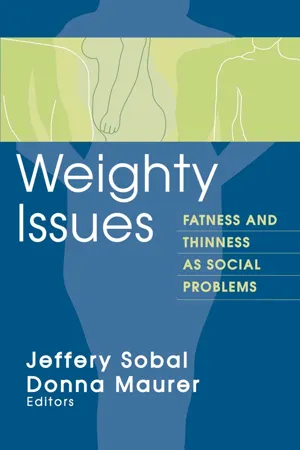
Many people consider their weight to be a personal problem; when, then, does body weight become a social problem? Until recently, the major public concern was whether enough food was consistently available. As food systems began to provide ample and stable amounts of food, questions about food availability were replaced with concerns about ideal weights and appearance. These interests were aggregated into public concerns about defining people as too fat and too thin.Social constructionist perspectives can contribute to the understanding of weight problems because they focus attention on how these problems are created, maintained, and promoted within various social environments. While there is much objectivist research concerning weight problems, few studies address the socially constructed aspects of fatness and thinness.This book however draws from and contributes to social constructionist perspectives. The chapters in this volume offer several perspectives that can be used to understand the way society deals with fatness and thinness. The contributors consider historical foundations, medical models, gendered dimensions, institutional components, and collective perspectives. These different perspectives illustrate the multifaceted nature of obesity and eating disorders, providing examples of how a variety of social groups construct weight as a social problem.
Information
I
INTRODUCTION
1
Body Weight as a Social Problem
While body weight is a salient personal issue to many individuals, weight is also increasingly seen as a broader social problem. Numerous analyses of weight as a public health problem claim that there are “epidemics” of obesity and eating disorders (van’t Hof and Nicolson 1996; Jeffery and French 1998; Rippe 1998). In contrast, body weight as a social problem has received less attention (Maurer and Sobal 1995), and many questions remain. What are the historical foundations of current conceptions of body weight? How have medical models dealt with weight issues? How do the gendered dimensions of weight relate to it as a social problem? Do the institutional components of society determine how fatness and thinness are constructed? How are collective processes involved in defining and negotiating weight issues?
The chapters in this volume address these questions by examining socially problematic aspects of weight. All of the contributions use a constructionist perspective to examine weight as a social problem, but in different forms. Authors from multiple disciplines provide different orientations about how weight interpretations occur in society. History, sociology, nutrition, communications, psychology, and public health all elicit different constructionist orientations. The chapters in this book are grouped into sections that reflect fundamental perspectives that can be employed to examine social aspects of body weight: historical, medical, gendered, institutional, and collective.
HISTORICAL FOUNDATIONS
Historical analyses examine prior periods of time and search for patterns of changes, considering precursors and precedents that shape contemporary phenomena (Breisach 1994). Current concerns about body weight are located in a stream of time, and historical analyses provide insights about how weight was cast and recast into its current patterns and interpretations. A growing number of social history analyses have examined weight and eating disorders, primarily as narrative histories (e.g., Bell 1985; Brumberg 1988; Levenstein 1993; Schwartz 1986; Seid 1989; Stearns 1997). The chapters in this volume provide more specific analyses of how weight has been constructed differently over time.
Comparative historical analyses consider how societies deal with issues differently, contrasting them to reveal alternative social trajectories. The chapter by Peter N. Stearns examines the different ways American and French societies dealt with body weight among children, revealing strikingly different national paths. The French focus on eating discipline produced few obese children, while American laissez-faire eating patterns contributed to weight problems. Cultural contrasts provide evidence that interpretations of weight are constructed and not inherent, as exemplified by the earlier and stricter reactions of the French to overweight children.
The social construction of children’s eating patterns and body weight over time can also be examined through a biographical lens, as seen in Paula Saukko’s chapter, which provides historical contextualization for the work of Hilde Bruch. Bruch was a pioneering figure influential in the construction of contemporary thinking about obesity and eating disorders among both health professionals and the general public. Saukko explains how the interweaving of Bruch’s personal history, psychiatric history, and such events in world history as the depression and the cold war produced complex portraits of weight as historically and socially located within specific times and contexts.
MEDICAL MODELS
Medical history examines general and specific examples of the ways that health professionals and the health system deal with medical phenomena (Breiger 1984). Medical historians examine historical precedents, precursors, and patterns that can provide insights into contemporary events and practices. The study of the medical history of body weight is no exception to the usefulness of examining past medical events and processes.
The chapter by Mark T. Hamin cuts a broad path in describing the scope of “historical legacies” and their effects on approaches to obesity, tracing the early development of several scientific communities during the twentieth century. Hamin analytically differentiates five major biomedical traditions that were held in different scientific and clinical communities, each with its own diagnostic views about weight, which led to different therapeutic interventions. His case studies of each tradition reveal important links with current conceptual schools and their practices.
Assessment techniques play a crucial role in the success of medical practice, and the development and adoption of a new assessment method can be an important development in the state of a field. However, if a technique later proves to be inadequate, or even worse, inappropriate, then considerable time and trust have been lost. David Smith and Sally Horrocks’s chapter provides a case study of the rise and fall of the assessment of physical well-being developed by Georges Dreyer. Their analysis of this historical case reveals that the adoption and rejection of a method is not simply an objective and technical matter, but rather it is a social product constructed through a web of dynamic organizational relationships. Their account gives sobering pause to the unconsidered acceptance of contemporary scientific body weight procedures.
GENDERED DIMENSIONS
Weight and gender are so tightly intertwined that they often seem inseparable (Bordo 1993). The gendered nature of bodies, and the weight of these bodies, cannot be ignored. Differences and inequalities between women and men permeate all aspects of body weight, with the higher salience of weight among women a central consideration in thinking about fatness and thinness. Obesity is feared by most women, and eating disorders are largely gender bound. The social construction of weighty issues among women can be examined from many perspectives, and several are illustrated by chapters in this volume.
The construction, change, and enactment of cultural ideals have a powerful influence on the way women have dealt with weight. Nita Mary McKinley’s chapter considers the gendered nature of weight ideals in a society where women are evaluated on their appearance and adherence to notions of femininity. The many dimensions of womanly ideals also carry weight ideals, revealing a complex (and contradictory) amalgam between being a woman and being a particular weight. McKinley shows that the case of fat women is an exception that demonstrates the current cultural rules, with their resistance to weight norms making it difficult to break free of entanglement with gender norms.
The extent of penetration of concern about weight into the social construction of women’s bodies is perhaps most clearly apparent in the practice of dieting. The chapter by John Germov and Lauren Williams describes how women engage in continuous surveillance of other women’s bodies as well as their own, which leads to perpetual dieting often becoming a taken-for-granted component of women’s roles. Their examination of the dieting discourse, however, moves beyond a simple description of women’s social oppression to a presentation of alternative discourses of resistance to pressures to be thin.
Role contrasts are frequently invoked to seek insights about gender and weight, as in the juxtaposition of professional football players and ballerinas as examples of heros and heroines of different weight identities. Martha McCaughey’s chapter pursues parallels between female anorexia and male compulsive bodybuilding in the similar underlying processes involved in seeking opposite body types. She explains how the pursuit of control by both anorexics and bodybuilders leads down a pathway of addiction to body projects that consume the individual in the process of constructing his or her body.
INSTITUTIONAL COMPONENTS
Social institutions are important forces that shape the ways society deals with issues such as body weight. The role of industries, professions, governments, organizations, and other institutions in shaping perceptions and actions related to fatness and thinness is often not widely recognized, and should not be underestimated. Chapters in this volume begin to lay out some of the institutional landscape within which body weight is interpreted, negotiated, and performed.
S. Bryn Austin’s chapter focuses on the processes involved in the making of the diet industry, which has emerged only in the last several decades to become a major force in food and health arenas. Austin traces the development of mass consumerism and how it incorporated a focus on healthy eating, focusing on how the evolution of dietary fat reduction serves diet food markets at least as much as the public’s health. The intertwining of industrial and public health interests raises important questions about the institutional underpinnings of the pursuit of diet foods and dieting.
Professions also play an important role in the landscape of fatness and thinness. Ellen S. Parham’s chapter discusses the multiple meanings of weight among dietitians and nutritionists. Parham provides important insights about the ways that dietitians are caught up in and cope with what she identifies as a weight dilemma, in which they are trained to feel responsible for helping clients lose weight, but do not have effective therapeutic options that can successfully help patients lose weight and maintain the weight loss. This weight dilemma has important consequences for perceptions of dietitians as professionals in the weight arena.
COLLECTIVE PROCESSES
Collective behavior involves social movements that change the way society frames and deals with particular issues, such as fatness and thinness (Bash 1995; Lofland 1996). Social movements may attempt to change how the food and nutrition system operates, using a toolbox of strategies to present their points of view and to modify others’ perspectives and actions. Collective processes have been examined with respect to some aspects of food, eating, and nutrition, but relatively little attention has focused on how movements deal with body weight.
Social movements attempt to present themselves to the public in the best possible light to advance their causes and avoid criticisms or problems. Donna Maurer describes how the vegetarian movement deals with issues of fatness and thinness. Maurer shows how public images of vegetarians as “skinny” are considered, negotiated, and managed in the vegetarian movement’s presentation to the broader public by de-emphasizing weight loss aspects of vegetarianism and neutralizing the “skinny vegetarian” image.
Some social movements deal directly with body weight, attempting to change the way society constructs fatness and thinness. The chapter by Jeffery Sobal examines the size acceptance movement, which acts as an advocate for fat people. Sobal examines the structure and processes of the size acceptance movement, considering origins, allies, strategies, and other aspects of the movement as it establishes a niche among the diversity of players in the broader body weight arena.
CONCLUSION
Society deals with weight not just as an objective physiological condition, but also as a set of social meanings. These chapters examine some important aspects of the social construction of weight as a social problem. However, there is much more work to be done to more fully elaborate the social discourses, interpretations, claims, negotiations, management, and presentation of body weight in society. Constructionist insights offer additional tools for those who practice in areas that deal with body weight as both a personal problem and a social issue.
REFERENCES
Bash, H. H. 1995. Social Problems and Social Movements: An Exploration into the Sociological Construction of Alternative Realities. Highlands, NJ: Humanities.
Bell, R. M. 1985. Holy Anorexia. Chicago: University of Chicago Press.
Bordo, S. 1993. Unbearable Weight: Feminism, Western Culture, and the Body. Berkeley: University of California Press.
Breiger, G. H. 1984. “History of Medicine.” Pp. 121–94 in A Guide to the Culture of Science, Technology, and Medicine, edited by P. Durbin. New York: Free Press.
Breisach, E. 1994. Historiography, 2nd edition. Chicago: University of Chicago Press.
Brumberg, J. J. 1988. Fasting Girls: The Emergence of Anorexia Nervosa as a Modern Disease. Cambridge, MA: Harvard University Press.
Jeffery, R. A., and S. A. French. 1998. “Epidemic Obesity in the United States: Are Fast Food and Television Viewing Contributing?” American Journal of Public Health 88:277–80.
Levenstein, H. 1993. Paradox of Plenty: A Social History of Eating in Modern America. New York: Oxford University Press.
Lofland, J. 1996. Social Movement Organizations: A Guide to Research on Insurgent Realities. Hawthorne, NY: Aldine de Gruyter.
Maurer, D., and J. Sobal (eds.). 1995. Eating Agendas: Food and Nutrition as Social Problems. Hawthorne, NY: Aldine de Gruyter.
Rippe, J. M. 1998. “The Obesity Epidemic: A Mandate for a Multidisciplinary Approach.” Journal of the American Dietetic Association 98(10, Supplement 2):S5–54.
Schwartz, H. 1986. Never Satisfied: A Cultural History of Diets, Fantasies, and Fat. New York: Free Press.
Seid, R. P. 1989. Never Too Thin: Why Women Are at War with Their Bodies. New York: Prentice Hall.
Stearns, P. 1997. Fat History: Bodies and Beauty in the Modern West. New York: New York University Press.
van’t Hof, Sonja, and Malcolm Nicolson. 1996. “The Rise and Fall of a Fact: The Increase in Anorexia Nervosa.” Sociology of Health and Illness 18(5):581–608.
Table of contents
- Cover
- Half Title
- Title Page
- Copyright Page
- Table of Contents
- Preface
- Part I Introduction
- Part II Historical Foundations
- Part III Medical Models
- Part IV Gendered Dimensions
- Part V Institutional Components
- Part VI Collective Processes
- Biographical Sketches of the Contributors
- Index
Trusted by 375,005 students
Access to over 1.5 million titles for a fair monthly price.
Study more efficiently using our study tools.
Frequently asked questions
Yes, you can cancel anytime from the Subscription tab in your account settings on the Perlego website. Your subscription will stay active until the end of your current billing period. Learn how to cancel your subscription
No, books cannot be downloaded as external files, such as PDFs, for use outside of Perlego. However, you can download books within the Perlego app for offline reading on mobile or tablet. Learn how to download books offline
Perlego offers two plans: Essential and Complete
- Essential is ideal for learners and professionals who enjoy exploring a wide range of subjects. Access the Essential Library with 800,000+ trusted titles and best-sellers across business, personal growth, and the humanities. Includes unlimited reading time and Standard Read Aloud voice.
- Complete: Perfect for advanced learners and researchers needing full, unrestricted access. Unlock 1.5M+ books across hundreds of subjects, including academic and specialized titles. The Complete Plan also includes advanced features like Premium Read Aloud and Research Assistant.
We are an online textbook subscription service, where you can get access to an entire online library for less than the price of a single book per month. With over 1.5 million books across 990+ topics, we’ve got you covered! Learn about our mission
Look out for the read-aloud symbol on your next book to see if you can listen to it. The read-aloud tool reads text aloud for you, highlighting the text as it is being read. You can pause it, speed it up and slow it down. Learn more about Read Aloud
Yes! You can use the Perlego app on both iOS and Android devices to read anytime, anywhere — even offline. Perfect for commutes or when you’re on the go.
Please note we cannot support devices running on iOS 13 and Android 7 or earlier. Learn more about using the app
Please note we cannot support devices running on iOS 13 and Android 7 or earlier. Learn more about using the app
Yes, you can access Weighty Issues by Jeffery Sobal in PDF and/or ePUB format, as well as other popular books in Social Sciences & Gender Studies. We have over 1.5 million books available in our catalogue for you to explore.