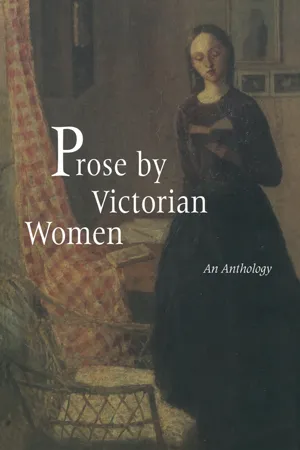
- 752 pages
- English
- ePUB (mobile friendly)
- Available on iOS & Android
eBook - ePub
About this book
First published in 1996. The first modern collection of its kind, this anthology includes unabridged essays written by 19th century Britain's' most eminent women intellectuals- the female counter-parts to the Victorian men of letters. Writing on topics ranging from animal rights and trade unions to aesthetic theory and literary criticism, the women whose rare and hard-to-find woks are presented in this anthology include Mary Russell Mitford, George Eliot, Lady Elizabeth Eastlake, Isabella Bird Bishop, Anne Thackerary Ritchie, Sarah Grand and others.
Information

V. Frances Power Cobbe
(1822–1904)
Frances Power Cobbe was an extremely prolific writer who directly influenced Victorians with her theories about liberal politics, theology, and practical humanitarianism. Her dozens of publications challenged thinkers on both sides of contemporary debates and offered genuine resolutions in an age anxious for compromise. Cobbe was primarily concerned with ending women’s subjection and with animal vivisection. She helped found the National Anti-Vivisection Society in 1875 and was editor of Zoophilist. Furthermore, her promotion of the revised Matrimonial Causes Act certainly helped lead to its passage in 1878. Cobbe’s philanthropic battles extended far beyond the fight for her own sex and for the lives of animals, however. She was also an instrumental force in Poor Law reform and worked directly to better conditions for the young, the sick, the uneducated, and the aged.
Cobbe descended from a family of theological intellects which included five archbishops and a bishop among its connections. She was born in Dublin on December 4, 1822, the only daughter of Frances Conway Cobbe and Charles Cobbe, a landowner and magistrate. In addition to studies at home, Cobbe attended school in Brighton for two years and learned Greek and geometry from a parish clergyman. Always interested in languages, Cobbe eventually learned several during her extensive travels throughout Europe and when serving as a foreign correspondent from Italy for a London newspaper.
Through travel and journalism, Cobbe crossed paths with some of the most influential thinkers of her day. She is mentioned by Matthew Arnold in Essays in Criticism (1865), and she writes in her articles of personal acquaintance with Charles Darwin, William Gladstone, Alfred, Lord Tennyson and Theodore Parker. Indeed, her friendship with Parker led to her being selected as editor for this eminent theologian’s works.
When Cobbe returned from Italy in 1858, she began establishing herself as an influential philanthropist. Due to a modest inheritance and to the money she earned writing, Cobbe was able to devote herself wholeheartedly to social causes. In the late 1850s, she joined Mary Carpenter in Bristol to work at the Red Lodge Reformatory for girls, and also to assist her in working for ragged school reform. During this period, Cobbe developed a romantic attachment to Carpenter which was frustrated. As Barbara Caine notes, Carpenter wished Cobbe to be her competent subordinate. Cobbe ultimately left Carpenter, and in 1861 she became the “beloved friend” (to use their own term) of Mary Lloyd, with whom she remained until Lloyd’s death in 1898.
Although clearly an assertive presence, Cobbe found herself warmly welcomed and esteemed as a benevolent force; her opinion was sought not only by suffragists and antivivisectionists, but also by legislators and numerous editors. The extensive publication and reprinting of her articles, lectures, books, and autobiography point to the popularity of this woman of letters. Certainly the range of Cobbe’s writing is wider than could be competently achieved in modern times, due to the specialization of fields. Literally writing from “A” (“Allured, an Allegory,” 1866) to “Z” (“Zoophily,” 1882), Cobbe tackled a variety of topics: anthropology, biography, civil rights, crime, economics, education, entertainment, government, literary and art criticism, medicine, mysticism, philosophy, poverty, psychology, sadism, and theology. As both a sophisticated investigator and a popular journalist, Cobbe reached a wide audience; she wrote for more than thirty periodicals.
Cobbe created solid arguments for progressive thought. Although she was ridiculed in 1862 at the Social Science Congress for advocating women’s admission to university degrees, many of her other pragmatic recommendations (as outlined in “Workhouse Sketches” and “Wife-Torture in England”) were acted upon. While frequently witty, Cobbe’s prose style is characterized by clear organization, frankness, and appeals to common sense. She showed little compunction about publicly chastising the elusive and flowery prose of the most respected male “sages,” especially those whose reform proposals were grounded in theory rather than in reality. Her place among the great reformers and prose stylists of the nineteenth century was clearly noted by her contemporaries; the failure to acknowledge her importance falls absolutely on modern shoulders.
More can be learned about Cobbe by reading her series on faith, Broken Lights (1864–65) and Light in Dark Places (1883–89), and her autobiography, The Life of Frances Power Cobbe (1894). Another primary source of information is Re-Echos (1876), which collects fifty-two of the articles Cobbe had written for the London newspaper Echo in the early 1870s. Her essays appeared primarily between 1860 and 1890 in a variety of periodicals, including the Contemporary Review, Eraser’s, the Theological Review, Cornhill, Eclectic Magazine, Temple Bar, Fortnightly Review, and Littell’s Living Age. Surprisingly little recent scholarship exists on Cobbe; however, Barbara Caine’s lengthy discussion of Cobbe’s feminism in Victorian Feminists (1992) is a valuable, lucid examination of this activist’s complicated relationship to the women’s rights movement. Another important secondary source is Carol Bauer and Lawrence Ritt’s “A Husband Is a Beating Animal—Frances Power Cobbe Confronts the Wife-Abuse Problem in Victorian England” (International Journal of Women’s Studies 6 [March-April, 1983] 99–118), and “Wife Abuse, Late Victorian English Feminists, and the Legacy of Frances Power Cobbe” (International Journal of Women’s Studies 6 [May-June, 1983] 195–207).
John Hallock,
Temple University
11. What Shall We Do with Our Old Maids?
Introduction
Frances Power Cobbe’s “What Shall We Do with Our Old Maids?” first appeared in Fraser’s Magazine in November, 1862, and is reprinted here from that periodical. With this essay, Cobbe concludes the discussion she previously initiated in “Celibacy v. Marriage” (Fraser’s, 1862). Following a spicy introduction which celebrates the recent support of Deaconesses, the “lady guerillas of philanthropy,” Cobbe calls attention to an expanding single female population. She attacks the notion that marriage is the happiest state for women, and she supports women’s “free competition” in the employment market. The artistry of Cobbe’s rhetoric is fully displayed in this discussion of the morality and immorality of marriage. With flawless logic, Cobbe disarms her opponents and states an eloquent case for the freedom to love whomever one is moved to love. Typical of Cobbe’s foresight is her realization that both marriage partners must develop identities beyond the mere titles of “husband” and “wife.” As Cobbe writes, only “a woman who has something else than making love to do and to think of will love really and deeply.” Although Cobbe is careful to recognize the constraints brought on by motherhood, she does encourage women to develop interests away from their children. As with all of her women’s rights essays, “What Shall We Do with Our Old Maids?” was regarded as highly controversial; nevertheless, it was noted as a chief catalyst for reforms in women’s education, employment, and marital status.
What Shall We Do with Our Old Maids?
In the Convocation of Canterbury for this year of 1862, the readers of such journals as report in full the sayings and doings of that not very interesting assembly, were surprised to find the subject of Protestant Sisterhoods, or Deaconesses, discussed with an unanimity of feeling almost unique in the annals of ecclesiastic parliaments. High Churchman and Low, Broad Churchman and Hard, all seemed agreed that there was good work for women to do, and which women were doing all over England; and that it was extremely desirable that all these lady guerillas of philanthropy should be enrolled in the regular disciplined army of the Church, together with as many new recruits as might be enlisted. To use a more appropriate simile, Mother Church expressed herself satisfied at her daughters “coming out,” but considered that her chaperonage was decidedly necessary to their decorum.
Again, at the Social Science Congress of this summer, in London, the Employment of women, the Emigration of women, the Education of women, and all the other rights and wrongs of women, were urged, if not with an unanimity equal to that of their reverend predecessors, yet with, at the very least, equal animation. It is quite evident that the subject is not to be allowed to go to sleep, and we may as well face it valiantly, and endeavour to see light through its complications, rather than attempt to lecture the female sex generally on the merits of a “golden silence,” and the propriety of adorning themselves with that decoration (doubtless modestly declined, as too precious for their own use, by masculine reviewers), “the ornament of a meek and quiet spirit.” In a former article (“Celibacy v. Marriage”—Fraser’s Magazine for April, 1862) we treated the subject in part. We now propose to pursue it further, and investigate in particular the new phases which it has lately assumed.
The questions involved may be stated very simply.
It appears that there is a natural excess of four or five per cent, of females over the males in our population. This, then, might be assumed to be the limits within which female celibacy was normal and inevitable.
There is, however, an actual ratio of thirty per cent, of women now in England who never marry, leaving one-fourth of both sexes in a state of celibacy. This proportion further appears to be constantly on the increase. It is obvious enough that these facts call for a revision of many of our social arrangements. The old assumption that marriage was the sole destiny of woman, and that it was the business of her husband to afford her support, is brought up short by the statement that one woman in four is certain not to marry, and that three millions of women earn their own living at this moment in England. We may view the case two ways: either—
1st, We must frankly accept this new state of things, and educate women and modify trade in accordance therewith, so as to make the condition of celibacy as little injurious as possible; or—
2nd, We must set ourselves vigorously to stop the current which is leading men and women away from the natural order of Providence. We must do nothing whatever to render celibacy easy or attractive; and we must make the utmost efforts to promote marriage by emigration of women to the colonies, and all other means in our power.
The second of these views we shall in the first place consider. It may be found to colour the ideas of a vast number of writers, and to influence essentially the decisions made on many points—as the admission of women to university degrees, to the medical profession, and generally to free competition in employment. Lately it has met a powerful and not unkindly exposition in an article in a contemporary quarterly, entitled, “Why are Women Redundant?” Therein it is plainly set forth that all efforts to make celibacy easy for women are labours in a wrong direction, and are to be likened to the noxious exertions of quacks to mitigate the symptoms of disease, and allow the patient to persist in his evil courses. The root of the malady should be struck at, and marriage, the only true vocation for women, promoted at any cost, even by the most enormous schemes for the deportation of 440,000 females. Thus alone (and by the enforcing of a stricter morality on men) should the evil be touched. As to making the labours of single women remunerative, and their lives free and happy, all such mistaken philanthropy will but tend to place them in a position more and more false and unnatural. Marriage will then become to them a matter of “cold philosophic choice,” and accordingly may be expected to be more and more frequently declined.
There is a great deal in this view of the case which, on the first blush approves itself to our minds, and we have not been surprised to find the article in question quoted as of the soundest common-sense. All, save ascetics and visionaries, must admit that, for the mass of mankind, marriage is the right condition, the happiest, and the most conducive to virtue. This position fairly and fully conceded, it might appear that the whole of the consequences deduced followed of necessity, and that the direct promotion of marriage and discountenancing of celibacy was all we had to do in the matter.
A little deeper reflection, however, discloses a very important point which has been dropped out of the argument. Marriage is, indeed, the happiest and best condition for mankind. But does any one think that all marriages are so? When we make the assertion that marriage is good and virtuous, do we mean a marriage of interest, a marriage for wealth, for position, for rank, for support? Surely nothing of the kind. Such marriages as these are the sources of misery and sin, not of happiness and virtue, nay, their moral character, to be fitly designated, would require stronger words than we care to use. There is only one kind of marriage which makes good the assertion that it is the right and happy condition for mankind, and that is a marriage founded on free choice, esteem, and affection—in one word, on love. If, then, we seek to promote the happiness and virtue of the community, our efforts must be directed to encouraging only marriages which are of the sort to produce them—namely, marriages founded on love. All marriages founded on interest, on the desire for position, support, or the like, we must discourage to the utmost of our power, as the sources of nothing but wretchedness. Where, now, have we reached? Is it not to the conclusion that to make it a woman’s interest to marry, to force her, by barring out every means of self-support and all fairly remunerative labour, to look to marriage as her sole chance of competency, is precisely to drive her into one of those sinful and unhappy marriages? It is quite clear we can never drive her into love. That is a sentiment which poverty, friendlessness, and helplessness can by no means call out. Nor, on the contrary, can competence and freedom in any way check it. It will arise under its natural conditions, if we will but leave the matter alone. A loving marriage can never become a matter of “cold philosophic choice.” And if not a loving one, then, for Heaven’s sake, let us give no motive for choice at all.
Let the employments of women be raised and multiplied as much as possible, let their labour be as fairly remunerated, let their education be pushed as high, let their whole position be made as healthy and happy as possible, and there will come out once more, here as in every other department of life, the triumph of the Divine laws of our nature. Loving marriages are (we cannot doubt) what God has designed, not marriages of interest. When we have made it less women’s interest to marry, we shall indeed have less and fewer interested marriages, with all their train of miseries and evils. But we shall also have more loving ones, more marriages founded on free choice and free affection. Thus we arrive at the conclusion that for the very end of promoting marriage—that is, such marriage as it is alone desirable to promote—we should pursue a precisely opposite course to that suggested by the Reviewer or his party. Instead of leaving single women as helpless as possible, and their labour as ill-rewarded—instead of dinning into their ears from childhood that marriage is their one vocation and concern in life, and securing afterwards if they miss it that they shall find no other vocation or concern;—instead of all this, we shall act exactly on the reverse principle. We shall make single life so free and happy that they shall have not one temptation to change it save the only temptation which ought to determine them—namely, love. Instead of making marriage a case of “Hobson’s choice” for a woman, we shall endeavour to give her such independence of all interested considerations that she may make it a choice, not indeed “cold and philosophic,” but warm from the heart, and guided by heart and conscience only.
And again, in another way the same principle holds good, and marriage will be found to be best promoted by aiding and not by thwarting the efforts of single women to improve their condition. It is a topic on which we cannot speak much, but thus far may suffice. The reviewer alludes with painful truth to a class of the community whose lot is far more grievous than either celibacy or marriage. Justly he traces the unwillingness of hundreds of men to marry to the existence of these unhappy women in their present condition. He would remedy the evil by preaching marriage to such men. But does not all the world know that thousands of these poor souls, of all degrees, would never have fallen into their miserable vocation had any other course been open to them, and they had been enabled to acquire a competence by honest labour? Let such honest courses be opened to them, and then we shall see, as in America, the recruiting of that wretched army becoming less and less possible every year in the country. The self-supporting, and therefore self-respecting woman may indeed become a wife, and a good and happy one, but she will no longer afford any man a reason for declining to marry.
It is curious to note that while, on the one hand, we are urged to make marriage the sole vocation of women, we are simultaneously met on the other by the outpourings of ridicule and contempt on all who for themselves, or even for their children, seek e...
Table of contents
- Cover
- Half Title
- Title Page
- Copyright Page
- Table of Contents
- Foreword
- Introduction
- I. Mary Russell Mitford
- II. Harriet Martineau
- III. Lady Elizabeth Eastlake
- IV. George Eliot
- V. Frances Power Cobbe
- VI. Eliza Lynn Linton
- VII. Margaret Oliphant
- VIII. Isabella Bird Bishop
- IX. Helen Taylor
- X. Anne Thackeray Ritchie
- XI. Alice Brooke Bodington
- XII. Edith Jemima Simcox
- XIII. Clementina Black
- XIV. Mona Alison Caird
- XV. Sarah Grand
- XVI. Vernon Lee
Trusted by 375,005 students
Access to over 1.5 million titles for a fair monthly price.
Study more efficiently using our study tools.
Frequently asked questions
Yes, you can cancel anytime from the Subscription tab in your account settings on the Perlego website. Your subscription will stay active until the end of your current billing period. Learn how to cancel your subscription
No, books cannot be downloaded as external files, such as PDFs, for use outside of Perlego. However, you can download books within the Perlego app for offline reading on mobile or tablet. Learn how to download books offline
Perlego offers two plans: Essential and Complete
- Essential is ideal for learners and professionals who enjoy exploring a wide range of subjects. Access the Essential Library with 800,000+ trusted titles and best-sellers across business, personal growth, and the humanities. Includes unlimited reading time and Standard Read Aloud voice.
- Complete: Perfect for advanced learners and researchers needing full, unrestricted access. Unlock 1.5M+ books across hundreds of subjects, including academic and specialized titles. The Complete Plan also includes advanced features like Premium Read Aloud and Research Assistant.
We are an online textbook subscription service, where you can get access to an entire online library for less than the price of a single book per month. With over 1.5 million books across 990+ topics, we’ve got you covered! Learn about our mission
Look out for the read-aloud symbol on your next book to see if you can listen to it. The read-aloud tool reads text aloud for you, highlighting the text as it is being read. You can pause it, speed it up and slow it down. Learn more about Read Aloud
Yes! You can use the Perlego app on both iOS and Android devices to read anytime, anywhere — even offline. Perfect for commutes or when you’re on the go.
Please note we cannot support devices running on iOS 13 and Android 7 or earlier. Learn more about using the app
Please note we cannot support devices running on iOS 13 and Android 7 or earlier. Learn more about using the app
Yes, you can access Prose by Victorian Women by Andrea Broomfield,Sally Mitchell in PDF and/or ePUB format, as well as other popular books in Literature & European Literary Collections. We have over 1.5 million books available in our catalogue for you to explore.