- 488 pages
- English
- ePUB (mobile friendly)
- Available on iOS & Android
eBook - ePub
About this book
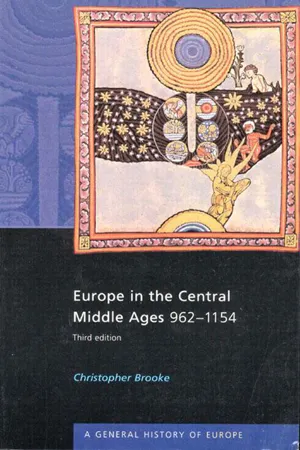
This wide-ranging introduction to medieval Europe has been updated and revised. In his popular survey Brooke explores the variety of human experience in the period. He looks at society, economy, religious life and popular religion, learning, culture, as well as political events; the rise of the Normans and the heyday of the medieval Empire. For the new edition there is increased coverage of the role of women and more attention to central Europe, Bohemia, Hungary and Poland.
Chapter 1
Introduction
The millennium
In an edition published in the year 2000 it is natural to enquire whether the first millennium was marked by notable events and celebrations and a Millennium Dome. Stirring events there certainly were. The young Emperor Otto III, who had made Rome his capital and the revival of the Roman Empire his motto, went on a penitential pilgrimage to the tomb of his old friend, St Adalbert – martyred in 997 attempting to convert the pagan Prussians – at Gniezno in Poland. While there he conferred with a new friend, Duke Boleslav, and gave imperial recognition to the now Christian duchy of Poland, making Boleslav a cooperator imperii, an imperial ally; and with papal support established Gniezno as the seat of an archbishopric. Armed with relics of St Adalbert, Otto went on a further pilgrimage to Aachen, where he had the tomb of Charlemagne excavated, and, with deep emotion, contemplated the bones of his predecessor. Then Otto returned to Rome and in 1001 he and the pope sent a crown to Stephen, king of Hungary.1 Much else happened in 1000; but let this suffice, for it was momentous enough. However fragile the life of Otto, who was to die in 1002, and the foundations of his power, his life helped to consecrate the imperial idea fostered by his grandfather, Otto I; and his dealings with Poland and Hungary marked a decisive phase in the formation of central Europe as we know it. Otto may well have been inspired to his pilgrimage to Gniezno first of all by an earnest desire to do penance which was deep in his nature. But the political adventures were not accidental or secondary. The Polish duchy was emerging from the group of west Slav principalities in any case; and it was the marriage of Boleslav’s father, Mieszko, with a Christian wife which had effectively started the conversion. Similarly in Hungary the traditional marauding way of life of the Magyars had been curbed by Otto I on the west at the battle of the Lechfeld in 955 and on the east by the Bulgars and the Byzantine emperors in the following decades. Stephen’s crown – and his ultimate canonisation – marked the recognition both within and outside Hungary that its destiny lay with the empire and the west. From that day to this, both Poland and Hungary have been frontier nations having ties with eastern Europe and Byzantium – and with the Orthodox Churches – as well as close ties with the west. It was only much later that Poland finally became the most Catholic country in Europe, with the intimate links with Rome which have culminated in the late twentieth century in a Polish pope.2 The boundaries of Poland in particular have fluctuated many times – and in the nineteenth century even disappeared for a time in the age of the Partitions; the relations of Poland and Germany have passed through many unhappy vicissitudes. Nonetheless, the events of 1000 and 1001 represented a vital moment in the mutual recognition of the central and western European peoples. The year 1000 was as momentous here as one could wish.
Unfortunately, it is not at all clear that contemporaries were impressed by the year 1000. Of popular reactions to the event we have little evidence. Some folk expected it to mark the end of the world – but it may well be that there has been no year in recorded history of which this is not true. The notion that a thousand years was a significant period had been propounded by the author of the Book of Revelation: ‘And I saw an angel coming down from heaven, having the key of the bottomless pit, and a great chain in his hand. And he laid hold on the dragon, the old serpent, which is the devil and Satan, and bound him for a thousand years… And after that, he must be loosed a little time.’ The author probably meant by a thousand years ‘a very long time’, but his words led to much learned and unlearned speculation. The mid-tenth-century German monk, Adso, wrote a Libellus de Antichristo (A brief study of Antichrist), which he dedicated to Gerberga, sister of Otto the Great and wife of Louis d’Outremer, the west Frankish king, and which may therefore have been known in both Frankish and German courts. In this he interpreted the dragon as Antichrist and argued that the reign of Antichrist was held at bay so long as the Franks had kings to uphold the Roman empire.3 This may have been known to Otto I; yet none of the chroniclers and biographers who recounted Otto III’s adventures made any play with the year; nor it seems did Otto III himself, though he and his remarkable entourage of elderly monks and intellectuals were adepts in propaganda. Their most splendid production, the Gospel Book of Otto III, reflects his aspirations by displaying symbolic figures for the peoples coming to do homage to him – Sclavinia, Francia, and Germania, and above all Roma.4 Another of his books represents Otto as a second Christ in a mandorla. But the millennium is never mentioned or portrayed.
Partly this was because the year of grace – though widely used by chroniclers and chronographers – had not entered popular consciousness to anything like the extent to which we are accustomed. Even among those who were accustomed to years a.d. as a normal part of their mental furniture there was no agreement as to when the year 1000 began. Some thought a date in September should begin the year; some preferred Easter. More often, by the central Middle Ages, either Christmas or the Annunciation, 25 December or 25 March, were the chosen dates, though 1 January retained some of its significance as the beginning of the Roman year. But as 25 March became more widely adopted, a problem arose as to whether one counted from the year before or the year itself – from 25 March in 1 b.c., as they did in Pisa, or 25 March in 1 a.d., as they did in Florence. The point was made in a famous paper by R.L. Poole: ‘If we suppose a traveller to set out from Venice on 1 March 1245, the first day of the Venetian year, he would find himself in 1244 when he reached Florence; and if after a short stay he went on to Pisa, the year 1246 would have already begun there.’5 By the same token, a man who commuted between these places might miss the year 1000 altogether.
One historian of the age was indeed fascinated by the arithmetic of the millennium, and on this account Rodulfus Glaber has won the reputation of being ‘the chronicler of the millennia’ – in the plural because, on the whole, he showed more interest in the millennium of the Passion in 1033 than in that of the Incarnation in 1000.6
To Glaber these millennial dates reflected moments of divine judgement. After listing various events of the late tenth century, he observes that ‘All this accords with the prophecy of St John [in Revelation], who said that the Devil would be freed after a thousand years’ – but he fails to develop the theme. Later on, ‘[a]bout the year 1000 of the Incarnation of the Word’, he tells us, Robert I king of the French married Constance of Aquitaine, and she brought disgraceful southern fashions with her – especially (oddly enough) short hair for men and ‘indecent hose and shoes’. These fashions were fiercely denounced as the brand-marks of Satan by Glaber’s hero, the great monastic leader, St William of Fruttuaria, Dijon and Fécamp, and inspired some doggerel verses by Glaber himself, opening ‘A thousand years after the Lord was born on earth of a Virgin, men are become prey to the gravest errors …’ Better things were to follow the year 1000, especially the millennium dome: ‘Just before the third year after the millennium [the programme was perhaps a little late], throughout the whole world, but most especially in Italy and Gaul, men began to reconstruct churches, although for the most part the existing ones were properly built and not in the least unworthy. But it seemed as if each Christian community were aiming to surpass all others in the splendour of construction. It was as if the whole world were shaking itself free, shrugging off the burden of the past, and cladding itself everywhere in a white mantle of churches …’7
‘At the millennium of the Lord’s Passion, which followed… years of famine and disaster [lugubriously delineated by the chronicler], by divine mercy and goodness the violent rainstorms ended; the happy face of the sky began to shine and to blow with gentle breezes and by gentle serenity to proclaim the magnanimity of the Creator. The whole surface of the earth was benignly verdant, portending ample produce which altogether banished want. It was then that the bishops and abbots and other devout men of Aquitaine first summoned great councils of the people, to which were borne bodies of many saints and innumerable caskets of holy relics’ – inspired by which they tried to stimulate a movement to promote peace, the so-called ‘Peace of God’. ‘But alas! since the beginning of time mankind has ever been forgetful of the benefits conferred by God, and prone to evil; like a dog returning to its vomit… in many respects they broke their own sworn agreements’ – and things grew worse again; though even in this pessimistic mood, Glaber takes comfort from the ‘innumerable multitude’ as he fondly imagines it who went on pilgrimage about this time to Jerusalem.8
It is a mark of the poverty of historical writing about the year 1000 that we depend on Glaber for these views and events. As a political chronicler he is deplorable; and he managed to summarise the later career of Otto III without mentioning the year 1000 or the notable events we have chronicled above. Yet he is not without virtue as a historian. He can describe popular religious movements like the Peace of God, and new saints’ cults, including (with particular gusto) those based on bogus relics; he is a major source for early eleventh-century heresies.9 He had real expertise in portraying popular attitudes and movements, both of assent and dissent. But he gives no real inkling that the year 1000 caused any such excitement as we are encountering in 2000.
Some paradoxes
When I was a student I was fascinated by the problems of studying common attitudes in the past and the analogies between the concepts and methods of historians and anthropologists. In the mid-twentieth century this study was erected almost into a science of its own, especially by a group of leading French scholars: the pursuit of mentalités, Mentalitäten, mentalities, gripped the historical world. Beyond doubt the perception of common ideas and assumptions is a fundamental aim for a historian and the pursuit of mentalités added greatly to the breadth and depth of our understanding of the past. But it also served to foster beyond all reason some of a historian’s natural prejudices: that people in the past had less variety of outlook, less individuality, than in the present; that one could iron out exceptions and look at the vast mass of opinion as something fundamental and concrete. But variety is of the essence of human experience, and there has been a salutary reaction against the tyranny of mentalités.10 Human affairs are full of paradox. We perceive this very readily in our own world, and it is abundantly clear that it was no less true in the Middle Ages.
Thus we have been growing increasingly aware in recent years of the remarkably cosmopolitan nature of eleventh- and twelfth-century civilisation. It was then that papal monarchy came to have some meaning, when men came regularly to travel in large numbers between Rome and distant parts of Europe not just as pilgrims but also as diplomats and litigants; when students flocked to Paris and Bologna from every part of western Christendom; when not only Latin but French and Provençal language and literature overlapped the political boundaries of the age; when Bohemia, Poland and Hungary joined the peoples of Christian Europe. But it was also precisely in this period – so far as the evidence allows us to discern it – that ethnic feeling and the sense of a common past (and an imaginary biological unity)11 as well as common language were creating the peoples of Europe as we know them. If the Poles and the Hungarians or Magyars are the most substantial, the much smaller groups of the British Isles are perhaps the best documented of the emerging peoples of the central Middle Ages – and the nature of these peoples and their growing self-awareness have been brilliantly portrayed by Rees Davies in his Presidential Addresses to the Royal Historical Society.12 To language and a common memory he adds common customs and laws and other aspects of the life of peoples; and increasingly as the centuries went on, the sense of a common need by Scots, Welsh and Irish alike to preserve their identity in the face of English aggression. ‘In my own family …’, said Jeeves, ‘it was only necessary to invite Aunt Annie for a visit to heal all breaches between the members of the household.’ Tragically, as well as sometimes comically too, the English played the role of Aunt Annie in the rest of the British Isles. We witness the early days of this phenomenon: it had not proceeded all that far by 1154. But the Norman Conquest had already helped to create a much more aggressive attitude by the English towards their neighbours. It may seem absurd to label this ‘English’; it was Norman or Anglo-Norman. But it boasted the name ‘English’ increasingly in the twelfth century; the cosmopolitan kings called themselves ‘Kings of the English’, and not long after 1154 Henry II received from the English Pope Adrian IV a bull granting him Ireland – so helping to inaugurate centuries of alien domination, and foster what was ultimately to become Irish nationalism.
We cannot salvage mentalités in this region by observing that the cosmopolitan and the local were each in their own way mentalities, however much in conflict with one another – sometimes, probably often, within a single human breast. For we have every reason to suppose that both sets of attitudes harboured an infinite variety of different viewpoints. Early in the twelfth century a royal official – the queen’s chancellor – Bernard was sent by King Henry I to control the Church in south-western Wales. But he was inspired by the traditions of his see – and doubtless by the Welsh clergy among whom he had settled – and travelled to the papal Curia in an attempt to prove that the Welsh Church, the outward and visible sign of Welsh independence, was not part of the province of Canterbury.13 He failed, but in his fa...
Table of contents
- Cover
- Half Title
- Title
- Copyright
- Contents
- List of genealogical charts
- List of maps
- Preface
- Abbreviations
- Dedication
- 1 Introduction
- 2 Sources
- 3 The shape of Europe
- 4 Economic life
- 5 Society
- 6 The role of women
- 7 Marriage
- 8 Cities and towns
- 9 Travel
- 10 Kingship and government
- 11 The Empire, 962–1056
- 12 From the Salians to the Hohenstaufen
- 13 The kingdom of the French
- 14 Britain and the Vikings, 959–1035
- 15 The Normans
- 16 The crusades, Byzantium and Spain
- 17 Monasticism and papal reform
- 18 The papal conflicts
- 19 The new monastic orders
- 20 Schools and scholarship
- 21 Popular religion
- 22 Epilogue
- Appendix: chronological lists
- Bibliography
- Genealogical charts
- Maps
- Index
Trusted by 375,005 students
Access to over 1.5 million titles for a fair monthly price.
Study more efficiently using our study tools.
Frequently asked questions
Yes, you can cancel anytime from the Subscription tab in your account settings on the Perlego website. Your subscription will stay active until the end of your current billing period. Learn how to cancel your subscription
No, books cannot be downloaded as external files, such as PDFs, for use outside of Perlego. However, you can download books within the Perlego app for offline reading on mobile or tablet. Learn how to download books offline
Perlego offers two plans: Essential and Complete
- Essential is ideal for learners and professionals who enjoy exploring a wide range of subjects. Access the Essential Library with 800,000+ trusted titles and best-sellers across business, personal growth, and the humanities. Includes unlimited reading time and Standard Read Aloud voice.
- Complete: Perfect for advanced learners and researchers needing full, unrestricted access. Unlock 1.5M+ books across hundreds of subjects, including academic and specialized titles. The Complete Plan also includes advanced features like Premium Read Aloud and Research Assistant.
We are an online textbook subscription service, where you can get access to an entire online library for less than the price of a single book per month. With over 1.5 million books across 990+ topics, we’ve got you covered! Learn about our mission
Look out for the read-aloud symbol on your next book to see if you can listen to it. The read-aloud tool reads text aloud for you, highlighting the text as it is being read. You can pause it, speed it up and slow it down. Learn more about Read Aloud
Yes! You can use the Perlego app on both iOS and Android devices to read anytime, anywhere — even offline. Perfect for commutes or when you’re on the go.
Please note we cannot support devices running on iOS 13 and Android 7 or earlier. Learn more about using the app
Please note we cannot support devices running on iOS 13 and Android 7 or earlier. Learn more about using the app
Yes, you can access Europe in the Central Middle Ages by Christopher Brooke in PDF and/or ePUB format, as well as other popular books in History & European History. We have over 1.5 million books available in our catalogue for you to explore.