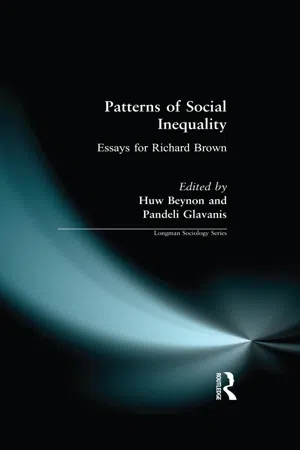
- 240 pages
- English
- ePUB (mobile friendly)
- Available on iOS & Android
eBook - ePub
About this book
Written by a group of the UK's leading Sociologists, this book covers in one volume all of the themes central to an understanding of contemporary British Society. Essays provide an historical overview of such topics as class, gender, work, ethnicity and community but also make a theoretical and substantive contribution to current debates.
Information
Chapter 1
Introduction
We have come together in these pages to write a book which reflects upon the nature of social inequality in contemporary society, something which we feel has been severely neglected in recent times. Our emphasis is upon changes taking place in UK society and this, in part, relates to our concern to produce an account which sits easily with the work of one of Britain’s leading sociologists, Richard Brown. Richard retired from his post as professor at the University of Durham in 1995, and these essays mirror his interests and parallel the work which continues to preoccupy his thoughts.
Our concern to restate the importance of social inequality to an adequate sociology might seem a little odd. The study of social stratification has been one of the bench marks of British sociology. ‘Class’, ‘status’ and ‘social mobility’ remain dominant concepts whose study has been marked by a high degree of conceptual and methodological rigour which has rightly been granted international aclaim. However, this dominance has not been unproblematic. In the 1980s and 1990s it provoked attack from sociologists who claimed that its rigorous conceptual framework was more of a straightjacket than a help to our understanding of the dramatic and remarkable processes of change taking place in the contemporary world (see Morgan and Stanley, 1993; Pahl, 1992). In particular it was felt that new complex questions of social differentiation were being raised in relation to issues such as gender, ethnicity and race. Moreover, contemporary society seemed to be creating other equally problematic and marginalised social catagories often associated with age and residence. These changes in the social composition and demography of societies were accentuated by technological changes. Patterns of communication have altered dramatically as a consequence of television and the uses of information technology. Forms of contraception and reproductive technologies have contributed to new forms of sexual identity and household organisation. Furthermore, a century of nationalist movements and labour migrations has produced a complex set of diasporas and novel political and socio-cultural patterns in the ‘host’ societies (Papastedgiadis, 1998). These were the themes which attracted the attention of cultural studies and sparked the ‘culturalist turn’ in sociology. It has become increasingly clear that if the study of social inequality is to take up its place as a central part of a sociological agenda, it also needs to address them, not least because they figured dominantly in people’s understandings of the ways in which inequalities are ordered, reproduced and experienced in daily life.
In the changed political culture associated with ‘Thatcherism’ new accounts of society emerged which gave central ground not to class and social stratification but to issues relating to identity and culture. Radical in intent, these new and inspirational analyses reopened society for analysis, and discovered highly complex and intriguing sets of social relationships and understandings. Increasingly in these years a ‘class analysis’ which stressed material inequalities in society was contrasted and opposed to a variety of analyses which gave primacy to the examination of cultural practices and identity formation in daily life. In contrast to the theories of social stratification, these approaches most frequently relied upon qualitative research methods, drawing their materials from ethnographic studies, and the analysis of text and visual images. Unintentionally, perhaps, these approaches tended to underplay issues of material inequality and the ways in which these affect the conditions of life of particular groups in society.
One of the unfortunate consequences of these developments has been the separation of the study of social stratification (once the mainstream) from more generalised studies of social life. Distinct academic literatures (on class and inequality, culture and identity) developed with increasing degrees of separateness. As a consequence, British sociology approaches the end of the century in a rather schizophrenic state, its high sophistication in both theory and method masking the fault lines that run between its major schools of thought. While this diversity has its strengths, it can also be seen to weaken the discipline’s capacity to address adequately many of the problems and issues that present themselves in contemporary society. This is perhaps demonstrated most clearly in relation to the study of work and employment. Here, there might have been a possibility of combining the two frameworks in interesting and novel ways. However stratification theorists have tended to ignore the routines of work in producing their accounts in the changing class system. Their studies have emphasised patterns of income inequality and occupational mobility to the neglect of studies of power and inequality in the workplace. For their part, theorists who have emphasised culturalist approaches have tended to be attracted to accounts that conceptually recast society as ‘post-Fordist’ or ‘post-modern’ (see Hall and Jacques, 1989). These conceptions have often relied upon assertions of the changed nature of economic relations, especially in the workplace, and the replacement of ‘the worker’ by ‘the consumer’ as the central economic agent in society. In this way leisure and consumption as people’s ‘central life interest’ were seen to have replaced ‘work’. This was seen to have occurred in part as a result of technical changes in the workplace. As a consequence studies which have emphasised the creative nature of human capacities in relation to identity-formation have often relied upon notions of a ‘flexible’ workplace where jobs are becoming increasing open-ended and humane. However very little empirical support has been produced to support these accounts. With few exceptions (see du Gay, 1995) the ‘culturalist’ accounts of post-modern society assume changes in workplaces rather than investigate them.
A society in transition?
UK society at the end of the century remains deeply unequal, and the inequality is patterned along lines that are familiar. The share of income received by the least affluent declined steeply in the 1980s for the first time in 40 years. In the last decade of the twentieth century, the children of unskilled manual working parents had as much chance of getting to university as they had in the first. Income, education and housing still map together well as variables of inequality. It is for this reason that insurance companies, estate agents, credit agencies and others, rely so heavily upon the postal code for guidance in their assessment of risk and reward. In so many ways these issues are reminiscent of an earlier period when social inquiry by Booth, Rowntree and the Webbs focused on the condition of the working and workless poor. In the contemporary period, the writers who have drawn most attention to these conditions have been journalists, not academic sociologists (see e.g. Danziger, 1995; Davies, 1997). Accounts such as these point to the damage done to people and to social relationships as a consequence of social dislocation, poverty and inequality.
Yet within this familiarity there is also change and, with it, the appearance of novel patterns which are not easily understood, or which raise dilemmas and complications not encountered previously, or at least for some while, in the United Kingdom. There are many reasons for this. The established system of employment relations that underpinned the economic relationships within our society has changed considerably. There has been a continuing decline in the proportion of the labour force engaged in manual work. This has been closely associated with the accelerating decline in employment in extractive and manufacturing industry, and the concomitant absolute and relative growth in the size of the service sector. Added to this has been a radical transformation of the public sector as a consequence of political programmes of privatisation and commercialisation of many state-owned industries and services. So intense and rapid have been these changes that sociologists have talked of a new international division of labour (Frobel, Heinrichs and Kraye, 1980) and a new kind of post-industrial society (see e.g. Kumar, 1985; 1995).
In the UK, these changes have been linked with the continuing increase in the proportion of women in employment, including married women, and the rapid growth in the number of part-time jobs, the majority of them also filled by women. Alongside this has gone a reversal of the long-term decline in the proportion of those who are self-employed, and the marked and rapid increase in their numbers. Most of these self-employed people, are not entrepreneurs in the classic sense: they employ themselves alone. Their rise is associated with continuing, though fluctuating, high levels of unemployment, especially for younger and older workers, and for those without skills and/or qualifications (see Brown, 1997; Reich, 1991). Not surprisingly these developments have contributed to a serious weakening of the power of trade union organisations, and the likelihood that individual workers will have trade union membership and the patterns of collective association which relate to it.
These changes have considerable implications for the ways in which society is ordered and is understood. At the very least they would seem to indicate some significant alteration in the ways in which men and women organise their lives and relate to each other. The increased involvement of women in the formal economy has combined with changes in divorce legislation to alter the overall structure of households and of their internal organisation. Sociological analysis for decades has relied upon the idea of the male household head (and alongside this some normative notion of the nuclear family) as the basis of its analysis of social differentiation. This was especially appropriate to the old industrial regions like the North-East of England where employment (of all grades from unskilled worker to manager and director) was dominated by men, and a ‘woman’s place’ was understood to be in the home. This was the context of most of Richard Brown’s empirical researches and where the changes have been seen most dramatically. Here, the shipyards, the steel mills and the coal mines have been replaced by office complexes, call-centres and electrical and light engineering factories. Industries and activities associated with the production and use of computing and information technologies are seen to be the new growth points. Across the burgeoning service sector, women dominate. As a result, the two-income household replaced the established notion of the ‘family wage’ in the minds of most people. Alongside the no-income household, it required sociologists to contemplate the ways in which social class related to gender in the patterning of power relationships and social inequalities.
These, of course, are not the only changes that accompanied the transformation of the old industrial economies at the end of the twentieth century. The boom years of the post-war period were associated with a severe labour shortage. The employment of married women as part-time workers helped ease this, but alone this was inadequate. The largest supply of new employees (industrial labourers, bus drivers and doctors) came through international migration. Within and between continents the migrant worker has endured as a key – low-paid – element in Western economies. In the USA, Mexicans and Puerto Ricans joined black people – descendants of the freed slaves – in the dirty jobs. In Europe, the Southern Mediterranean states provided the labour to fuel the boom years of the 1960s. In Britain it was slightly different, for Britain had had an Empire which had become a Commonwealth. This, on the one hand, gave British business access to a potentially infinite supply of labour, while on the other made them dependent upon labourers who, as Commonwealth citizens, had gained their own political rights. If they came as migrants they, unlike the Mexicans and Turkish, had the right to stay.
Between 1955 and 1967, two-thirds of a million people from India, Pakistan and West Indies arrived in the United Kingdom. As a wave of immigration it fell into three distinct periods. In the 1950s, West Indian migrants dominated. These – male and female – were in the most part manual workers and mostly skilled. In the 1960s things changed. Anticipation of the 1962 Commonwealth Act brought a flood of migrants keen to ‘beat the ban’. After the Act itself – and the voucher system it introduced – the focus of migration shifted from the West Indies to the East. It shifted too from manual workers to professional, as Indian and Pakistani teachers, doctors, engineers and scientists took up their ‘B vouchers’ and moved to the United Kingdom.
Migration therefore was tied closely to the needs of the British economy, a fact that drove one contributor to an annual conference of the Royal Society to point to its ‘uncomfortable resemblance to slavery’ (Skinner, 1971: 63). The new immigrants were ‘drawn to those regions which, in spite of demand for labour, have not been able to attract much net population from other parts of the country’. They went to the towns British people had moved out of. They moved into the ‘decreasing urban cores of expanding industrial regions’, pulled in by the web of capital’s needs. Many of them have now lived in these cities – places like Birmingham, Bristol and London – for over 30 years. They arrived – particularly those from the West Indies – with high hopes and fond feelings for the United Kingdom and the ‘English way of life’. Sadly, these were badly shaken by their early experiences of racism and discrimination in the housing and employment markets. In reflecting upon these processes, an editorial in the Financial Times in 1973 carried the headline ‘We live in a multi-racial country’:
Irretrievably? Short of the overthrow of the British constitutional tradition and the installation of an authoritarian regime, the answer must be ‘Yes, irretrievably’. The reason is that no British government that respects British law and tradition could honestly legislate for the enforced expulsion from this country of people born here, or people who are British under the law, and are already living here…. Thus it must be accepted that significant numbers of people of West Indian and Asian origin are here to stay. Once this fundamental fact is established it should not be very difficult to proceed to the next, which is that these newcomers should be treated as equals within the society of which they are now a part. The fact that so many of them are not so treated, which is amply documented in dozens of learned reports, should alarm us, because it is this that could lead to conflict in the future. (3 October 1973)
These movements of workers were accompanied by movements in capital, as large manufacturing and service corporations began to operate more and more freely as transnational organisations. In the early 1970s, for example, senior executives in the Ford Motor Company were heard to complain the ‘we are not Ford Europe – we are Ford half of Europe’. As a consequence the company began to move their factories toward the workers in the south of Europe and not the other way around (see Beynon, 1984). This process was not unique to Ford. Increasingly the world’s largest corporations began to operate with a view of their investment strategies that were global in scope (see Barnett and Muller, 1974; Dicken, 1997).
In the context of such major transformative processes associated with complex patterns of migration and industrial and social change, it often seems that such established notions of class are also swept away. Certainly if the concept is to help make sense of current patterns within our society, it will need to go beyond conventional definitions which relate it to occupation or income and other material characteristics alone. This need is exacerbated when we realise that these processes of migration by capital and labour have had cultural as well as economic implications. The economies of places became increasingly associated with other parts of the world. These changes impacted upon people’s understandings of themselves and of their ways of life. They were further accelerated by technological changes in patterns of communication. Coca-Cola and the logos of Shell and the MacDonald companies became easily recognised throughout the world as global symbols (see Ritzer, 1993). Moreover the eating habits of people in the United Kingdom altered to incorporate international cuisine. So much has this been the case that Harry Redknap, the manager of the West Ham football team, was amusingly described in 1997 as a man who had never eaten a curry! This complex process of cultural change has been well described by Robertson as ‘the interpenetration of the universalisation of particularism and the particularisation of universalism’ (Robertson, 1992; 1995). It influences our concern with the study of social inequality through its impacts upon people’s subjective understandings of their situation and their relationships with each other.
Within stratification theory, the study of the subjective world has most usually been dominated by discussions of class consciousness and of processes of collective solidarity which derive from class position, often expressed through notions of community. In the contemporary world, such accounts need to be transformed by an understanding that gender, race and ethnicity are equally important sources of social differentiation, and that classes are made up of people with complex identities which often run across class lines. A working class composed of migrant workers will be a different one from that made up of skilled indigenous workers organised in a trade union. Equally, the social position and kinds of understandings developed by women manual workers may well be very different from those of men (see e.g. Hunt, 1980; Porter, 1983; Skeggs, 1997). Nevertheless, to recognise the importance of the social composition (and thereby the formation of classes) is not to deny the centrality of life chances (and class location) in structuring social inequality. Access to education and differing urban environments and cultures constitute equally significant indicators of social differentiation, social exclusion and marginalisation (see e.g. Massey, 1994). This broader analytical remit for the concept of social class can be gleaned from the writings of E. P. Thompson (Thompson, 1965) and was alluded to by Richard Brown when he emphasised that:
with respect to some areas of social experience religion and region may be further important independent lines of social differentiation. As a result social analysis becomes very much more complex, but hopefully also more adequate. (Abrams and Brown, 1984: 3)
Perhaps it is through this notion of an ‘adequate’ sociology that some important developments can take place. Certainly there is a worry that accounts which focus purely on the cultural and social realm cannot adequately grasp and account for the changes that are taking place in the world at the present time. Equally certain is the fact that analyses which ignore this area of life will be unconvincing ones.
Social inequalities, work and community
In attempting to understand the complex ways in which UK society is changing, it is helpful to draw attention to the ways in which associated processes of differentiation (gender, ethnicity and class) each and together explain on-going patterns of inequality. These patterns are played out in the economy: through the education system which serves as an allocative mechanism, and the workplace itself. People’s understandings of themselves in relation to each other are often influenced by what goes on at work and by the ways in which this iterates with life in the locality beyond the workplace. Commonly understood as ‘the community’, these localised places have historically given meaning to people’s lives and their sense of place within their society. These are the themes which organise this book. The chapters that follow aim to accomplish a dual objective. First, to consider the new characteristics and parameters which map social inequality in contemporary society. Second, to examine carefully the particular ways in which social inequality is still reflected within our society and how sociologists are attempting to account for it. They are written from a variety of perspectives and each of us has developed insights in our own personal and particular ways.
The first three essays consider the three primary elements in the social ontology of collectivity: gender, class and race. Sheila Allen addresses the theme of social inequality through the interrelationship of gender relations and work and the conceptual changes this have provoked. She examines the ideologies of home/household/family in relation to those of work and employment and considers the associated inequalities of condition by reference to a broader analysis of structural persistence and change within o...
Table of contents
- Cover
- Half Title
- Series Page
- Title
- Copyright
- CONTENTS
- Series Editors Preface
- Acknowledgements
- The Contributors
- 1 Introduction
- 2 Richard Brown and British sociology
- 3 Gender inequality and divisions of labour
- 4 A classless society?
- 5 ‘Race’, racism and the politics of identity
- 6 Patterns of inequality in education
- 7 Culture at work
- 8 Industrial sociology and the labour process
- 9 Manufacturing myths and miracles: work reorganisation in British manufacturing since 1979
- 10 A historical construction of the working class
- 11 Sexual segregation and community
- 12 Not working in the inner city: unemployment from the 1970s to the 1990s
- References
- Subject index
- Author index
Trusted by 375,005 students
Access to over 1.5 million titles for a fair monthly price.
Study more efficiently using our study tools.
Frequently asked questions
Yes, you can cancel anytime from the Subscription tab in your account settings on the Perlego website. Your subscription will stay active until the end of your current billing period. Learn how to cancel your subscription
No, books cannot be downloaded as external files, such as PDFs, for use outside of Perlego. However, you can download books within the Perlego app for offline reading on mobile or tablet. Learn how to download books offline
Perlego offers two plans: Essential and Complete
- Essential is ideal for learners and professionals who enjoy exploring a wide range of subjects. Access the Essential Library with 800,000+ trusted titles and best-sellers across business, personal growth, and the humanities. Includes unlimited reading time and Standard Read Aloud voice.
- Complete: Perfect for advanced learners and researchers needing full, unrestricted access. Unlock 1.5M+ books across hundreds of subjects, including academic and specialized titles. The Complete Plan also includes advanced features like Premium Read Aloud and Research Assistant.
We are an online textbook subscription service, where you can get access to an entire online library for less than the price of a single book per month. With over 1.5 million books across 990+ topics, we’ve got you covered! Learn about our mission
Look out for the read-aloud symbol on your next book to see if you can listen to it. The read-aloud tool reads text aloud for you, highlighting the text as it is being read. You can pause it, speed it up and slow it down. Learn more about Read Aloud
Yes! You can use the Perlego app on both iOS and Android devices to read anytime, anywhere — even offline. Perfect for commutes or when you’re on the go.
Please note we cannot support devices running on iOS 13 and Android 7 or earlier. Learn more about using the app
Please note we cannot support devices running on iOS 13 and Android 7 or earlier. Learn more about using the app
Yes, you can access Patterns of Social Inequality by Huw Beynon,Pandeli Glavanis in PDF and/or ePUB format, as well as other popular books in Social Sciences & Cultural & Social Anthropology. We have over 1.5 million books available in our catalogue for you to explore.