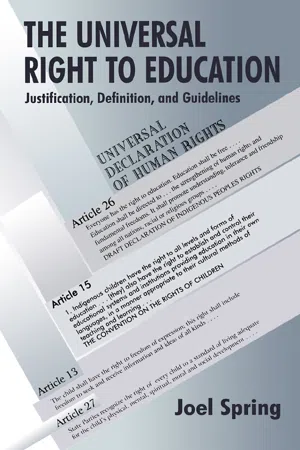
In this book, Joel Spring offers a powerful and closely reasoned justification and definition for the universal right to education--applicable to all cultures--as provided for in Article 26 of the United Nation's Universal Declaration of Human Rights.
One sixth of the world's population, nearly 855 million people, are functionally illiterate, and 130 million children in developing countries are without access to basic education. Spring argues that in our crowded global economy, educational deprivation has dire consequences for human welfare. Such deprivation diminishes political power. Education is essential for providing citizens with the tools for resisting totalitarian and repressive governments and economic exploitation. What is to be done? The historically grounded, highly original analysis and proposals Spring sets forth in this book go a long way toward answering this urgent question.
Spring first looks at the debates leading up to the Universal Declaration of Human Rights in 1948, to see how the various writers dealt with the issue of cultural differences. These discussions provide a framework for examining the problem of reconciling cultural differences with universal concepts. He next expands on the issue of education and cultural differences by proposing a justification for education that is applicable to indigenous peoples and minority cultures and languages. This justification is then applied to all people within the current global economy. Acknowledging that the right to an education is inseparable from children's rights, he uses the concept of a universal right to education to justify children's rights, and, in turn, applies his definition of children's liberty rights to the concept of education. His synthesis of cultural, language, and children's rights provides the basis for a universal justification and definition for the right to education -- which, in the concluding chapters, Spring uses to propose universal guidelines for human rights education, and instruction in literacy, numeracy, cultural centeredness, and moral economy.
- 202 pages
- English
- ePUB (mobile friendly)
- Available on iOS & Android
eBook - ePub
About this book
Information
1
Justifying Human and Educational Rights
“Everyone has the right to education,” proclaims Article 26 of the 1948 Universal Declaration of Human Rights. Is there a universal justification for the right to education? Is there a universal definition of education? Are there minimum guidelines for fulfilling the right to education?
Answers to these questions are of more than academic interest, in view of global educational problems. One sixth of the world’s population—nearly 855 million people— is functionally illiterate, while 130 million children in developing countries are without access to basic education. According to the 1999 United Nations’ report, The State of the World’s Children 1999, “Girls crowd these ranks disproportionately, representing nearly two of every three children in the developing world who do not receive a primary education (approximately 73 million of the 130 million out-of-school children).”1
In the current world economy, educational deprivation has dire consequences for human welfare. Since the 1970s, income and wealth are increasingly related to years of education as wages increase for jobs requiring technological skills and wages decline for low-skilled jobs.2 Also, education contributes to health: Population movement and crowded living conditions have enhanced the conditions for the spread of infectious diseases. Rudimentary health education programs can make dramatic improvements in mortality rates. The United Nations Children’s Fund estimates that a “10 percentage point increase in girls’ primary enrolment can be expected to decrease infant mortality by 4.1 deaths per 1,000, and a similar rise in girls’ secondary enrolment by another 5.6 deaths per1,000.”3 In addition, education can provide citizens with the tools for resisting totalitarian and repressive governments and economic exploitation. Under current conditions, education does contribute to human welfare.
A major difficulty in formulating a universal justification and definition for the right to education is the existence of multiple languages and cultures. This issue was discussed but left unanswered during the writing of the 1948 Universal Declaration of Human Rights. As I explain later, human rights were simply proclaimed without an agreed-on universal justification. In fact, the right to education was announced as if all people shared the same beliefs about learning and development. Article 26 of the 1948 Universal Declaration of Human Rights states:
- Everyone has the right to education. Education shall be free, at least in the elementary and fundamental stages. Elementary education shall be compulsory. Technical and professional education shall be made generally available and higher education shall be equally accessible to all on the basis of merit.
- Education shall be directed to the full development of the human personality and to strengthening of respect for human rights and fundamental freedoms. It shall promote understanding, tolerance and friendship among all nations, racial or religious groups, and shall further the activities of the United Nations for the maintenance of peace.
- Parents have a prior right to choose the kind of education that shall be given to their children.4
UNIVERSAL JUSTIFICATION, DEFINITION, AND GUIDELINES FOR THE RIGHT TO EDUCATION
My formulation of a justification for the right to education begins with an exploration of the original debates about the 1948 Universal Declaration of Human Rights. Two important educational ideas emerged from these discussions. One was the difference between authoritarian and nonauthoritarian school systems. This distinction is important for defining a universal concept of education. It is also important, as I argue throughout this book, for unlocking the social imagination of all people so that they can think about alternatives to current political, social, and economic systems.
The second important idea was the educational rights of cultural minorities. Delineating the educational rights of cultural minorities is key to providing a universal justification for education that is applicable to all cultures. In chapter 2, I discuss the educational rights of minority and indigenous cultures in the context of the evolution of a global economy and culture. The meaning of global economy and culture is complex and requires discussion of the origins of a world sys-tem and the relation between global and local. At the end of this chapter, I present a list of rights under the title: “The Right to Education for Indigenous and Minority Cultures in Multicultural Societies.”
The right to education for indigenous and minority cultures provides the basic framework for a universal justification, as I discuss in chapter 3, for education in a global economy and culture. In chapter 3, I elaborate on cultural and educational rights in the context of the 1960 Convention Against Discrimination in Education, global ethics, and the relation between environmental destruction and the right to education.
An important consequence of a universal justification of the right to education, I argue in chapter 4, is the protection of childrens’ rights. Exercising the right to education requires that children have the right to adequate nutrition, health care, and housing and the right to protection from exploitive labor and physical abuse. These basic rights must be met before children can exercise their right to education. In addition, children’s rights include freedom of ideas and expression and freedom of access to information. These basic intellectual freedoms highlight the right of children to nonauthoritarian school systems and to an education in human rights. Chapter 4 concludes with a set of principles that provide a ‘Justification for the Universal Right to an Education and Children’s Rights.”
Because the right to education includes the right to education in human rights, I analyze in chapter 5 existing human rights education programs and then propose universal guidelines for instruction in human rights. In addition, I propose that all children be taught that they have a moral duty to actively protect the rights of others. Based on the universal justification for education and children’s rights, I provide in chapter 6 a universal definition of education including basic guidelines for literacy and numeracy instruction. These guidelines are intended to protect local cultures while preparing students to decide on the advantages and disadvantages of the global economy and culture. These guidelines are also intended to provide minimum guidance in the organization of school systems. In chapter 7, I provide educational guidelines for preparing students to mediate the effect of world culture and economics. In the next section, I begin my search for a universal justification of the right to education.
THE RIGHT TO EDUCATION
Can a “right to education” be justified for all the world’s peoples regardless of differences in culture, religion, and political and social circumstances? If there is a justification for a universal right to education, should education have the same meaning in every culture? Is there a universal concept of education that is applicable to all cultures?
The rush to compose the 1948 Universal Declaration of Universal Rights left little time to debate these questions. In fact, while recognizing major differences in cultural and political concepts of rights, participants set aside their disagreements to produce a document that might in the future stop the spread of the nationalism and racism that led to World War II. Unfortunately, future generations were left with a hollow document waiting to be given meaning and direction.
Despite efforts since 1948 to implement the “right to education,” there is still no universal justification for the right and no universal concept of education. The boldest initiative to ensure the right occurred with the 1990 World Conference on Education for All (EFA) with its rousing theme song,
Education is the right of all
For you and for me
It’s action time and time is now
Let’s all heed the call
Join us, come with us,
We are on our way
To Education for All
By the year 2000.5
While delegates joined in singing this hymn to education for all, they were bitterly divided over political and economic educational goals. As a result, there never emerged from their discussions an agreement on a universal concept of education. Sponsored by the United Nations Educational, Scientific, and Cultural Organization (UNESCO), the United Nations Children’s Fund (UNICEF), the United Nations Development Programme (NDP), and the World Bank, the World Conference on Education for All, meeting in Jomtien, Thailand, on March 5, 1990, was characterized by an array of conflicting educational purposes. Some delegates wanted the right to an education to be linked to individual liberation and democracy. These delegates declared, “Education is the crucible for democracy and liberty…. Education for All must be oriented towards individual liberation from every form of domination and oppression.“6 In contrast to those advocating education for individual liberation, some delegates wanted basic education to stress moral and spiritual values. Moslem countries were particularly concerned about the ethical and moral aspects of education. As Professor A. Boutaleb observed, “The first revealed word in the Holy Qu’ran is ‘Read.’”7 For Moslems, the fundamental reason for literacy was for learning the teachings of the Qu’ran. Crown Prince Hassan of Jordan, the leader of a monarchical and antidemocratic nation, stated, “Education can and should be made to implant human values that should manifest themselves in the endeavors of groups and individuals, and in the struggle to improve the quality of life.”8 Delegates were divided over the economic purposes of basic education. For some, a basic education should include, along with literacy and numeracy, skills for living and increasing national economic growth. Others warned against defining education according to economic outcomes because education for economic development does not necessarily include education for democracy and individual liberation. The most daunting problem for delegates was reconciling a universal declaration of the right to education with cultural differences, particularly those of indigenous peoples.
In an effort to achieve agreement despite significant political, economic, and cultural differences about the meaning of education, the Preamble to the World Declaration on Education for All was written in such a manner that any group can find support for its vision of education. Of course, one could argue that all preambles are filled with highsounding words waiting to be given meaning. The Preamble states as a justification for education for all:
Recalling that education is a fundamental right for all people, women and men, of all ages, throughout the world;
Understanding that education can help ensure a safer, healthier, more prosperous and environmentally sound world, while contributing to social, economic, and cultural progress, tolerance, and international cooperation;
Knowing that education is an indispensable key to, though not sufficient condition for, personal and social improvement;
Recognizing that traditional knowledge and indigenous cultural heritage have a value and validity in their own right and a capacity to both define and promote development;
Acknowledging that, overall, the current provision of education is seriously deficient and that it must be made more relevant and qualitatively improved, and universally available;
Recognizing that sound basic education is fundamental to the strengthening of higher levels of education and of scientific and technological literacy and capacity and thus self-reliant development; and
Recognizing the necessity to give to present and coming generations an expanded vision of, and a renewed commitment to, basic education to address the scale and complexity of the challenge; proclaim the following.9
Oddly missing from the Preamble is any justification of education as necessary for the protection of human rights. Of course, human rights education would undermine the effort at “education for all” by threatening oppressive governments or economic systems. The only reference in the actual articles of the World Declaration on Education for All that comes close to human rights education is the suggestion in Article I, Clause 2, that education “empowers individuals…to further the cause of social justice.”10 Social justice is never defined, although it could have been through reference to Universal Declaration of Human Rights.
Clause 1 of Article I of the World Declaration on Education for All is the only clause that provides a definition of education. The other nine articles are devoted to establishing the conditions for education and the methods for implementing education for all. Article 1 states:
1. Every person—child, youth and adult—shall be able to benefit from educational opportunities designed to meet their basic learning needs. These needs comprise both essential learning tools (such as literacy, oral expression, numeracy, and problem solving) and the basic content (such as knowledge, skills, values, and attitudes) required by human beings to be able to survive, to develop their full capacities, to live and work in dignity, to participate fully in development, to improve the quality of their lives, to make informed decisions, and to continue learning. The scope of basic learning needs and how they should be met varies with individual countries and cultures, and inevitably, changes with the passage of time.11
In addition to not identifying the specific content of a universal education—there is a vague reference to literacy, oral expression, and numeracy—there is no reference to human rights education or to a specific means by which education will be adapted to “individual countries and cultures.” For instance, it was not the intention of the writers of the Universal Declaration of Human Rights that the “right to education” would be used to justify school systems that supported dictatorial governments practicing torture, engaging in random acts of violence, and economically exploiting a subjugated population. The writers of the Universal Declaration of Human Rights did not envision a literacy campaign that would result in political prisoners being able to read their own death warrants.
The World Declaration on Education for All fails to provide an adequate and complete justification of the right to education and definition of education. In part, this is a result of the inability of the writers of the 1948 Universal Declaration of Human Rights to reconcile their differences.
FINDING A JUSTIFICATION AND DEFINITION FOR “EVERYONE HAS THE RIGHT TO EDUCATION”
My search for a universal justification for the right to education and a universal concept of education begins with the original debates over the 1948 Universal Declaration of Human Rights. I use the accumulated debates since 1948 about education and children’s rights as a starting point for articulating a justification and concept of universal education.
Two important conditions, I believe, are required for a universal justification for the right to education. First, a justification must protect the right to education for all people, notwithstanding differences in culture, language, and religion. Second, there must be a definition of education that is appropriate to all cultures, languages, and religions. None of these conditions was met when Article 26 was drafted.
These two conditions were only partially mentioned in debates leading to the drafting of the 1948 Universal Declaration of Human Rights. In addition, there was little agreement on a justification for universal rights or even an agreed-on definition of “human right.” During the writing of the Universal Declaration of Human Rights, disputes cut across cultural and political lines. Directing the effort, John Humphrey, Director of the United Nations’ newly created Division of Human Rights, wondered whether the competing sides could ever agree on a declaration of rights. Leaving his academic position at Montreal’s McGill University Law School in 1947 for the untested waters of the United Nations (UN) human rights efforts, Humphrey found himself embroiled in a dispute over the nature and protection of human rights between advocates of Asian and European social concepts and capitalist and communist economic ideologies.
The 1947 opening session of the Human Rights Commission was the first attempt in human history by an international group to identify and agree on common values and beliefs shared by the world’s cultures. After Humphrey organized the Human Rights Commission, Eleanor Roosevelt, the U.S. champion of human rights, was elected chairperson of the Commission, with P.C.Chang, China’s representative to the UN’s Economic and Social Council, el...
Table of contents
- Cover Page
- Title Page
- Copyright Page
- Preface
- 1: Justifying Human and Educational Rights
- 2: Justifying a Universal Right to Education for Indigenous and Minority Cultures
- 3: The Right to Education in a Global Culture and Economy
- 4: Universal Justification for Education and Children’s Rights
- 5: A Universal Concept of Education: Human Rights Education and Moral Duties
- 6: A Universal Concept of Education: Guidelines for Literacy and Numeracy Instruction
- 7: Mediating the Effects of World Culture and Economy
- 8: Summary: The Universal Right to Education
- Notes
Trusted by 375,005 students
Access to over 1.5 million titles for a fair monthly price.
Study more efficiently using our study tools.
Frequently asked questions
Yes, you can cancel anytime from the Subscription tab in your account settings on the Perlego website. Your subscription will stay active until the end of your current billing period. Learn how to cancel your subscription
No, books cannot be downloaded as external files, such as PDFs, for use outside of Perlego. However, you can download books within the Perlego app for offline reading on mobile or tablet. Learn how to download books offline
Perlego offers two plans: Essential and Complete
- Essential is ideal for learners and professionals who enjoy exploring a wide range of subjects. Access the Essential Library with 800,000+ trusted titles and best-sellers across business, personal growth, and the humanities. Includes unlimited reading time and Standard Read Aloud voice.
- Complete: Perfect for advanced learners and researchers needing full, unrestricted access. Unlock 1.5M+ books across hundreds of subjects, including academic and specialized titles. The Complete Plan also includes advanced features like Premium Read Aloud and Research Assistant.
We are an online textbook subscription service, where you can get access to an entire online library for less than the price of a single book per month. With over 1.5 million books across 990+ topics, we’ve got you covered! Learn about our mission
Look out for the read-aloud symbol on your next book to see if you can listen to it. The read-aloud tool reads text aloud for you, highlighting the text as it is being read. You can pause it, speed it up and slow it down. Learn more about Read Aloud
Yes! You can use the Perlego app on both iOS and Android devices to read anytime, anywhere — even offline. Perfect for commutes or when you’re on the go.
Please note we cannot support devices running on iOS 13 and Android 7 or earlier. Learn more about using the app
Please note we cannot support devices running on iOS 13 and Android 7 or earlier. Learn more about using the app
Yes, you can access The Universal Right to Education by Joel Spring in PDF and/or ePUB format, as well as other popular books in Education & Education General. We have over 1.5 million books available in our catalogue for you to explore.