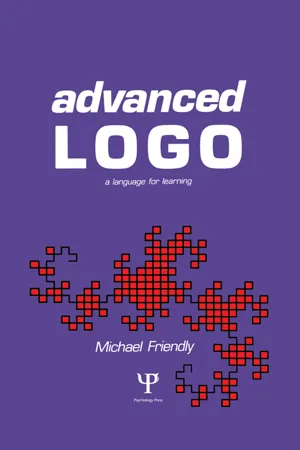
Advanced Logo shows how LOGO can be used as a vehicle to promote problem solving skills among secondary students, college students, and instructors. The book demonstrates the wide range of educational domains that can be explored through LOGO including generative grammars, physical laws of motion and mechanics, artificial intelligence, robotics, and calculus.
- 676 pages
- English
- ePUB (mobile friendly)
- Available on iOS & Android
eBook - ePub
About this book
Information
Publisher
Psychology PressYear
2014Print ISBN
9780805800746
9780898599336
Edition
1eBook ISBN
9781317766780
1 | What is Logo? |
“When we were little,” the Mock Turtle went on at last, more calmly, though still sobbing a little now and then,’ “we went to school in the sea. The master was an old Turtle—we used to call him Tortoise—”
“Why did you call him Tortoise, if he wasn’t one?” Alice asked.
“We called him Tortoise because he taught us,” said the Mock Turtle angrily. “Really you are very dull!”
(Alice in Wonderland, p. 126–127)
1.1. Learning to Compute and Computing to Learn
“Logo is a language for learning.” This sentence—the subtitle of this book—has become one of the slogans of the Logo movement. There is of course a double meaning hidden slightly beneath the surface. One meaning suggests that Logo is a language for learning to compute, or to “program a computer.” This is true, since Logo was designed to make computing as easy as possible to understand. But Logo is also a language for computing to learn. In this sense, it is useful to think of Logo as a computing environment to explore and “play with” ideas.
This book has two parts, each written to achieve a particular goal corresponding to these two meanings:
Part I, “Logo Thinking,” is designed to help you learn the important ideas behind Logo as a programming language. The emphasis in this part is on learning to compute by describing ideas and processes with Logo programs, and understanding how to translate a verbal description into a working Logo program.
Part II, “Learning with Logo,” is designed to demonstrate the use of Logo as a tool for exploring a variety of content areas. The emphasis here is on computing to learn and understanding the power of computing for making abstract ideas more concrete and manipulable.
The rest of this chapter describes some additional relations between Logo and language, explains how Logo is tuned toward learning and education, and describes how to use this book.
1.2. Logo is a Language for Learning
There are several deeper meanings to “Logo is a language for learning.” First of all, Logo shares a great deal with natural language in its construction and how it is learned. Of course, Logo is not a natural language (which is not to say it is an unnatural one), and the differences outweigh the similarities if we are simply counting “features.” Yet, the characteristics that Logo shares with natural language are, I believe, among the important reasons for its success as a tool for learning and education.
Perhaps the most important characteristic of natural language is the way larger language units are built from smaller units at several levels, as shown in Table 1–1. Most natural languages have many thousands of words constructed from 20–50 characters, letters, or symbols. Words in natural language stand for things (“tree”) concepts (“education”) a process or action (“sell”) or a relation or property (“larger”; “red”). In Logo, words are also used as names for such things.
At higher levels, the words of natural language are combined to form phrases, sentences, paragraphs or verses, stories, chapters, and books. In every case, larger structures are built out of smaller units, and the range of ideas you can express increases enormously. Again, many of these things may be said about the use of words in Logo to build lists, commands, procedures, and so forth.
There are also similarities between learning natural language and learning Logo, though it is stretching the point to claim that they are the same. Children learn language in an orderly, step-by-step fashion. Starting with the basic sounds of language, they learn word concepts, learn to combine words into simple sentences, and are soon using language in a rich and productive way. And all this happens with very little direct instruction but with a great amount of active exploration and experience. Throughout, language learning begins with actions, sensations, and concrete objects and proceeds to words and more abstract concepts.
Logo learning also begins with a few simple words, but with these the learner can “say” some interesting things. There is very little overhead needed to get started. Like language, Logo can be learned in small increments, begins with concrete and graphic things, and can progress to words and more abstract concepts.
1.2.1. Logo is a Language of Words
ABRACADABRA! Open Sesame! The power of magic words plays a big part in stories and folk tales. Yet all words are powerful, and some have a bit of magic too. One of the most important features of nat...
Table of contents
- Cover Page
- Title Page
- Copyright Page
- Contents
- Preface
- Acknowledgments
- 1 What is Logo?
- 2 Logo Basics
- 3 Defining Procedures
- 4 Listful Thinking
- 5 Interactive Techniques
- 6 Exploring Numbers, Words and Lists
- 7 The Tower of Hanoi: A Case Study
- 8 The World of Trees
- 9 Multiple Turtles, Cyber Bugs and Robots
- 10 Knowledge Programming in Box World
- 11 Representing Knowledge
- 12 Exploring Language
- 13 PlotWorld: A Visit to Mathland
- 14 Turtle Dynamics and the Laws of Motion
- 15 Inside Logo
- Appendix A Versions of Logo
- Appendix B Answers to Selected Activities
- References
- Author Index
- Procedure & Subject Index
Trusted by 375,005 students
Access to over 1.5 million titles for a fair monthly price.
Study more efficiently using our study tools.
Frequently asked questions
Yes, you can cancel anytime from the Subscription tab in your account settings on the Perlego website. Your subscription will stay active until the end of your current billing period. Learn how to cancel your subscription
No, books cannot be downloaded as external files, such as PDFs, for use outside of Perlego. However, you can download books within the Perlego app for offline reading on mobile or tablet. Learn how to download books offline
Perlego offers two plans: Essential and Complete
- Essential is ideal for learners and professionals who enjoy exploring a wide range of subjects. Access the Essential Library with 800,000+ trusted titles and best-sellers across business, personal growth, and the humanities. Includes unlimited reading time and Standard Read Aloud voice.
- Complete: Perfect for advanced learners and researchers needing full, unrestricted access. Unlock 1.5M+ books across hundreds of subjects, including academic and specialized titles. The Complete Plan also includes advanced features like Premium Read Aloud and Research Assistant.
We are an online textbook subscription service, where you can get access to an entire online library for less than the price of a single book per month. With over 1.5 million books across 990+ topics, we’ve got you covered! Learn about our mission
Look out for the read-aloud symbol on your next book to see if you can listen to it. The read-aloud tool reads text aloud for you, highlighting the text as it is being read. You can pause it, speed it up and slow it down. Learn more about Read Aloud
Yes! You can use the Perlego app on both iOS and Android devices to read anytime, anywhere — even offline. Perfect for commutes or when you’re on the go.
Please note we cannot support devices running on iOS 13 and Android 7 or earlier. Learn more about using the app
Please note we cannot support devices running on iOS 13 and Android 7 or earlier. Learn more about using the app
Yes, you can access Advanced Logo by Michael Friendly in PDF and/or ePUB format, as well as other popular books in Psychology & Cognitive Psychology & Cognition. We have over 1.5 million books available in our catalogue for you to explore.