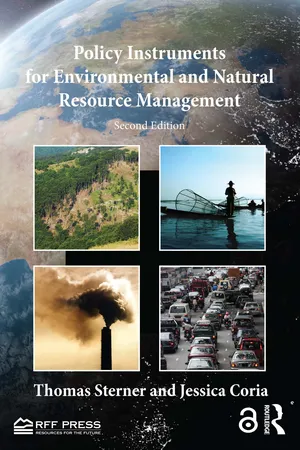
Policy Instruments for Environmental and Natural Resource Management
eBook - ePub

Policy Instruments for Environmental and Natural Resource Management

  1. 638 pages
  2. English
  3. ePUB (mobile friendly)
  4. Available on iOS & Android
eBook - ePub

Policy Instruments for Environmental and Natural Resource Management

About this book

Thomas Sterner's book is an attempt to encourage more widespread and careful use of economic policy instruments. The book compares the accumulated experiences of the use of economic policy instruments in the U.S. and Europe, as well as in rich and poor countries in Asia, Africa, and Latin America. Ambitious in scope, it discusses the design of instruments that can be employed in any country in a wide range of contexts, including transportation, industrial pollution, water pricing, waste, fisheries, forests, and agriculture.

While deeply rooted in economics, Policy Instruments for Environmental and Natural Resource Management is informed by political, legal, ecological, and psychological research. The new edition enhances what has already been widely hailed as a highly innovative work. The book includes greatly expanded coverage of climate change, covering aspects related to policy design, international equity and discounting, voluntary carbon markets, permit trading in United States, and the Clean Development Mechanism. Focusing ever more on leading ideas in both theory and policy, the new edition brings experimental economics into the main of its discussions. It features expanded coverage of the monitoring and enforcement of environmental policy, technological change, the choice of policy instruments under imperfect competition, and subjects such as corporate social responsibility, bio-fuels, payments for ecosystem services, and REDD.

The Open Access version of this book, available at http://www.taylorfrancis.com, has been made available under a Creative Commons Attribution-Non Commercial-ShareAlike (CC BY-NC-SA) 4.0 license.

Trusted byĀ 375,005 students

Access to over 1.5 million titles for a fair monthly price.

Study more efficiently using our study tools.

Information

Publisher
Routledge
Year
2013
Print ISBN
9781617260971
eBook ISBN
9781317703860

Chapter 1
Background and Overview

Global population is growing fast—over 80 million people per year—and has doubled since 1960. Most of that growth is in poor countries. India’s population has passed 1 billion, and India may become the world’s most populous nation within a few decades. Recent projections indicate that the rate of growth is slowing somewhat, but world population is still projected to reach 9 billion within a few decades. This population growth poses considerable challenges for resource and environmental management.

Definitions, Concepts, and Challenges for Policymaking

The links among population, poverty, growth, resources, and environment are complex, and the mechanisms that determine human fertility and mortality (and thereby population dynamics) are an interesting topic of study.1 The harsh-but-effective Chinese policy has shown the world that policy mechanisms can affect human fertility and mortality, but can population growth be affected by policies that do not infringe so heavily on personal liberties?
Interestingly enough, population growth appears to be decreasing quickly in most countries. The global average number of children per woman has fallen from about 6 in 1950 to 2.8 in the year 2000. In the richer countries, fertility is typically around 2 children per woman, which means that population will stabilize or in fact slowly decline. Income and education are particularly important determinants of fertility, and thus ā€œdevelopmentā€ automatically brings some decrease. The speed of transition depends on many cultural and institutional factors that may lock countries into a form of ā€œdemographic trapā€ in which poverty is both cause and effect of fast population growth. Results of studies exploring the links among institutions such as property, marriage, and inheritance law as well as the more subtle cultural determinants of fertility indicate that policies can and do have a large effect on household decisions, such as whether to marry and how many children to have (Dasgupta 1993). This finding indicates that policymakers may be able to successfully affect the fertility issue, but the sociocultural and personal aspects of fertility and mortality make it a difficult area for policy application.
Besides population, other major determinants of human impact on ecosystems are level of consumption and choice of technology. This concept is neatly summarized by the I = PAT equation, whereby impact depends on population, affluence, and technology (Ehrlich and Holdren 1971).

Market Failures

One frustration of many environmentalists is that seemingly simple solutions to serious environmental problems exist but are never implemented. In this book, we write about policy instruments that are designed to ensure implementation. To begin, policymakers must understand why environmental policy is needed. The reasons include market and policy failures that are interlinked with the evolution of property rights.
Market failure is a technical term that roughly refers to conditions under which the free market does not produce optimal welfare. It is thus a ā€œfailureā€ compared with the abstract model economists make of a perfect market economy. Important examples of such failure include external effects (externalities), public goods, common pool resources, poorly defined or defended property rights, noncompetitive markets, and imperfect (or asymmetric) information. Policy failure may appear to be a simpler concept, but a seemingly neutral concept of welfare underlies it. Policies reflect economic interests, and in some cases, there may not be a single policy that is ā€œoptimalā€ for every group in society. One can sometimes distinguish between corrupt policy and bad policy. The corrupt policy is one that claims to be in the interest of the whole country but actually serves the interest of one group (and may actually do that very successfully). A bad policy is one that intends to enhance welfare in a reasonable way but fails due to ineptitude. Property rights are institutions that can be affected by policy, although the process is typically very slow.
Externalities are nonmarket side effects of production or consumption, such as soil erosion caused by unsuitable agricultural practices (particularly on hillside slopes). The silting of dams and the destruction of coral reefs are real costs, but these costs are not borne by the individuals or corporations that cause the damage. Such situations can be seen as consequences of incomplete property rights: if waterways had owners with a right to clean water, then those owners could sue those who caused the soil erosion and thus internalize the effects.
Public goods are products or services that are enjoyed in common, such as defense and air (clean or dirty). The market tends to undersupply these goods because it is hard to exclude those who do not pay. Instead, political processes are needed, such as the election of a government that collects taxes and finances public goods. Common pool resources also have costly exclusion, but the goods produced with these resources are consumed individually (as private goods). Examples include firewood and fodder, and the resources are often managed as common property. Free riding and other mechanisms that lead to the undersupply of public goods may also lead to the overuse of common pool resources unless institutions are strong enough to limit access by the users. Noncompetitive markets, monopolies, and oligopolies usually result in nonoptimal supply (e.g., too little may be sold at too high a price).
Of all the market failures, asymmetric information is perhaps the most pervasive. Economists typically point out that there are no ā€œfree lunchesā€ yet commonly assume that information is freely available to everyone. Information is costly, and lack of information stops the market from operating perfectly. Understanding information asymmetries not only helps us design policy instruments to address monitoring difficulties; it also goes to the heart of the most essential dilemma: how to promote social goals such as equity without destroying incentives for work and efficiency. Because policymakers do not have reliable data on pollution damages and abatement costs, for instance, they cannot design policies that are both efficient (with respect to resource allocation) and fair (in sharing the burdens of all the costs involved). If policymakers need the cooperation of individuals who have ā€œinsideā€ information, then they must accept that those individuals may be able to earn something in return for disclosing information.

Social Rights and Norms Concerning Nature

The concept of environmental problems sounds simple enough, and depending on one’s background, it may bring to mind issues such as factory smoke, soil erosion, and dam siltation. However, at a deeper level, the concept is difficult to comprehend because it touches on the relationship not only between human beings but also between humans and nature.
To determine what an environmental problem is and what needs to be remedied, policymakers must understand not only technology and ecology but also the sociology, economics, and politics of property rights. Rights, policy instruments, and politics are interlinked in ways that vary between economies, and information also plays a pervasive role. One everyday illustration of rights is cigarette smoking.
A few decades ago, individuals had the right to smoke almost wherever they pleased. People who suffered from the effects of secondhand smoke had no alternative but to try to avoid smokers. Over time, increased information and other factors have changed this situation so much that today, in some countries, the rights have been reversed: individuals have the right to enjoy a smoke-free environment. This sea change has permeated even the private sphere, so smokers visiting private homes kindly ask permission to smoke, or they simply go outside before lighting up. The use of instruments such as no-smoking zones, tobacco taxes, prohibition of tobacco advertising, and legal suits against the tobacco companies has strongly affected the general perception of rights regarding cigarette smoking. Whereas some policy instruments are only possible thanks to changes in individual rights, instruments also can help to change the structure of rights by changing moral and ethical perceptions.

Current Problems and Warning Signals

A few examples illustrate the kinds of problems that face humanity:
  • Over the course of this century, net carbon uptake by terrestrial ecosystems is likely to peak, thus amplifying climate change.
  • Earth’s protective stratospheric ozone layer has been degraded by the emission of toxic synthetic chemicals into the air.
  • Synthetic chemicals and toxic metals have spread to the supposedly most inaccessible corners of the planet, including the Antarctic; some have accumulated in the food chain and have penetrated the genetic makeup of the human population.
  • Already in the 1980s, human activities used about 40% of the primary energy transformation through photosynthesis, which is the basis of all life on Earth. This consumption level does not leave much for natural ecosystems and biodiversity (Vitousek et al. 1986, 1997). Energy consumption, especially of fossil fuels, poses threats at local and global levels. Its potential effects on climate are a topic of international concern.
  • Water scarcity is a threat to agriculture and consumers in many countries. The level of some of the world’s major waterways (e.g., Nile, Indus, Ganges, Colorado, and Yellow Rivers and the Aral Sea) has fallen visibly as a result of industrial, agricultural, and residential use, and water tables in many regions of the United States, India, China, and other countries are being drawn down rapidly.
  • Soil degradation, loss of forest cover, and threats to the marine and coastal ecosystems (e.g., mangroves and coral reefs) have created considerable risk to biodiversity as well as to the sustainability of the food chain.
  • Yields of many of the world’s fisheries are decreasing. To keep up catches, earnings, and employment, fishermen have stepped up efforts by using larger boats, nets with smaller mesh, and sophisticated technologies such as sonar and satellite navigation. Instead of encouraging restraint, many policies ā€œhelpā€ the fishermen by subsidizing the purchase of boats and technology, thus lowering costs to fishermen and increasing the overall fishing effort—thus exacerbating the problem rather than resolving it.
  • The energy crisis of the 1970s spurred research into technologies for saving energy (e.g., fluorescent lighting, heat pumps, ā€œhypercars,ā€ and thyristors) and for alternative methods of producing energy (e.g., wind power, solar power, and biofuels); good technologies have been developed for efficient energy use in transportation, lighting, heating, and industrial processes. However, sometimes the consumer price of energy is too low to make the alternative technology commercially viable. External costs related to local and global environmental problems (e.g., health and productivity costs of getting asthma and bronchitis in urban areas) usually are not included as part of the cost of electricity or gasoline. If consumers were required to pay the real total cost of energy, they would be more motivated to adopt energy-efficient techniques.
  • People whose livelihood depends on natural resources (e.g., grazing lands) typically know their resources well and would have the knowledge to manage those resources rationally, even optimally, if given the opportunity and the means. However, absolute poverty makes the risk of variations in yield unacceptable and can result in unsustainable behavior. Instead of investing in new productive and sustainable technology, for example, poor individuals might continue to use methods that damage the ecosystem. These methods may be individually rational adaptations that fill the place of missing markets or institutions for savings and insurance, thus showing the detrimental effect of this market failure.
  • The income and equity aspects of environmental issues and policy instrument design are often crucial. Imposing taxes to reduce herd size, overfishing, or vehicular traffic can solve congestion and overuse problems but may still be resisted because they leave the users with less welfare if the taxes collected are siphoned off for purposes that are perceived as unproductive for the local users. Policy instruments must give local users a price signal that internalizes externalities without transferring the money out of the local community. There are numerous ways of doing this—for example, through permits that are allocated freely to local users, or by levying charges rather than taxes and then using the charges for local environmental or resource funds, which then can be allocated locally. Many environmental fees in developing countries operate in this way (see Chapter 21).
  • In many instances where environmental policy is warranted, polluters have more information and typically greater resources at their disposal than the policymakers do; informational instruments may be an important first step toward successful policy. By collecting and disseminating information, an agency can create a baseline for future action; encourage transparency in implementation, so that individual inspectors cannot ā€œmake dealsā€ with polluters outside the law; and clear the way to inform and empower customers, workers, investors, neighbors, and other concerned groups (see Chapter 20).

Applying Theory to Nature

Environmental economics (or ecological economics2) addresses the interface between economics and the life support system of Earth. Natural resources economics addresses both geological resources such as oil and minerals and, increasingly, biological resources such as forests and fisheries. It can be considered an integral part of environmental economics, even though it often is treated as a separate discipline. To take advantage of the lessons that these two areas can provide for each other, we discuss them jointly as far as possible. Environmental policy is interdisciplinary; although economic theory can make a fundamental contribution to the understanding of policy instruments, it can do so only in ...

Table of contents

  1. Cover Page
  2. Half Title page
  3. Title Page
  4. Copyright Page
  5. About Resources for the Future and RFF Press
  6. Resources for the Future
  7. Dedication
  8. Contents
  9. Preface
  10. Acknowledgments
  11. Abbreviations
  12. Chapter 1 Background and Overview
  13. Part I The Need for Environmental and Natural Resource Policy
  14. Part II Review of Policy Instruments
  15. Part III Selection of Policy Instruments
  16. Part IV Policy Instruments for Road Transportation
  17. Part V Policy Instruments for Industrial Pollution
  18. Part VI Policy Instruments for the Management of Natural Resources and Ecosystems
  19. Part VII Conclusion
  20. References
  21. Index

Frequently asked questions

Yes, you can cancel anytime from the Subscription tab in your account settings on the Perlego website. Your subscription will stay active until the end of your current billing period. Learn how to cancel your subscription
No, books cannot be downloaded as external files, such as PDFs, for use outside of Perlego. However, you can download books within the Perlego app for offline reading on mobile or tablet. Learn how to download books offline
Perlego offers two plans: Essential and Complete
  • Essential is ideal for learners and professionals who enjoy exploring a wide range of subjects. Access the Essential Library with 800,000+ trusted titles and best-sellers across business, personal growth, and the humanities. Includes unlimited reading time and Standard Read Aloud voice.
  • Complete: Perfect for advanced learners and researchers needing full, unrestricted access. Unlock 1.5M+ books across hundreds of subjects, including academic and specialized titles. The Complete Plan also includes advanced features like Premium Read Aloud and Research Assistant.
Both plans are available with monthly, semester, or annual billing cycles.
We are an online textbook subscription service, where you can get access to an entire online library for less than the price of a single book per month. With over 1.5 million books across 990+ topics, we’ve got you covered! Learn about our mission
Look out for the read-aloud symbol on your next book to see if you can listen to it. The read-aloud tool reads text aloud for you, highlighting the text as it is being read. You can pause it, speed it up and slow it down. Learn more about Read Aloud
Yes! You can use the Perlego app on both iOS and Android devices to read anytime, anywhere — even offline. Perfect for commutes or when you’re on the go.
Please note we cannot support devices running on iOS 13 and Android 7 or earlier. Learn more about using the app
Yes, you can access Policy Instruments for Environmental and Natural Resource Management by Thomas Sterner,Jessica Coria in PDF and/or ePUB format, as well as other popular books in Economics & Environmental Economics. We have over 1.5 million books available in our catalogue for you to explore.