- 312 pages
- English
- ePUB (mobile friendly)
- Available on iOS & Android
eBook - ePub
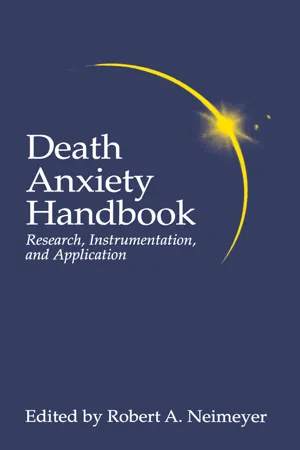
Death Anxiety Handbook: Research, Instrumentation, And Application
About this book
Presenting a broad coverage of this major area of studies on death and dying, this book provides a systematic presentation of the six most widely used and best validated measures of death anxiety, threat and fear. These chapters consider the available data on the psychometric properties of each instrument and summarize research using them, and also supply a copy of the instrument with scoring keys - to facilitate their use. In addition, other chapters make use of the instrumentation by pursuing questions of applied significance in various health care settings nursing homes, psychotherapy, death education, near death experiences, persons with AIDS, experiences of bereaved young adults.; An introductory chapter introduces the major philosophical and psychological theories of the causes and consequences of death anxiety in adult life, and a closing chapter gives an overview of death education and how this affects attitudes towards death and dying.
Information
Publisher
Taylor & FrancisYear
2015Print ISBN
9781138967243
9781560322825
Edition
1eBook ISBN
9781317763666
Theoretical Overview
Chapter 1
Death Anxiety in Adult Life— Theoretical Perspectives
Adrian Tomer
The purpose of this review is to present several theoretical approaches that are relevant to the study of death anxiety. Neimeyer's (1988) examination of the empirical papers dealing with death anxiety reveals, in general, a richness of findings together with a relative weakness in the theoretical justification of the research strategy in this area (Neimeyer & Moore, 1989). This observation, together with the realization that there are rich theoretical systems that can be used in a more efficient way in the study of death anxiety, was the main motivation for writing this review.
The review is by necessity selective with several restrictions to help define its scope. First, the age span reviewed is adult and old age. Childhood and adolescence are very important ages in the study of death anxiety but they are beyond the scope of this review. Second, a limitation was imposed on the subject matter: Death anxiety as defined here is that experienced in "daily life," not the anxiety experienced in coping with immediate threats to one's life. Moreover, the main interest here is anxiety caused by the anticipation of the state in which one is dead, excluding related aspects such as fear of dying or death of significant others. Third, when several related theories were similar from the point of view of their implications for death anxiety, only one of them was presented.
Many terms have been used in the literature to relate to the issue of (negative) attitudes toward death. The most common terms, besides death anxiety, are fear of death, death threat, death concern, and death acceptance. Although these terms sometimes can be (and have been) used interchangeably, in other cases they reflect important conceptual distinctions, often accompanied by attempts to develop scales focused on one concept or another (see Warren, 1989, ch. 4). For example, the term anxiety has a connotation of "nonspecific" distress (Kastenbaum & Ainsberg, 1972) and "confusion" (Kelly, 1955), which distinguishes it from other terms such as fear or threat. In fact, a theory such as personal construct theory (Kelly, 1955) makes a systematic distinction between threat and anxiety. In this review the usage was adapted to match the usage made by the proponents of the various theories. For general discussions I have used death anxiety as a generic term that subsumes more specific terms.
For reasons of space, no general exposition of the theories discussed is attempted. Rather, these theories are presented in the context of death anxiety and selected empirical results are used to indicate to the reader the existence of relevant evidence.
The review divides the theoretical approaches into several categories, beginning with philosophical perspectives. Several psychological theories are then reviewed including: self-realization theories, search-for-meaning theories, personal construct theory, theories of denial, self-concept discrepancy theory, and developmental approaches such as Erikson's psychosocial theory or theories of intellectual development. Recurrent themes in these approaches are the annihilation of the self, death as radical transformation, death as threat to life's meaningfulness, and death as threat to realization of basic life projects. These aspects are discussed in the concluding section. The discussion also formulates several "challenges" faced by the researcher in the field of death anxiety.
Selected Philosophical Approaches
Philosophical approaches usually cannot serve as psychological theories, and philosophical approaches toward death are no exception. There are, however, at least three reasons to include a brief review of philosophical perspectives in a psychologically oriented review. First, existential and phenomenological approaches in psychology are based upon firm philosophical foundations. Second, there have been interesting occasional attempts to use insightful philosophical descriptions of death as psychological models. Thus, Neimeyer and Chapman (1980) applied Sartre's existentialism to make predictions regarding death anxiety. Third, both philosophical and psychological perspectives emphasize the need to "integrate" or make sense of death. For these reasons I will begin by considering several philosophical approaches to death.
Heidegger’s View
Martin Heidegger (1927/1962) is well known for his statement in Being and Time that being (Dasein) is freedom toward death. Characteristic of our beingin-the-world is our being as not-yet, as no-thing. The realization of the inability to become a full being brings about (actually, is) the state of mind called anxiety. Death shows that there is no hope in being what we are. On the other hand, as pointed out by Carse (1980), death holds also a positive promise: The promise to being that it always will be in the manner of being-toward-an-end. One can choose oneself authentically only by choosing oneself as a being-toward-the-end-of-oneself. Only then is freedom, including freedom from fear of death, realized.
Heidegger's position implies that death is on one hand a threat—the threat of nonexistence. On the other hand, according to Heidegger a realization of our future nonexistence is a precondition of a fuller understanding of our life and, eventually, a precondition for freeing ourselves from anxiety. A psychological model based on this approach may be expected to explain and perhaps to predict when one or another construction of death (as threat to existence or as condition of meaning) will prevail. While the philosophical analysis supplies the main variables that need to be explained, it remains the task of the psychological theory to specify mechanisms, circumstances, etc., in order to achieve a model that represents a scientific explanation of human behavior.
Sartre’s View
While for Heidegger death is the foundation of one's freedom, for Sartre (1943/1966) death prevents an individual from realizing his or her possibilities. Death is in the future but my death is not in my future. Death is the "in-itself" that cannot be experienced because there is no "for-itself" to experience it. Ultimately, death reduces one's existence to what this existence really is: a "useless passion," nothing. Reflection on death is, from this point of view, reflection on the meaninglessness of existence. It seems, therefore, that we should predict higher death anxiety to the extent one spends more time thinking about death.
A more positive interpretation of Sartre's thought was provided, however, by Neimeyer and Chapman (1980) in their use of the existential theory to connect death anxiety to self-actualization. The researchers elaborated upon Sartre's statement in Being and Nothingness that death reduces one to one's essence, which is his past, to what one has been. Given this, a person who has realized his or her central life projects to a great extent is less likely to be anxious about death than one whose projects remain incomplete. It seems, however, that on this point Sartre agrees basically with Heidegger's position that presents refuge in the past as unauthentic. There cannot be any refuge in the past for a being whose mode of being is not to be one's own essence. A different way of explaining the relationship between death anxiety and self-actualization would be through self-actualization theories and/or "search of meaning" theories in which a person "detects" oneself rather than "invents" oneself (Frankl, 1963). Both sets of theories will be reviewed below.
A Logician’s Point of View—Hofstadter’s Metaphors
Hofstadter (1979) contrasts two levels at which personal nonexistence might be considered. At one level one looks upon oneself as "just another human being." It is clear then that personal nonexistence is, in the long run, unavoidable. At another level one tries to consider nonexistence as an attribute of the self. However, a "nonexistent self" is inconceivable. For Hofstadter personal nonexistence is perhaps "the best metaphorical analogue of Gödel's Theorem" (p. 698).
It is instructive to pursue this analogy a bit further. It was shown by Gödel (1931/1962) that a system or calculus including arithmetic and also some prepositional logic may be constructed in such a way that, in a precise sense, it may mirror statements about properties of expressions of the calculus in the calculus itself. This system is shown to include a formula that mirrors a statement known (in the metalanguage) to be true but that is not provable in the language of the calculus itself. The analogy may be realized by interpreting the self as a structure including beliefs that correspond to the theorems of a formal calculus. Axioms may be interpreted as fundamental beliefs. A belief of complete nonexistence is incompatible with these axioms and therefore cannot be added to them.
Hofstadter's philosophical formulation reminds us of Kelly's (1955) psychological formulation (see the section on the Personal Constructs Theory), with the difference that in Hofstadter's view no "death integration" (more correctly no "nonexistence integration") is possible. Of course, the idea that death is unimaginable is hardly original. Freud, for example, contended that "in the unconscious every one of us is convinced of his own immortality" (Freud, 1915/1959, p. 313). What is peculiar to Hofstadter's argument is the presentation of this impossibility as an almost logical necessity.
Summary
Philosophical approaches, perhaps not surprisingly, differ in their conclusions as to the possibility that reflection on death might confer meaning to life. Heidegger's approach, as well as other phenomenological approaches that have not been reviewed here (e.g., Koestenbaum, 1971), make the meditation on personal death a precondition for achieving meaning and freedom of fear in everyday life. In contradistinction, for Hofstadter the ultimate understanding and assimilation of death is an impossibility. The question to what extent, under what circumstances, etc., a person may achieve integration, is an empirical question. It is the task of psychological theories to drive the research that, eventually, will provide satisfactory answers to these questions.
Psychological Theories
Self-Realization Theories
Several personological theorists, in particular Maslow (1968, 1970) and Rogers (1959), posited that individuals are motivated to realize their innate potentials. Maslow's self-actualizing person has among other theoretical characteristics a greater acceptance of him- or herself, a lower anxiety, and a lower death fear. For Rogers, self-actualization is an important aspect of the "actualizing tendency." Actualization is an inherent tendency to maintain and enhance the organism. Roger's theory of personality presents the self and the corresponding urge for self-actualization as an upshot of the process of differentiation (which is a manifestation of the fundamental actualizing tendency). The same process of differentiation generates, besides the self (a symbolic representation of what one is), the ideal self, which constitutes a representation of what one wishes to be.
The notions of threat, anxiety, and defense are based in the Rogerian system on the concepts of positive regard, congruence, and conditions of worth. The individual has a need for warmth and support from other human beings—a need for positive regard. The need for self-regard develops when the individual learns to experience positive regards in relation to his or her self-experiences and independently of transactions with significant others. In this process the individual starts avoiding or seeking self-experiences because these experiences are discriminated as being more or less worthy of self-regard. At this point the individual is said to have acquired "conditions of worth," a kind of "introjected values" that reflect the evaluation of self-experiences in terms of their contribution to self-regard. The individual protects himself or herself against experiences that are perceived (or rather "subceived," since the perception is at a subliminal level) as not fitting these conditions of worth. The process of defense against this threat consists of selective perception or distortion of the experience and/or complete denial of the experience or part of it. A break of these defenses, with the subsequent realization in awareness of the aforementioned incongruence, produces anxiety...
Table of contents
- Cover Page
- Half Title page
- Series in Death Education, Aging, and Health Care
- Title Page
- Copyright Page
- Contents
- Contributors
- Preface
- Part I: Theoretical Overview
- Part II: Research Instruments
- Part III: Applications
- Part IV: Conclusion
- Index
Trusted by 375,005 students
Access to over 1.5 million titles for a fair monthly price.
Study more efficiently using our study tools.
Frequently asked questions
Yes, you can cancel anytime from the Subscription tab in your account settings on the Perlego website. Your subscription will stay active until the end of your current billing period. Learn how to cancel your subscription
No, books cannot be downloaded as external files, such as PDFs, for use outside of Perlego. However, you can download books within the Perlego app for offline reading on mobile or tablet. Learn how to download books offline
Perlego offers two plans: Essential and Complete
- Essential is ideal for learners and professionals who enjoy exploring a wide range of subjects. Access the Essential Library with 800,000+ trusted titles and best-sellers across business, personal growth, and the humanities. Includes unlimited reading time and Standard Read Aloud voice.
- Complete: Perfect for advanced learners and researchers needing full, unrestricted access. Unlock 1.5M+ books across hundreds of subjects, including academic and specialized titles. The Complete Plan also includes advanced features like Premium Read Aloud and Research Assistant.
We are an online textbook subscription service, where you can get access to an entire online library for less than the price of a single book per month. With over 1.5 million books across 990+ topics, we’ve got you covered! Learn about our mission
Look out for the read-aloud symbol on your next book to see if you can listen to it. The read-aloud tool reads text aloud for you, highlighting the text as it is being read. You can pause it, speed it up and slow it down. Learn more about Read Aloud
Yes! You can use the Perlego app on both iOS and Android devices to read anytime, anywhere — even offline. Perfect for commutes or when you’re on the go.
Please note we cannot support devices running on iOS 13 and Android 7 or earlier. Learn more about using the app
Please note we cannot support devices running on iOS 13 and Android 7 or earlier. Learn more about using the app
Yes, you can access Death Anxiety Handbook: Research, Instrumentation, And Application by Robert A. Neimeyer in PDF and/or ePUB format, as well as other popular books in Psychology & Emotions in Psychology. We have over 1.5 million books available in our catalogue for you to explore.