![]()
1
Meet and Greet
A Point to Ponder
“When I retire, I want to be a Wal-Mart greeter.” We know you’ve heard it before. You may have even said it! But have you ever really analyzed why so many teachers continue to say this? We have.
Stores like Wal-Mart actually hire people to pretend to be happy to see you, a stranger, as you enter the store. In fact, these people possess the jobs that many teachers say they want to have when they retire. The reason so many teachers say they want to retire and be a Wal-Mart greeter is twofold: (1) The Wal-Mart greeter looks happy. (2) The Wal-Mart greeter looks stress-free! Who wouldn’t want a job where he felt happy and stress-free?
Now consider why Wal-Mart pays people to greet its customers. WalMart does this because of the simple fact that happy customers who feel wanted and welcome are more likely to buy what is being sold and will happily return to buy even more. Period. This is why you are greeted when you walk into a restaurant, when you step onto an airplane, and when you enter any other establishment that puts concerted thought into making its customers feel happy and welcome.
So wouldn’t this same concept work with students? And shouldn’t we be putting concerted thought into making our students (customers) feel happy and welcome every time they enter our classrooms? Don’t we want them to want to “buy” what we are “selling”? Don’t we want them to want to come back? The answers to those questions are yes, yes, yes, and yes!
Classroom Solution/Strategy
So let’s bring this simple strategy into the classroom. In our observations of teachers, we have found that most teachers claim that they greet their students every day. The fact is that some do, and others don’t. So let’s first establish what greeting does not mean. Some teachers stand at their classroom doors and, as the students arrive, say things like, “Let’s go. Your work is on the board. Get busy as soon as you get into the room. Hurry. Let’s get moving. The bell is about to ring.” This, our fellow teachers, is not greeting. Rather, it is the equivalent of saying, “Welcome to my torture chamber!” Any student who is rushed into the classroom in this oh-so-unwelcoming manner will hardly feel like you want him in your classroom! Students not feeling wanted? That is a recipe for misbehavior, and class has not even begun! But the foundation has been laid and the little rascals are scheming.
Now, let’s look at what greeting does mean. The very best teachers, the ones who always seem to have the fewest behavior problems, know the simple strategy that stores such as Wal-Mart know: If the teacher (greeter) looks happy to see his or her students (customers) every day and can actually make the students feel wanted and valued in the classroom, then the students are much more likely to “buy” what the teacher is “selling” and are more apt to want to return to that particular class the next day and the day after!
So here’s a simple way to greet your students every day. Don’t reinvent the wheel. Just do what the most successful teachers do. Simply stand at your classroom door, every day, every class period, and say things like, “Hello. How are you? Thank you for coming to class. Nice outfit. I love your new haircut. Jason, I’m so happy you’re back today. I missed you yesterday!” Okay, so you prayed last night that Jason would never come back, but the important thing is that Jason does not know that! He believes that you are happy to see him, and therefore he will be more likely to behave.
The truth is that students are less likely to misbehave in a classroom where they feel wanted and valued. To think that the simple act of “greeting” someone can solve so many problems! It can. The fact is that if you consistently greet your students every day, then you will soon decrease your discipline problems drastically. Anyone who does not believe this fact is not greeting students every day. Now, we do want to warn you that if you tend to be a little negative with your students and do not typically greet them every day with a smile on your face, this new approach will confuse your students at first. It will take more than one day of greeting your students to convince them that you are a “changed” person. But stick with it! The results will be worth it.
Is it possible that your “greeting” may be a little phony? Probably. Are you really that happy to see every student every day? Possibly not. But remember, we were hired to be actors and actresses! Oh, and just so you know, the Wal-Mart greeter is probably not overly happy to see you either! The flight attendant is possibly tired and hoping for a fairly empty flight. But here you are, yet another passenger! However, you should never know that that greeting was possibly a little overexuberant. You deserve to feel welcome and wanted and valued. Make your students feel the same way—every day! Even if you’re faking it just a little, you will soon find that the more you “fake it,” the more you will actually begin to feel happier, and thus your greetings will become more genuine. What a bonus!
Oh, and what more does it cost to tell them good-bye as they leave your room each day? If they arrive and leave on a happy note, better behavior you will promote!
Bottom Line
If you want your students to want to be in your classroom, then you have to convince them that you actually want them there. You never know when a simple hello will make someone’s day more okay!
A Simple "Hi"
Each day when I entered her classroom, she smiled and said hello
Just what that gesture meant to me, she truly could not know
She did not know that she and only she made me feel wanted
That her smile got me through a time in life when I felt daunted
That life at home was way too tough for any kid to take
That her classroom was my refuge, that my happiness was fake
That for her I put my best foot forward, even when times were rough
That my smile was a façade to hide my pain, for I was tough
But even though she never knew, it meant so much to me
That there was one place in my life where someone wanted me
Wanted me to be there, wanted me to learn
Wanted to help me realize there were good things I could earn
For beyond the books and content, I learned that year that I
Was someone who, to someone, was worth a simple “Hi.”
![]()
2
A Letter of Introduction
A Point to Ponder
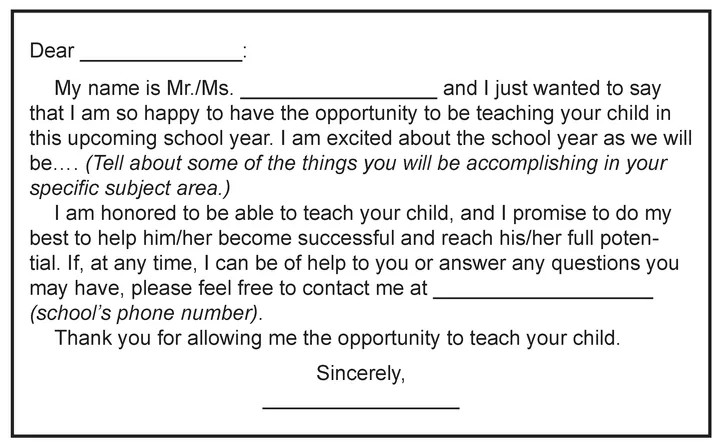
Imagine being the parent of a school-age child and receiving a letter in the mail over the summer months from your child’s prospective teacher saying who she is, what she wants for your child, what she believes about teaching, and just how happy she is to be teaching your precious angel.
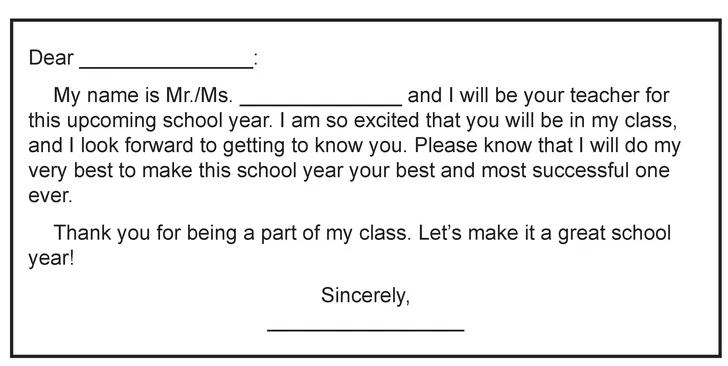
Imagine being a child and receiving a letter from your prospective teacher saying how happy she is that you will be in her class and how anxious she is to meet you, to get to know you, and to teach you.
Think back to how many letters like this you actually received, as a parent or a student. Not too many, if any, right? Well, here are a few things to consider:
- Parents want to believe that their children are in the hands of competent, caring, trustworthy teachers.
- Children want to believe that their teachers are people who are excited to teach them and happy to have them in class.
- Parents who believe that you care about their children are much more likely to work cooperatively with you.
- Children who are in the classrooms of teachers they perceive as caring are more likely to exhibit better behavior than children who do not believe that their teachers care about them.
This is not rocket science. Rather, it is human nature. So let’s take what we know about human nature and use it in our classrooms to foster better student behavior.
Classroom Solution/Strategy
A simple strategy for setting the stage for good student behavior is to write notes to students and parents before the first day of school. As soon as you receive your class rosters, write two simple notes—one to parents and one to students. Here are two samples:
Bottom Line
By taking the time to send such letters, you have just laid the groundwork for a positive start to your school year and a positive relationship with the parents of your students. You may consider asking your principal if the school can pay for the postage. If not, you may consider putting both letters in one envelope....