This volume brings together established and new scholarly voices to explore how participatory and situated approaches to learning can contribute to educational innovation. The contributors' critical examinations of educational programming and engagements provide insights into how educators, youth, families, and community members understand and enact their commitments to diversity and equitable access. Collectively, these essays complicate notions of community, alerting readers to ways in which community can be constructed other than in geographical and ethnoracial terms--as alliances and collaborations of individuals joining together to accomplish or negotiate shared agendas. The focus on agency combined with social context, a dialectic to which all of the authors speak, enlarges and invigorates our sense of what is pedagogically possible in societies characterized by diversity and flux.
*Part I, "Linking Pedagogy to Communities," focuses on dynamic initiatives where practitioners collaborate with community members and other professionals as they acknowledge and build on the cultural, linguistic, and intellectual resources of ethnic-minority students and their communities.
*Part II, "Professional Learning for Diversity," centers on the authors' experiences in facilitating opportunities for working with prospective and practicing teachers to develop situated pedagogies, highlighting both the challenges that emerge and the transformations that occur.
*Part III, "Learning in Community (and Community in Learning), illustrates how educational innovation can extend beyond the realm of schools and classrooms by elucidating ways in which individuals construct learning venues in out-of-school settings.
Learning, Teaching, and Community: Contributions of Situated and Participatory Approaches to Educational Innovation is a compelling and timely text ideally suited for courses focused on teacher education and development, informal learning, equity and education, multilingual and multicultural education, language and culture, educational foundations, and school reform/educational restructuring, and will be equally of interest to faculty, researchers, and professionals in these areas.
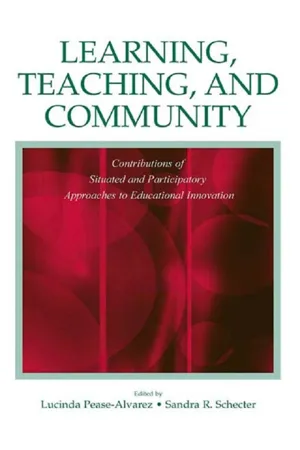
eBook - ePub
Learning, Teaching, and Community
Contributions of Situated and Participatory Approaches to Educational Innovation
- 208 pages
- English
- ePUB (mobile friendly)
- Available on iOS & Android
eBook - ePub
Learning, Teaching, and Community
Contributions of Situated and Participatory Approaches to Educational Innovation
About this book
Information
P A R T
I
LINKING PEDAGOGY TO COMMUNITIES
C H A P T E R
1
“It’s Our Kuleana”: A Critical Participatory Approach to Language-Minority Education
Kathryn A. Davis
Sarah Bazzi
Hye-sun Cho
Midori Ishida
Julius Soria
University of Hawai’i
Kuleana translates from Hawaiian as “right and responsibility.” Since the early 1900s native Hawaiians, immigrants, and local speakers of Hawai’i Creole English (HCE) have been denied the right to maintain their heritage languages1 and receive the academic preparation needed for educational and socioeconomic success. This chapter reports on a critical participatory project in which teachers, students, parents, community members, and university researchers collectively assume responsibility for positively transforming educational practices and linguistic attitudes within a predominately Filipino (Ilokano-speaking), Samoan, and Hawaiian high school. Participants are committed to educational programming that acknowledges and builds on the linguistic and cultural resources of communities that have suffered years of economic, social, and political oppression.
LANGUAGE AND EDUCATION IN HAWAI’I
Present-day educational policies and practices in Hawai’i have their roots in the state’s colonial past, beginning with the institutionalization of a formal educational system by haole2 missionaries in 1820. This educational system was established as a means of converting indigenous Hawaiians to Christianity and operated as a means of maintaining a stratified colonial social order. “Select” English-medium schools served White mission children and the children of Hawaiian royalty, whereas Hawaiian-language “common schools” provided education for all others.
In 1894, a year after the American coup that toppled the Hawaiian monarchy, the Hawaiian language was banned as a medium of instruction and replaced by English throughout the islands’ schools. This policy led to further decline in the use of the Hawaiian language, resulting in its near extinction and in educational segregation based on proficiency in English. Although the number of Hawaiians had decreased3 by the turn of the 20th century, investment in sugarcane and pineapple production by the offspring of Caucasian missionaries brought an influx of immigrants from China, Portugal, Japan, the Philippines, Korea, and Puerto Rico to work on plantations. The language mix occurring under plantation conditions prompted the creation of a pidgin that eventually developed into a creole (Hawai’i Creole English or HCE) as children began to adopt pidgin as their first language4.
Constant immigration to Hawai’i contributes to an ongoing diverse cultural and linguistic landscape. Of a population of just over 1.2 million, 41.6% is Asian, 24.3% is Caucasian, and 9.4% is Hawaiian and other Pacific Islander (U.S. Census Bureau, 2000). Ilokano (a Filipino language) and Samoan are among the leading languages spoken in the home. Other native languages of Hawai’i residents include Korean, Cantonese, Mandarin, Vietnamese, Tongan, Laotian, Mexican Spanish, and Thai. Recently, increasing immigration from the Marshall Islands and Micronesia has resulted in immigrant native speakers of Marshallese, Yapese, Chuukese, Ponapean, and Kosraean. The 2000 U.S. Census reports that there are more than 100 languages spoken in Hawai’i communities. Thus, through a historical legacy of colonization and immigration, Hawai’i is now home to the indigenous Hawaiian language, the creole language HCE (known as Pidgin by the local population), and a vast number of immigrant languages.
Despite the linguistic and cultural diversity of the islands, U.S. mainstream norms have dominated language policies and schooling practices. Since the early 20th century, Americanization campaigns have resulted in the suppression of a multilingual press, the closure of heritage language schools, and ongoing attempts to eradicate Pidgin. English Standard Schools from the 1920s through the 1940s privileged speakers of mainstream U.S. English by using this language as the primary criterion for admission. This legacy of linguistic and economic privilege has continued in the form of private schools. Today, 20% of students in Hawai’i attend private school, the highest proportion in the United States (Benham & Heck, 1998). In contrast, Hawai’i public schools have been charged in 1976, 1979, and 1999 for civil rights violations associated with neglecting the language and academic needs of immigrant students. These violations include under-identification of language minorities, lack of services for those who were identified, disproportionate placement of language minorities in special education programs, inappropriate staffing of programs designed for language minority students, and improper mainstreaming procedures (Talmy, 2001).
Hawai’i is clearly not alone in its tradition of educational policies and practices that deny the language and ethnic heritage of indigenous, local, and immigrant populations, or in the educational needs created by these discriminatory actions. Hawai’i represents the range of linguistic issues confronting educational systems in the United States and worldwide: reviving or maintaining indigenous languages; recognizing and building on nonstandard language varieties; and acknowledging language rights and building on heritage language resources. In addition, recent policies and practices in Hawai’i hold promise for modeling transformative minority language and educational policies and practices. With more than 1,200 children in K–12 Hawaiian immersion schools, Hawai’i leads the way in developing school programs designed to regain the indigenous language and culture (Hinton, 1996). A strong literary movement in Pidgin has transformed this language from one of disdain to a place of acceptance within many schools and communities. These movements aimed at linguistic and cultural acceptance have opened the way for increased appreciation for heritage languages as resources and efforts to meet the English-language needs of immigrant populations. In the following section, we describe the theories and praxis of a critical participatory approach to language and academic development that we hope will provide a model of educational transformation for linguistic minorities.
A CRITICAL PARTICIPATORY APPROACH
The Studies of Heritage and Academic Languages and Literacies (SHALL) curriculum is being developed and implemented at the largest public high school in Hawai’i. In the school year 2000–2001, Filipinos accounted for 58.4% of the Farrington High School student population, and Samoans for another 13.3% (Hawai’i Department of Education, 2001). This school population represents the overall predominance in the state of Ilokano-speaking Filipinos and an increasing Pacific Islander population. The federally funded SHALL project5 is directed by a University of Hawai'i faculty member in the Department of Second Language Studies who also directs the Center for Second Language Research (Kathryn A. Davis) and employs a staff of experts in the areas of heritage language instruction (Julius Soria, Michelle Aquino, and Jacinta Galea’i), English as a second language (ESL)/academic English (Sarah Bazzi6 and Gina Clymer Rupert), educational technology (Randy Gomabon), and assessment (Hye-sun Cho and Midori Ishida). The director worked with the principal, vice-principals, and key teachers at the school to incorporate SHALL courses into the preexisting program. They agreed that SHALL instructors would develop and pilot curriculum that would then be shared with other Farrington High School teachers to use in ways that fit their particular needs and purposes.
The SHALL program is specifically designed to meet the needs of Filipino and Samoan students at Farrington High School by drawing on recent cross-disciplinary theoretical and ideological developments intended to redress inequitable schooling for linguistic minorities. Recent literature on the identity of the learner (Canarajah, 1993; Norton, 1997; Norton & Toohey, 2000) views contexts and identities as multiple and varied (Bourdieu, 1991; Gee, 1996; Wenger, 1998). Such contexts extend beyond narrowly defined language and literacy skills to include the socially constructed values, understandings, and behaviors associated with language use.
Within their local communities, students commonly navigate multiple and complex identities. The Kalihi neighborhood, where most students live, is largely Filipino and Samoan. A constant influx of relatives from home countries provides a continuum of cross-generational linguistic abilities and cultural practices. Friendships and marriage across ethnic cultural communities, a unifying local language (Pidgin) and culture (Local7), and U.S. mainstream English and social influences ensure a rich tapestry of language and culture, which we encourage students to explore in view of their own emerging cultural identities.
In our courses at Farrington High School, we use a student-as-ethnographer approach to examine the multiple layers of the cultural and linguistic practices that are part of students’ lives in their homes and communities. At the intercultural level, students explore what “family” or “community” means within their cultural milieu in terms of how these meanings are lived in the routine practices of everyday life and how these relate to their peergroup and school communities of practice. Students then engage in a critical examination of their own identity formation through exploring who they are and how others within and outside their communities view their emerging multiple identities. For example, there may be tension between family and church attempts to maintain traditional Samoan cultural practices and students’ need to “fit in” by adopting Local culture and the Pidgin language. This exploration not only aids students in considering a possible hybrid cultural and language identity, but can also help parents and teachers value students’ ability to draw on a repertoire of cultural and linguistic knowledge for appropriate language use in particular interactional situations. Through community explorations, students begin to develop metalinguistic and meta-cognitive awareness about how language is structured and used that they then can transfer to understanding school communities of practice.
Because many of the students we work with have little understanding of how to “do school” in the United States, we have found ways to support them in gaining explicit knowledge of how school tasks are performed. When observing classroom interaction and collecting classroom documents, students also use student-as-ethnographer strategies that enable them to understand and identify norms and expectations regarding the use of written and oral language in school communities of practice. Through careful analyses of reading material and writing assignments at the textual and rhetorical levels, students begin to “notice,” and thus have the capacity to reproduce teacher expectations for classroom behavior and written work. However, because our curriculum rejects a pure “apprenticeship to” or “socialization into” the school community of practice, students do not necessarily learn to conform to the norms and expectations that they have found underlie classroom participation. Rather, they engage in and share critical discursive analyses of texts and practices, which ultimately enables them to enter into discussions and decision making about their own schooling.
As documented in studies about schooling in Hawai’i (e.g., Kadooka, 2001; Talmy, 2001), many of our students have been treated in dehumanizing ways, considered illegitimate members of the larger society, and subjected to a form of censorship that has denied them the right to have voice in school and other communities. However, they have also routinely resisted these forms of oppression and positioning by employing counter-discourses. We help students build on this practice by encouraging them to draw from their own experiences as they “talk back” or respond to written texts. As they engage in this process, they learn to cross-reference their own experiences and theories with those of so-called “experts,” and use these sources to develop cohesive, academic critiques of the texts that they encounter, thereby moving beyond simply disagreeing with texts to providing carefully substantiated rationales for and descriptions of their views.
Integrated throughout the curriculum are assessment procedures that reflect our process and discursive orientations. Through developing individual electronic portfolios of their work, students learn sophisticated technological applications such as Power Point and iMovie, reflect on their own literacy progress, and engage in critical analyses of school and society. When assessing students’ oral language ability, we use procedures that tap a range of communicative language abilities that are not usually recognized on foreign language tests, such as skill in code switching (in the heritage language, Pidgin, and standard English), interactional competence with friends and family, and self-assessment of language abilities.
In sum, the theoretical perspectives described above represent a critical participatory approach to education. Rather than hold low expectations and employ rote memorization practices commonly found in low-income schools, we assume high levels of student achievement and provide for use of higher order cognitive skills through project-centered work (Moll, Amanti, Neff, & Gonzalez, 1992). Also, through th...
Table of contents
- Cover
- Half Title
- Full Title
- Copyright
- Contents
- List of Contributors
- Foreword
- Preface
- Acknowledgments
- PART I: LINKING PEDAGOGY TO COMMUNITIES
- PART II: PROFESSIONAL LEARNING FOR DIVERSITY
- PART III: LEARNING IN COMMUNITY (AND COMMUNITY IN LEARNING)
- Author Index
- Subject Index
Trusted by 375,005 students
Access to over 1.5 million titles for a fair monthly price.
Study more efficiently using our study tools.
Frequently asked questions
Yes, you can cancel anytime from the Subscription tab in your account settings on the Perlego website. Your subscription will stay active until the end of your current billing period. Learn how to cancel your subscription
No, books cannot be downloaded as external files, such as PDFs, for use outside of Perlego. However, you can download books within the Perlego app for offline reading on mobile or tablet. Learn how to download books offline
Perlego offers two plans: Essential and Complete
- Essential is ideal for learners and professionals who enjoy exploring a wide range of subjects. Access the Essential Library with 800,000+ trusted titles and best-sellers across business, personal growth, and the humanities. Includes unlimited reading time and Standard Read Aloud voice.
- Complete: Perfect for advanced learners and researchers needing full, unrestricted access. Unlock 1.5M+ books across hundreds of subjects, including academic and specialized titles. The Complete Plan also includes advanced features like Premium Read Aloud and Research Assistant.
We are an online textbook subscription service, where you can get access to an entire online library for less than the price of a single book per month. With over 1.5 million books across 990+ topics, we’ve got you covered! Learn about our mission
Look out for the read-aloud symbol on your next book to see if you can listen to it. The read-aloud tool reads text aloud for you, highlighting the text as it is being read. You can pause it, speed it up and slow it down. Learn more about Read Aloud
Yes! You can use the Perlego app on both iOS and Android devices to read anytime, anywhere — even offline. Perfect for commutes or when you’re on the go.
Please note we cannot support devices running on iOS 13 and Android 7 or earlier. Learn more about using the app
Please note we cannot support devices running on iOS 13 and Android 7 or earlier. Learn more about using the app
Yes, you can access Learning, Teaching, and Community by Lucinda Pease-Alvarez, Sandra R. Schecter, Lucinda Pease-Alvarez,Sandra R. Schecter in PDF and/or ePUB format, as well as other popular books in Education & Education General. We have over 1.5 million books available in our catalogue for you to explore.