- 152 pages
- English
- ePUB (mobile friendly)
- Available on iOS & Android
eBook - ePub
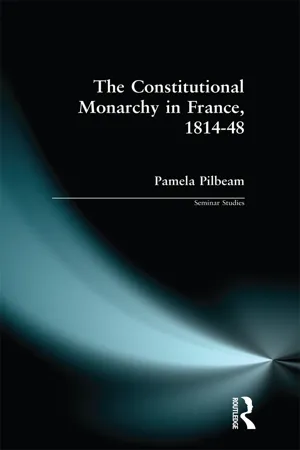
The Constitutional Monarchy in France, 1814-48
About this book
Historians in France assume that the restoration of Monarchy after the defeat of Napoleon was doomed. The first compact recent history of the period in English, this book reveals that although the French experimented with two Monarchies and a Republic (1814 - 48), there was substantial stability. The Institutional framework constructed during the Revolutionary years (1789 - 1814) remained intact, and the ruling elites retained basic control.
Trusted by 375,005 students
Access to over 1.5 million titles for a fair monthly price.
Study more efficiently using our study tools.
Part One: Introduction
1 Restorations 1814-15
The First Restoration, 1814
The Bourbon Monarchy has been condemned by recent historians as 'impossible'. How impossible [72; 169; 182]? The two Bourbon Restorations, the first in April 1814 and the second in July 1815, were not the product of popular monarchist movements in France, but solely the consequence of Napoleon's defeat by Allied troops [118]. There was nothing inevitable about the Quadruple Alliance, which was merely cobbled together by the 1813 Treaty of Chaumont. Collapse could have occurred at any stage, given the degree of mutual suspicion and rivalry among the Allies: Britain, Russia, Prussia and Austria. There was nothing inevitable about their victories, nor the subsequent destruction of the Empire. This is not to say that the Empire was universally popular, but by 1814 22 years of warfare was beginning to seem less than a patriotic adventure, particularly considering the costly defeats in Spain and Russia (1812). However the Imperial regiments showed staunch loyalty to Napoleon, even after the comprehensive defeats of 1814 and 1815.
There was no immediate, obvious alternative to Napoleon. The majority of politically active and ambitious individuals, including republicans and former monarchists, had been employed by the Empire and were unlikely to forego their income lightly. Napoleon had been careful to secure as much support from rival factions as he could. There was no alternative republican consensus. The Jacobin phase of the Republic had been equated with the Terror by the propagandists of the Directory, Consulate and Empire.
The decision to restore the Bourbon dynasty was made by the Allies on pragmatic grounds; alternatives were seriously debated, including the Orleanist branch of the family represented by Louis-Philippe, due d'Orléans. However, Louis-Philippe remained loyal to his Bourbon cousins, with whom he had shared two decades of exile, unlike his father, who during the Revolution had called himself Philippe-Egalité and, as a member of the Convention voted the death of his cousin, the king. The Allies also considered one of the many dispossessed German princes as well as Bernadotte, one of Napoleon's generals, whom Napoleon had made ruler of Sweden and who subsequently had rebelled against him. The Allies finally settled for Louis XVI's two brothers, the comte de Provence, old and childless, to be succeeded by his brother, the comte d'Artois; in the event they seemed the least disruptive, most malleable choice. Their resettlement had the additional benefit that it would also eliminate the huge cost of supporting the émigrés, which represented a substantial charge on Britain. The final structure of the new system of government owed something to British ideology too; as the chief paymaster of the Allied war effort and the only state with a limited monarchy, Britain insisted that Louis XVIII be restored in tandem with a constitutional parliamentary system similar to its own.
The Constitutional Charter of 1814
How similar? The Allied armies entered Paris on 31 March 1814. On 6 April the rump of Napoleon's Senate, called together by Talleyrand, Napoleon's Minister of Foreign Affairs and an adroit turn-coat, made the first independent decision of its life in offering a royal throne to the comte de Provence, if he would rule in conjunction with them. Louis XVIII promptly commissioned nine from the Senate, nine from Napoleon's equally powerless Legislative Body and three of his own appointees to write a constitution [98]. The Constitutional Charter of 4 June 1814 was a stitched-together compromise. This can be demonstrated by the fact that on the day of its publication Louis added a preamble, never discussed by the committee [Doc. 1].
This preamble exemplified the long-treasured aspirations of the émigrés. The constitution, a 'charter', was, it claimed, 'octroyée', given to the people by the grace and favour of a king in the twenty-first year of his reign, and in line with charters granted by his forefathers. The writer claimed that it was 'Divine providence' that had facilitated the king's return. Louis's title also assumed that his elder brother's son, who died in prison, had been king. The main part of the constitution sounded less divine and far more the result of human negotiation [Doc. 2]. Its clauses spelled out a compromise in which the king acquired an hereditary throne under certain conditions. Most important, he was to govern in combination with a parliament, of a kind that no revolutionary constitution had ever envisaged. This consisted of a Chamber of Deputies of 258 elected members and a Chamber of Peers, nominated by the king. The deputies were to be directly elected by all adult male taxpayers of 30 years and more who paid at least 500 francs in direct taxes. During the Restoration (1814-30) there were never more than 100,000 qualified voters out of a total population of around 32.5 millions. With a requirement that candidates pay an annual tax bill of 1,000 francs and be at least 40 years of age, the number of potential candidates was a mere 15,000. The king would nominate peers, either for life, or with hereditary tenure. At first the vast majority were former Napoleonic senators, but subsequent nominations favoured loyal royalists.
Parliament had the right to discuss and vote all legislation. All taxation had to be approved first by the deputies. Article 14 allowed the king to make decrees in an emergency without consulting the assembly. The king would select his own ministers. The constitution said they were 'responsible', but did not specify to whom. At first these ambiguities were not significant. Both kings were careful to choose ministers and propose legislation acceptable to the deputies. Clearly this was not a full-blown parliamentary system and neither assembly had a direct say in ministerial appointments, but it did provide France with a novel constitutional framework (11; 46; 72; 111).
The Institutions of the Empire That Survived in the Monarchy
The constitutional arrangements of 1814 marked a positive attempt to invent a workable combination of royal and parliamentary authority. In other respects the Restoration has been described as the Empire without Napoleon. Revolutionary and Imperial institutions were retained with very few changes. The administrative heart of the system, the Imperial council of state, became the king's council, with the same role of preparing legislation and providing professional training for the huge army of bureaucrats of which they were the apex. Ministers, all directly appointed by the king and individually, not collectively, responsible to him, had their own bureaucratic hierarchies, each appointing relevant officials, at all levels, throughout the kingdom. At the base of the pyramid were the 84 departments, new divisions carved out of the old provinces by the revolutionaries. Each was run by a prefect, appointed by the Minister of the Interior. Every official within this structure, down to the mayor and post-master of the tiniest commune, was appointed from Paris, on the advice of the local prefect. The Restoration retained the Imperial tradition of appointing outsiders as departmental prefects, although all other officials tended to be local men. Prefects acquired an even more important role in 1814 as electoral agents for 'suitable' deputies. The judicial and legal structures of the Revolution also remained in place. During the revolutionary years, a single centralised system of courts and standardised written codes of law had replaced the overlapping, jealously autonomous corporations and systems of law of the ancien régime. This centralised system was accepted in 1814 by all, except a small minority of verdets, ultra-royalists in western France, who dreamt of the restoration of a mythical de-centralised framework of semi-autonomous provinces.
A major issue in 1789 had been the problem of how to finance government. In 1814 the fiscal systems worked out during the Revolution were retained without question. These consisted of uniform direct wealth taxes, principally on land, but also on commercial, industrial or other business property. These were not taxes on income or profits as such; the fancière, or land tax, amounted roughly to a 16 per cent levy, while the mobiliere and the patente, or industrial taxes, were concerned with the property on which business was based. These taxes raised less than one-third of the revenue the vastly expanded bureaucratic machine of government consumed. In 1804, detested old indirect taxes on salt, wine and tobacco were reintroduced to run local government and these droits réunis were maintained in 1814. The Bank of France, founded in 1800, also survived the Restoration, although the costs of war had put an almost insuperable strain on its reserves [196].
As sons of the Enlightenment, the revolutionaries had been committed to developing a lay, state system of education which under Napoleon became centralised. The Restoration retained the shell, but clerical control was gradually inserted into higher education, including the faculties and the more specialised grandes écoles. The Church regained dominance in the secondary schools, the lycées and the collèges, and in the managing body of the secondary system, the University, where in 1822 a senior cleric, Monseigneur de Frayssinous, became Grand Master. Primary schooling had never been taken out of the control of the Church [76].
The clearest indication that the First Restoration witnessed a continuation of the Empire was in personnel. Louis XVIII had spent his exile in the company of around 70,000 émigrés who expected that their sacrifice would be rewarded by jobs. Instead the king retained all those Napoleonic officials who were prepared to serve him. Louis kept 76 per cent of the Imperial civil servants, including 45 of the 87 prefects. Among the new prefects, 29 per cent had been Imperial prefects. In totality, two-thirds of the Restoration prefects had served Napoleon in a similar capacity [166]. Even the new Chamber of Peers, where émigrés may have expected to predominate, bore a close resemblance to the Senate. Only 37 senators lost their seats, 103 senators and marshals of the Empire sat in the new upper house.
The Hundred Days
The king's circumspection was rewarded by a peace settlement that imposed neither an indemnity nor an army of occupation. However, France's borders were reduced to their 1792 position and she lost some colonies. This tolerable compromise was torpedoed by Napoleon's escape from Elba, a carelessly-adjacent choice of exile, just a short boat journey from Marseille. There, Napoleon was soon joined by sections of his old army and officials, apprehensive that the new monarchy would revert to old ways.
Thus ensued a 100-day resurrection of the Empire in which the federations that rallied were often more committed to the memory of the Revolution than Napoleon [35]. The Emperor was careful to revise his Imperial Constitution with Additional Acts, drafted by the doyen of liberals, Benjamin Constant. These mimicked the Restoration's parliamentary arrangements, declaring in their preamble that only the determination of the Allies to fight and destroy the regime had prevented Napoleon from establishing liberal institutions. Preparations were made to elect an assembly of 629 deputies by the 600 most wealthy males in each department.
The Allies had other ideas, convinced that a settled peace in Europe was inconceivable while Napoleon remained in power. His defeat at Waterloo heralded a very different Restoration, which soon began to show signs of 'impossibility'. The peace settlement drawn up in Vienna left all or part of 61 departments occupied initially by 1,200,000 Allied troops (reducing to 150,000) until an indemnity of 700 million francs had been paid. The 250 million francs annual cost of the occupation had to be borne by the occupied departments. France was now reduced to her 1789 borders, losing Savoy and some border fortresses. The Allies even demanded that the art treasures, gathered up by the Imperial armies, particularly in Italy, be returned. The British seized 75 Rubens and sent them back to their point of origin. Napoleon himself was exiled to the remote southern Atlantic island of St Helena.
The White Terror and the Second Restoration
Parts of France remained in virtual civil war for several months after Waterloo, pacified only when the armies of occupation established themselves. Ultra-royalists in southern France, led by the comte d'Artois's eldest son, the due d'Angouleme, did battle with the federations which had sprung up to defend Napoleon, and which subsequently were to be the nucleus of opposition to the Bourbons. A 'White Terror' was unleashed (the term refers to the white flag of the Bourbons), recalling the lawlessness of the early 1790s in which many were murdered, 200 Protestants in the Card alone [67]. Thousands were injured, tortured, jailed or forced to flee. Houses and shops were ransacked and torched. In Marseille on 24 June 1815, the ultras inflicted 50 deaths, 200 were injured and 80 shops and houses fired. The Rhone valley was soon in uproar and the commander of the garrison in Toulon, marshal Brune, was assassinated in Avignon. In Nimes, gangs, led by a labourer, Trestaillons, terrorised the Protestant elite. It was said they took down the women's drawers and beat their bottoms with a cudgel studded with nails in a fleur-de-lis pattern.
In Toulouse the ultra backlash was orchestrated by the verdets, so called because they wore the green cockade of the comte d'Artois. They even murdered the moderate royalist commander of the local national guard, general Ramel, when he tried to merge the guard and the verdets. They had no time for moderate royalism and were suspicious of Louis XVIII. The verdets dreamed of regional autonomy and a separate southern kingdom of 'Occitania', ruled by the unlikely and incompetent Angoulême. The violence recalled not only the conflicts of the 1790s, but the religious tensions of the sixteenth century in areas like the Languedoc where substantial Protestant communities had done well during the Revolution. Royalist local officials were either unwilling or unable to prevent the revenge attacks; Fouche's reputation as an omnisicient chief of police was shaken. Violence was brought to an end in the Var, Bouches-du-Rhone and Gard, three of the most disrupted departments, only by the arrival of the Austrian army of occupation. The White Terror was geographically limited. In Brittany during the Hundred Days, conflict between the federations and the royalist chouans had been restrained and counter-revolutionary reprisals were muted. In the occupied departments further north, the superior strength of the federations and the presence of foreign troops forestalled a violent ultra backlash [63; 167].
The unofficial White Terror was followed by an official purge. Talleyrand and Fouche, both too tainted with an Imperial past, were replaced in September 1815 by Richelieu, an efficient administrator, trailing a noble, landowning, émigré pedigree. A Chamber of Deputies of 402 members was elected in August. It was 90 per cent ultra and dubbed the chambre introuvable (unbelievable) by the embarrassed king. The deputies were bent on revenge for the Hundred Days; one member even demanded the death penalty for anyone who owned a tricolored flag. Emergency legislation gave prefects extra powers to maintain law and order and facilitated the arrest of anyone accused of plotting or publishing seditious literature. Up to 80,000 (one-third of all) administrators were sacked or demoted along with 15,000 army officers. The army was reduced to less than a third of a million men. The Chamber of Peers was purged of 29 members who had supported the Hundred Days. Over 70,000 political arrests were made. Special courts, (cours prévotales), were created to deal with the resulting prisoners, although only about 250 of the 6,000 subsequent convictions were their work. Lay courts imposed comparatively light sentences. Military courts were less forgiving. They ordered the arrest of 54 generals. Some escaped, but 17 were put on trial and some of the consequent death sentences caused a public outcry. The execution of marshal Ney in December 1815 turned him into a martyr for the liberals. While the White Terror may not have made the Restoration 'impossible', it certainly did ensure that a cohort of politically ambitious men were kept permanently alienated and excluded from public life. This was the very situation that Louis XVIII previously had sought to avoid [169].
2 Social Tensions
The Inheritance of the Revolution and Empire: The Ruling Elites
Historians today focus on the political consequences of 1789 [72; 74]. During the years of the constitutional monarchy, observers of all political persuasions were very aware of the divisive social impact of the revolutionary years. In addition, the fashion for statistical reports on poverty of the 1830s, plus endemic social unrest, made people acutely aware of the social ...
Table of contents
- Cover
- Half Title
- Title
- Copyright
- Contents
- An Introduction to the Series
- Note on Referencing System
- Acknowledgements
- Preface
- PART ONE: INTRODUCTION
- PART TWO: ANALYSIS
- PART THREE: ASSESSMENT
- PART FOUR: DOCUMENTS
- Chronology
- Bibliography
- Index
Frequently asked questions
Yes, you can cancel anytime from the Subscription tab in your account settings on the Perlego website. Your subscription will stay active until the end of your current billing period. Learn how to cancel your subscription
No, books cannot be downloaded as external files, such as PDFs, for use outside of Perlego. However, you can download books within the Perlego app for offline reading on mobile or tablet. Learn how to download books offline
Perlego offers two plans: Essential and Complete
- Essential is ideal for learners and professionals who enjoy exploring a wide range of subjects. Access the Essential Library with 800,000+ trusted titles and best-sellers across business, personal growth, and the humanities. Includes unlimited reading time and Standard Read Aloud voice.
- Complete: Perfect for advanced learners and researchers needing full, unrestricted access. Unlock 1.5M+ books across hundreds of subjects, including academic and specialized titles. The Complete Plan also includes advanced features like Premium Read Aloud and Research Assistant.
We are an online textbook subscription service, where you can get access to an entire online library for less than the price of a single book per month. With over 1.5 million books across 990+ topics, we’ve got you covered! Learn about our mission
Look out for the read-aloud symbol on your next book to see if you can listen to it. The read-aloud tool reads text aloud for you, highlighting the text as it is being read. You can pause it, speed it up and slow it down. Learn more about Read Aloud
Yes! You can use the Perlego app on both iOS and Android devices to read anytime, anywhere — even offline. Perfect for commutes or when you’re on the go.
Please note we cannot support devices running on iOS 13 and Android 7 or earlier. Learn more about using the app
Please note we cannot support devices running on iOS 13 and Android 7 or earlier. Learn more about using the app
Yes, you can access The Constitutional Monarchy in France, 1814-48 by Pamela M. Pilbeam in PDF and/or ePUB format, as well as other popular books in History & 19th Century History. We have over 1.5 million books available in our catalogue for you to explore.