- 244 pages
- English
- ePUB (mobile friendly)
- Available on iOS & Android
eBook - ePub
English: An Essential Grammar
About this book
English: An Essential Grammar is written specifically for native speakers, beginning with the basics and going on to deal with phrase, clause and sentence structure, word formation and spelling. This fully revised third edition features new material on:
- the structure of phrases and clauses
- light verbs
- nominal adjectives
- the Operator
- preposition to and infinitival to
- the four thats
- determiners, prepositions, and common errors
With new exercises and answers for all new sections, this Essential Grammar continues to be the ideal reference for anyone who would like to improve their knowledge of English grammar.
Frequently asked questions
Yes, you can cancel anytime from the Subscription tab in your account settings on the Perlego website. Your subscription will stay active until the end of your current billing period. Learn how to cancel your subscription.
At the moment all of our mobile-responsive ePub books are available to download via the app. Most of our PDFs are also available to download and we're working on making the final remaining ones downloadable now. Learn more here.
Perlego offers two plans: Essential and Complete
- Essential is ideal for learners and professionals who enjoy exploring a wide range of subjects. Access the Essential Library with 800,000+ trusted titles and best-sellers across business, personal growth, and the humanities. Includes unlimited reading time and Standard Read Aloud voice.
- Complete: Perfect for advanced learners and researchers needing full, unrestricted access. Unlock 1.4M+ books across hundreds of subjects, including academic and specialized titles. The Complete Plan also includes advanced features like Premium Read Aloud and Research Assistant.
We are an online textbook subscription service, where you can get access to an entire online library for less than the price of a single book per month. With over 1 million books across 1000+ topics, we’ve got you covered! Learn more here.
Look out for the read-aloud symbol on your next book to see if you can listen to it. The read-aloud tool reads text aloud for you, highlighting the text as it is being read. You can pause it, speed it up and slow it down. Learn more here.
Yes! You can use the Perlego app on both iOS or Android devices to read anytime, anywhere — even offline. Perfect for commutes or when you’re on the go.
Please note we cannot support devices running on iOS 13 and Android 7 or earlier. Learn more about using the app.
Yes, you can access English: An Essential Grammar by Gerald Nelson in PDF and/or ePUB format, as well as other popular books in Languages & Linguistics & Languages. We have over one million books available in our catalogue for you to explore.
Information
Chapter 1
Introducing sentence structure
1.1 The constituents of a sentence
Consider the following sentence:
My father retired when he was sixty.
The sentence consists of seven words in a specific order. However, it is not simply a sequence of seven individual words. Instead, certain words ‘go together’ to form meaningful units, as follows:
[My father] [retired] [when he was sixty].
One of these units (retired) consists of just one word, while the others are multi-word combinations. Regardless of their length, however, these are the basic ‘building blocks’ of the sentence, and they are known in grammar as the constituents of the sentence. A constituent is a word or a string of words that behaves grammatically and semantically as a unit.
So our sentence consists of seven words but only three constituents. Each constituent has its own grammatical function: my father, for example, functions as the Subject (1.4) and when he was sixty functions as an Adjunct (1.8). Every constituent has a complete meaning in itself, and for that reason, every constituent (except the verb) can be replaced by a single word:
[My father] [retired] [when he was sixty]. → [He] [retired] [then].
Similarly:
[After the robbery], [the thieves] [drove] [to a safe house]. → [Then], [they] [drove] [there].
[The postman] [left] [the package] [on my doorstep]. → [He] [left] [it] [there].
[Paul] [married] [his girlfriend] [last August]. → [He] [married] [her] [then].
When you begin analysing the structure of a sentence, it is useful to apply this One-word Substitution Test, because it provides a useful initial overview of the sentence constituents.
1.2 The Grammatical Hierarchy
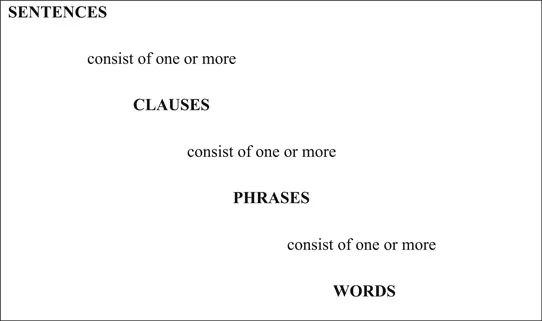
In grammar, there are only three types of constituents: words, phrases, and clauses. We will discuss words in Chapter 2, phrases in Chapter 3, and clauses in Chapter 4.
The Grammatical Hierarchy (Figure 1.1) provides a very useful summary of how these three types of constituents go together to form a sentence.
Words are at the bottom of the Hierarchy, and for many people, this is the most familiar area of grammar. Most people learn about word classes (nouns, verbs, adjectives, etc) early in their school careers, but do not continue their studies to look at how those words combine to form phrases and clauses. This is unfortunate, since the step from word level to phrase level is actually a very short one. For example, dog is a noun, but the dog, the little dog, and the little dog that I love are noun phrases (3.6). Similarly, happy is an adjective, while very happy and very happy to see you are adjective phrases (3.4).

Figure 1.1
The word-based approach to grammar – looking at word classes only – leads to a ver...
Table of contents
- Cover
- Half Title
- Series Page
- Title
- Copyright
- Contents
- List of abbreviations
- Introduction
- Chapter 1 Introducing sentence structure
- Chapter 2 Words and word classes
- Chapter 3 Phrases
- Chapter 4 Clauses and sentences
- Chapter 5 Word formation and spelling
- Answers to exercises
- Appendix: English irregular verbs
- Glossary of terms
- Further reading
- Index