- 270 pages
- English
- ePUB (mobile friendly)
- Available on iOS & Android
eBook - ePub
About this book
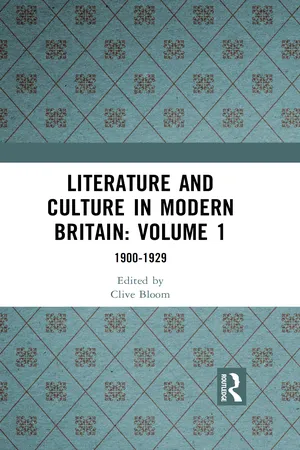
The first in a three-volume sequence, this book covers the period between 1900 and 1929, providing a perceptive and thorough analysis of British literature within its historical, cultural and artistic context. It identifies the crucial, interwoven relationships between literature and the visual arts, modern poetry, popular fiction, journalism, cinema, music and radio. Much factual detail and a literary chronology guide the reader through the text.
Information
CHAPTER ONE
The Poets: Georgians, Imagists and Others
Gary Day
“Drake and Nelson, rural England, fear in a handful of dust”1
As Clive Bloom notes in his introduction, the period between 1900 and 1929 saw a shift from an individualist to a collectivist state apparent in the development of monopoly capitalism, the extension of the franchise and new legislation to deal with poverty and unemployment. One consequence of this change was the growth of new discourses of social regulation which addressed the human subject less as a unique individual than as an object for state concern. The subject was no longer an active agent, as in classical laissez-faire economics, but someone to be regulated and administered according to particular forms of knowledge, specifically the sciences of human engineering, often summarized in the phrase ‘social Darwinism’.2
The subject was now perceived as a citizen, not an individual. The category of the citizen stresses what members of a society have in common, the category of the individual how they differ. The term citizen functions as a norm by which difference becomes deviancy, the term individual, by contrast, allows for and even celebrates difference. With the ascendancy of the term citizen comes a standardized view of the subject expressed in standardized language.
Of course, this transformation was a gradual process and one which still continues. The concept of the individual was not suddenly usurped by that of the citizen, rather they constituted a complex and shifting relationship in which the category of the individual and its attendant structures persisted as a critique within the formations of citizenship and collectivization.
The question this essay addresses is how this relationship manifested itself in the poetry of the period and the part that poetry itself played in that relationship. One immediate point is that modernism, with its emphasis on impersonality, helped to produce the kind of perceptions appropriate to the idea of the citizen, while the more traditionalist verse of the period continued to provide resources and vocabularies appropriate to the idea of the unique individual. However, it is necessary to be cautious about such assertions for Georgian verse could be as modernist as imagist poetry could be traditionalist.
Showing how poetry reflects and shapes society’s perceptions of itself is an important way of understanding how poetry functions in society. But it is also important to remember that poetry is made to function in a quite specific way by the institutions of criticism such as schools, colleges and universities where it is decided what can actually count as poetry and which criteria are to be used for its appreciation. By these and other means criticism plays a small but not insignificant part in producing and maintaining society’s ideological consensus. This process will also be touched on in the course of this essay, and raises the question of whether it is possible to read otherwise and thus free poetry from its normal ideological usage so as to challenge that usage and perhaps generate new readings, offering new perspectives on the present as well as the past.
Before addressing these issues in more detail, however, it is first necessary to give a brief account of poetry prior to 1911 so as to better understand the place of Georgian poetry and the impact of modernism.
POETRY PRIOR TO 1911
The sense of a major cultural shift was expressed in poetry by a number of developments at the turn of the century. The Decadent poets of the 1890s differed from the great Victorian ones in their concern for the elusive nature of experience. Their conception of it was somewhat complex and suggests that the traditional ideological way of authenticating and making sense of experience were no longer adequate. For the Decadent ‘all actual experience ha[d] the habit of seeming vicarious’.3 There was also a concern with being understood, most clearly evident in Dowson’s lament ‘You would have understood me, had you waited’ which points to a problem in intersubjective relations.4 Experience is pursued, not for itself but for the fruits it yields and there is a desire to charge bodily experiences with profundity. Chiefly there is a consciousness of corruption which is both desired and reviled, ‘waters of bitterness, how sweet’. 5 The sense of decadence and corruption is important because it compensates for the absence of meaning in experience by the intensity of experience. Subjectivity is reduced to sensation, which is private and perhaps incommunicable but certainly is the one genuine experience open to the self. Indeed, being oneself becomes a matter of artifice, as Olive Scott remarks of the Decadents:
Make-up, the music hall milieu with its garish lights, costumes, and other forms of ostentation are at once the art of being oneself and the way that, for others, knowledge of a self becomes a series of sensory delights. In this essentially baroque world of fluid roles, identity depends on the particular stimulus one transmits at a given time. 6
But it is not just in their approach to the problems of subjectivity and experience that the Decadents anticipate modernist verse. One of the prime figures in the Decadent movement, Arthur Symons wrote the influential The Symbolist Movement In Literature (1899) which Eliot admitted changed the course of his life.7 Symbolism valued form over content, it was suggestive rather than straightforward and was based on a belief that reality lay beneath the surface of things and could only be apprehended by the symbol. These related ideas were to have a profound influence on modernist verse: the symbol came to be a focus, a way of organizing and making sense of disparate phenomena, but its significance in the work of say Yeats and Eliot could only be known to the educated few. The symbol thus redefined the relationship between the poet and his public, making verse exclusive and ‘élitist.’
Symbolism did not inform Decadent poetry to any great extent but the symbol, with its connotation of privacy and irreducible complexity, was not alien to the Decadent concern with experience. Both Decadence and symbolism represent an ambiguous response to the atrophy of the notion of the individual. On the one hand they are an assertion of the individual in the face of the forces of collectivization but, on the other, they seem to suggest that the individual is an empty category – either sensation or technique, nothing more. Over-refinement and accumulation of adjectives which mark the Decadent style seem a desperate attempt to capture a vanishing essence as indeed does the symbol. The notion of the individual is almost protected by the latter’s obscurity. Just at the moment when history wants to dispense with the individual, symbolism pronounces him or her infinitely rich and complex. Thus art can be seen to be trying to maintain an ideological category just as, in other fields, it begins to lose its effectivity.
Both Decadence and symbolism were to influence modernist verse but, around 1911, the poetry with which most people were familiar was a mixture of the pastoral, the romantic and the patriotic. The poet was a bluff, no nonsense type of figure who wrote decent, comprehensible verse which dealt with matters anyone could understand and, in both form and content, that poetry represented a conservative reaction not just to the morbid sensitivity of the Decadents. Poets like Alfred Noyes, Henry Newbolt and William Watson were typical of the period. Their writing was characterized by approval of imperial adventures and a sentimental view of England as essentially a collection of villages when in fact it was becoming progressively and disturbingly urban. These writers confidendy presumed to speak on behalf of the public in matters of morality and religion. However, their broad generalities, imprecise diction and traditional poetic forms were essentially a nostalgic assertion of Victorian certainties in an age of rapid change. The imperialism of poems such as Henry Newbolt’s ‘Drake’s Dream’ were a confident assertion of the quintessential British voice defying the forces, such as foreign competition and the growth of mass consciousness, that threatened to destroy it. But although this verse gestured to the past it also, paradoxically, belonged to the present and future, for the very public as opposed to the private nature of the poetic voice allied it with movement from an individual to a more collective notion of subjectivity. This did not, however, prevent it from being displaced by Georgian poetry which, while clearly different to imperialist verse in some respects, in others was very similar; both for example showed a preference for the rustic rather than the metropolitan life.
GEORGIAN POETRY
Georgian poetry can be identified most simply as the five volumes of verse which appeared between 1912 and 1922, edited by Edward Marsh and published by Harold Munro at the Poetry Bookshop.8 At first, Georgian poetry was seen as a healthy reaction to the ornate, specious and didactic verse represented by poets like Noyes. In contrast to them both Georgian Poetry I (1911–12) and Georgian Poetry II (1914–15) displayed ‘poetic realism or truth to life’.9 The achievement of the Georgians, according to Stead, was ‘to confine poetry within the limits of what had actually been experienced’.10 James Reeves goes further, praising Georgian poetry for its ‘natural simplicity, emotional warmth, and moral innocence’11 and he goes on to say that ‘The celebration of England, whether at peace or war, became a principal aim of Georgian poetry’.12 By the end of the First World War, however, Georgianism was already under attack, though there were still two more volumes to appear. It seemed out of touch with the modern world and Edith Sitwell in particular was merciless in her derision of poets who only seemed to be able to write about sheep. Even allowing for her modernist bias it is hard not to feel some sympathy for her views, vitriolic though they were, when confronted with the following:
I lingered at a gate and talked
A litde with a lonely lamb
He told me of the great still night
Of starlight
…
William Kerr, ‘Counting Sheep’ (GP V, 1920–22)
The faults of Georgian poetry are well known: sloppy sentimentality, facile rhythm and a concern with the trivial and the commonplace.13 However, to discuss the poetry in this manner is to accept the terms of an aesthetic discourse which trades in value judgements that are by no means as innocent as they seem. For example, is the dismissal of Georgian poetry anything to do with the fact that a number of Georgians, such as Wilford Gibson and James Stephens, had not trod the usual paths of public school and Oxbridge? It is also interesting to note that poets who did, like Robert Graves and Edmund Blunden, rarely have their Georgian past referred to except as something of an embarrassment. In other words, the marginalizing of Georgian poetry is perhaps ideologically motivated. In this context it is worth remembering that Georgian poetry with its gentle celebrations of Enghshness was arguably the first popular poetry of the modern age. The first volume sold 15,000 copies, a phenomenal number for a poetry book, prompting W.H. Davies, one of the contributors, to write to Edward Marsh saying ‘You have performed a wonder, made poetry pay’.14
Critical dismissal of Georgian simplicity in favour of modernist sophistication identifies poetry as a speciahst discourse, the preserve of an intellectual elite. Poetry is thus placed out of the reach of the ‘ordinary person’ but, more than that, the values embedded in the particular poetic discourse of Georgian- ism are neutralized, making it difficult for them to signify with any effectivity either in poetry or even in politics. A mode of expression is thus removed from popular circulation and so are the values belonging to it. In addition, not only is poetry, for so long associated in the popular mind with self-ex- pression, removed from the people, thus leaving them even fewer forms in which to voice their concerns, but it is also, to reinforce the point, redefined as the very antithesis of self-expression first by the modernist mandarins and later by successive critics. By such means does criticism support the hierarchy of class society; crushing poetry’s democratic potential by implicitly suggesting that only those of taste and education can apprecia...
Table of contents
- Cover Page
- Half Title page
- Title Page
- Copyright Page
- Contents
- Series Preface
- List of Contributors
- Chronology
- Introduction
- 1. The Poets: Georgians, Imagists and Others
- 2. The Novel as Art Form
- 3. Popular Fiction and Middle-Brow Taste
- 4. Theatre: Roots of the New
- 5. British Newspapers in the Early Twentieth Century
- 6. John Reith and the Rise of Radio
- 7. British Cinema: From Cottage Industry to Mass Entertainment
- 8. The Visual Arts: Change and Continuity
- 9. The World of Popular Music
- 10. The New Technological Age
- Index
Trusted by 375,005 students
Access to over 1.5 million titles for a fair monthly price.
Study more efficiently using our study tools.
Frequently asked questions
Yes, you can cancel anytime from the Subscription tab in your account settings on the Perlego website. Your subscription will stay active until the end of your current billing period. Learn how to cancel your subscription
No, books cannot be downloaded as external files, such as PDFs, for use outside of Perlego. However, you can download books within the Perlego app for offline reading on mobile or tablet. Learn how to download books offline
Perlego offers two plans: Essential and Complete
- Essential is ideal for learners and professionals who enjoy exploring a wide range of subjects. Access the Essential Library with 800,000+ trusted titles and best-sellers across business, personal growth, and the humanities. Includes unlimited reading time and Standard Read Aloud voice.
- Complete: Perfect for advanced learners and researchers needing full, unrestricted access. Unlock 1.5M+ books across hundreds of subjects, including academic and specialized titles. The Complete Plan also includes advanced features like Premium Read Aloud and Research Assistant.
We are an online textbook subscription service, where you can get access to an entire online library for less than the price of a single book per month. With over 1.5 million books across 990+ topics, we’ve got you covered! Learn about our mission
Look out for the read-aloud symbol on your next book to see if you can listen to it. The read-aloud tool reads text aloud for you, highlighting the text as it is being read. You can pause it, speed it up and slow it down. Learn more about Read Aloud
Yes! You can use the Perlego app on both iOS and Android devices to read anytime, anywhere — even offline. Perfect for commutes or when you’re on the go.
Please note we cannot support devices running on iOS 13 and Android 7 or earlier. Learn more about using the app
Please note we cannot support devices running on iOS 13 and Android 7 or earlier. Learn more about using the app
Yes, you can access Literature and Culture in Modern Britain: Volume 1 by Clive Bloom in PDF and/or ePUB format, as well as other popular books in Literature & Literary Criticism. We have over 1.5 million books available in our catalogue for you to explore.