eBook - ePub
Standards-Based Learning for Students with Disabilities
- 208 pages
- English
- ePUB (mobile friendly)
- Available on iOS & Android
eBook - ePub
Standards-Based Learning for Students with Disabilities
About this book
This book describes in detail how educators can apply curriculum standards, performance standards and opportunity standards to improve education of special learners. It provides practical examples which show you how to develop and implement standards-based IEPs, use curriculum standards and benchmarks to develop long term plans, develop performance tasks for students with disabilities, and develop curriculum units for students with disabilities. This book shows you that students with disabilities can profit from and be involved with the types of standards currently used with other students.
Information
PART I
SEEING THE BIG PICTURE
1
UNDERSTANDING STANDARDS-BASED LEARNING
This book is about standards-based learning for students with disabilities. Rather than being simply a current “buzz word,” the term denotes a specific approach for the learning of all students who have a range of disabilities. As a foundation for what follows, this chapter defines the concept and examines its implications. In accomplishing this goal, the chapter also serves as an organizer for the rest of the book.
UNDERSTANDING THE CONCEPT OF STANDARDS
The term standards is used in three different senses. Curriculum standards (sometimes called content standards) identify what students are to learn in one subject, K-12. Here is a curriculum or content standard: The student will learn money management skills, saving, and spending in a prudent manner. Curriculum standards for students with disabilities are explained in Chapter 6.
Performance standards state the quality of the performance considered satisfactory. Here is an example of a performance standard: The student will develop a weekly budget that meets three criteria: (a) allocates 20 percent of what is earned to savings; (b) shows a reasonable amount allocated to personal needs; and (c) stays within the limits of income. Chapter 10 discusses performance standards.
Opportunity standards identify the opportunities that students need if they are to accomplish the performance standards. Here are some of the opportunities that are needed by students with disabilities: a planned program; individualized instruction; grouping that does not stigmatize them; a responsive curriculum; and adequate time for learning. Chapter 5 explains opportunity standards.
These three types of standards are all included in standards-based learning, which is defined in this manner: standards-based learning is learning whose content is clearly defined, that meets explicit levels of performance, and that requires sufficient opportunities for learning.
Figure 1.1 represents schematically the key aspects of standards-based learning. As the figure indicates, those aspects include the central goal, the foundation elements, the key attributes, and the facilitative components, each of which will be examined below.
THE CENTRAL GOAL
As Figure 1.1 suggests, at the center is standards-based learning for students with disabilities. All the other elements are intended to influence or contribute to this goal, either directly or indirectly. In essence, as the figure suggests, all that matters is results, construed broadly. For students with disabilities, the desired results include development of physical, mental, and emotional abilities. Achieving those results requires an understanding of the students, as explained in Chapter 2.
THE FOUNDATION ELEMENTS
Three elements provide a foundation for standards-based learning.
SCHOOL AND CLASSROOM CULTURE
For standards-based learning to operate effectively, it requires a supportive school environment. The chief aspect of the school and classroom environment is the culture. The term culture has been defined variously. (For a review of the different definitions, see Cunningham & Gresso, 1993.) The following definition has been derived from a review of that source and other literature: The values of a group of people who share a common place and purpose. These shared values result in norms, or similar ways of behaving, and are manifested in celebrations, ceremonies, customs, and other events.
FIGURE 1.1. STANDARDS-BASED LEARNING
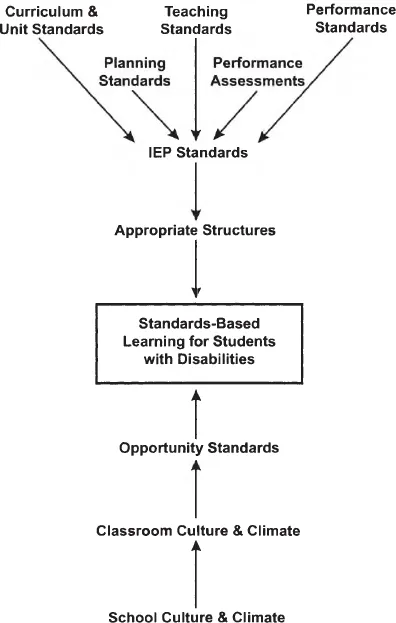
To understand the importance of culture, consider these examples. The faculty of School A share a belief that students with disabilities are problem students who need to be segregated from the rest of the student population. The faculty of School B, on the other hand, believe that students with disabilities are unique individuals who can learn best in the regular classroom. Evidently, those differing cultures will result in very different environments and procedures. Chapter 3 provides a more detailed analysis of cultural standards that support learning for all students with disabilities.
In an attempt to crystallize their school’s culture, several faculties have developed written statements of their shared beliefs. An example of one such statement is shown in Figure 1.2. Faculties should keep in mind that the deeply held beliefs matter much more than such written statements.
FIGURE 1.2. BELIEFS OFTHE FACULTY OF WASHINGTON MIDDLE SCHOOL
We Believe…
1. That learning is the goal for everyone: students, administrators, teachers, and parents. All that matters is results.
2. That all students can achieve, given the needed supports.
3. That all students have both talents and limitations.
4. That all students are individuals who are more than the labels we give them.
5. That all students learn most when they learn to accept themselves and each other. For most students that acceptance is best developed in inclusive environments.
6. That all parents should be actively involved in the education of their sons and daughters. This involvement is especially crucial for students with disabilities.
7. That the best results for all students are achieved through teamwork and collaboration. Such cooperation and teamwork are critically important for students with disabilities.
SCHOOL AND CLASSROOM CLIMATE
Climate is the emotional “weather” of the school and the classroom. A review of the literature suggests that the following attributes would best facilitate standards-based learning. (See, for example, McGregor & Vogelsberg, 1998.)
♦ Safe and secure
Students feel safe in the school, not anxious about their security. Students with disabilities believe that they will not be harmed.
♦ Clean and inviting
The physical environment is clean and well maintained. The school looks inviting, and teachers and administrators make the students feel welcome. Students with disabilities feel as if they belong.
♦ Warm and friendly
Students do not feel isolated and alone. Visitors are greeted in a friendly manner. Parents are welcomed. Students with disabilities are included, not excluded.
♦ Challenging and supportive
High expectations are held for administrators, teachers, and students. Students with disabilities are given the support they need to achieve those expectations.
A further discussion of the climate desired in a school that functions as a community of learners can be found in Chapter 4.
OPPORTUNITY STANDARDS
As noted above, opportunity standards are statements of the opportunities and supports that students need if they are to achieve what is expected of them. For example, it is manifestly unfair if students are expected to achieve at a satisfactory level if they do not have qualified teachers.
Several opportunity standards are especially important for students with disabilities. First, they need an opportunity to learn in inclusive classrooms where they are valued for what they are, not stigmatized by a label. They need teachers who accept them and know how to bring out the best in the...
Table of contents
- Cover
- Title Page
- Copyright Page
- MEET THE AUTHORS
- TABLE OF CONTENTS
- ACKNOWLEDGMENTS
- PREFACE
- PART I: SEEING THE BIG PICTURE
- 2 UNDERSTANDING STUDENTS WITH DISABILITIES
- PART II: THE FOUNDATION ELEMENTS
- 4 DEVELOPING A STANDARDS-BASED LEARNING COMMUNITY
- 5 ASSESSING OPPORTUNITY STANDARDS AND ACCEPTING THE CONSTRAINTS
- PART III: THE KEY FACTORS
- 7 USING CURRICULUM STANDARDS AND BENCHMARKS TO DEVELOP LONG-TERM PLANS
- 8 DEVELOPING PERFORMANCE TASKS FOR STUDENTS WITH DISABILITIES
- 9 DEVELOPING CURRICULUM UNITS FOR STUDENTS WITH DISABILITIES
- 10 MAKING PERFORMANCE ASSESSMENTS THAT MEET THE STANDARDS
- 11 USING STANDARDS TO IMPROVE TEACHING AND LEARNING
- PART IV: THE FACILITATING COMPONENTS
- 13 USING LEARNING STRUCTURES THAT MEET THE STANDARDS
Trusted by 375,005 students
Access to over 1.5 million titles for a fair monthly price.
Study more efficiently using our study tools.
Frequently asked questions
Yes, you can cancel anytime from the Subscription tab in your account settings on the Perlego website. Your subscription will stay active until the end of your current billing period. Learn how to cancel your subscription
No, books cannot be downloaded as external files, such as PDFs, for use outside of Perlego. However, you can download books within the Perlego app for offline reading on mobile or tablet. Learn how to download books offline
We are an online textbook subscription service, where you can get access to an entire online library for less than the price of a single book per month. With over 1.5 million books across 990+ topics, we’ve got you covered! Learn about our mission
Look out for the read-aloud symbol on your next book to see if you can listen to it. The read-aloud tool reads text aloud for you, highlighting the text as it is being read. You can pause it, speed it up and slow it down. Learn more about Read Aloud
Yes! You can use the Perlego app on both iOS and Android devices to read anytime, anywhere — even offline. Perfect for commutes or when you’re on the go.
Please note we cannot support devices running on iOS 13 and Android 7 or earlier. Learn more about using the app
Please note we cannot support devices running on iOS 13 and Android 7 or earlier. Learn more about using the app
Yes, you can access Standards-Based Learning for Students with Disabilities by Marsha Craft- Tripp,Allan Glatthorn in PDF and/or ePUB format, as well as other popular books in Education & Education General. We have over 1.5 million books available in our catalogue for you to explore.