The entrance of women into managerial positions in significant numbers brings work and family issues to center stage, shifting the spotlight from issues of entry and equality of access to the consideration of the work-family conflicts and the difficulties posed on female managers. Looking at new approaches to enhance the work-family interface individually and in the firm, Work and Family: An International Research Perspective:
*provides an overview on the antecedents of work-family conflict and the major consequences of work-family conflict, for well-being, productivity, and the strength of the relationship with the firm;
*discusses the migrant's work and family experiences in terms of the demands, opportunities, and constraints they face and the role of work-family culture in reconciling the demands of work and family in organizations;
*presents descriptive data concerning the linkages between work-family pressure and several known correlates and the differences in reported levels of each of these variables;
*explores the work-life balance challenges and opportunities created by global assignments;
*examines the work-family interface of the Western model and urban sub-saharan Africa;
*emphasizes the importance of organizational change to the dynamics of work-family policies; and
*highlights the progress in moving the field toward an open-systems perspective.
Written by well-known contributors, this book offers international research in order to test the models mostly developed in the United States. In addition, it develops new models to capture the complexity and diversity of work-family experiences around the globe and explores cross-cultural topics.
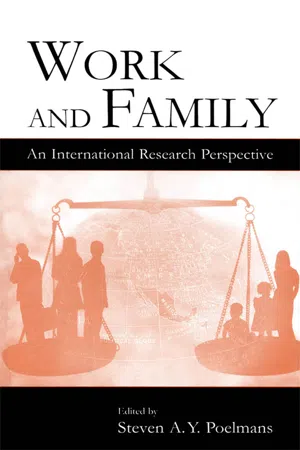
- 524 pages
- English
- ePUB (mobile friendly)
- Available on iOS & Android
eBook - ePub
About this book
Information
Publisher
Psychology PressYear
2005Print ISBN
9780805848823
9780805848816
Edition
1eBook ISBN
9781135614966
II
Organizational-International Perspective
4
Work-Family Culture in Organizations: Theoretical and Empirical Approaches
Ulla Kinnunen and Saija Mauno
University of jyväskylä, Finland
Sabine Geurts and Josje Dikkers
Rodboud University Nijmegen, The Netherlands
ABSTRACT
In this chapter, we shall discuss the role of work-family culture reconciling the demands of work and family in organizations. We have three primary aims: The first is theoretical: to theorize work-family culture from the perspective of organizational culture; the second is empirical: to present a review of the existing literature on work-family culture and provide directions for future research; and the third is practical: to make suggestions for creating family-friendly organizations.
INTRODUCTION
It is widely assumed that work-family policies (e.g., child care, reduced working hours, job sharing) can enhance the positive reconciliation of employment and family life. On the one hand, such policies enhance opportunities for women in working life and are seen as a practical response to the increasing proportion of women in the work force. On the other hand, men are placing increasing value on their family roles and showing greater willingness to modify their work in the interests of their families, particularly among the younger generation. Work-family policies, therefore, enhance opportunities for men to become more involved in family life.
However, although organizations may have formal work-family policies in place, employees may be reluctant to take advantage of them. It seems that these policies are generally perceived as enabling those with family commitments to work at the margins, seldom challenging the traditional patterns of work as the norm and ideal (Lewis, 2001). According to Lewis (1997, 2001), the traditional male model of work, one which constructs the ideal worker as one who works continuously and full-time and does not allow family to interfere with work, continues to prevail the norm. Because the male model of work is deeply embedded in most organizational cultures, we need to move beyond the formulation of policies to organizational culture, in seeking an answer to this basic problem of the lack of use of work-family initiatives (Blair-Loy & Wharton, 2002; Judiesch & Lyness, 1999; Lewis, 1997, 2001).
In addition to this theoretical aim—understanding work-family culture from the perspective of organizational culture—we have also an empirical aim, that is, to present a review of the findings of the empirical studies in the field. In this review, we focus on the following issues: Does the prevailing work-family culture truly contribute to the utilization of work-family arrangements, as has been suggested? What do we know about the outcomes of work-family cultures for employees and the organizations? Finally, we try to put the theory as well as the empirical findings into a practical context and give some suggestions on how family-friendly organizations might be created.
THEORETICAL FRAMEWORK: WORK-FAMILY CULTURE IN ORGANIZATIONS
General Perspectives on Organizational Culture Theories
Organizational culture is a very complex multilevel dynamic phenomenon and for this reason it is difficult to provide any universal definition for the concept (see Martin, 2002, for a review of different definitions). Consequently, it is not possible within the scope of this article to provide a comprehensive overview of organizational culture; rather our intention is to introduce some of the basic and commonly agreed characteristics of organizational culture.
Despite the fact that different organizational culture theories emphasize different constructs and processes (e.g., basic assumptions, practices, or values), some general agreement exists on the characteristics of organizational culture. For example, the overwhelming majority of scholars (see e.g., Isaac & Pitt, 2001; Lundberg, 2001; Martin, 2002; Sackmann, 2001) agree that organizational culture is a socially learned and transmitted group-level phenomenon, comprising many different visible or conscious, and invisible or subconscious, “deep” cognitive, behavioral and emotional aspects. These aspects are responsible for the rules governing organizational behavior and for the particular characteristics of an organization or a unit/group within that organization.
There is also some agreement on how organizational culture manifests itself in organizations. In our view, this can be seen to occur at two different levels, either as phenomena at the abstract (ideal) level or as phenomena at the concrete (material) level (see also Martin, 2002). At the more abstract level, are those phenomena that cannot easily be detected or known, values in particular, but this category also includes ideologies, beliefs, meanings, and discourses that the employees of a particular organization or work unit share. However, even though many scholars agree on these cultural manifestations, they disagree on the extent to which they are open to examination. For example, regarding values, Hofstede (2001) considers these to be invisible cultural phenomena that are so abstract and “deep” that examining them for organizational differences is extremely difficult. Other researchers perceive values as the most important cultural manifestation and one that can be examined both inside and between organizations, e.g., via surveys (e.g., Cameron & Quinn, 1999; Denison, 2001). At the more concrete or material level, in turn, are those issues that are easier to see, “feel,” and research, for example, physical arrangements, dress codes, everyday practices in organizations, symbols, and rituals (e.g., Schein, 1985, 1990, 1999). According to Hofstede (2001), therefore, organizational culture within an organization manifests itself most visibly via organizational practices, encompassing such everyday actions as how things get done, how people in the organization are expected to behave, think, and feel as well as symbols and rituals (see also Sackmann, 2001).
As stated above, researchers seem to agree—at least to some degree—on the most typical characteristics of organizational culture. However, they do not agree on the epistemological or methodological issues relating to organizational culture. Consequently, organizational culture is usually approached from either an interpretative or functionalistic perspective (Davey & Symon, 2001; Martin, 2002; Sackmann, 2001). Adopting the former approach means that organizational culture should be defined and studied as a unique construct, specific to a particular organization (or within an organization). On this definition, the interpretative, inductive research paradigm using qualitative research methods is regarded as the most appropriate in organizational culture research (see Czarniawska-Joerges, 1992; Sackmann, 2001; Schein, 1990, 1999).
The latter, functional perspective, in turn, aims at revealing the role of organizational culture in the various functions of an organization. This type of research is typically concerned with the relationships among organizational culture and productivity, organizational changes, or employees’ well-being (e.g., Denison, 2001; Kotter & Heskett, 1992; Kristoff, 1996; O’Reilly, Chatman, & Caldwell, 1991). Hence, functional researchers are often interested in examining “cause-effect” links between culture and various outcomes, for which the deductive research paradigm using quantitative methods is adopted (e.g., Cameron & Quinn, 1999).
However, many researchers have recently emphasized the need for methodological triangulation in exploring organizational culture (Davey & Symon, 2001; Martin, 2002; Sackmann, 2001), suggesting, among other things, that both quantitative and qualitative research methods should be applied in a single study. Unfortunately, this kind of triangulation in studying organizational culture remains rare.
Organizational Culture Theories in the Context of the Work-Family Interface
Recently, some organizational culture theories—or at least some of their ideas—have been adopted in the context of the work-family interface. Of these, we shall briefly discuss the perceived organizational support (POS) theory, the border theory by Sue Campbell Clark and, finally, Susan Lewis’ ideas about how to utilize Schein’s theory in this context.
Perceived Supportiveness and Work-Family Culture. From the organizational viewpoint, one particularly important concept has been supportiveness, which generally refers to the extent that an environment is family-supportive. According to Thomas and Ganster (1995), a family-supportive work environment is composed of two major components: family-supportive policies and family-supportive supervisors. Both components exemplify organizational efforts to support employee needs to balance work and family responsibilities. The group of supportive persons in the organization has been broadened to include colleagues as well as managers and supervisors (e.g., Haas, Allard, & Hwang, 2002; Dikkers, den Dulk, Geurts, & Peper, 2004; Secret, 2000).
More recently, a supportive work-family culture has been defined as the shared assumptions, beliefs, and values regarding the extent to which, for women and for men, an organization supports and values the integration of work and family lives (Thompson, Beauvais, & Lyness, 1999). According to Thompson et al. (1999), this definition is consistent with both Schein’s (1985) and Denison’s (1996) conceptualizations of organizational culture as “the deep structure of organizations, which is rooted in values, beliefs, and assumptions held by organizational members” (Denison, 1996, p. 264). Managerial support and sensitivity to employees’ family responsibilities form one component of the operationalization of this definition.
No matter what supportive structures and practices an organization has in place, ultimately an organization’s supportiveness in work-family issues rests upon employees’ perceptions. According to the perceived organizational support (POS) theory, support-iveness is defined as employees’ global beliefs concerning the extent to which the organization values their contributions and cares for their well-being (see Behson, 2002; Eisenberger, Huntington, Hutchison, & Sowa, 1986). Perceived organizational support describes employees’ attitudinal responses to the organization as a whole, as distinct from the attitudinal response that an employee may form regarding his or her immediate supervisor. Recently, it has been suggested that perceived organizational support (POS) should also include the organization’s supportiveness toward the demands of its employees’ families (see Allen, 2001); and these employee perceptions are referred t...
Table of contents
- Cover Page
- Series In Applied Psychology
- Title Page
- Copyright Page
- Series Foreword
- Foreword: Canaries in the Mine: Reflections on Women in Management and Work and Family Research
- Editorial Introduction
- I: Individual-International Perspective
- II: Organizational-International Perspective
- III: Cross-Cultural Perspective
- IV: Case Studies
- V: Conclusions and Recommendations for Future Research
- Epilogue: Globalization and the Integration of Work with Personal Life
Trusted by 375,005 students
Access to over 1.5 million titles for a fair monthly price.
Study more efficiently using our study tools.
Frequently asked questions
Yes, you can cancel anytime from the Subscription tab in your account settings on the Perlego website. Your subscription will stay active until the end of your current billing period. Learn how to cancel your subscription
No, books cannot be downloaded as external files, such as PDFs, for use outside of Perlego. However, you can download books within the Perlego app for offline reading on mobile or tablet. Learn how to download books offline
Perlego offers two plans: Essential and Complete
- Essential is ideal for learners and professionals who enjoy exploring a wide range of subjects. Access the Essential Library with 800,000+ trusted titles and best-sellers across business, personal growth, and the humanities. Includes unlimited reading time and Standard Read Aloud voice.
- Complete: Perfect for advanced learners and researchers needing full, unrestricted access. Unlock 1.5M+ books across hundreds of subjects, including academic and specialized titles. The Complete Plan also includes advanced features like Premium Read Aloud and Research Assistant.
We are an online textbook subscription service, where you can get access to an entire online library for less than the price of a single book per month. With over 1.5 million books across 990+ topics, we’ve got you covered! Learn about our mission
Look out for the read-aloud symbol on your next book to see if you can listen to it. The read-aloud tool reads text aloud for you, highlighting the text as it is being read. You can pause it, speed it up and slow it down. Learn more about Read Aloud
Yes! You can use the Perlego app on both iOS and Android devices to read anytime, anywhere — even offline. Perfect for commutes or when you’re on the go.
Please note we cannot support devices running on iOS 13 and Android 7 or earlier. Learn more about using the app
Please note we cannot support devices running on iOS 13 and Android 7 or earlier. Learn more about using the app
Yes, you can access Work and Family by Steven A.Y. Poelmans in PDF and/or ePUB format, as well as other popular books in Business & International Business. We have over 1.5 million books available in our catalogue for you to explore.