![]()
Chapter 1
The Creative Cycle
From Page to Screen
In the beginning was the creative Idea, and the Idea was an interesting one. At least that’s what we thought. So we thought about it some more, did some quick sketches in our sketchbook and slowly began seeing the potential of it. We wrote it down, highlighting in point form the good bits. We even Googled it—hoping that nobody else thought about our same exact Idea already. And behold! No one has claimed it. We then wrote a few paragraphs, fleshed out the Idea from an amorphous concept to something a little more substantial. We did some research, some preliminary concept art and decided that the Idea had a definite future and was yearning to be born and be shared amongst the people of the world (or not, but that’s a personal choice). A long period of dedication, hard work, sweat and personal sacrifices—along with guzzling vast amounts of caffeine—ensued. It enveloped our every waking hour in order to bring the Idea into a state of Reality. And finally one fine morning, the Idea did become a Reality and went forth amongst the other creative Ideas that became Realities. And all was good.
That was the Creative Cycle (yes, capitalized) in a very loose nutshell. For the most part, in the professional world of CG animation—be it for feature films, broadcast or video games—modelers, riggers and animators do not always have the opportunity to be included in the creative process at its conceptual stages. Usually by the time they get involved, the production process is already in full-throttle and they are using their particular areas of expertise to move the project along. Being involved in the conceptual stages of a production can be an extremely rewarding experience and allows the flexing of the creative muscles. At this stage, nothing is impossible and like the old cliché goes—the imagination is the limit.
In the next few pages we will discuss the typical process of bringing the Idea from a concept that exists in our heads to a “tangible” creative expression. I placed tangible in quotes since for the most part, the art that we create in the CG animation industry is audio-visual, and not tangible in a physical sense. But then again, at the rate technology is moving, who knows what the morrow will bring.
Although this book, by its nature, will deal mainly with the rigging aspects within a game development cycle, we will cover some of the other aspects of production that typically come before and after the rigging component. In the case of Tin, there is also a cinematic component planned that acts as the introduction of the game, and which follows a traditional production cycle similar to those found in films and broadcast productions
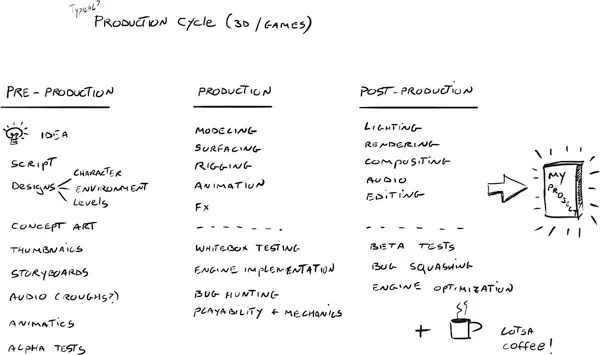
Generally, the creative cycle of a typical creative production consists of three main sections. First, we have the pre-production phase, which is the solid foundation base of the Idea and where everything is built upon. Next, we have the actual production phase, where everything that went into the Idea gets built, painted, engineered, coded, moved and lit. Finally, the post-production phase is where all of the various components come together, get spliced, buffed, tested, edited and have the slick factor™ applied to them. The Idea is then finally ready for reality prime time (see figure 1.1).
NOTE: To clarify—when video games will be discussed from this point on, it will refer to the general narrative-based games, where characters (organic, alien, or mechanical and even vehicular at times) are the main protagonists and follow some kind of story arc. Game types such as card games, luck games, match-3 games, and other types of games that depend on mechanics such as simple point or score collections, random placement, or that are purely representations of game pieces (i.e. cards, alphanumerical, tokens, etc.) won’t necessarily fit within the guidelines we will discuss in the book. This doesn’t mean that there are not useful practices and techniques present in these pages that can be applied to it. On the contrary, properly organizing your ideas and processes will always help in achieving your goal. Rather, the main game style discussed will be of a player navigating a character through a game level, exploring and interacting with the game world.
Figure 1.1 Hand drawn diagram of the production cycle
Where Do Ideas Come From?
Before we start discussing the details of the pre-production phase and all that it entails, let us go back to the very beginning and try to figure out the answer to the question: “So where do good Ideas come from?”
Unfortunately, there is no magical idea place where you can send your mind to and shop around for Ideas—at least not that I know about. Frankly, I don’t think anyone really knows where and how those ideas generate, and asking writers and other creative types about it more often than not will result in an annoyed response.
Now, since we are creative individuals, we are going to tackle this inquiry head-on and try to come up with some kind of solution to this rhetorical question. Hint: there are no wrong answers.
Let’s start with the typical run-of-the-mill places where good creative Ideas might be hiding. Here is a very short and definitely non-comprehensive list I compiled which I’d like to share with you.
- Your personal life experiences—Your unique perspective on life. Look back on some of the events and experiences that shaped your life and see if your fears, your joys or just the way you look at the world around you can trigger the creative process. Sometimes being in the right place at the right time can trigger that “Aha!” moment and get the creative wheels turning.
- Literature—A common tactic is finding inspiration in the endless twists and plots found in the written words of literature. The archetypal stories passed on from generation to generation, throughout the ages and cultures. What you might find interesting is that at the end, there are only a handful of narratives that get recycled time and again. Or, according to Joseph Campbell, there is only one main narrative which falls under The Hero’s Journey (or the Monomyth). Sometimes all you need is a paragraph or a description of a character or event in an existing piece of literature to trigger a brave new world in your mind.
- Music—There is something about listening to certain songs or musical compositions that can take your mind on a trip along an aural landscape. Music can affect emotions on a primal level. Sometimes you just have to go with the flow (pun intended) and see what creative doors open with the music.
- Popular media—We are surrounded by the media, especially now in the Information Age. It is almost impossible to escape the constant bombardment of visuals and sounds that surround us, especially in metropolitan urban settings. On the one hand, we are more than ever connected to our surroundings, and are offered a continuous stream of inputs to stimulate our minds. Yet on the other hand, it could limit the creative ability to truly expand and pursue our own creativity. A lot of things end up being derivative of existing media that is out there. Too much media can be detrimental to your creative and imaginative health.
- Putting your body on auto-pilot—A great example for this is to go on long hikes in nature, if possible. I found that once the body gets into the rhythm of walking, it takes over and effectively frees the mind to soar. It’s a great way to open up your creative senses. As a bonus, you get to get out, breathe some fresh air and not stare at a screen for hours on end.
- Travel—Relating to the point above, if you have the chance and opportunity to travel, be it within your own country, or somewhere in the world, do it! Experiencing new places, cultures, traditions, sights, sounds and smells personally is one of the best ways to expand your creative senses. And one of the best ways I found to do so was to get off the beaten track and talk to the locals, hear the stories they have to tell and experience their country or locale from their perspective. And as always, remember that common sense is your best guide.
- Focused observation—This point might be the opposite of the previous two in the sense that it means focusing on one very particular object (or situation, condition, setting, etc.) and asking yourself “what if…?”. An example might be, say, if you’re doodling on your sketchbook and you look at your pencil and ask yourself “What if I could use this pencil to draw a door into another part of the city?” It’s an absolutely ridiculous notion, but for one second there—as you were thinking that thought—a myriad of possibilities appeared in your mind and opened up endless creative options.
As you can see, a lot of the points in this list are very subjective and necessitate an active use of your senses to get the gears in your mind to start rolling and hopefully generate the elusive Idea.
Yet, what if none of this works? We all have at some point in our lives hit that dreaded creative block, that blank page/canvas/wall where nothing we did got us through and our Idea-generating tools remained very still and silent. How do you get them to start turning again?
Here’s a trick I learned when I was in art school years ago during a first-year course in 3D design—back when 3D meant building things with your hands out of tangible material, not virtual pixels and polygons. We had a group project that required us to create a sculpture/installation that told some kind of narrative, made out of found objects. The clincher was that the narrative had to be randomly generated, without pre-conceived structure from the group members, yet finalized into a cohesive story and put together as a physical structure.
The whole purpose of this trick was to get the creative gears in our minds rolling, and now I shall share it with you. For this, you will need a pen or pencil, paper to write on and the most important item: a dictionary. Now—a very important detail for this to work—the dictionary must be the one that comes in book form, made out of honest-to-goodness tree pulp which you can handle physically and feel the pages. Not—and I repeat—not a dictionary app in your mobile or web-connected device.
Here’s what you do: the goal is to pick a handful or random words from the dictionary and write them down. See if there is some kind of connection between them and if they generate some kind of narrative or visual in your mind. For example, here are some words that were randomly picked from the dictionary—as in flip to a random page, put my finger on the page and write down the word underneath it:
- Dream, Medication, Hebetic, Dungaree, Prusik, Glue, Rigor.
At first look, a random bunch of words. On a closer look, though, we can see that by combining some of those words together, we can start making connections between them and create a rudimentary narrative.
Take, for example, the words hebetic (which means youth, youthful, occurring at puberty) and dungaree. These two words already can define the type of character we can start developing, such as a young person wearing work clothes. Male or female, that is something you can decide, but this description already gives you a starting point. Maybe our character is a young woman, who works in a job that requires dungarees—say, a mechanic. Great, we have a protagonist to get us started.
Next, we will look at the word rigor. It has multiple meanings including unyielding, tremors caused by a cold chill, and a situation making life difficult. Let’s use the “making life difficult” meaning, because we all like drama and tie it in with our protagonist. See? The gears in your mind already started turning! An image or situation is already taking place in your mind’s eye, waiting to be elaborated upon.
Sometimes, the words you randomly pick will not make sense at all, or fit with the rest of what you have. Worry not, that is completely fine. Another trick we will use to get around this is word association. Let us analyze the word Prusik. Not the most common word in the lexicon. A Prusik is a type of knot that loops around a main rope and tightens as weight is placed on it. It is mainly used in rock climbing, mountaineering, caving and other activities that require ropes.
Using word association, we can take the word Prusik (which was allegedly named after its inventor, an Austrian mountaineer by the name of Karl Prusik) and follow some logical connections (at least to me).
- Prusik → mountain → avalanche → hidden cave
Using the same word-association technique, we can apply it to the words medication and glue:
- Medication → illness → viral → pandemic
- Glue → broken → fix
So far, looking at what we have, we can start telling this story:
In a not-so-distant future, where the rigors of life took their toll on the last of the human colonies who survived the pandemic apocalypse, our protagonist—a young female apprentice mechanic who is gifted with the ability to fix old, broken down machinery—is beset by a prophetic dream revealed to her as she leaves the innocence of childhood behind and enters the world of adulthood. In it, the salvation of humanity lies in finding an alien artifact long buried in a cave that was exposed by an avalanche.
There you have it—the making for a story. As the Fates would have it, these random words chosen for this exercise—through cosmic confluence (or some metaphysical happening that is best analyzed while sitting in a solitary chateau, full moon lighting the landscape and the howling of wolves heard in the distance)—created a kind of parallel story to Tin. I wonder what I was channeling. Stranger things have been known to happen….
Anyway, I digress. Getting back to our point, for those few minutes that you were reading the above story synopsis, an image formed in your mind and created a living world in your imagination. The gears started spinning, and the dreaded creative block was lifted, opening up countless possibilities. Now that this initial narrative is in place, you can run ahead with it and mold the story further into new directions and experiment with them.
So now there are no more excuses for “I don’t have any ideas!” Get those creative gears spinning and start generating Ideas. And like most things in life, the more you practice and hone those skills, the easier and better they will get with time. You can apply this method to any type of creative endeavor, be it a concept for an illustration, a written story, a short film, a video game concept or any other creative undertaking.
The Production Cycle
As...