eBook - ePub
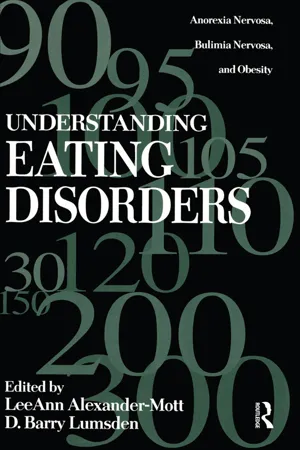
Understanding Eating Disorders
Anorexia Nervosa, Bulimia Nervosa And Obesity
- 302 pages
- English
- ePUB (mobile friendly)
- Available on iOS & Android
eBook - ePub
Understanding Eating Disorders
Anorexia Nervosa, Bulimia Nervosa And Obesity
About this book
First published in 1994. As the incidence of eating disorders such as anorexia nervosa, bulimia nervosa and obesity sometimes caused by compulsive eating has risen, so has research and literature in the field. Presenting current knowledge of these eating disorders - the most common types found in adolescents and adults - this book addresses issues relevant to all.; Examining the pertinent history, aetiology, psychotherapy, and sociology, the contributors define these eating disorders and discuss issues of recovery and methods of treatment.; They also consider the problem as it exists in both male and females in this multicultural society. The resulting volume is divided into four parts: the first gives an overview in general, and the next three focus individually on anorexia nervosa, bulimia nervosa, and obesity respectively.
Information
Publisher
Taylor & FrancisYear
2019Print ISBN
9781560322955
9781560322948
Edition
1eBook ISBN
9781317822677
Part One
General Issues
The chapters in part one consider issues related generally to eating disorders. “The Eating Disorders: A Historical Perspective,” the chapter on the history of eating disorders, considers anorexia nervosa, bulimia nervosa, and obesity. The remaining chapters focus on the more commonly paired anorexia nervosa and bulimia nervosa. These chapters, “Critical Issues in the Developmental Psychopathology of Eating Disorders,” “Parenting and Family Factors in Eating Problems,” and “Sexual Abuse and the Eating Disorders” focus on critical issues in the development of anorexia nervosa and bulimia nervosa.
Chapter 1
Eating Disorders: A Historical Perspective
Anorexia Nervosa
The word anorexia, derived from the Greek, means lack of appetite or avoidance and loathing of food. However, as used clinically in the eating disorders literature, this term is partially a misnomer. For a patient with anorexia nervosa, global appetite is not diminished; rather, it is modified, distorted, and initially, forcefully controlled. It is not until the advanced stage of the clinical disorder that the appetite may be significantly diminished. Hungry or not, the patients starve themselves to a point where the illness can progress to fatality.
Anorexia nervosa is a disorder that most commonly affects females in their teenage and young adult years. On some college campuses (Leichner & Gertler, 1988; Yu, 1986), it is estimated that as many as 20% of the young women demonstrate anorexic behaviors. Although the clinical occurrence of the illness is uncommon before age 10 and after age 30, anorexia nervosa may occur throughout the life cycle and affects males also (Anderson & Mickalide, 1983; Leichner & Gertler, 1988; Sibley & Blinder, 1988). Preadolescent occurrence of anorexia nervosa may begin as young as age 6; it is usually associated with childhood depression, anxiety, or trauma and involves a relatively higher proportion of boys (female to male ratio is 6 to 1). Male predominance is characteristic of atypical cases of anorexia nervosa occurring in the geriatric age group (Morley & Castel, 1983). Overall, women are afflicted by anorexia nervosa more frequently than men (Anderson & Mickalide, 1983; Gislason, 1988; Goodman, Blinder, Chaitin, & Hagman, 1988; Jones, Fox, & Babigian, 1980; Morley & Castel, 1983), with the ratio as high as 20 to 1. In past reports, the mortality rates were as high as 19% (Halmi, Broadland, & Rigas, 1975; Hsu, 1980). More commonly, the mortality rate is 5% and possibly much lower in the past decade (1980 to 1990) because of earlier recognition of the illness and improved comprehensive therapeutic approaches with advanced technical and medical support. Prognosis of treated anorexia nervosa patients 4 years after onset of illness are as follows (APA Practice Guideline for Eating Disorders, 1993): 44% had a good outcome (weight restored to within 15% of recommended weight for height and regular menstruation established); 24% had a poor outcome (weight never approached 15% under recommended weight for height and menstruation was absent or at best sporadic); 28% had an intermediate outcome (between that of the good and poor group); and fewer than 5% had died.
Prehistory
As early as the 9th century, a Persian boy, the son of the reigning Khalifah of the Islamic empire, developed rapid weight loss after he refused to eat or drink. He was diagnosed with a secondary condition of somatic complications. With a behavioral approach emphasizing rewards for eating, the court physician was able to help the boy to gradually restore his weight and health (Hajal, 1982; Sibley & Blinder, 1988).
The first recorded case of anorexia nervosa in a historical text was found in 895 A.D. (Habermas, 1986; Yates, 1989). Friderada, a serf, reportedly would first gorge and “eat(s) like a cow,” then she would totally restrict food intake. However, even during fasting, some saw her eat in secrecy, and in fact, she often did so at night. Friderada’s personality traits parallelled those found clinically in anorexia nervosa: an apparent fierce independence, denial of debility, piousness, and intense industriousness.
These early accounts of eating disorders were not confined to individuals. The legend of St. Wilgefortis (Lacey, 1982), the bearded medieval female saint, led to the development of cults based on rejection of sexuality, asceticism, and wasting of the body. St. Wilgefortis was suspected to be anorexic. Her hirsutism was likely the result of lanugo (long, fine, dark hair) found in chronic patients with anorexia nervosa.
Isolated Medical Accounts (Nonreligious)
The author of the first medical account of anorexia nervosa was Richard Morton (Bliss & Branch, 1960), a fellow of the College of Physicians in London and the appointed physician in ordinary to the King of England. (See Silverman’s [1983] biography of Morton.) In his Phthisologia, or, a Treatise on Consumptions in 1696, Morton called anorexia nervosa a nervous disorder with an emotional or psychic basis. Labeling the disease a “nervous consumption,” Morton noted that it was due to a disturbance of animal spirit.
Morton’s first case involved a 20-year-old woman with the symptoms of diminished appetite and decreased menses. Upon examination, Morton was in awe to see the girl “so wasted … like a skeleton only clad with skin (Silverman, 1988, p. 83).” He concluded the disease was caused by sadness and anxious care and attributed it to excessive studying. This case was significant in the understanding of anorexia nervosa because, for the first time, this disease was differentiated from tuberculosis (Trail, 1970); Morton did not find other somatic symptoms except wasting and amenorrhea. Furthermore, despite the patient’s physical condition, Morton noted she was indifferent to her own malnutrition and continued to be very hyperactive. She died 2 years later from weight loss.
Morton’s second case involved a young adult son of a clergyman (Silverman, 1988). As with his first case, Morton noted his patient was not afflicted with tuberculosis since there was no cough, fever, or other symptoms of the lung. Morton concluded his patient suffered from anorexia and “passion of the mind” due to excessive study. For treatment, Morton suggested abandonment of studies, country air, and a milk diet. In addition, Morton encouraged a psychological treatment plan. The patient recovered in great measure.
Other early accounts of anorexia nervosa were written by Whytt in 1767. Whytt, a distinguished physician and president of the Royal College of Physicians of Edinburgh (Beumont, 1991; Silverman, 1987; Strober, 1986), conceived of anorexia nervosa as “wasting of body from morbid states of nerves” and a type of hypochondria or hysteria. Whytt found patients usually alternate between having an uncommon hunger (fames canina or dog hunger) and starvation. In one of Whytt’s cases, a 14-year-old boy lost his appetite and had bad digestion. During one examination, Whytt noted the boy’s pulse to be 40 per minute. However, 3 months later, the boy’s appetite increased, he craved large meals every 2 or 3 hours, and his pulse went up to 110. As did Morton, Whytt concluded this patient suffered from nervous atrophy, which he defined as a morbid disease that affected the nerves of the stomach and was associated with nausea.
De Valangin, a fellow of the Royal College of Physicians, encountered a noteworthy case in which the patient developed anorexia from deliberate dieting (Beumont, 1991; De Valangin, 1768). He wrote, “A young lady who was inclined to be fat, was advised to make use of vinegar to reduce her fat; she lived accordingly on pickled mangoes, and only upon tea, with the smallest quantity of bread and butter, till at last prevailed upon by her physician to take a more nourishing diet.”
Physicians of the 18th and 19th centuries often thought of anorexia nervosa as a female disease, attaching terms such as “nymphomania,” “hysteria,” and “the wandering womb disease.” Giorgio Baglivi, chair of Medical Theory in Collegio Della Sapienza in Rome, concluded that anorexia affected young females of “genteel breeding” who were unrequited in love. Baglivi stated that it was the passion of the mind that led to the various physical ailments, and that anorexia nervosa was a mental illness that resulted in gastrointestinal symptoms. His treatment plan included getting the patient well by encouragement and persuasion (Bell, 1985).
Religious Fasting Women, Holy Anorexia
Food refusal, a characteristic of holy women of the Middle Ages in Western Europe, was associated with passionate devotion to the Holy Communion. Such prolonged abstinence from food was often undertaken for religious motives. St. Jerome stated in the 4th century: “Let your companion be pale and thin with daily fast” (Beumont, 1991, p. 9)
Asceticism, defined as “a spiritual or religious foundation for the practices of its devotees” (Rampling, 1985, p. 89), was the central theme among the anorexic religious fasting women of this period. These religious women used starvation as a measure to unite themselves with God. By refusing food and by practicing other acts of penance, the holy women believed they were on their way to salvation, eternal life, and God’s love. Bell (1985) noted that these women believed they were becoming more acceptable in God’s eyes by fasting. An individual gained spiritual liberation and merged herself with God through mortification of the flesh. Additionally, these religious women appeared to have used starvation as a way to rebel against societal mores and its patriarchal structure. For example, St. Catherine of Siena used self-starvation to defy church authority (Rampling, 1985).
In Bell’s monograph, Holy Anorexia, three types of religious fasting women were defined. Catherine of Siena believed that bodily urges such as hunger and sexual desires were obstructions to holiness. By control through starvation, Catherine tried to decrease her bodily demands so she could free herself to commune with God. Catherine believed she was a bride of Jesus Christ, thereby a servant to God. The starvation implied the perfection of the soul, which elevated self-esteem through the resulting euphoria of union with God. Catherine eventually died of starvation; even death, she claimed, was a sweet liberation from flesh. (For further information on Catherine of Siena, see Bank and Kahn [1982], Blinder [1972], Freud [1936], and Rampling [1985].)
The second type of religious fasting women was typified by Veronica Giuliani (Bell, 1985). Unlike Catherine, Veronica recovered from her anorexia and gained a sense of self. Brought up by a very religious mother and three older sisters, all of whom became nuns, Veronica spent the major part of her life proving her autonomy and contesting her will and freedom from the male-dominated society. Veronica believed that to be one with God implied starvation and other harsh austerities. Fed by the church and the elders, however, Veronica ultimately ate a limited diet. Furthermore, Veronica renewed her faith in the Virgin Mary as her mother and nurturer.
Reactions to these religious fasting women were numerous. Some saw them as miraculous and saintly; others, however, said they were the devil’s agents or a fraud. In the Middle Ages, it was left to the responsibility of the church to examine the veracity of the miraculous origin of behaviors or events. By the late 19th century, these decisions were made by scientific and medical investigators (Brumberg, 1988).
A third type of religious fasting women were the married penitents (Bell, 1985; van der Eycken, 1988). They were women who married at a very young age and who never had the opportunity to contest their identity and find a sense of autonomy. It was when widowhood or other life crises occurred that they started to rebel and developed anorexia nervosa.
The Franciscan church appealed to most married penitents. It was St. Francis himself who displayed compassion for women developing a calm immunity to their sexuality. Most of the married penitents joined the church after the death of their husbands. A majority of them were more than 25 years old; a few may have already undergone menopause.
Bell [1985] stated that religious fasting women were seen as docile, un-complaining, and servile; in the spiritual world their accomplishments were important in rescuing their souls and in paying debt for mortal sins. Religious fasting women suppressed their physical urges and basic feelings, therefore freeing their bodies to perform heroic feats and to commune with God. They believed themselves to be Christ’s brides and his servants; they believed saintly austerities, starvation, and even death intensified the ultimate reward of uniting with God.
When comparisons are made between the holy anorexics and 20th century, modern-day anorexics, many similarities are found (Bell, 1985; Beumont, 1991; Brumberg, 1988; Bynum, 1987). Both carried the internal pseudodynamic theme of decreased sexuality. Both were trapped in their highly valued societal goals, such as thinness, self-control, and self-denial. They were also champions for perfection. Both had enhanced their confidence by achieving through starvation a newly won, but fragile, self-esteem. However, from this self-esteem, a sense of insecurity soon arose, provoking an even more relentless pursuit of starvation, the characteristic feature of which was often an obsessional march toward death.
For these women, the essential self-functioning capacity of will and autonomy was at stake. Suppression of hunger and restriction of food intake created the paradoxical facade of simultaneous iron will and dangerous vulnerability. Ultimately, the loss of conscious control of the body led to physical disregulation and damage, despite the appearance of prodigious act...
Table of contents
- Cover
- Half Title
- Title
- Copyright
- Dedication
- Contents
- Contributors
- Preface
- PART 1: GENERAL ISSUES
- PART 2: ANOREXIA NERVOSA
- PART 3: BULIMIA NERVOSA
- PART 4: OBESITY
- Afterword
- Index
Trusted by 375,005 students
Access to over 1.5 million titles for a fair monthly price.
Study more efficiently using our study tools.
Frequently asked questions
Yes, you can cancel anytime from the Subscription tab in your account settings on the Perlego website. Your subscription will stay active until the end of your current billing period. Learn how to cancel your subscription
No, books cannot be downloaded as external files, such as PDFs, for use outside of Perlego. However, you can download books within the Perlego app for offline reading on mobile or tablet. Learn how to download books offline
Perlego offers two plans: Essential and Complete
- Essential is ideal for learners and professionals who enjoy exploring a wide range of subjects. Access the Essential Library with 800,000+ trusted titles and best-sellers across business, personal growth, and the humanities. Includes unlimited reading time and Standard Read Aloud voice.
- Complete: Perfect for advanced learners and researchers needing full, unrestricted access. Unlock 1.5M+ books across hundreds of subjects, including academic and specialized titles. The Complete Plan also includes advanced features like Premium Read Aloud and Research Assistant.
We are an online textbook subscription service, where you can get access to an entire online library for less than the price of a single book per month. With over 1.5 million books across 990+ topics, we’ve got you covered! Learn about our mission
Look out for the read-aloud symbol on your next book to see if you can listen to it. The read-aloud tool reads text aloud for you, highlighting the text as it is being read. You can pause it, speed it up and slow it down. Learn more about Read Aloud
Yes! You can use the Perlego app on both iOS and Android devices to read anytime, anywhere — even offline. Perfect for commutes or when you’re on the go.
Please note we cannot support devices running on iOS 13 and Android 7 or earlier. Learn more about using the app
Please note we cannot support devices running on iOS 13 and Android 7 or earlier. Learn more about using the app
Yes, you can access Understanding Eating Disorders by LeeAnn Alexander Mott,Barry D. Lumsden in PDF and/or ePUB format, as well as other popular books in Psychology & Abnormal Psychology. We have over 1.5 million books available in our catalogue for you to explore.