Gated Communities provides a historic, socio-political and contemporary cultural perspective of gated communities. In doing so it offers a different lens through which to view the historical vernacular background of this now global phenomenon. The book presents a collection of new writing on the issue by an international and interdisciplinary group of contributors. The authors review current thinking on gated communities and consider the sustainability issues that these contemporary 'lifestyle' communities raise. The authors argue that there are links that can be drawn between the historic gated homesteads and cities, found in much of the world, and today's Western-style secure complexes. Global examples of gated communities, and their historical context, are presented throughout the book. The authors also comment on how sustainability issues have impacted on these communities. The book concludes by considering how the historic measures up with the contemporary in terms of sustainability function, and aesthetic.
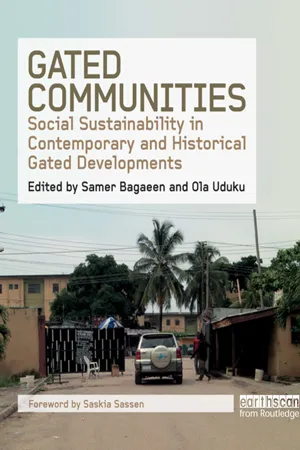
eBook - ePub
Gated Communities
Social Sustainability in Contemporary and Historical Gated Developments
- 160 pages
- English
- ePUB (mobile friendly)
- Available on iOS & Android
eBook - ePub
Gated Communities
Social Sustainability in Contemporary and Historical Gated Developments
About this book
Information
1
Gated Histories: An Introduction to Themes and Concepts
Samer Bagaeen and Ola Uduku
Introduction
This book considers the genesis of gated communities in different areas of the world, offering both a historical and contemporary analysis of examples. In doing this, it seeks to respond to and engage with the ongoing debate surrounding the roots of gated communities. There is, at present, no unanimously agreed contemporary definition of what constitutes a gated community; however, the description of what constitutes ‘gating’ throughout urban history is extensive. Atkinson and Blandy (2005, p177), in the special issue on gated communities of Housing Studies, give their definition of the gated community as:
… a housing development that restricts public access, usually through the use of gates, booms, walls and fences … residential areas may also employ security staff or CCTV [closed-circuit television] systems to monitor access … [they may] include a variety of services such as shops or leisure facilities.
These building enclosures are usually governed by legal and social frameworks that form the statutory conditions that residents have to comply with. Blakely (2007, p475) further defines gated communities as:
… residential areas with restricted access, such that spaces normally considered public have been privatized. Physical barriers – walled or fenced perimeters – and gated or guarded entrances control access. Gated communities include both new housing developments and older residential areas retrofitted with barricades and fences.
From these two definitions, what is certain is that both the privatization of public space and the fortification of the urban realm, in response to the fear of crime, has contributed significantly to the rise of the contemporary gated community phenomena.
Despite the outpouring of literature and research on the subject, mainly from North America and more recently including authors from Western Europe, since the early 1990s, there is ample evidence to suggest that the phenomenon can also be linked to older historic patterns of enclosure found globally.
Recognition of this other ‘strand’ or notion enclosure, derived from more traditional housing and residence practices in the world, should equally inform the debate about the epistemology and nature of the gating phenomenon. This is important as the incorporation of ‘gated communities’, in one form or another, has influenced and had a bearing on the planning, design ‘codes’ and design guidelines in most contemporary urban areas, at both suburban and inner-city level today.
There is an ongoing discussion about the place of, infrastructure needs and spatial relationship of the gated community contextually within today’s cities, both in the evolving and developed world. Much of the current analysis, and resultant planning guidance and codes assume that gated communities are simply a ‘me too’ reaction by the local elite in emulating the ‘American’ lifestyle within the local urban context.
Often, where gated housing enclaves of various forms have been incorporated within the city plan, the socio-economic and historic antecedents are assumed to be Western; links to earlier relevant historic fortified cities and enclosed forms of architecture from other parts of the world are rarely alluded to or incorporated within the new ‘securitized’ architecture of the contemporary 21st-century gated community.
In this chapter, we discuss the broad historic associations to contemporary gated communities, and then review current literature and research into these communities and linkages to social sustainability. Gated communities provide an example of a much wider rise in contractual governance resulting from the new relationship between the state, market and civil society designed to address concerns about social order. ‘Gated living’ often means that residents agree to sign up to communally agreed arrangements that allow for money to be charged for payments for services such as waste collection, snow ploughing, leaf clearing, street lighting and parks management. In light of this, Atkinson and Blandy (2005, p178) refine the definition of gated communities, noting that they are ‘characterised by legal agreements which tie the residents to a common code of conduct and (usually) collective responsibility for management’.
Other attempts at creating defensible space are worthy of attention. Suburban areas with electronic bars across private access roads and housing estates with buffer zones of grass and cul-de-sacs are all also intentionally designed to exclude or deter non-residents from acquiring access. Thus, although not creating overtly physical barriers, these moderated forms of physical separation of space ensure de facto spatial segregation and separation.
Can we then justify the need to ‘gate’? We surmise that in the predominantly neo-liberal, capitalist-oriented urban landscape that still characterizes most global cities, this has been the free choice of residents and estate developers who have been willing to pay the price and know the profit potential, respectively, of these communities. Davis (1992), in his polemic text City of Quartz, describes the ultra-gated suburbs of downtown America, as does Low (2003) in her academic study Behind the gates: life, security, and the pursuit of happiness in fortress America. Clearly, in the West, contemporary America leads the revolution as its spacious suburbs and traditional residents, who value the certainty and sense of shared community ascribed to gated communities, make their location and construction from small housing estate level to whole-town level relatively easy to achieve.
Europe and elsewhere in the world are not far behind this evolution since increasingly globalized work patterns and lifestyles have meant that real estate construction in Boston, the US, is similar to developments in Lagos, Nigeria, or Beijing, China. Thus, the gated community has now become an ubiquitous part of urban life. Contexts are similar in most cases as the emergent middle class or bourgeoisie acquire local affluence and with it a real, or perceived, fear of encroaching crime and ‘contamination’ from society not part of their socio-economic status.
Coupled with this fear is the ability and willingness to pay for the segregation and services that a gated community can provide. This has driven much of the market for the construction of new gated residences, condominiums and town/housing estates. In addition, a relatively ready supply of subsidized land for developers to create new estates and occasionally convert existing residential enclaves into gated communes is a contextual feature familiar in many developed countries. This ‘conversion’ possibility has meant that in the less real estate-abundant countries in Europe, such as the UK, the gated community phenomenon has still managed to spread and also become rooted in national urban planning debates.
What issues, then, must we consider as the ‘global gated’ phenomenon continues apace in some parts of the world more than others? Its sustainability, the authors in this book argue, both conceptually and physically is a crucial issue to consider. By this we mean how viable are gated communities in the current socio-economic environment? In addition, is the current Western-based gated model sustainable in non Western-based cultural contexts?
We suggest that the sustainability of the gated community, as a physical and ideological urban design concept, depends on the ability to maintain barriers between those within the gates and those without, both physically and psychologically. Effectively, the fortress created by gated communities suggests that the status quo can be sustained, and those outside the gates can remain permanently excluded as the ‘others’. These ‘others’ outside the gates could therefore legitimately be demonized as the low life, criminals and undesirables from whom the deserving middle classes needed to protect themselves. Psychologically, therefore, as well as physically, today’s gated residences are in place to protect residents from the fear of the outsiders, as well as from anxieties about privacy and social integration.
Determining and describing the gated community: Urban form
There are a myriad of typologies for gated developments, all with contextual relevance. A general discussion about the forms that these developments may take provides an introductory background to the volume.
Despite the recent outpouring of literature and research on the subject of gated communities since the early 1990s (Davis, 1992; Caldeira, 1996, 2000; Blakely and Snyder, 1997; Low, 1997; Leisch, 2002; Atkinson et al, 2004; Wu and Webber, 2004; McKenzie, 2005; Blandy, 2006; Le Goix and Webster, 2008) there is ample evidence to suggest that the phenomenon can be linked to historic patterns of enclosure, to be found globally. Denyer (1978, pp66–73) devoted an entire chapter on traditional African dwellings to ‘defence’, in which she asserts that:
It is a truism to say that defences were only required by those who felt threatened by external aggression … Simple small-scale societies living at subsistence level tried to minimize serious conflict … but even in the absence of armed conflict some protection was needed almost everywhere from large mammals. The slave raiding which intensified from the 18th and the political upheavals of the 19th century meant that few people were immune from danger, and by 1900 nearly every village and town in sub-Saharan Africa had some form of defensive cordon.
Her text and Oliver’s (1987) further give examples of historic ‘fortress’ settlements in locations as geographically diverse as Afghanistan (Oliver, 1987), Greater Zimbabwe and Benin (Denyer, 1978). Within current literature on gated communities, Wu and Webber (2004) describe the historic Chinese gated community in similar detail.
While these examples might be considered more anthropological in their description, their influence on Western planning should not be underplayed. British colonial planners often incorporated or adapted existing planned settlements; thus, in Kaduna, Nigeria, Max Locke’s 1966 plan incorporates the old walled town into the new plan (Locke, 1966). Arguably, England’s first colony in Ireland was also built as a walled citadel (Home, 1997).
McKenzie (1994) suggests that the American engagement with the gated community also has British origins; the cross-fertilization of Ebenezer Howard’s garden city movement from the UK to the US, he feels, began this evolution. Of critical importance also is Olmsted’s study of the British park and its associated housing, which he then developed into his planning of Central Park and other great American landscapes (Olmsted, 1967). In effect, McKenzie’s thesis claims that the American version of Howard’s Garden City was always essentially a privatized one, as opposed to the more benevolent public view of the early English versions (see Howard, 1945).
There is also no doubt, however, that there are South American origins to the gated citadel, as many of the pre-colonial settlements in this southern continent were also communities built with defences against the elements and hostile marauders. The thick adobe walled architecture can be seen as far north as New Mexico, US, and other southern parts of the US. It is no surprise, then, that the contemporary evolution of the fortress citadel, now termed gated community, is most associated with the US. However Caldeira’s (2000) discussion of the phenomenon in Brazil, and the literature on the post-apartheid city, embodied by Landman (2004), and Wu and Webber’s (2004) discussion about China are equally valid descriptions of today’s translation of ‘gatedness’ across the world.
Davis’s (1992) description of the Carceral city in the City of Quartz is the most quoted description of the ultimate horror of the fortress idea, while both Newman’s (1972) ‘defensible space’ and Jacobs’s (1964) The Death and Life of Great American Cities discussion of space are most often given as the theoretical reason for the move to the safer gated communities, while the New Urbanist movement comes close to endorsing this closed-community network.
However, there has been, in the last few years, a more critical analysis of gatedness, the gated community network being a forum for this. Soja (2000), McKenzie (1994) and others question the inevitability theory that all cities will become compositions of self-governing gated communities for the rich and ghettoes of despair, non-governance and zero services provision for the poor.
Engagement amongst academics in this critical discourse is furthered by the activities of the gated communities’ network, which with its diverse membership of researchers has a global remit and audience in which to spread its findings.
With respect to the cultural determinants of urban form, in some countries it was residual habits and customs such as personal commitments, tribal solidarities and self-regulating social structures that had an influence on form. This is what Galantay (1987, p8) called the ‘culture specific determinants’ (in this case, religious practices and legal traditions of Islam) that have shaped the built environment in the historic Muslim city. The nature of the physical fabric, the importance of law, communal responsibility and local networks have all contributed to how the inhabitants of this traditional city have solved their housing problems in th...
Table of contents
- Cover
- Halftitle
- Title Page
- Copyright
- Dedication
- Contents
- List of Figures and Tables
- Acknowledgements
- Foreword: Urban Gating – One Instance of a Larger Development? by Saskia Sassen
- List of Contributors
- List of Acronyms and Abbreviations
- 1. Gated Histories: An Introduction to Themes and Concepts
- 2. Opening the Gates: An East–West Transmodern Discourse?
- 3. Gated Urban Life versus Kinship and Social Solidarity in the Middle East
- 4. Gating Urban Spaces in China: Inclusion, Exclusion and Government
- 5. Lagos: ‘Urban Gating’ as the Default Condition
- 6. Gated Minds, Gated Places: The Impact and Meaning of Hard Boundaries in South Africa
- 7. Latin American Gated Communities: The Latest Symbol of Historic Social Segregation
- 8. Gated Communities in Mexico City: A Historical Perspective
- 9. Production and Social Sustainability of Private Enclaves in Suburban Landscapes: French and US Long-Term Emergence of Gated Communities and Private Streets
- 10. Barriers and Boundaries: An Exploration of Gatedness in New Zealand
- 11. Afterword
- Index
Trusted by 375,005 students
Access to over 1.5 million titles for a fair monthly price.
Study more efficiently using our study tools.
Frequently asked questions
Yes, you can cancel anytime from the Subscription tab in your account settings on the Perlego website. Your subscription will stay active until the end of your current billing period. Learn how to cancel your subscription
No, books cannot be downloaded as external files, such as PDFs, for use outside of Perlego. However, you can download books within the Perlego app for offline reading on mobile or tablet. Learn how to download books offline
Perlego offers two plans: Essential and Complete
- Essential is ideal for learners and professionals who enjoy exploring a wide range of subjects. Access the Essential Library with 800,000+ trusted titles and best-sellers across business, personal growth, and the humanities. Includes unlimited reading time and Standard Read Aloud voice.
- Complete: Perfect for advanced learners and researchers needing full, unrestricted access. Unlock 1.5M+ books across hundreds of subjects, including academic and specialized titles. The Complete Plan also includes advanced features like Premium Read Aloud and Research Assistant.
We are an online textbook subscription service, where you can get access to an entire online library for less than the price of a single book per month. With over 1.5 million books across 990+ topics, we’ve got you covered! Learn about our mission
Look out for the read-aloud symbol on your next book to see if you can listen to it. The read-aloud tool reads text aloud for you, highlighting the text as it is being read. You can pause it, speed it up and slow it down. Learn more about Read Aloud
Yes! You can use the Perlego app on both iOS and Android devices to read anytime, anywhere — even offline. Perfect for commutes or when you’re on the go.
Please note we cannot support devices running on iOS 13 and Android 7 or earlier. Learn more about using the app
Please note we cannot support devices running on iOS 13 and Android 7 or earlier. Learn more about using the app
Yes, you can access Gated Communities by Samer Bagaeen,Ola Uduku in PDF and/or ePUB format, as well as other popular books in Architecture & Urban Planning & Landscaping. We have over 1.5 million books available in our catalogue for you to explore.