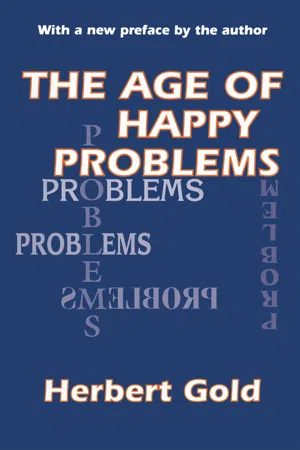
In his first book of non-fiction, originally published in 1962, Herbert Gold explores some not-so-happy problems confronting people in an age of "mass destruction, mass inertia, mass everything." While acknowledging that we live in a time of utmost global significance-war on an enormous scale was a reality of the twentieth century and continues to threaten, unadulterated evil has exhibited itself in grandiose proportions-Gold tackles issues and problems which are very much of significance to the individual: teaching, writing, love, marriage, divorce, and death. In The Age of Happy Problems, Gold takes the reader through a journey of eclectic characters, situations, and locales. Part I is a selection of essays entitled "American Events." In "The Age of Happy Problems" we are presented with an analysis of the problems facing people in the middle of their lives and careers. "How to Be an Artist's Wife" explores the prospect of being married, and remaining married, to a temperamental and egotistical artist. "Divorce as a Moral Act" describes the termination of marriage as a means for renewal and the chance to start over again the search for love. "The Bachelor's Dilemma" evokes the decisions confronting the male of the "big city." And "A Dog in Brooklyn, A Girl in Detroit: A L"ife Among the Humanities" is a memoir on the paradoxes of teaching in a university. Part II is entitled "American Places." The author examines in this section various American lifestyles. In "Paris: Notes from La Vie de Boheme," Gold describes Americans abroad, why they decide to become expatriates, and how they adapt to their new surroundings. In "Greenwich Village: The Changing Village" he writes about the importance of New York City's symbol of change, experiment and nonconformity. Finally, the author meditates on "Death in Miami Beach," offering a moving account of the relationship between death and the popular Florida city. Gold writes: "How can I total it up? What is the map of the map? Well, to begin with, Plato was wrong. The life of contemplation is not sufficient...and for another thing, Plato was right. He knew that men must learn to come together in the practice of intelligence and moral privilege." Gold's essays, stemming from the author's own humanity, are just as poignant and relevant today as they were when they were first published. The Age of Happy Problems is sure to captivate, but perhaps most of all, make the reader contemplate the importance of these issues for his or her own life.
- 238 pages
- English
- ePUB (mobile friendly)
- Available on iOS & Android
eBook - ePub
The Age of Happy Problems
About this book
Trusted by 375,005 students
Access to over 1.5 million titles for a fair monthly price.
Study more efficiently using our study tools.
Information
PART ONE
American Events
The Age of Happy Problems
RECENTLY I HAVE had occasion to live again near my old college campus. I went into a hole-in-the-wall bakery where the proprietor recognized me after ten years. “You haven’t changed a bit, son,” he said, “but can you still digest my pumpernickel? The stomach gets older, no? Maybe you want something softer now—a nice little loaf I got here.”
He had worn slightly. But for me the change was from twenty-two to thirty-two, and it is this ten-year time that I want to think about—the generation which came back from the war to finish college on the GI Bill and is now deep into its career. We are the generation which knew the Depression only through the exhilaration of the burgeoning New Deal and the stunned passion of war. I remember the bank crash because my mother wept and I said, “If we’re poor now, can I wear corduroy pants?” For the most part, we were taken care of and never hopelessly hunted jobs. Now some of us say we are cool, say we are beat; but most of us are allrightniks—doing okay. We are successful. In the late forties and the fifties, it was hard to know economic struggle and want—and for the most part we didn’t experience these traditional elements of youth—and it was hard for the skilled and the trained not to know success. We did not doubt overmuch. We have done well. How well?
“Money money money,” as Theodore Roethke says.
I have married my hands to perpetual agitation,
I run, I run to the whistle of money.
Money money money
Water water water
I should like to take a look at some of the college idealists. The lawyer, fascinated by “the philosophy of law,” now uses his study to put a smooth surface on his cleverness. Cardozo and Holmes? Very interesting, but let’s find that loophole. The doctor who sent flowers to the first mother whose baby he delivered now specializes in “real-estate medicine”—his practice gives him capital for buying apartment houses. The architect who sat up all night haranguing his friends about Lewis Mumford and Frank Lloyd Wright now works for a mass builder who uses bulldozers to level trees and slopes, then puts up tri-level, semi-detached, twenty-year-mortgaged, fundamentally identical dormitories for commuters. He admits that his designs make no decent sense, but they do have that trivial, all-important meaning: “It’s what the market wants, man. You’d rather I taught city planning for six thousand a year?”
The actor becomes a disc jockey, the composer an arranger, the painter a designer; the writer does TV scripts in that new classic formula, “happy stories about happy people with happy problems.” How hard it is to be used at our best! One of the moral issues of every age has been that of finding a way for men and women to test, reach, and overreach their best energies. Society has always worked to level us. Socrates has always made it hot for the citizens in the market place. But there was usually room for the heroic-hemlock not a serious deterrent—and perhaps rarely so much room on all levels as in the frontier turbulence of the nineteenth and early twentieth century in America. Hands reached out like the squirming, grasping, struggling railroad networks; the open society existed; freedom had a desperate allure for the strongly ambitious, and men stepped up to take their chances—Abraham Lincoln and William James, Mark Twain and Melville, Edison and Rockefeller and Bet-a-Million Gates.
Allowing for a glitter of nostalgia on what we imagine about the past, still something has happened to change the old, movemented, free, open American society to something persuasive, plausible, comfortable, and much less open. We are prosperous, we get what we think we want, we have a relatively stable economy without totalitarian rule. “I’m not selling out,” my friend the architect says, “I’m buying in.” Without attempting a simple explanation of the causes of this age of happy problems, let us look at its consequences for the new postwar young people who should be in full action toward their ambitions and the surest, sturdiest signs of a civilization’s health.
What are these personal symptoms? How is the vital individual human creature doing in his staff meetings, at his family’s table, over the baby’s bassinet, and with that distant secret self that he may sometimes meet at the water cooler? Well, for this man it is very hard to be exceptional. Talent apart, he has too much to do, too much on his mind, to give himself over to his best energies. Think, for example, of the writers in the advertising agencies, on TV, or in the colleges. They all wanted to write great books; they tend now to prefer “competence” as an ideal to greatness. Some of them are trying, but they risk the situation of the girl in the short-story writing class: “I can’t be a creative writer, I can’t, because I’m still a stupid virgin.” She will take up going steady, she will take up marriage; she will be mildly disappointed; she will remain as she was, but aging—“adjusted,” “integrated,” virgin to danger, struggle, and the main chance of love and work.
In composite, in our thirties, we of this prosperous and successful generation are still in good health and rather fast at tennis (but practicing place shots which will eliminate the need to rush the net); hair receding but still attractive to college girls, or at least recent graduates; a slight heaviness at the middle which makes us fit our jackets with especial care (sullen jowls beginning, too) or, if not that, a skinniness of anxiety (etching around the mouth, dryness of lips). We go to an athletic club. We play handball in heavy shirts “to sweat it off.”
The girls we marry are beautiful in wondrous ways. Savant make-up is no longer sufficient. Blemishes are scraped until the skin is pink and new; scars are grown away by cortisone injections—what reason to be marked in this world?; noses are remade, the same for mother and daughter, just like heredity. Money is spent much more gracefully than in those fantastic times when silver coins were put in ears and jewels in navels.
The old truth—“we must all come from someplace”—is amended in 1956. We can create ourselves in our own image. And what is our own image? The buttery face in the Pond’s advertisement, the epicene face in the Marlboro publicity.
The matters that we are told to worry about—and perhaps we think we worry about them—do not really trouble us. The prospect of war is like a vague headache, no worse. The memory of war is even dimmer. A depression is something which will reduce the value of our shares in the mutual fund, make us keep the old car another year. Radioactive fallout and the slow destruction of the human species through cancerous mutation—well, what is so much bother to imagine cannot really come to pass. Who lets the newspaper interfere with a good meal?
2
Still, we are not blithe spirits; birds we are not. This generation is particularly distinguished by its worry about making its wives happy, about doing right by its kids (title of a hugely popular paperbound book: How to Play with Your Chita), about acquiring enough leisure and symbols of leisure, which it hopes to cash in for moral comfort. Fortune reports a method used by salesmen to get the second room air conditioner to the couple which already has one in its bedroom. “The machine operates as expected? Fine! You sleep better with it? So do I, that’s just dandy. But, friends, let me tell you how I sleep so much better now that I know my kiddies are cool and comfy, too.”
This capitalizes on the child-oriented anxiety which the class known commercially as Young Marrieds has been taught to feel by modern psychiatry. Advertisements for McCall’s, “The Magazine of Togetherness,” demonstrate Togetherness in a brilliant summer scene. The man, wearing a white skirtlike apron and a proud simper, is bending to serve a steak to his wife (summer frock, spike heels), who will season it for them and for their happy gamboling children. The little boy and girl are peeking and smiling. The wife is lying in a garden chair. Togetherness consists in the husband’s delighting his wife and kids by doing the cooking.
Actually, of course, most American women don’t want to go this far. They are already equal with men. Women are usually too wise to define “equal” as “better than.” It is not momism or any such simple psychological gimmick that tells this sad tale. The consumer culture—in which leisure is a menace to be met by anxious continual consuming— devours both the masculinity of men and the femininity of women. The life of consuming requires a neuter anxiety, and the pressure to conform, to watch for our cues, to consume, makes us all the same—we are customers—only with slightly different gadgets. Women have long bought men’s shirts; men are buying colognes with “that exciting musky masculine tang.”
Togetherness represents a curious effort by a woman’s magazine to bring men back into the American family. Togetherness does not restore to the man a part of his old-time independence. It does not even indicate that he may be the provider with an independent role defined partly by ambitions outside his family. Instead, it suggests the joys of being a helpmate, a part of the woman’s full life, and battens greedily on the contemporary male’s anxiety about pleasing his wife. The Togetherness theme has been a great commercial success. A full-page advertisement by that canny old American institution, the New York Stock Exchange, shows a photograph of a harried young man pleading with a young woman on a parlor couch. She remains unconvinced, pouting, hands gloved and folded together, as brutal as the shocked beauties in the classical halitosis or B.O. tragedies. The caption reads: “Is the girl you want to marry reluctant to say Yes? Do you need to build character with your wife? Then just use the magic words: I’LL START A MONTHLY INVESTMENT PLAN.”
It used to be thought that answering economic needs was the main purpose of man’s economic efforts. Now, however, an appeal to emotional insecurity about money—without crass financial trouble—can do good work for an advertiser. “Do you need to build character with your wife?” This is whimsey with a whammy in it. Money works symbolically to stimulate, then assuage male doubts.
SHE: What can the stock do for our marriage?
HE: It can help keep it sweet and jolly because when we own stock we are part-owners of the company.
In the image projected by this advertisement, the wife is prosecutor, judge, and jury. She may fall into a less exalted role, however, while her husband is downtown making the money which will go for food, clothing, shelter, and sound common stocks. That she too frets about keeping her marriage sweet and jolly is obvious. The popular media again point to trouble while pitching a new solution to her problems. One of the former radio soap operas is now sponsored by Sleep-eze. Apparently almost everyone uses soap these days, but not everyone has caught on to the virtues of non-habit-forming sedatives. Want your husband to love you? This pill will help or your money back. “Ladies! Fall asleep without that unsightly twisting and turning.”
It’s time to mention Barbara. A tough wise creature of a girl, Barbara comes to this observation out of her marriage and love life: “Men worry too much about making the girl happy. We seem to scare them out of themselves. Let them really be pleased—that’s what we want most of all—and then we’ll be happy. Delighted. But really.”
In other words, long live primary narcissism! And secondary. And tertiary. But let us call it by an older, better name—respect for the possibilities of the self. This includes the possibility of meaningful relationships with meaningful others.
3
Our wounds as a people in this time and place are not unique in kind, but the quality of difference makes this a marvelously disturbing period. The economic problem, no longer rooted in hunger for essential goods, food, housing, clothing, is an illustration of the difference. Sure, we are still busy over food—but packaged foods, luxury foods, goodies in small cans; housing—but the right house in the right neighborhood with the right furnishings and the right mortgage; clothing—but the cap with the strap in the back, Ivy League pants, charcoal gray last year and narrow lapels this year, and male fashions changing as fast as female.
It used to be thought that, given money, relative job security, and the short work week, culture would then bloom like the gardens in the suburbs and the individual spirit would roar with the driving power of a Thunderbird getting away after a red light.
Who could have predicted that we would have to keep pace with a cultural assembly line in the leisure-time sweatshop? At least in the older sweatshop, you sighed, packed, and left the plant at last. Now we are forever harassed to give more, more, more. We no longer have to keep up with the Joneses; we must keep up with Clifton Fadiman. He is watching you. The steady pressure to consume, absorb, participate, receive, by eye, ear, mouth, and mail, involves a cruelty to intestines, blood pressure, and psyche unparalleled in history. The frontiersmen could build a stockade against the Indians, but what home is safe from Gilbert Highet? We are being killed with kindness. We are being stifled with cultural and material joys. Our wardrobes are full. What we really need is a new fabric that we don’t have to wrinkle, spot, wash, iron, or wear. At a beautiful moment in Walden, Thoreau tells how he saw a beggar walking along with all his belongings in a single sack on his back. He wanted to weep for the poor man—because he still had that sack to carry.
The old-style sweatshop crippled mainly the working people. Now there are no workers left in America; we are almost all middle class as to income and expectations. Even the cultural elite labors among the latest in hi-fi equipment, trips to Acapulco and Paris, the right books in the sewn paper editions (Elizabeth Bowen, Arnold Toynbee, Jacques Barzun—these are the cultivated ones, remember), Fortune and the Reporter, art movies and the barbecue pit and the Salzburg music festival. It is too easy to keep up with the Joneses about cars and houses, but the Robert Shaw Chorale is a challenge. In the meantime, the man in the sweatshop is divorced or psychoanalyzed (these are perhaps remedies in a few cases); he raises adjusted children, or kills them trying; he practices Togetherness in a home with a wife who is frantic to be a woman and a nonwoman at the same time; he broods about a job which does not ask the best that he can give. But it does give security; it is a good job. (In college this same man learned about the extreme, tragic instances of desire. Great men, great books. Now he reads Evelyn Waugh.)
In his later, philosophical transmogrification, David Reisman consoles the radar-flaunting other-directeds by holding out the reward of someday being “autonomous” if they are very, very good. Same thing, brother, same thing. When he describes the autonomous personality’s “intelligent” distinctions among consumer products, exercising his creative imagination by figuring out why High Noon is a better western than a Gene Autry, well, then, in the words of Elvis Presley:
Ah feel so lonely,
Ah feel so lo-oh-oh-lonely.
We’re in Heartbreak Hotel where, as another singer, Yeats, put it:
The ceremony of innocence is drowned;
The best lack all conviction, while the worst
Are filled with a passionate intensity.
Refusal to share to the fullest degree in the close amity of the leisure-time sweatshop is—for Mr. Riesman—a kind of ethical bohemianism. His autonomous consumer, sociable, trained, and in the know, is a critic of the distinctions between the Book-of-the-Month Club and the Reader’s Subscription, Inc., marks the really good shows in his TV guide, buys educational comic books for his children, tastes the difference in fine after-dinner coffee, knows that the novel is a dead form and why. Bumper to bumper in the traffic home from work, or jammed into the commuter train, he has plenty of time to think. And he does think (thinking means worrying) while the radio blares “The House with the Stained Glass Window” or “The Magic of Believing,” a little rock-and-roll philosophical number.
Does he have a moral problem, let’s say, about leaving a changing neighborhood “for the sake of the children”? He is a liberal, of course, but after all, the Negroes who are moving in come from a different world, and he should not inflict his principles on his children. Still, there is a certain discomfort. He discusses it with his analyst. Why does he suffer from this moral qualm? Does it have some link with the ever-ambiguous relationship with parents? What moral problem? They are all psychological. Anxiety can be consumed like any product. And from his new, split-level, sapling-planted housing development he speeds into the city now ten miles further out.
We are a disappointed generation. We are a discontented people. Our manner of life says it aloud even if discreetly our public faces smile. The age of happy problems has brought us confusion and anxiety amid the greatest material comfort the world has ever seen. Culture has become a consolation for the sense of individual powerlessness in politics, work, and love. With gigantic organizations determining our movements, manipulating the dominion over self which alone makes meaningful communion with others possible, we ask leisure, culture, and recreation to return to us a sense of ease and authority. But work, love, and culture need to be connected. Otherwise we carry our powerlessness with us onto the aluminum garden furniture in the back yard. Power lawn mowers we can buy, of course.
The solution in our age of happy problems is not to install (on time) a central air-conditioning system and a color TV this year because the room air conditioner and the black-and-white TV last year did not change our lives in any important respect. The solution is not in stylish religious conversions or a new political party. The answer is not even that Panglossian fantasy about “the autonomous personality” which will naturally emerge out of the fatal meeting of the other-directed consumer with a subscription to the Saturday Review.
The ache of unfulfilled experience throbs within us. Our eyes hurt. Vicarious pleasures buzz in our heads. Isn’t there something more, something more?
There is still awareness; there is still effort. “It should be every man’s ambition to be his own doctor.” This doesn’t mean that he should not see a dentist when his tooth hurts, perhaps a psychoanalyst when his psyche hur...
Table of contents
- Cover
- Half Title
- Title Page
- Copyright Page
- Content Page
- Dedication
- Preface to the Transaction Edition
- Introduction
- Part I: American Events
- Part 2: American Places
Frequently asked questions
Yes, you can cancel anytime from the Subscription tab in your account settings on the Perlego website. Your subscription will stay active until the end of your current billing period. Learn how to cancel your subscription
No, books cannot be downloaded as external files, such as PDFs, for use outside of Perlego. However, you can download books within the Perlego app for offline reading on mobile or tablet. Learn how to download books offline
Perlego offers two plans: Essential and Complete
- Essential is ideal for learners and professionals who enjoy exploring a wide range of subjects. Access the Essential Library with 800,000+ trusted titles and best-sellers across business, personal growth, and the humanities. Includes unlimited reading time and Standard Read Aloud voice.
- Complete: Perfect for advanced learners and researchers needing full, unrestricted access. Unlock 1.5M+ books across hundreds of subjects, including academic and specialized titles. The Complete Plan also includes advanced features like Premium Read Aloud and Research Assistant.
We are an online textbook subscription service, where you can get access to an entire online library for less than the price of a single book per month. With over 1.5 million books across 990+ topics, we’ve got you covered! Learn about our mission
Look out for the read-aloud symbol on your next book to see if you can listen to it. The read-aloud tool reads text aloud for you, highlighting the text as it is being read. You can pause it, speed it up and slow it down. Learn more about Read Aloud
Yes! You can use the Perlego app on both iOS and Android devices to read anytime, anywhere — even offline. Perfect for commutes or when you’re on the go.
Please note we cannot support devices running on iOS 13 and Android 7 or earlier. Learn more about using the app
Please note we cannot support devices running on iOS 13 and Android 7 or earlier. Learn more about using the app
Yes, you can access The Age of Happy Problems by Herbert Gold in PDF and/or ePUB format, as well as other popular books in Literature & North American Literary Collections. We have over 1.5 million books available in our catalogue for you to explore.