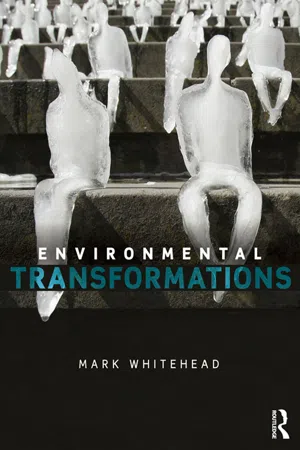
Environmental Transformations
eBook - ePub

Environmental Transformations

A Geography of the Anthropocene

  1. 176 pages
  2. English
  3. ePUB (mobile friendly)
  4. Available on iOS & Android
eBook - ePub

Environmental Transformations

A Geography of the Anthropocene

About this book

From the depths of the oceans to the highest reaches of the atmosphere, the human impact on the environment is significant and undeniable. These forms of global and local environmental change collectively appear to signal the arrival of a new geological epoch: the Anthropocene. This is a geological era defined not by natural environmental fluctuations or meteorite impacts, but by collective actions of humanity.

Environmental Transformations offers a concise and accessible introduction to the human practices and systems that sustain the Anthropocene. It combines accounts of the carbon cycle, global heat balances, entropy, hydrology, forest ecology and pedology, with theories of demography, war, industrial capitalism, urban development, state theory and behavioural psychology. This book charts the particular role of geography and geographers in studying environmental change and its human drivers. It provides a review of critical theories that can help to uncover the socio-economic and political factors that influence environmental change. It also explores key issues in contemporary environmental studies, such as resource use, water scarcity, climate change, industrial pollution and deforestation. These issues are 'mapped' through a series of geographical case studies to illustrate the particular value of geographical notions of space, place and scale, in uncovering the complex nature of environmental change in different socio-economic, political and cultural contexts. Finally, the book considers the different ways in which nations, communities and individuals around the world are adapting to environmental change in the twenty-first century.

Particular attention is given throughout to the uneven geographical opportunities that different communities have to adapt to environmental change and to the questions of social justice this situation raises. This book encourages students to engage in the scientific uncertainties that surround the study of environmental change, while also discussing both pessimistic and more optimistic views on the ability of humanity to address the environmental challenges of our current era.

Frequently asked questions

Yes, you can cancel anytime from the Subscription tab in your account settings on the Perlego website. Your subscription will stay active until the end of your current billing period. Learn how to cancel your subscription.
No, books cannot be downloaded as external files, such as PDFs, for use outside of Perlego. However, you can download books within the Perlego app for offline reading on mobile or tablet. Learn more here.
Perlego offers two plans: Essential and Complete
  • Essential is ideal for learners and professionals who enjoy exploring a wide range of subjects. Access the Essential Library with 800,000+ trusted titles and best-sellers across business, personal growth, and the humanities. Includes unlimited reading time and Standard Read Aloud voice.
  • Complete: Perfect for advanced learners and researchers needing full, unrestricted access. Unlock 1.4M+ books across hundreds of subjects, including academic and specialized titles. The Complete Plan also includes advanced features like Premium Read Aloud and Research Assistant.
Both plans are available with monthly, semester, or annual billing cycles.
We are an online textbook subscription service, where you can get access to an entire online library for less than the price of a single book per month. With over 1 million books across 1000+ topics, we’ve got you covered! Learn more here.
Look out for the read-aloud symbol on your next book to see if you can listen to it. The read-aloud tool reads text aloud for you, highlighting the text as it is being read. You can pause it, speed it up and slow it down. Learn more here.
Yes! You can use the Perlego app on both iOS or Android devices to read anytime, anywhere — even offline. Perfect for commutes or when you’re on the go.
Please note we cannot support devices running on iOS 13 and Android 7 or earlier. Learn more about using the app.
Yes, you can access Environmental Transformations by Mark Whitehead in PDF and/or ePUB format, as well as other popular books in Biological Sciences & Geography. We have over one million books available in our catalogue for you to explore.

Information

Chapter One Introduction Geography in the Anthropocene

DOI: 10.4324/9781315832678-1
Welcome to the Anthropocene. It’s a new geological era, so take a look around. A single species is in charge of the planet, altering its features almost at will. And what [is] more natural than to name this new era after the top of the range anthropoid, ourselves? (Pearce, 2007: 58).

1.1 Meme or Geological Epoch: Introducing the Anthropocene

It is, I must admit, unusual for an academic conference to produce a new geological epoch. But this is, in a sense, precisely what happened when the eminent Nobel Prize-winning atmospheric chemist Paul Crutzen announced the arrival of the Anthropocene. While attending a scientific conference, Paul Crutzen described suddenly feeling uneasy about a fellow delegate’s use of the term Holocene (Pearce, 2007: 58). The Holocene is a geological term used by environmental scientists to denote the warmer, inter-glacial period in which we now live (the Holocene began approximately 12,000 years ago, or around 10000 BCE). For Crutzen, however, the rapid and extensive nature of global environmental change over more recent history made the Holocene seem like an out-dated marker. In a short article he would later write in the journal Nature, Crutzen explained why he felt we had experienced an environmental shift of geological proportions (see Crutzen, 2002; see also Steffen et al, 2007).1 At the heart of Crutzen’s argument was his belief that humans had collectively become a force of nature. For Crutzen, what marked humans out as a force, at least, equivalent to nature were two key processes: 1) the range of different ways in which humans had transformed the environment; and 2) the ways in which these transformations were increasingly expressed at a planetary level. The Anthropocene is thus marked, according to Crutzen, by ‘greenhouse gases’ reaching their highest levels for 400,000 years; the increasing power of humans to regulate and control the flow of water through dam-building and sluice constructions; global industries releasing some 160 million tonnes of sulphur dioxide into the atmosphere each year; increasing levels of oceanic exploitation by the fisheries industry; rising rates of artificial fertilizer application to soils; and the increasingly high extraction of minerals and aggregates from the Earth’s crust through mining. This book is premised on the fact that the Anthropocene appears to require a change in the ways in which we study environmental transformations. Studying the deep times of other geological eras and epochs has required scientific skills that can capture and interpret the hidden records of environmental history (including fossils, rock samples and sediment cores). Studying the Anthropocene is, however, a real-time project that requires us to look as much at the horizontal record of human–environmental relations across (and above) the surface of the planet (including habitat change, urban sprawl, coral bleaching and desertification), as at the vertical record of the geological past. But if we take Crutzen’s notion seriously, studying the Anthropocene also requires much more of us. It means that we must have a reliable toolkit for studying the geological force that is humankind. Humans are very different objects of enquiry than the forces that have shaped and defined previous geological epochs. To understand them appears to require a peculiar mix of analytical skills spanning psychology, anthropology, economics, politics, history, sociology, biology and geography. Consequently, while understanding the nature of the environmental past has required an understanding of geological and paleontological processes (including extinction level events, the changing composition of the atmosphere and the movement of tectonic plates), studying the Anthropocene requires us to ask questions about the drivers of human behaviour, the structures of global capitalism, the processes of urbanization, the political constitution of nation states and the nature of multinational corporations.

Box 1.1 The Anthropocene

The term Anthropocene is increasingly being used to describe the geological epoch in which we now live. The term is actually a neologism (or new word) made from a combination of the prefix anthropo- (of humankind) and the suffix- cene(from the ancient Greek for ‘new’: this term is regularly used to denote new geological era such as the Cenozoic, Pleistoceneand the Holocene).
It was the atmospheric chemist Paul Crutzen and his colleague Eugene Stoermer (an ecologist) who first coined the term Anthropocene. Although the word Anthropocene is relatively new, the idea of a geological era of humankind has actually been with us for some time. Back in 1873, for example, the Italian geologist Antonio Stoppani used the term ‘anthropozoic era’ to convey the increasing impact that human beings (and the broader processes of agricultural development and industrialization) were having on the global environment (see Crutzen, 2002).
Plate 1.1 Paul Crutzen Source: Wikimedia Creative Commons, Biswarup Ganguly

Key readings

  • Biermann, F. et al (2012) ‘Navigating the Anthropocene: Improving earth system governance’, Science 335: 1306–1307
  • Crutzen, P.J. (2002) ‘Geology of mankind’, Nature 415.3: 23
  • Economist (2011) ‘The Anthropocene: A man-made world’, The Economist 26 May
  • Rohe, R.E. (1983) ‘Man as geomorphic agent: Hydraulic mining in the American west’, Pacific Historian 27: 5–16
  • Steffen, W., Crutzen, P.J. and McNeill, J.R. (2007) ‘Are humans now overwhelming the great forces of nature?’ Ambio 36(8): 614–621
  • Zalasiewicz, J. et al (2008) ‘Are we now living in the Anthropocene?’, GSA Today 18: 4–8
Plate 1.2 A geological timeline of life on the planet Earth Source: Getty Images
Scientists remain uncertain as to whether the human impact on the global environment constitutes a geological level shift in planetary history (see Zalasiewicz et al, 2008). One of the key issues is that for the ‘age of humans’ to exist geologically, it is necessary not only to show that humans have changed the environment (something that the fossil record for the Anthropocene, which will include things ranging from cities to an assemblage of domesticated animal life, should demonstrate (Economist, 2011)), but also to illustrate that humans actually changed the ways in which the global environment operated (this tends to be more difficult to discern from the relatively short-term perspective we currently have on the would-be Anthropocene). The Inter -national Commission on Stratigraphy (which essentially polices the official geological timeline of the Earth) has established an official Working Group to explore the scientific credentials of the Anthropocene (this group includes Paul Crutzen). It will be this Commission that will determine whether the Anthropocene is simply a popular meme, which has spread among aca -demics and commentators as a helpful term, or a scientifically approved geological epoch (see New York Times, 2012).
While acknowledging these technical debates, this volume is primarily interested in what the processes of ecological change associated with the Anthropocene mean for those who study environmental issues. To these ends, whether the collective wisdom of scientists eventually determines that we are (or are not) living in new geological times is not the most important issue. The very fact that the International Com -mission on Stratigraphy is considering the Anthropocene’s scientific validity suggests that something profound has happened in human–environmental relations. This volume provides an introductory account of the role of human beings, and associated social, economic and political processes, in transforming the environment. This book serves as an introduction on three counts: 1) it introduces the nature and extent of the physical changes human beings have caused to local and global environmental systems; 2) it introduces the different processes that appear to be driving environmental transformation; and 3) it asks what can be done, and what is being done, to address human impacts on the natural environment.
Visit the website of the Anthropocene Working Group at: http://www.quaternary.stratigraphy.org.uk/workinggroups/anthropocene/.
In addition to providing guidance on how the notion of the Anthropocene can pass from being an ‘informal’ to official geological era, the site also provides links to related articles about the Anthropocene.
One aspect of the debates that surround the Anthropocene that is taken up by this volume are its ethical implications (for a broader discussion of the ethics of the Anthropocene, see Gibson-Graham and Roelvink, 2010). At one level the very idea of the Anthropocene presents an opportunity for humankind to collectively reflect upon its environmental impacts and res -ponsibilities. To these ends, many in the environmental movement see the types of environmental trans formation that are associated with the Anthropocene as a basis for reducing the demands we place on the planet, to challenge the assumed value of economic growth and to re-localize our economies. At the other end of the ethical spectrum are those who feel that the idea of humans as intelligent agents of geological power should be a spur to further and deeper interventions into our planetary ecosystem. For example, in its recent feature on the Anthropocene, The Economist (Economist, 2011: 6) observed that it was ‘[B]etter to embrace the Anthropocene’s potential as a revolution in the way the Earth system works … than to try to retreat onto a low-impact path that runs the risk of global immiseration’. The Economist review claimed that the same intellectual powers that had created the Anthropocene could enable the ‘evolutionary leap’ ℃ particularly in the ways in which we harness energy sources and artificially regulate the global environment ℃ that our contemporary environmental problems appear to require. At the heart of the technocentric solutions envisaged by The Economist were the building of zero-carbon energy infrastructures and the initiation of new geoengineering programmes. These normative perspectives on what we ℈should’ do in response to contemporary forms of environmental change, and where these perspectives come from, are themes we will continually revisit in this volume.

Box 1.2 Geoengineering

Geoengineering is a term that is used to describe a series of large-scale, technologically driven interventions in the Earth's climatic system. Geoengineering can take many different forms, including: cloud whitening, space mirrors, carbon capture and storage. At the heart of all geoengineering efforts is a desire to artificially regulate the Earth's temperature and avert the onset of climate change. While supported by many as a necessary response to the emerging threats of climate change, many are sceptical of geoengineering efforts. Concerns have been expressed that a reliance on geoengineering could see less effort being made to reduce greenhouse gas emissions. Others, such as the World Economic Forum (2013), argue that geoengineering technologies carry with them the threat of being exploiting by rogue nations in order to cause climate-related problems in different parts of the world.

Key readings

  • See The Guardian's special section on geoengineering at: http://www.guardian.co.uk/environment/geoengineering
  • World Economics Forum (2013) Global Risks 2013, WEF, Davos

1.2 The Rough Geographies of the Anthropocene

I find one of the debates surrounding the notion of the Anthropocene particularly interesting. This debate concerns precisely when this new geological epoch may have begun. Some see its origins in the human domestication of animals and the associated birth of modern agriculture (the so-called Long Anthropocene) (see Chapters 3 and 7 of this volume). Paul Crutzen is more precise, suggesting that the Anthropocene began in 1784 when James Watt developed the first design for the steam engine and kick-started the industrial revolution. Others link the Anthropocene to the rise of nuclear technology and the clear radioactive traces it has left in the geological record. As a geographer, I feel that these historical deliberations can often lead us to forget an equally important question: where is the Anthropocene? Asking where is the Anthropocene is a spatial question. As a spatial question it has both historical and more contemporary implications. In historical terms, it leads us to ask in what places did the processes associated with the Anthropocene first begin? In more contemporary terms, it can result in important questions being asked about how the effects of the Anthropocene are being experienced differently in different locations. The geograp...

Table of contents

  1. Cover Page
  2. Half Title Page
  3. Series
  4. Title Page
  5. Copyright Page
  6. Dedication
  7. Contents
  8. List of plates
  9. List of figures
  10. List of tables
  11. List of boxes
  12. Acknowledgements
  13. 1 Introduction Geography in the Anthropocene
  14. Part 1 Environmental transformations
  15. Part 2 Living in the Anthropocene
  16. Bibliography
  17. Index