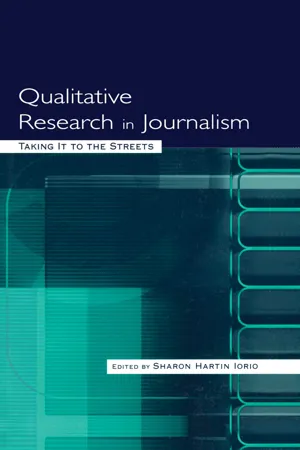
This volume highlights the integration of qualitative research methods into traditional journalism, offering new ways of expanding and enhancing news coverage. Designed for readers without prior experience in social science research, this collection presents a wide variety of qualitative techniques and their applications in journalistic practice. The work brings together contributions from professional journalists and journalism scholars who are highly experienced in conducting qualitative research. These experts demonstrate how valid, reliable qualitative procedures can be used to increase coverage and offer new insights.
Written in a straightforward, reader-friendly style, features in this volume include:
*real-world examples from contemporary newsrooms and interviews with practicing journalists who use the techniques of qualitative research in reporting;
*a rationale for the use of qualitative methods in journalism, with an illustration of how various qualitative methods tie together;
*step-by-step instructions for applying each methodology;
*a solid foundation for understanding the history and theory behind qualitative research and its usefulness in journalism;
*chapters on pairing qualitative and quantitative methods in journalism and on detailing partnerships between academics and professional journalists to facilitate newsroom research and reporting; and
*a discussion of "objectivity" in qualitative research and in journalism that offers an ethic for journalists of today.
The methodologies covered here include oral and life histories, textual analysis, focused interviews, ethnographies, focus groups, and case studies. In addition, a recently developed technique, civic mapping, is presented as a qualitative tool for reporting.
Qualitative Research in Journalism is an indispensable resource for current and future journalists interested in enhancing their coverage of the news.
- 264 pages
- English
- ePUB (mobile friendly)
- Available on iOS & Android
eBook - ePub
About this book
Information
Part
I
1
Qualitative Method Journalism
For journalists and those who hope to be journalists in the 21st century, one thing is abundantly clear—this line of work is being transformed. Technological change has created a 24-hour news cycle where breaking news is reported around the clock, and shocking world events can be viewed almost at the instant they happen—then observed as they continue to develop. Myriad international sources disseminate social and political opinion to individuals who choose not only their mode of information delivery but the very nature of the information they receive. Yet, the most remarkable shift is not the astonishing pace of delivery or the capability of individuals to select the news they receive; the most significant development is the network of technologies that let individuals interact with people worldwide, more specifically, to interact with those who provide their news. Everyday people use newspaper call-in columns, Web sites, list serves, talk-radio, talk-television, and a host of other tools to connect with news media, and they do it every day.
The increasing accessibility to information, the speed of its delivery, and the individual’s more active role in information exchange create a new dimension for journalism. Information is now so abundant and the world so interconnected that journalists must not only find new ways to provide analytical context for the growing onrush of information, they must learn to present the information in a mode that is not generalized or passive but is individualized and dynamic. Some of the ways journalism is practiced are in transition. This should not be surprising, but it is challenging.
The challenge is to fill the gaps for people that mere access to, and mediated interaction with, information cannot. To bridge that gap and survive in the current media environment, journalists will need to link individuals’ personal interests and common concerns and the larger issues that touch people’s daily lives. For this work, journalists are going to need specific training beyond traditional reporting skills.
Helping journalists meet these new challenges also may resolve some of the complaints directed toward journalism over time. News media, both historically and recently, have been accused of ignoring the interests of the public by allowing manipulation by politicians, special interest groups, and their own business interests (Bagdikian, 2000). One explanation for this situation is that the agenda of mainstream journalism is shaped to highlight events over issues then sensationalize those events, thereby missing stories important to individuals’ common concerns. The intense focus on strong-impact news does create a uniform news product (Graber, 2001), and this, in turn, offers another focal point for public skepticism.
While the complaints appear to ring true, they emanate not from low commitment on the part of news organizations but develop from numerous, diverse, and complex causes. Nonetheless, journalists trained to know effective methods to expand reporting of grassroots problems overlooked in a media-rich atmosphere and how to apply the methods in an interactive media environment surely would not hurt the situation and likely would help it. While challenging in many respects, the milieu of abundant information and direct feedback has potential to open opportunities and correct some of the problems of the past.
The Interactive Media Environment
The ability of the public to have direct, ongoing interaction with mediated information is a decided advantage, but not one that substitutes for the work of journalists. According to Thompson (1995), communication technologies foster new forms of action and social relationships, but often technology use is not reciprocal. For example, talk-radio and call-in television shows, Thompson (1995) argues, are merely one-shot opportunities for individuals to broadcast an opinion. Similarly, other writers (Bennett & Entman, 2001; Poster, 1999) note that the Internet does not always encourage a public sphere for rational debate.
Rather than being diminished, the role and training of journalists become more crucial in the new media environment. New technologies open points of entry for people to exchange ideas, but interactive technology alone cannot help individuals bring their common concerns to news media attention or project a representative picture of the constituent groups in society. Those needs, however, become primary obligations of those who conceive a democratic role for the press. Following the traditional routines of journalism, however, may not always move 21st-century journalists forward. To communicate in their new environment, journalists need training greater than before.
While contemporary journalism training incorporates a range of reporting methods, the rapid changes that now impact journalism create a demand for journalists with specialized skills. The chapters included here focus on methods for journalists rather than the impact of technology or its use in the newsroom, even though some productive discussion along those lines is included. The purpose of this book is to provide journalists with the professional, empirical news-gathering tools they need to operate in the current media environment. The authors of the chapters to follow demonstrate how valid, reliable procedures developed in a particular field of the social sciences—qualitative study—can be used to increase coverage. The authors present tangible, qualitative social-science practices as a guide for:
- Finding newsworthy but overlooked or underreported concerns;
- Organizing that information within broader contexts; and
- Providing a conduit for people’s interaction along the way.
This kind of reporting increases traditional news coverage. The chapters that follow show how qualitative methods can be and are being used to enhance journalism.
Journalism Education
University programs and professional development training for journalists teach traditional skills for reporting and writing news, but, at present, journalists do not learn a great deal about using additional methods to find and analyze information. The traditional journalism skills taught in American universities, for much of the past century, were mostly procedural (Meyer, 2001). Techniques for constructing a news story “lede,” rules for editing copy, interpretation of libel and privacy laws, and other reporting conventions were the mainstays of the curriculum. Little attention was given to the development of journalism or the basis of its methods.
In 1973, Philip Meyer sought to increase professionalism in journalism by enlarging the concept of journalistic training and practice. His book Precision Journalism explained how the tools of quantitative social science research could and should be applied to the practice of journalism. The book focused on methods of data processing and statistical analysis. It showed journalists ways to conduct and interpret surveys and public opinion polls, and it emphasized the importance of social scientific research for high-quality journalism.
Meyer thought his work might not be accepted by journalists because, in asking journalists to apply the techniques of social science to their reporting, Meyer perceived a move away from the journalistic code of strict objectivity (1991, p. 4), but Meyer’s book was received well in newsrooms and academe. Neither academics nor professional journalists viewed precision journalism as a major threat to objectivity. Perhaps this is because the epistemology on which Meyer’s training rests is embedded within a positivist theoretical framework. This tradition is based on the belief that the social, like the natural, world is an orderly system. Within this framework, the role of the scientist is that of a deductive, detached observer who uses explicit procedures for the purpose of observing and measuring.
In short, precision journalism, though a new concept, was based on an established model of scientific research developed from the natural sciences, one that holds as its primary purpose the search for objective reality. This model of scientific research parallels many of the standard practices of “objective” reporting in journalism. Expanded and retitled The New Precision Journalism, several updated editions of Meyer’s work were released, as recently as 2001. University professors welcomed the books as helping advance journalism as a discipline. Journalists appreciated Meyer’s work because it helped them and did not threaten the traditional norms of objective reporting (e.g., finding facts and reporting them without wasting time).
Qualitative Research and Journalism
In social science there are two overarching methodological perspectives. Meyer introduced one of them, quantitative research methods, into the nomenclature of journalism. Qualitative research emerges from a different worldview. Qualitative researchers seek to explain the world rather than measure it. The world of qualitative social science is explanatory. Dealing primarily with words, qualitative research is holistic and blatantly interpretative. Qualitative researchers go “into the field” to gather data by observation and interaction with people from whom they hope to learn. Qualitative researchers also examine extant texts or artifacts in their work. They record what they find in writing or on videotape, then analyze and interpret it to show how the world makes sense to those they study. To ensure reliable and valid findings, qualitative researchers set up strict protocols to search for answers to their research questions. The findings of qualitative research develop from “the ground (field) up” and within the context of a larger social world.
Even though qualitative research and quantitative research emerge from different epistemological orientations and the distinction between them is obvious, the two forms of research are not mutually exclusive. The past 20 years have witnessed a growing dialogue between qualitative and quantitative researchers (Jensen, 2002). Exciting work is now being conducted to specify how the two methodologies together build knowledge, as Susan Huxman and Mark Allen will explain in a subsequent chapter.
It is obvious that, from the basic approach of knowing reality to the way journalists practice their craft, qualitative research shares much in common with journalism. The emphasis on observation and in-depth interviewing to gather information, the skeptic’s approach to interpretation, and the importance of perspective in explanation—all are principal foundations of traditional journalism as well as qualitative methods. Common to both the journalist and the qualitative researcher is the concern with current phenomena and the action of individuals.
In academic circles, the relationship of the journalist and the qualitative researcher has never been incompatible. As Kathryn Campbell and Lewis Friedland describe in their chapter, early qualitative researchers drew heavily on journalistic practices. In fact, at the turn of the last century, sociologist Robert Park literally took his students into the streets to discover common concerns that were shared by the general public and report a representative picture of the groups they studied based on the researchers’ interaction with group members (Park & Burgess, 1925). Park, who transformed the University of Chicago into a center for participant-observer-based fieldwork and helped originate qualitative methodology, was himself a former journalist.
Theory that is associated with the social reality being observed by Park and his students developed from the thinking of Thomas & Znaniecki (1927), George Herbert Mead (Miller, 1982), and others. Working on the premise that society was formed from the micro-interaction of individuals, a theoretical orientation emerged called symbolic interaction. Another University of Chicago scholar of the period was John Dewey (1927), the leading American pragmatist of the era, whose thinking provided a philosophical base for this work. Overall, the scholarship was associated with interpretative orientations to research. The Chicago scholars were familiar with the journalistic model of investigation.
In the press, however, parallels between qualitative social scientists and journalists are virtually nonexistent. There is not much journalism training that connects the two, and some of the traditions of journalists can exacerbate the differences. For example, both qualitative researchers and journalists go into the field as open-minded observers, but journalism traditions require an interpretation of open-mindedness that can position the journalist as “a passive and innocent witness” (Meyer, 2001, p. 3). Likewise in-depth interviewing, which in qualitative research results in categorizing and analyzing a wide range of different opinions, can become in the journalist’s work a vehicle for framing opposing or conflicting views in order to produce “balanced” news stories. Perhaps because a critical factor in the practice of modern journalism has been the search for objective facts, the similarities of journalism and qualitative research for the most part have gone unrecognized in journalism education.
The Road to the 21st Century
The sociologists, anthropologists, social psychologists, and philosophers at the University of Chicago in the first two decades of the 20th century formed a nucleus of intellectual thought that ignited American social science research. As the years passed, however, the initial influence of Park and other researchers associated with the University of Chicago began to wane. Eventually, the center of sociological study broke ties with pragmatism and the model of the journalist-scholar as researcher, shifted its interactive orientation, and departed the University of Chicago. Leadership in the study and practice of sociology moved toward positivism and embraced the quantitative methods practiced by U.S. East Coast academics. Over the ensuing years, sociological study developed into at least three major theoretical paradigms and several schools of thought, among which both quantitative and qualitative methodologies are practiced. Meanwhile, the training of journalists, also fed initially by the emergent positivist paradigm, moved toward an increasingly reified interpretation of objectivity.
The training of modern journalists can be traced as a gradual evolution that corresponds with the development of news media technologies from the introduction of newspapers to the present. During the 1920s university programs in journalism education began to grow in number and, eventually, became the established path to a career in the field. The curriculum developed as general education in the liberal arts and sciences. University education in journalism included the concepts of inverted pyramid writing, and personal detachment of the reporter from the news event. The establishment of professional training for journalists coincided roughly with the emergence of a code of objectivity as a fully nuanced standard by which the profession of journalism could be measured.
Although there was widespread agreement that true objectivity was impossible given human frailty, balanced reporting based on the ideal of objectivity, it was thought, could be achieved. The theory that a code of objectivity would provide the most effective guideline for the profession draws from a book newspaper columnist Walter Lippmann wrote as a young man in 1922. Lippmann recognized the subjective nature of public opinion and feared its effect on democratic processes. He wrote that the usefulness of journalists rested on the ability to objectify facts. As an overar...
Table of contents
- Cover Page
- Half Title page
- Title Page
- Copyright Page
- Dedication
- Contents
- Foreword
- Preface
- About the Contributors
- Part I
- Part II
- Glossary
- References
- Author Index
- Subject Index
Trusted by 375,005 students
Access to over 1.5 million titles for a fair monthly price.
Study more efficiently using our study tools.
Frequently asked questions
Yes, you can cancel anytime from the Subscription tab in your account settings on the Perlego website. Your subscription will stay active until the end of your current billing period. Learn how to cancel your subscription
No, books cannot be downloaded as external files, such as PDFs, for use outside of Perlego. However, you can download books within the Perlego app for offline reading on mobile or tablet. Learn how to download books offline
Perlego offers two plans: Essential and Complete
- Essential is ideal for learners and professionals who enjoy exploring a wide range of subjects. Access the Essential Library with 800,000+ trusted titles and best-sellers across business, personal growth, and the humanities. Includes unlimited reading time and Standard Read Aloud voice.
- Complete: Perfect for advanced learners and researchers needing full, unrestricted access. Unlock 1.5M+ books across hundreds of subjects, including academic and specialized titles. The Complete Plan also includes advanced features like Premium Read Aloud and Research Assistant.
We are an online textbook subscription service, where you can get access to an entire online library for less than the price of a single book per month. With over 1.5 million books across 990+ topics, we’ve got you covered! Learn about our mission
Look out for the read-aloud symbol on your next book to see if you can listen to it. The read-aloud tool reads text aloud for you, highlighting the text as it is being read. You can pause it, speed it up and slow it down. Learn more about Read Aloud
Yes! You can use the Perlego app on both iOS and Android devices to read anytime, anywhere — even offline. Perfect for commutes or when you’re on the go.
Please note we cannot support devices running on iOS 13 and Android 7 or earlier. Learn more about using the app
Please note we cannot support devices running on iOS 13 and Android 7 or earlier. Learn more about using the app
Yes, you can access Qualitative Research in Journalism by Sharon Hartin Iorio in PDF and/or ePUB format, as well as other popular books in Languages & Linguistics & Communication Studies. We have over 1.5 million books available in our catalogue for you to explore.