- 200 pages
- English
- ePUB (mobile friendly)
- Available on iOS & Android
eBook - ePub
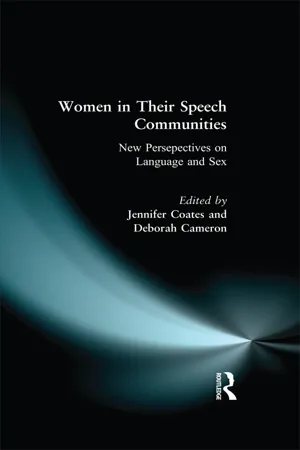
Women in Their Speech Communities
About this book
This collection of essays presents a picture of research on women and language in Britain. The contributors cover a range of British speech communities, linguistic events and settings using approaches from sociolinguistics and discourse analysis.
Information
Part One
Language and Sex in the Quantitative Paradigm
Chapter 1
Introduction
Deborah Cameron
1. Some preliminaries
This introduction attempts to place in context four essays on sex differences in linguistic behaviour at the level of phonology and to a lesser extent grammar. While research on this topic undoubtedly represents a legitimate academic endeavour from the point of view of the pursuit of knowledge, it should be made clear that the framework in which I shall discuss it is to a very large extent a political one. The work which women are currently undertaking on language and sex must reflect, to a greater or lesser extent, the influence of feminism over the past two decades. Feminism has foregrounded issues of gender difference and male dominance in society; it has prompted a concern with putting women ‘on the map’ and a critical reappraisal of pre- and nonfeminist research. Accordingly, my discussion will focus on this feminist project of ‘redressing the balance’, as it has manifested itself in one particular academic field.1
2. The quantitative paradigm
All the essays which make up this section either deal with or exemplify an approach to the study of linguistic variation which has come to be known as the quantitative paradigm. Adherents of this approach adopt varying methods with regard to the collection and manipulation of data, but what defines their work as part of the paradigm is their use of the analytic concept of the linguistic variable. It is this concept which allows sociolinguists to quantify their data and to make correlations between linguistic and social structures.2
A brief example will illustrate the method. Perhaps the best-known exponent of the quantitative paradigm, William Labov, carried out a famous study in three New York City department stores (Labov 1972a). He was interested in the linguistic variable (r) – that is, the fact that in New York City r in postvocalic position can either be pronounced [ɹ] or not at all (these alternatives are known as variants). Labov asked sales staff in the three stores questions which elicited the answer fourth floor – a phrase in which the variable appears twice. Every time a subject pronounced the [ɹ] variant he gave them a score of 1; each time the zero variant was produced he awarded a score of 0. He was thus able to arrive at an overall numerical score for the speakers in each store. The stores he had chosen were ranked by social status from a high-class establishment to a fairly downmarket one. This ranking was reflected in the scores for (r): in New York City it is prestigious to use the pronunciation [ɹ], and Labov found that the higher the status of the store, the higher the score of its staff for (r). A more detailed study of New York City speakers confirmed that the variable (r) was ‘socially stratified’, that is, a speaker’s (r) score could be correlated with their class.
The social stratification of (r) is one example of a sociolinguistic pattern – a statistical regularity which connects linguistic to nonlinguistic variables. It has been found empirically that this regularity is not peculiar to New York City but typical of linguistic variation in urban speech communities generally. For example, Peter Trudgill in his pioneering British study of Norwich English (1974a) found that the variable (ing) – whether the suffix in items like walking is realised as [Iŋ] or [In] – behaved much like (r) in New York City. The salient linguistic variables differ from place to place, but the social stratification pattern recurs.
The early phase of the quantitative paradigm was characterised by a concern to demonstrate a small number of sociolinguistic patterns in a wide range of speech communities. Social stratification is only one of the patterns this research uncovered. Another correlation which regularly appeared was that between rising scores on prestige variants and increasing formality of the speech situation (this is usually referred to as ‘styleshift’). A further important sociolinguistic pattern was associated with the sex of the speaker. When informants in each social class were subdivided by sex, it was typically found that women’s scores were closer to the standard than those of men of the same status.
This particular finding about sex differences was reported in an impressive number of communities, including: rural New England (Fischer 1958); North Carolina (Levine & Crockett 1966; Anshen 1969); New York City (Labov 1966); Detroit (Shuy, Wolfram & Riley 1967); Norwich (Trudgill 1974a); Glasgow (Macaulay 1977); and Edinburgh (Romaine 1978). Not surprisingly, it came to be regarded by sociolinguists as an almost unchallengeable fact about the structure of sociolinguistic variation. Their attention was therefore turned to the matter of explanation: the pattern clearly existed, but why did it exist? Why should women use more standard pronunciation than men?
In fact, the answer to this question and the implications of it are still being debated, and the essays in this section are contributions to the continuing debate. The matter, in other words, is not yet settled; the various competing proposals that have been made about it will be reviewed in much more detail in Chapter 2. What does need to be pointed out here, though, is that by the mid-1970s an explanation of sorts had emerged which commanded widespread agreement and respect. This explanation, championed by the extremely influential Labov and the increasingly respected Trudgill, related women’s more correct or careful speech to their social role as females. This role involved paying attention to appearances and superficial aspects of behaviour to a higher degree than was expected of men (language ‘refinement’ being an aspect of this). It involved responsibility for transmitting the norms of speech to children (something which would make women especially sensitive to correctness and encourage them to ‘set a good example’) and finally, it denied women the opportunity to pursue social status through work in the same way men did (the implication being that if women wished to improve their social standing they would be obliged to focus on markers like accent).
At the time of Labov and Trudgill’s actual field research – the late 1960s – this all must have seemed reasonable enough. But it was soon to be challenged by feminists who criticised almost every aspect of the quantitative paradigm’s dealings with women. The reasons for such feminist dissatisfaction have, unfortunately, very often been misunderstood (especially, it seems, by Trudgill: see Trudgill 1983: Ch. 9), and it is therefore necessary to place them in their wider context. Feminists were not and are not arguing that ‘anything you can do we can do better’ – including nonstandard pronunciation! Rather, their point has been that methodology, measuring instruments and scoring systems, theoretical assumptions and individual interpretations have been, in sociolinguistics as elsewhere, riddled with bias and stereotype; and that this bias must not be ignored, because studies of ‘difference’ are not just disinterested quests for the truth, but in an unequal society inevitably have a political dimension.
3. Sociolinguistics and the feminist critique
3.1 The politics of difference
The description and explanation of gender difference, not only in language but in any sphere whatever, is not a straightforward enterprise; with the emergence of a feminist perspective in the academy as well as outside it, the topic has been rapidly and explicitly politicised. We must remember, of course, that to feminist minds it always was implicitly a political question. For sex – like race – is an area of social relations where dominance has invariably been justified by difference. Male investigators have devoted endless time and trouble to the quest for significant differences between the sexes on which to base their unequal treatment of women.
Thus to take two nineteenth-century examples, it was widely contended that women should not have civil rights (e.g. to own property, to vote, etc.) because they lacked the necessary reasoning faculties. Women’s status as legal minors could be justified on the grounds of their ‘childlike’ mental inferiority (we hear analogous arguments about black people from today’s white South Africans). Similarly, as late as 1873 it was argued that higher education for women would shrivel their reproductive organs and render them sterile. Both these assertions, ridiculous as they now seem, were put forward at the time as ‘scientific fact’ and the results of ‘research’.3 And while discussions of who uses what linguistic variant may well seem less immediately unjust and partisan, these examples from the past should serve to remind us just what is at stake in research on gender difference. The hidden agenda is female inferiority – or put another way, continued male dominance.
The feminist critique of the social sciences which began to gain momentum in the late 1960s has made it its business to seek out and challenge this hidden agenda in social research. The quantitative paradigm in sociolinguistics has by no means escaped the critique’s attentions, and we may look at the complaints which have been levelled against it.
3.2 Invisible, peripheral and ‘deviant’ women
The first complaint made by feminist critics concerns the ‘invisibility’ of women: the way they are excluded from research or at best, defined as peripheral and ‘deviant’. Sociolinguistics, at least in Britain, inherited a tradition of work in dialectology from which women informants were almost completely absent. The Survey of English Dialects provides little information on women speakers, because in the words of Harold Orton – words for which he put forward no evidence at all – ‘men speak vernacular more frequently, more consistently and more genuinely than women’ (Orton, 1962: 15).
While major sociolinguistic studies have usually sampled the speech of both sexes, some classic studies have excluded women, the most notorious being Labov’s work with Black peer groups (Labov 1972a). The speech of men can apparently stand for speech in general, whereas we do not find ‘representative’ studies of all-female groups. The net result is that we know less than we might about women’s speech. Labov has asserted in his defence that ‘males are the chief exemplars of the vernacular culture’ (Labov et. al, 1968: 41): but as Conklin (1973) points out ‘no conclusive evidence has been presented’.
In any case, it all depends what you take the vernacular culture to be. As many feminists have observed, there is a circularity here whereby men’s behaviour is taken as a yardstick and when women behave differently they are perceived to fall short (just as, if we define ‘average height’ as average male height, this will automatically define the majority of women as ‘below average’). If vernacular culture is defined as a property of gangs whose main activities are fighting and ‘hanging out’, and only those linguistic variables are examined which are salient to gang-members, then it is obvious that women’s activities and language will not be described as ‘vernacular’.
In their paper ‘some problems in the sociolinguistic explanation of sex differences’ (Ch. 2), Cameron and Coates discuss a number of instances where women in quantitative sociolinguistic studies have been measured using instruments designed for men. This paper suggests that both traditional socioeconomic indices and conventional criteria for network strength, as well as definitions of vernacular culture, may well be inapplicable to the particular circumstances of women, and that by using them investigators risk losing important information and distorting the results which they do obtain.
3.3 Explaining difference: stereotypes
Both Cameron and Coates and Margaret Deuchar (Ch. 3) draw attention to the inadequate and stereotypical accounts which have been marshalled to explain the classic sociolinguistic pattern of sex differentiation. This is the second main theme of the feminist critique: that researchers attempting to explain, as opposed to merely describing, gender difference, frequently resort to invoking sex stereotypes.
It is worth sorting out some confusions about...
Table of contents
- Cover
- Half Title
- Title Page
- Copyright Page
- Table of Contents
- Preface
- Part One: Language and Sex in the Quantitative Paradigm
- Part Two: Language and Sex in Connected Speech
- Appendix: Transcription notation
- References
- Index
Trusted by 375,005 students
Access to over 1.5 million titles for a fair monthly price.
Study more efficiently using our study tools.
Frequently asked questions
Yes, you can cancel anytime from the Subscription tab in your account settings on the Perlego website. Your subscription will stay active until the end of your current billing period. Learn how to cancel your subscription
No, books cannot be downloaded as external files, such as PDFs, for use outside of Perlego. However, you can download books within the Perlego app for offline reading on mobile or tablet. Learn how to download books offline
Perlego offers two plans: Essential and Complete
- Essential is ideal for learners and professionals who enjoy exploring a wide range of subjects. Access the Essential Library with 800,000+ trusted titles and best-sellers across business, personal growth, and the humanities. Includes unlimited reading time and Standard Read Aloud voice.
- Complete: Perfect for advanced learners and researchers needing full, unrestricted access. Unlock 1.5M+ books across hundreds of subjects, including academic and specialized titles. The Complete Plan also includes advanced features like Premium Read Aloud and Research Assistant.
We are an online textbook subscription service, where you can get access to an entire online library for less than the price of a single book per month. With over 1.5 million books across 990+ topics, we’ve got you covered! Learn about our mission
Look out for the read-aloud symbol on your next book to see if you can listen to it. The read-aloud tool reads text aloud for you, highlighting the text as it is being read. You can pause it, speed it up and slow it down. Learn more about Read Aloud
Yes! You can use the Perlego app on both iOS and Android devices to read anytime, anywhere — even offline. Perfect for commutes or when you’re on the go.
Please note we cannot support devices running on iOS 13 and Android 7 or earlier. Learn more about using the app
Please note we cannot support devices running on iOS 13 and Android 7 or earlier. Learn more about using the app
Yes, you can access Women in Their Speech Communities by Jennifer Coates,Deborah Cameron in PDF and/or ePUB format, as well as other popular books in Languages & Linguistics & Linguistics. We have over 1.5 million books available in our catalogue for you to explore.