- 804 pages
- English
- ePUB (mobile friendly)
- Available on iOS & Android
eBook - ePub
About this book
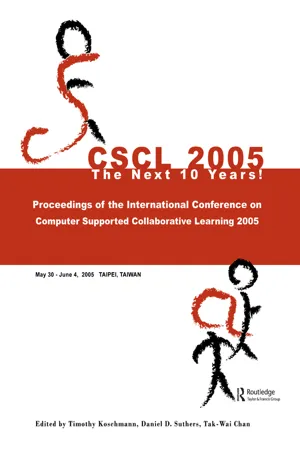
The Computer Supported Collaborative Learning (CSCL) conference has become an internationally-recognized forum for the exchange of research findings related to learning in the context of collaborative activity and the exploration of how such learning might be augmented through technology. This text is the proceedings from CSCL 2005 held in Taipei, Taiwan. This conference marked the 10th anniversary of the first CSCL Conference held at Indiana University in 1995. Subsequent meetings have been held at the University of Toronto, Stanford University, University of Maastricht (Netherlands), University of Colorado at Boulder, and the University of Bergen (Norway).Just as the first CSCL conference was instrumental in shaping the trajectory of the field in its first decade, the conference in Taipei will play an important role in consolidating an increasingly international and interdisciplinary community and defining the direction of the field for the next 10 years. This volume, and the papers from which it is comprised, will be an important resource for those active in this area of research and for others interested in fostering learning in settings of collaboration.
Information
Action Context and Target Context Representations: A Case Study on Collaborative Design Learning
Henrik Artman
Dept. for Numerical Analysis and Computer Science
The Royal Institute of Technology, Sweden
[email protected]
Dept. for Numerical Analysis and Computer Science
The Royal Institute of Technology, Sweden
[email protected]
Robert Ramberg, Hillevi Sundholm, Teresa Cerratto-Pargman
Dept. of Computer-and Systems Sciences
Stockholm University, Sweden
{robban, hillevi, tessy}@dsv.su.se
Dept. of Computer-and Systems Sciences
Stockholm University, Sweden
{robban, hillevi, tessy}@dsv.su.se
Abstract. This paper focuses on the concept of representations produced in the context of collaborative design. More specifically, on the interplay between collaborative creation of sketches (design proposals), and argumentation and negotiation processes taking place in the design activity. The question raised in this paper is how sketches produced during a design session reflect and mediate dialogues and argumentation in the design activity and how the sketches feed into an envisioned use context or vice versa. The concepts of action contextarid target context representations are introduced and used to illustrate shifts of focus during a design session. We have studied a group of students working on a design task in an interactive space for two weeks. The purpose of the study was to investigate how an environment meant to support collaborative work and learning support collaborative and creative learning of interaction design. The results indicate that students attending a course on interaction design did not pay enough attention to target representations. Furthermore the results suggest that "action context representations" to a large extent occupy student activities as a result of either complex technology or as a result of the students thrust to do something instrumental. We suggest that pedagogical programs for collaborative learning of design may relieve some of the mapping, or interplay, of design proposals and the target context representation.
Keywords: Design, Communication, Interactive Spaces, Learning, Representation
Representations as Resources for Action
Collaborative design can be viewed as an activity driven by communicative practices and representations for mediating ideas. In domains such as design, and interaction design in particular, learning goals are often difficult (if not impossible) to define in a precise manner. In this sense, design, interaction design and learning of these domains is often ambiguous and evolving rather than pre-defined. The need to propose, discuss and evaluate different ideas, design proposals, etc. is therefore crucial to learning and practice of design. In professional design, negotiation is a crucial part of the design situation and the student has to appropriate such knowledge to be prepared for this. Designers must learn not only the skill to design visual design, and design that is in line with some general aesthetic principle but also to learn how to negotiate the relation or the interplay between some actual system design and design of use (Arvola & Larsson 2004). Especially, in the conceptual stages of design, negotiations between different designers (system architecture, database designers, interaction design) are important, but also when integrating designs it is important, particularly if the general design concept has not been agreed upon or not been dealt with thoroughly to negotiate and mend the design proposal. In this paper we pose the question of relations between physical sketches and conceptual design imperatives.
In the study of complex situations the concept of representations for action has been suggested (Weill-Fassina, 1993; Rabardel and Dubois, 1993). Representations for action refer to the representations that people have of the situation they are part of and focuses on people's actions, how people act in relation to what others' do and say with or without artefacts. The temporality of the situation is very much dependent upon the communicative acts that people do, for example one might refer to the immediate context or to future or historical situations. Design as an activity is often directed towards the future in that the designed system will be used in some situation apart from the one the designer is in – that is the designer representation for action is, or should be, oriented towards the future. To learn to design is as much of building and communicating a repertoire of motivations for the future use-context as it is to actually build something that fulfils more immediate construction. Interaction designers must have some understanding, or representation if you like, of the interactions that the users will do. Thus the problem a team of designers who design a common object face is on the one hand to coordinate a common representation of the future use situation, and on the other hand a smooth mapping of mediated representations for actions within the context of design activities. We call these contexts target context and action context respectively.
Sketching, drawing, thus representing design ideas and learning to represent ideas have been found to be crucial to the design process and also to development of design ability (Lowgren & Stolterman, 1998). This is what the general design research has focussed on and what we call action context representations, i.e. the use of supportive tools within the design environment and those skills a designer must have in order to make good design proposals in action (Gedenryd, 1998; Lawson, 1997; diSessa & Cobb, 2004). Generally, the arguments are focused on the solitaire designer with much creativity and talent, rather than collaborative efforts and accomplishments within designer teams. We will instead focus on communicative practices which designers use in order to convey ideas and negotiate design (see Sundholm, Artman, Ramberg, 2004; Sundholm, Ramberg, Artman, 2004 where we have discussed creativity in collaborative design). This means that we do not focus on some general mental mechanism, talent or other trait, but rather how team members communicate and negotiate different solutions to an envisioned use situation. We are in this paper especially interested in describing how design can be viewed upon as an oscillation between different forms of design contexts, and how different forms of representations support or undermine collaborative design activities. This motivates a focus on the interplay between collaborative creation of sketches (design proposals), argumentation and negotiation, and how sketches that are created mediate discussions and argumentation and feed into new ones, and to what degree characteristics of artefacts in the environment that are used in the process permit coming to discussions of the target use situation.
Engestrom & Escalante (1996) presented a case where the designers fell in love with their design, the action context representations they created. The design became an idealistic vision, supported by suggestive design proposals and argumentation, which resulted in neglecting practicalities of use. A hypothesis is that inexperienced interaction designers may be immersed in action context representations resulting in that target context representations are not attended to or even ignored. Ideally, a design environment should support designers and design activities to focus on target context representations.
Ilounge – An Interactive Space
At the Royal Institute of Technology in Kista, Sweden, there is an interactive space called the iLounge designed and built to support collaborative work and learning. The room has two large touch-sensitive displays known as Smart boards built into a wall. In front of this wall there is a table with a horizontally embedded touch sensitive plasma screen. This interactive table is large enough for 6 to 8 people to sit around. In one of the corners of the room a smaller table and three chairs are placed in front of a wall-mounted plasma display, enabling a part of the group to work separately. In short, iLounge supports collaboration through; Large screens that can show material that can be viewed and ...
Table of contents
- Cover
- Half Title
- Title
- Copyright
- Contents
- Steering Committee
- Program Committee
- Additional Reviewers
- Sponsors
- Preface
- 1. Action Context and Target Context Representations: A Case Study on Collaborative Design Learning
- 2. (BPN) Coercing Knowledge Construction in Collaborative Learning Environments
- 3. Improving the Coordination of Collaborative Learning with Process Models
- 4. AGQ: A Model of Student Question Generation Supported by One-on-One Educational Computing
- 5. Effective Discussions, Social Talks and Learning: A Paradox on Learning in Discussion Forums
- 6. Animal Companions as Motivators for Teammates Helping Each Other Learn
- 7. MatrixDesks: Interactive Computing Desks toward One-on-Two Educational Computing Environments
- 8. (BSPN) Problem-Based Learning Online: Multiple Perspectives on Collaborative Knowledge Construction
- 9. A Pilot Study of Computer Supported Learning by Constructing Instruction Notes and Peer Expository Instruction
- 10. Measuring Motivation in Collaborative Inquiry-Based Learning Contexts
- 11. (BPN) Analyzing the Quality of Argumentation Supported by Personally-Seeded Discussions
- 12. Why Member Portraits Can Undermine Participation
- 13. ICT Can Recover Collaborative Tutorial Conversation and Position It within Undergraduate Curricula
- 14. Researching "Collaborative Knowledge Building" in Formal Distance Learning Environments
- 15. (BPN) Making a Mesh of It: A STELLAR Approach to Teacher Professional Development
- 16. Designing Collaborative Learning Systems: Current Trends & Future Research Agenda
- 17. (BPN) Supporting CSCL with Automatic Corpus Analysis Technology
- 18. (BPN) A Study of the Foundations of Artifact-Mediated Collaboration
- 19. Effects of an Individual's Prior Knowledge on Collaborative Knowledge Construction and Individual Learning Outcomes in Videoconferencing
- 20. The SENSE Project: A Context-Inclusive Approach to Studying Environmental Science within and Across Schools
- 21. (BSPN) No Need to Read Messages Right Now: Helping Mediators to Steer Educational Forums Using Statistical and Visual Information
- 22. (BPN) The Role of Floor Control and of Ontology in Argumentative Activities with Discussion-Based Tools
- 23. ACT: A Web-Based Adaptive Communication Tool
- 24. The Effects of Electronic Communication Support on Presence Learning Scenarios
- 25. From Parallel Play to Meshed Interaction: The Evolution of the eSTEP System
- 26. The Shape of the Elephant: Scope and Membership of the CSCL Community
- 27. Building Bridges within Learning Communities through Ontologies and "Thematic Objects"
- 28. A New Role for Computer-Mediated Communication in Engaging Teacher Learning within Informal Professional Communities
- 29. Preserving Authenticity in CoLs and CoPs: Proposing an Agenda for CSCL
- 30. V-Share - Video-Based Analysis and Reflection of Teaching Experiences in (Virtual) Groups
- 31. CSCL - The Next Ten Years – A View from Europe
- 32. Design Principles for Online Peer-Evaluation: Fostering Objectivity
- 33. Problem Solving as a Complex, Evolutionary Activity: A Methodological Framework for Analyzing Problem-Solving Processes in a Computer-Supported Collaborative Environment
- 34. Our Way to Taipei - An Analysis of the First Ten Years of the CSCL Community
- 35. (BSPN) Anonymity Options and Professional Participation in an Online Community of Practice
- 36. The Evolution of the Intellectual Partnership with a Cognitive Tool in Inquiry-Based Astronomy Laboratory
- 37. Review of Computer-Mediated Collaborative Concept Mapping: Implication for Future Research
- 38. Weak Guidance with "Look" Functionality in Handheld-Based Classroom Activities
- 39. (BSPN) The Effects of Remote Gesturing on Distance Instruction
- 40. Collaborative Learning through Augmented Reality Role Playing
- 41. Mystery at the Museum - A Collaborative Game for Museum Education
- 42. Progressive Refinement of a CSCL-Based Lesson Plan for Improving Student Learning as Knowledge Building in the Period for the Integrated Study
- 43. (BPN) (BSPN) Internal and External Collaboration Scripts in Web-Based Science Learning at Schools
- 44. A Cognitive Tool in Handheld Devices for Collaborative Learning: Comprehending Procedural Knowledge of the Addition of Common Fractions
- 45. Arguing on the Computer
- 46. A Lightweight Approach for Flexible Group Management in the Classroom
- 47. Information and Communications Technology and Literacy Development
- 48. Language Learning in a Virtual Classroom: Synchronous Methods, Cultural Exchanges
- 49. Assessing Learning Outcomes in CSCL Settings
- 50. (BPN) Students Assessing Their Own Knowledge Advances in a Knowledge Building Environment
- 51. (BSPN) Vulgar Competence, Ethnomethodological Indifference and Curricular Design
- 52. How Representation Matters: Comparing Collaborative Learning with Alternative Versions of Hypermedia
- 53. A Structured Chat Framework for Distributed Educational Settings
- 54. (BSPN) We Learn Better Together: Enhancing eLearning with Emotional Characters
- 55. Cognitive Tutoring of Collaboration: Developmental and Empirical Steps Towards Realization
- 56. CSCL Scripts: Modelling Features and Potential Use
- 57. An Experimental Study on Collaborative Scientific Activities with an Actual/Imaginary Partner
- 58. (BPN) Promotion of Self-Assessment for Learners in Online Discussion Using the Visualization Software
- 59. Designing for Constructionist Web-Based Knowledge Building
- 60. Explicit Referencing in Chat Supports Collaborative Learning
- 61. iTree: Does the Mobile Phone Encourage Learners to be More Involved in Collaborative Learning?
- 62. From CSCL Classroom to Real-World Settings through Project-Based Learning
- 63. Collaborative Scaffolding in Synchronous Environment: Congruity and Antagonism of Tutor/Student Facilitation Acts
- 64. Assessment of Collaboration in Online Courses
- 65. (BSPN) Mediated Chat Development Process: Avoiding Chat Confusion on Educational Debates
- 66. Computer-Supported Collaboration in a Scripted 3-D Game Environment
- 67. Mining Learning Groups' Activities in Forum-type Tools
- 68. Establishing Communities of Practice among Students and Start-Up Companies
- 69. Towards A Design Framework for Mobile Computer-Supported Collaborative Learning
- 70. Implementing Online Collaborative Professional Development for Innovative Educators
- 71. Local and Distributed Interaction in a Collaborative Knowledge Building Scenario
- 72. Supporting Collaborative Discovery Learning by Presenting a Tool
- 73. (BSPN) Experiences with Interactive Lectures – Considerations from the Perspective of Educational Psychology and Computer Science
- 74. The Impact of Role Assignment as Scripting Tool on Knowledge Construction in Asynchronous Discussion Groups
- 75. A New Direction for Log File Analysis in CSCL: Experiences with a Spatio-temporal Metric
- 76. (BPN) Teaching Distributed Software Development with the Project Method
- 77. Non-linear Dynamical Development of CSCL Communities
- 78. Why all CSL is CL: Distributed Mind and the Future of Computer Supported Collaborative Learning
- 79. Fostering Social Presence in Asynchronous Online Class Discussions
- 80. (BSPN) Instructional Methods for CSCL: Review of Case Studies
- 81. Understanding Computer Mediated Social Experience: Implications for CSCL
- 82. A New Method to Assess the Quality of Collaborative Process in CSCL
- 83. Group Cognition: The Collaborative Locus of Agency in CSCL
- 84. How Can We Use Hypervideo Design Projects to Construct Knowledge in University Courses?
- 85. (BPN) Functional versus Spontaneous Roles during CSCL
- 86. Identifying Peer Interaction Patterns and Related Variables in Community-Based Learning
- 87. (BPN) Technology Affordances for Intersubjective Learning: A Thematic Agenda for CSCL
- 88. Using Paper to Support Collaboration in Educational Activities
- 89. A Heterogeneous Animated Platform for Educational Participatory Simulations
- 90. (BSPN) The Effect of Video-Augmented Chat on Collaborative Learning with Cases
- 91. CSC*: Computer Supported Collaborative Work, Learning, and Play
- 92. Exploring Collaborative Aspects of Knowledge Building Through Collaborative Summary Notes
- 93. (BPN) Towards a Dialogic Understanding of the Relationship between CSCL and Teaching Thinking Skills
- 94. Computer-Supported Collaborative Learning in Higher Education: Scripts for Argumentative Knowledge Construction in Distributed Groups
- 95. Macroscopic Study of the Social Networks Formed in Web-based Discussion Forums
- 96. Story-Lines: A Case Study of Online Learning Using Narrative Analysis
- 97. Advanced Digital Video Technologies to Support Collaborative Learning in School Education and Beyond
- 98. (BPN) Usability as an Interactional Resource: Deictic Management of Scene Formulation
- 99. Texts-In-Interaction: Collaborative Problem-Solving in Quasi-Synchronous Computer-Mediated Communication
- 100. Analyzing and Supporting Collaboration in Cooperative Computer-Mediated Communication
- Subject Index
- Author Index
Trusted by 375,005 students
Access to over 1.5 million titles for a fair monthly price.
Study more efficiently using our study tools.
Frequently asked questions
Yes, you can cancel anytime from the Subscription tab in your account settings on the Perlego website. Your subscription will stay active until the end of your current billing period. Learn how to cancel your subscription
No, books cannot be downloaded as external files, such as PDFs, for use outside of Perlego. However, you can download books within the Perlego app for offline reading on mobile or tablet. Learn how to download books offline
Perlego offers two plans: Essential and Complete
- Essential is ideal for learners and professionals who enjoy exploring a wide range of subjects. Access the Essential Library with 800,000+ trusted titles and best-sellers across business, personal growth, and the humanities. Includes unlimited reading time and Standard Read Aloud voice.
- Complete: Perfect for advanced learners and researchers needing full, unrestricted access. Unlock 1.5M+ books across hundreds of subjects, including academic and specialized titles. The Complete Plan also includes advanced features like Premium Read Aloud and Research Assistant.
We are an online textbook subscription service, where you can get access to an entire online library for less than the price of a single book per month. With over 1.5 million books across 990+ topics, we’ve got you covered! Learn about our mission
Look out for the read-aloud symbol on your next book to see if you can listen to it. The read-aloud tool reads text aloud for you, highlighting the text as it is being read. You can pause it, speed it up and slow it down. Learn more about Read Aloud
Yes! You can use the Perlego app on both iOS and Android devices to read anytime, anywhere — even offline. Perfect for commutes or when you’re on the go.
Please note we cannot support devices running on iOS 13 and Android 7 or earlier. Learn more about using the app
Please note we cannot support devices running on iOS 13 and Android 7 or earlier. Learn more about using the app
Yes, you can access Computer Supported Collaborative Learning 2005 by Timothy Koschmann in PDF and/or ePUB format, as well as other popular books in Education & Education General. We have over 1.5 million books available in our catalogue for you to explore.