eBook - ePub
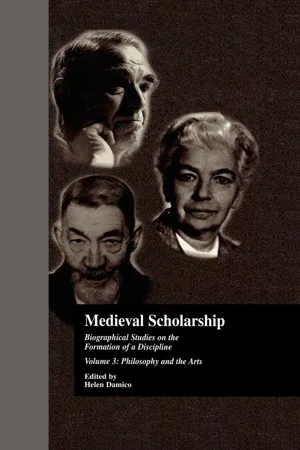
Medieval Scholarship
Biographical Studies on the Formation of a Discipline: Religion and Art
- 368 pages
- English
- ePUB (mobile friendly)
- Available on iOS & Android
eBook - ePub
Medieval Scholarship
Biographical Studies on the Formation of a Discipline: Religion and Art
About this book
This is the third of a three-volume set on medieval scholarship that presents original biographical essays on scholars whose work has shaped medieval studies for the past four hundred years. A companion to Volume 1: History and Volume 2: Literature and Philology, Volume 3: Philosophy and the Arts covers the lives of twenty eminent individuals-from Victor Cousin (1792-1867) to Georges Chehata Anawati (1905-1994) in Philosophy; from H.J.W. Tillyard (1881-1968) to Gustave Reese (1899-1977) in Music; and from Alois Riegl (1858-1905) to Louis Grodecki (1910-1982) in Art History-whose subjects were the art, music, and philosophical thought of Europe between 500-1500. The scholars of medieval philosophy strove to identify the nexus of philosophical truth, whether they were engaged in the clash of the Christian church and secular republicanism as reflected in the tension between theology and philosophy, in addressing the conflicting perceptions of Muslim identity, or in defining Jewish philosophical theology in non-Jewish culture. Medieval musicologists, who are included as the subjects of the essays, pioneered or recontextualized traditional views on the definition of music as subject matter, on the relationship between music and philosophical concepts, on interpretative distinctions between secular and sacred music, monophony and polyphony, and concepts of form and compositional style. The art historians treated in this volume not only overturn the view of medieval art as an aesthetic decline from classical art, but they demonstrate the continual development of form and style inclusive of minor and major arts, in textiles, architecture and architectural sculpture, manuscripts, ivory carvings, and stained glass. The philosophers, musicologists, and art historians who appear in Volume 3 worked in three newly-emerging disciplines largely of nineteenth-century origin. In their distinguished and extraordinary output of energy in scholarly and academic arenas, they contributed significantly to the emergence and formation of medieval studies as the prime discipline of historical inquiry into and hence the key to understanding of the human experience.
PHILOSOPHY
INTRODUCTION
The approaches to medieval philosophy taken by many of the scholars profiled in this book were affected by politics, in one form or another. Seeking to provide answers to the problems of their day in the medieval past, they left equivocal legacies to more recent medievalists who study the period for different reasons. In the history of philosophy the boundary between “medieval” and “modern” when they wrote was the divide between “religious” and “secular.” And religion, whether in the confessions of Christian churches, the conflicting conceptions of Muslim identity, or the self-understanding of Jews in the non-Jewish world, was embroiled in contestations with Enlightenment rationalism and its nineteenth-century sequels and with twentieth-century fascism and communism. That this situation should have conditioned the work of these major framers of the study of medieval philosophy is not surprising. Less predictable are the ways in which their approaches to the subject were later appropriated.
The essay on Victor Cousin flags how accidental his contribution to medieval studies actually was. Amid the flux of French revolutionary politics, he created a safe haven for his research through an eclecticism that disinclined him from locating truth in any one philosophical school or figure. Still, his nationalism led him to view the history of philosophy as the triumph of French thinkers, causing him to seize on Abelard and to exaggerate his significance. But Cousin also launched the critical edition of Abelard’s works. While Cousin’s periodization and characterization of medieval philosophy have not survived, his stress on the importance of critical editions has. And Abelard continues to draw disproportionate attention if for a host of reasons that have nothing to do with nationalism.
It is not just the clash between the church and secular republicanism that contextualizes the work of the Catholic scholars in this volume but also the timing of their careers in relation to internal developments in their church, most notably Pope Leo XIII’s launching of a neo-Thomist revival. The sense of being present at the creation, or at most, the creation plus one generation, deeply influenced scholars like Maurice De Wulf and Étienne Gilson, each of whom professed Thomism as the definitive philosophy, deemed to have superseded all its precursors and to have solved in advance the problems of the modern world. The felt need to defend the relevance of medieval thought as leading up to the Thomist synthesis of reason and revelation and to criticize thinkers after Thomas who departed from it united these two scholars. But it did not prevent them from taking sharply divergent positions on what medieval philosophy really was: philosophy tout court, whose practitioners’ religious beliefs were irrelevant to their philosophy, in De Wulf’s case, or philosophy enriched and informed by revelation, in Gilson’s. The message their books were designed to convey, especially to Francophone readers, was that religious belief was no bar to full citizenship in the republic, or the republic of letters. Further, the “integral humanism” Gilson promoted, along with Jacques Maritain (1882–1973), sought to offer a corrective to a society that, in abandoning metaphysics, had abandoned God, and hence had abandoned man. While the transatlantic side of Gilson’s career was not motivated by a need to escape European fascism, as was the case with some of the emigré literary scholars such as Ernst Robert Curtius and Erich Auerbach discussed in Volume 2 of this series, his defense of “integral humanism” as a rationale for his brand of Thomism shared something of the character of the rescue operation many of those literary scholars thought they needed to perform for the Western humanistic tradition.
In assessing the legacy of De Wulf and Gilson, readers should note that the authors of the essays on these figures are themselves proponents of their traditions. Fernand Van Steenberghen shares with De Wulf the tendency to emphasize those medieval philosophers whose work leads up to or shares in the Thomist paradigm. Like De Wulf he conceives of medieval philosophy as having a history distinct from theology. But with the exception of formal logic, which Van Steenberghen does not mention here, the felt need to defend the study of medieval thought in these terms has lost some of its cogency in recent scholarship on medieval philosophy in general and on Aquinas in particular. True, some carryover of the De Wulf-Van Steenberghen approach can be found in recent publications as, for example, Anthony Kennys Aquinas. But more typical is the desire to recover Aquinas the speculative theologian as discussed in Mark D. Jordans Ordering Wisdom and in Brian Davies’s The Thought of Thomas Aquinas.
Writing under the eaves of the Pontifical Institute of Mediaeval Studies which Gilson was instrumental in founding, and which thrives happily today, Edward A. Synan emphasizes correctly that Gilson placed medieval philosophy on a firmer and broader historical foundation than any scholar before his time. He also succeeded in incorporating theology into philosophy, sensitive, in particular, to the critical metaphysical questions raised for medieval thinkers by the revealed traditions of Christianity, Judaism, and Islam. While disagreeing with De Wulf on this last point, Gilson’s story line remained “the medieval synthesis and its disintegration.” To be sure, Gilson was more generous in treating medieval figures who were not stars in the Thomist or proto-Thomist scenario but who could not be written out of the script. At the same time, he tends to reformulate their thought in Thomistic terms. Thus, in his The Christian Philosophy of Saint Augustine, Gilson makes the table of contents of Thomas’s Summa theologiae his organizing principle, reassembling Augustine’s ideas according to that scheme. In his The Philosophy of St. Bonaventure, Gilson constantly compares Bonaventure with Thomas, making Thomas the reference point. Gilson aims at, and succeeds in, shedding his Thomist spectacles best in The Mystical Theology of Saint Bernard. Here, he recognizes in Bernard of Clairvaux an authentic anti-scholastic who has to be taken on his own terms.
Another kind of political and ecclesiastical agenda affected the career of Marie-Dominique Chenu. A Dominican, formed by a Thomistic education, he inherited a thoroughly historical and contextual approach to Thomism from his predecessor at Le Saulchoir, Pierre Mandonnet. In forwarding that enterprise, Chenu in that sense was not breaking fresh ground in opposing other neo-Thomists who opted for the atemporal “perennial philosophy” approach to Aquinas. What temporarily derailed him, rather, was his support for the Christian worker and worker-priest movements that smacked of Godless communism to his ecclesiastical superiors. But here, as is often the case with the victims of would-be censors, the wider scholarly world benefited when Chenu was benched as a seminary professor. For his move to the École pratique des hautes études in Paris made his ideas and methods available to researchers at the summit of the French secular educational establishment, where they continue to bear rich fruit. Chenu may have embraced the historical approach to medieval thought because, as a theologian, he held that doctrine has to incarnate itself, repeatedly, in the language and thought patterns of successive ages. His outlook has been validated and advanced in the work of the host of nontheological scholars whom he taught and inspired.
Politically vindicated by his church in Vatican Us decree on the church and the modern world, Chenu’s ongoing influence on the study of medieval thought can be seen at a number of points that go well beyond his richly contextual studies of Aquinas and thirteenth-century Scholasticism. Unlike many of his predecessors, Chenu took a stand on the wider interpretive issues facing medievalists in the mid-twentieth century. Not content merely to enlist in the ranks of medievalists contesting the dispraise of their period as the “Dark Ages,” as did several historians profiled in Volume 1 of this series, he also criticized Charles Homer Haskins’s conception of the twelfth-century Renaissance by showing that its flowering could not be grasped fully without appreciating the religious revival marking that age. In this sense, his most important current followers are Richard W. Southern, as demonstrated in his 1953 study The Making of the Middle Ages, and Giles Constable in his work, The Reformation of the Twelfth Century. No less significantly, in his seminal essay on grammar and theology in the twelfth century, Chenu was one of the first scholars to grasp the importance of speculative grammar, semantic theory, and logic as a field in which medieval thinkers made important new discoveries taking them well beyond the classical philosophy they inherited, discoveries creative in their own right as well as in their application to theological arguments. Here, Jean Jolivet, far too modestly, soft-pedals his own outstanding contributions to developing this insight in his works Godescalc d’Orbais et la Trinité: La méthode de la théologie à l’époque carolingienne, Abélard ou la philosophie dans le langage, and Arts du langage et théologie chez Abélard.
Another figure whose contribution endures more fully than that of De Wulf and Gilson although he also received his education at the dawn of the neo-Thomist revival is Martin Grabmann. As a German, he could ignore the stand-off between the Catholic Church and republican or left-wing politics across the Rhine. But, as a German, he might have found himself caught in the crossfire of the second Reich’s Kulturkampf in which Catholicism was stigmatized in some quarters as an archaic and unpatriotic throw-back to the Grossdeutsch empire centered at Vienna that the newly unified Germany had just rejected. Several circumstances enabled Grabmann to proceed with his own scholarly project while sidestepping such polemics. First, his initial doctoral studies prepared him in both theology and philosophy, both of which he taught at Vienna; he thus avoided the narrower outlook of many contemporaries. Second, Grabmann was among the first medievalists in his field to receive expert palaeographical training, a fact undergirding his conviction that editing texts from unpublished manuscripts was a professional necessity. And, given that his whole teaching career was spent in regions where Catholicism was the majority religion, he felt no need to develop a defensive strategy in order to justify his scholarly agenda. In Grabmann medieval scholarship acquired a founder whose ideas were fully capable of weathering the transition from his own time and place to our own, just as well as Chenu’s. For Grabmann, Scholasticism was not a set of doctrines—Thomist, Augustinian, Aristotelian, Neoplatonic—that united medieval thinkers, giving them their project and modern historians a predetermined story line. Rather, Scholasticism was a set of intellectual methods, whose development and use cut across other categories. Grabmann was, to be sure, an admirer of Aquinas. But his aim was less to insist on the normative value of Thomas’s solutions, for all times and places, than to learn, from Thomas, how to be as up-to-date and open-minded a Christian thinker in the present day as Thomas was in his. Finally, with Chenu, Grabmann was sensitive to the creative and post-Aristotelian aspects of medieval philosophy as well as to its receptive aspects. As Philipp W. Rosemann notes, Grabmann wrote with seminal effect on medieval logic and semantics in his 1951 article entitled “Die Geschichte der mittelalterlichen Sprachphilosophie und Sprachlogik.” In this and other ways, Grabmann joins Chenu in being the only neo-Thomist included in this volume whose work retained full viability after the age of Vatican II, when the neo-Thomists of the strict observance lost their primacy in Catholic intellectual circles.
In understanding how that shift occurred, the work of two other scholars treated in this volume is central. Neo-Thomists believed, with Dante, that Aristotle was “the master of those who know,” the exemplar of the “reason” that Thomas had joined to revelation. It was the separation of reason from revelation and the progressive criticism of Aristotle in various areas, from logic to epistemology to physics, that led to the disintegration of medieval thought after Thomas. Many of the figures responsible for that outcome were followers of John Duns Scotus (ca. 1266–1308) and William of Ockham (ca. 1285-ca. 1349), Franciscans who were far more influential in the later Middle Ages than Thomas, even though his own order closed ranks and made the defense of his positions obligatory for Dominicans. For neo-Thomists, it was necessary to mention Scotists and Ockhamists as the naysayers who were the beginning of the end. But interest in their thought more or less stopped there. In this setting the career of Philotheus Boehner marked a real turnaround. As noted in Gedeon Gal’s essay in this volume, political accident, the outbreak of World War II, led him to stay in North America and to found the Franciscan Institute at St. Bonaventure University, a body that perpetuated his work. Having completed the critical edition of Ockham, its members continued to contribute to critical editions of Scotus and other Franciscans. Boehner was also aware of Ockhams originality as a logician, and of the other post-Aristotelian aspects of his thought, an insight that continues to inform more recent assessments of him, as exemplified in Marilyn McCord Adams’s 1987 study, William Ockham. Here, we can see a parallel with Chenu. While Boehner was initially dismissed by the neo-Thomist establishment as developing his scholarly agenda merely out of partisan Franciscan zeal, in the wider, and more recent, scholarly community his work has been thoroughly vindicated.
Almost equally enduring, and for some of the same reasons, is the contribution of Pierre Duhem. In some respects he can be compared with Cousin: both scholars reflected nationalism in focusing on medieval thinkers who were French or who studied and taught at Paris even though similar ideas can be found in thinkers at other centers or from other countries. Still, most of Duhem’s working principles remain as fresh and pertinent today as when he wrote. First, for the new subdiscipline of history of science, he laid down the qualifications required of its medievalist researchers: now, as then, they must be schooled in “real science” as well as history, philosophy, and theology. Second, his argument that it was the High Middle Ages that launched the criticism of Aristotle’s worldview that was to culminate in the Newtonian revolution has been sustained, although recent scholars now push back the date to the thirteenth century and the work of Oxonians like Robert Grosseteste and Roger Bacon, noting its connection with the theories of the fourteenth-century Parisian physicists whom Duhem emphasized. Finally, while John Murdoch rightly observes that neither historians of science nor intellectual historians today share Duhem’s view that logic was unimportant to the development of the post-Aristotelian outlook, Murdoch is equally correct in noting that Duhem grasped the relevance to scient...
Table of contents
- Cover
- Half Title
- Title
- Copyright
- Contents
- Preface
- Photograph Credits
- Contributors
- Part I. Philosophy
- Part II. Musicology
- Part III. Art History
- Index
Trusted by 375,005 students
Access to over 1.5 million titles for a fair monthly price.
Study more efficiently using our study tools.
Frequently asked questions
Yes, you can cancel anytime from the Subscription tab in your account settings on the Perlego website. Your subscription will stay active until the end of your current billing period. Learn how to cancel your subscription
No, books cannot be downloaded as external files, such as PDFs, for use outside of Perlego. However, you can download books within the Perlego app for offline reading on mobile or tablet. Learn how to download books offline
Perlego offers two plans: Essential and Complete
- Essential is ideal for learners and professionals who enjoy exploring a wide range of subjects. Access the Essential Library with 800,000+ trusted titles and best-sellers across business, personal growth, and the humanities. Includes unlimited reading time and Standard Read Aloud voice.
- Complete: Perfect for advanced learners and researchers needing full, unrestricted access. Unlock 1.5M+ books across hundreds of subjects, including academic and specialized titles. The Complete Plan also includes advanced features like Premium Read Aloud and Research Assistant.
We are an online textbook subscription service, where you can get access to an entire online library for less than the price of a single book per month. With over 1.5 million books across 990+ topics, we’ve got you covered! Learn about our mission
Look out for the read-aloud symbol on your next book to see if you can listen to it. The read-aloud tool reads text aloud for you, highlighting the text as it is being read. You can pause it, speed it up and slow it down. Learn more about Read Aloud
Yes! You can use the Perlego app on both iOS and Android devices to read anytime, anywhere — even offline. Perfect for commutes or when you’re on the go.
Please note we cannot support devices running on iOS 13 and Android 7 or earlier. Learn more about using the app
Please note we cannot support devices running on iOS 13 and Android 7 or earlier. Learn more about using the app
Yes, you can access Medieval Scholarship by Helen Helen Damico in PDF and/or ePUB format, as well as other popular books in History & Historiography. We have over 1.5 million books available in our catalogue for you to explore.