- 112 pages
- English
- ePUB (mobile friendly)
- Available on iOS & Android
eBook - ePub
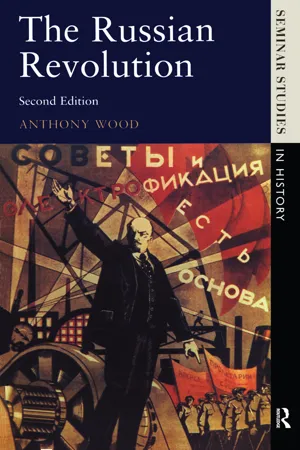
The Russian Revolution
1 The setting
Tsarist Russia
The empire of Tsar Nicholas II, which was to be the scene of revolution in 1917, stretched across the vast expanse of European Russia and beyond the Urals to the sparsely populated plains of Siberia and the Far East. Even at the end of the nineteenth century this was still predominantly an agricultural country, and the two main features of Russian society were a hereditary class of slightly more than a million landed nobility and a peasantry who by the census of 1897 numbered 97 million out of a total population of approximately 110 million.
Until 1861 the majority of these peasants had been serfs who had maintained themselves by farming strips of their lords’ land in return for labour service or a money payment, but with the emancipation of that year a portion of the landowners’ estates had been made over to them – rather more than half in the poorer districts, considerably less in the rich black earth region of the south. Each village commune, which was the centre of peasant life, was to hold its allocation of this land in collective ownership. Thus, since the state had initially supplied the bulk of the financial compensation received by the landowners, the commune was made responsible for the repayment of this debt to the government in annual redemption dues over the subsequent forty-nine years, and within the commune the individual peasant paid his share of these dues according to the number of scattered strips allotted to his household at meetings of the village elders (52).
Although the abolition of serfdom was rightly hailed as a great reform, it did not end the separate legal status of the peasant within Russian society. The communal responsibility for the redemption payments also meant that until their abolition in 1905 he was as tied to the commune as he had been formerly to his master, and the more enterprising peasant who wished to clear his redemption debt and to extend and consolidate his holdings was often obstructed by the need for the consent of two-thirds of the village assembly . Still, by 1905 it was reckoned that one-tenth of the peasantry – the richer farmers known as the kulaks – held about a third of the commune land, and since some of these were able to buy or rent additional fields from the local nobility, the peasantry as a whole were farming about three-quarters of all the cultivable land available. Even this, however, was inadequate to resolve two further difficulties. First, unscientific methods and poor equipment on the open fields made it difficult to gain a yield sufficient to meet a heavy burden of taxation and redemption dues. Second, the enormous growth of the peasant population in the last half of the nineteenth century naturally created a land hunger within the areas controlled by the communes. The number of poor farmers and landless agricultural labourers was steadily rising and although the Stolypin reforms after 1906 (see p. 21) eased the problem a little, the estates of the Crown, the Orthodox Church and the nobility were to be a tempting prize, once public order had begun to break down after the revolution of February 1917 (50).
The middle class of professional men and merchants had always been small in Russia and still amounted to little more than half a million in 1897. In the last decades of the nineteenth century, however, a remarkable industrial growth suggested that Russia was beginning to move towards a western type of economy. Between 1875 and 1913 the output of coal multiplied some fourteen times, that of pig-iron some nine times. Much of this was stimulated by an immense railway boom which had brought the total length of track from 1,626 kilometres in 1860 to 30,539 kilometres by 1890, and in the following year work began on the building of the Trans- Siberian railway. The most rapid development was in the oil industry in the Caucasus, where output increased five times in the twenty years after 1885 (42).
The state gave encouragement to all this expansion, particularly while Count Sergei Witte was minister of finance from 1892 to 1903. Industry was protected by tariffs; domestic loans were floated; the government invested from national revenue and 67 per cent of Russian railways were state-owned by 1904. The shortage of capital, however, remained the major difficulty. Accordingly, in 1897 Witte put the rouble on the gold standard as a means of attracting money from abroad and by 1914 some 2,000 million roubles of foreign capital had been invested in Russia.
By the turn of the century there were perhaps some three million industrial workers, still only a tiny proportion of the total population. The primitive processes in many of the industries made them highly labour-intensive and demanded the concentration of great numbers of workers in large units of production – particularly in mining and metallurgy. At this stage of her industrial revolution Russia reflected many of the characteristics of a similar development earlier in western Europe. A law of 1897 had restricted the adult working day to eleven and a half hours and a somewhat ineffective system of factory inspection had been set up, but working and living conditions in the slums of the cities were often appalling and trade unions and strikes were still illegal.
This economic and social backwardness was matched by a system of government that lacked all the constitutional refinements of the west. It consisted of an autocracy exercised by the Tsar through the army, the police and the bureaucracy. The position of the monarchy was buttressed by the Russian Orthodox Church and by the loyalty of the land-owning nobility, from whom the main executive posts were filled, and the decrees of the Tsar were passed down from his ministers, whom he could appoint and dismiss at will, to provincial governors and town commandants in the large cities.
The period of reform in the reign of Alexander II (1855–81) had brought about some minor modification of this. An element of popular representation in local government had been introduced, when elective assemblies were set up at district and provincial levels in thirty-four provinces of European Russia. The system of voting for the district zemstvos, as they were called, was based on the class divisions in Russia, in that the nobles, townspeople and peasantry each chose their own representatives in separate electoral colleges, the peasantry by three stages; the provincial zemstvos were elected by the district assemblies. These bodies were allowed to raise their own revenue and were responsible for matters such as health, prisons and schools, but much of their activity was supervised by the bureaucracy. In 1870 a similar arrangement was extended to the cities which were granted the right to elect municipal councils, the franchise being based on a property qualification. These then appointed a mayor and an executive committee, who would concern themselves with local administration, although the choice of mayor had to be confirmed by the minister of the interior who also retained control over their police.
In addition to this, Alexander II had attempted to modernize the judicial system, and by a decree in 1864 a regional court was established in each province to deal with civil and criminal cases. Judges, appointed by the minister of justice, were to be irremovable, and trials were to be by jury and to be heard in public. All this only affected a small section of the population, since the separate legal status of the peasantry meant that they were answer- able to their own volost court. At a district level, however, justices of the peace, elected by the zemstvos, were to deal with minor offences which did include cases involving the peasantry.
Naturally the reformers had hoped that these changes might be a prelude to the eventual establishment of a constitutional monarchy, but the only developments in the reign of Alexander III (1881–94) pointed in the other direction. In 1889 the position of justice of the peace was largely abolished and replaced by a land commandant, usually a civic official or a military or naval officer, who could exercise considerable control over the volost court and the communes. The powers of the zemstvos, too, were greatly restricted, and peasant representation in them was reduced, while in the cities the property qualification for the electors of the municipal councils was raised. In this atmosphere the likelihood of achieving the ultimate aim – the establishment of a parliamentary institution at a national level – appeared utterly remote.
Clearly much would depend upon the personality of the new Tsar who succeeded Alexander III in 1894 at the age of twenty-six. Nicholas II was a man of great personal charm, deeply religious and devoted to his family (90). He could be resolute, as he had shown when he had insisted upon marrying Princess Alix of Hesse- Darmstadt against the initial objections of his father. Unfortunately this quality of determination was marred by a sensitivity that inhibited him from openly opposing views with which he disagreed, and his ministers and officials could never be sure of his genuine acceptance of their advice, nor even of their own tenure of office. On one issue, at least, Nicholas did not leave them long in doubt. At the beginning of his reign the provincial zemstvo of Tver addressed an appeal to him for an extension of representative institutions. ‘I am informed’, said Nicholas in his reply, ‘that recently in some zemstvo assemblies voices have made themselves heard from people carried away by senseless dreams about participation by representatives of the zemstvo in the affairs of internal government; let all know that I, devoting all my strength to the welfare of the people, will uphold the principle of autocracy as firmly and as unflinchingly as my late unforgettable father.’ For Nicholas the autocracy was sacrosanct, a responsibility divinely entrusted to him, and the note of finality in his statement created an obstacle for the reformers that was to frustrate them until the last hours of the monarchy.
The Antecedents of Russian Revolutionary Thought
The vigilance of the Tsarist police in defence of the autocracy had given a special flavour to the political movements at work in Russia throughout the nineteenth century. They had had to be carried on in an atmosphere of conspiracy, and since their exponents lacked any practical experience in government, they tended towards an intellectual theorizing which was often radical and Utopian. In the main there were two general bodies of ideas, each inspired by a different response to the peculiar character of Russian history (31). The first of these demanded that Russia should shed her strange semi-Asiatic past and attempt to catch up with the west. The westernizers conceived this largely in technological terms – hence their liking for Peter the Great; they were not necessarily concerned with western types of constitutional development, although their attitude clearly influenced later Liberals who hoped for the growth of a parliamentary system of government. The second current of thought, known as Slavophil, strongly opposed any emulation of the west. The Slavophils regarded western institutions as alien to the spirit of Russia and they placed an almost mystical faith in the Russian peasant whose communal system of village life suggested the true foundation on which the future for Russia must rest.
Among the first to give intellectual shape to these vague aspirations in Russia was Alexander Herzen, originally a westernizer who emigrated to Paris and thence to London, grew disillusioned with what he saw there, and in 1857 began publishing his periodical The Bell, in which he sought to dissuade Russians from succumbing to the insidious example of the west. Initially Herzen made a considerable impact on the restless generations growing up in the 1860s and their response was to be seen in the Populist movement which dreamed of the liberation of the peasantry in a democratic Socialist society.
This was not to be based on any western model. The Populists believed that Russia must find a solution in harmony with her peasant institutions. Their vision of the future was a multiplicity of independent communes, each concerned with its own local industry and agriculture, and sufficiently small for the inhabitants to be saved from the depersonalizing effects of working in vast factories. They hated the thought of a monolithic state power and they maintained that once the revolution had occurred, the state would automatically wither away, although they were unsure of the precise stages by which this would happen. Despite these revolutionary objectives, however, most of the Populists maintained that the great transformation must come in its own time as a spontaneous manifestation of the will of the peasantry. Until then they intended simply to concentrate on propaganda and under Peter Lavrov and Nikolai Chaikovsky associations of university students were formed to encourage the dissemination of their ideas (40).
This patient approach did not appeal to all Populists and throughout the 1860s a far more extreme wing of the movement, known as Russian Jacobins, produced a highly significant series of statements (38). In September 1861 there was a proclamation by Mikhail Mikhailov, in 1862 a manifesto entitled Young Russia by Peter Zaichnevsky, in 1863 a novel What is to be done? by Nikolai Chernyshevsky, in 1868 A Programme of Revolutionary Action by Sergei Nechaev, followed later by A Revolutionary Catechism, and in 1874 The Tasks of Revolutionary Propaganda in Russia written by Peter Tkachev in Zurich (41). These spokesmen, who mostly died in prison or in exile, were not an organized group. Nevertheless, although the points that they’Stressed varied a little, there is an extraordinary consistency in their doctrine which combined fanaticism with a cold realism. Essentially they conceived a leadership in the hands of a small élite of professional revolutionaries; for Chernyshevsky these would be men of a totally superior type, puritanical and disciplined in their dedication to the cause; in Nechaev’s Catechism they could employ any means with utter ruthlessness to attain their ends. ‘Hard with himself, he must be hard with others.’ The aim of this élite should be to inspire an immediate revolution in which the peasantry would overthrow the existing regime. There was to be no waiting for spontaneity, since this might entail so long a delay that a western type of capitalism would become strongly entrenched in Russia, bringing with it the destruction of the peasant commune. Furthermore, the state would not wither away as soon as the revolution had been accomplished, since the ruling élite would need the governmental apparatus as a means of enforcing the full realization of a Socialist society [doc. 2].
Lavrov hotly contested these views, which he declared could only lead to dictatorship, and for the moment the mainspring of Populist fervour remained a heady idealism. Its climax came in the summer of 1874, when swarms of university students calling themselves Narodniki – the men of the people – descended upon the peasantry in the countryside. Their aim was to preach the new gospel of liberation, but many of them seemed also to have had hopes of assimilating themselves with the peasantry, sharing the hardships and simplicity of their way of life. The outcome was almost total disillusionment. They discovered that the peasant was not the earthy saint that they had imagined; he was not even a Socialist and their efforts to improve his lot were only greeted with suspicion and derision.
Many of the Narodniki were arrested; the rest of them under the leadership of M. A. Natanson and George Plekhanov, the son of a small landowner, attempted in 1876 to set up a more formal organization, entitled ‘Land and Liberty’, whose aim was to encourage an insurrection which would give all land to the peasantry. Before long, however, sterner counsels had prevailed. Radicals in the party, despairing of any assistance from liberals in the zemstvos, demanded a policy of terrorism, to be carried out by a small group of dedicated revolutionaries. At a secret congress at Voronezh in 1879 Plekhanov and Paul Akselrod were unable to defeat these proposals; the terrorists now took over the movement, calling themselves the People’s Will, and during the next few years built up an impressive record of assassination, including Tsar Alexander II in 1881.
Shortly after this split Plekhanov and Akselrod withdrew into self-imposed exile in Geneva. They had by this time lost faith in the revolutionary potential of the Russian peasantry and with this abandonment of Populism turned instead to Marxism. Karl Marx was a German Jew who in 1849 had established himself in London, where he devoted the rest of his life to an analysis of the laws which governed the development of society. He was a man of immense erudition and intellectual power, who, although no politician himself, was a source of inspiration for most Socialist bodies of his day and before his death in 1883 he had seen the emergence of large Marxist Social Democrat parties in most western European countries (36).
It is, nevertheless, important to distinguish between Marx and Marxism. Although dogmatic in utterance, he preserved a remarkable flexibility in his ideas; principally he was concerned with a new way of looking at things, rather than with providing any rule-of- thumb solutions, and he was often appalled at the oversimplifications made by his followers. But mass movements do not thrive on intellectual subtleties and Marx himself rather added to the difficulties of interpretation by leaving a good deal of his major writings incomplete. Capital was only the first part of a much larger unfinished work, of which his associate Engels put together two further volumes after his death, and much else was not published until long after the Russian revo...
Table of contents
- Cover Page
- Half Title page
- Title Page
- Copyright Page
- Contents
- Introduction To The Series
- Acknowledgements
- Foreword
- Part One: The Background
- Part Two: Descriptive Analysis
- Part Three: Assessment
- Part Four: Documents
- Bibliography
- Index
Trusted by 375,005 students
Access to over 1.5 million titles for a fair monthly price.
Study more efficiently using our study tools.
Frequently asked questions
Yes, you can cancel anytime from the Subscription tab in your account settings on the Perlego website. Your subscription will stay active until the end of your current billing period. Learn how to cancel your subscription
No, books cannot be downloaded as external files, such as PDFs, for use outside of Perlego. However, you can download books within the Perlego app for offline reading on mobile or tablet. Learn how to download books offline
Perlego offers two plans: Essential and Complete
- Essential is ideal for learners and professionals who enjoy exploring a wide range of subjects. Access the Essential Library with 800,000+ trusted titles and best-sellers across business, personal growth, and the humanities. Includes unlimited reading time and Standard Read Aloud voice.
- Complete: Perfect for advanced learners and researchers needing full, unrestricted access. Unlock 1.5M+ books across hundreds of subjects, including academic and specialized titles. The Complete Plan also includes advanced features like Premium Read Aloud and Research Assistant.
We are an online textbook subscription service, where you can get access to an entire online library for less than the price of a single book per month. With over 1.5 million books across 990+ topics, we’ve got you covered! Learn about our mission
Look out for the read-aloud symbol on your next book to see if you can listen to it. The read-aloud tool reads text aloud for you, highlighting the text as it is being read. You can pause it, speed it up and slow it down. Learn more about Read Aloud
Yes! You can use the Perlego app on both iOS and Android devices to read anytime, anywhere — even offline. Perfect for commutes or when you’re on the go.
Please note we cannot support devices running on iOS 13 and Android 7 or earlier. Learn more about using the app
Please note we cannot support devices running on iOS 13 and Android 7 or earlier. Learn more about using the app
Yes, you can access The Russian Revolution by Anthony Wood in PDF and/or ePUB format, as well as other popular books in History & European History. We have over 1.5 million books available in our catalogue for you to explore.