![]()
1
Introduction
You do not need to navigate a company to a pre-defined destination you take steps – one at a time into an unknowable future. There are not paths, no roads ahead of us. In the final analysis, it is the walking that beats the path – it is not the path that makes the walk
Poet Machada in the 5th Discipline – Senge (1990)
At the time of writing the original book, one job title that seemed to be on the increase for people in HR was that of “Business Partner”. Since our first publication in 2005, the title Business Partner has become commonplace although still not widely introduced in all organisations. Certainly some of the challenges that existed around that time are still significant today. We decided now was the time to write a revised edition as the thinking and practice of Business Partnering has moved on. Having said that, many of the themes in the original book remain constant, particularly around the skills to develop and the challenges to overcome. We have made the following specific additions to the book with the aim of bringing it up to date:
- A new part on project management skills;
- A new part on thinking styles;
- A chapter with case studies based on practitioner experience;
- A resource list and recommended further reading; and
- General updates to all chapters, including recent research and information on the value triangle as a way of assessing your contribution to the business.
In this chapter, we examine the history of the role of the Business Partner and the drivers for the changing role of HR. We also look at what it means to be a Business Partner in broad terms and how this differs from the role of both the internal and external consultant. We look at how thinking about Business Partner practice has evolved since 2005 and draw on more recent research to highlight what seems to be useful now in considering the Business Partner role. Ultimately, organisations and those of you working in HR will still need to think carefully about the drivers for any change in the way you work and what makes most sense for you in your own organisational context.
We start by looking at the title in more detail – what do the terms “Business” and “Partner” imply? – “Business” implies a level of strategic intervention, which goes beyond the individual. This differentiates a historic role of HR as being just about people and working at an operational level. It also implies that those in the role will have a good understanding of the nature of the business and therefore be in a good position to advise others in this respect. “Business” also conjures up a level of professionalism and credibility, a matter of factness, which sets people in this role apart from those in more traditional and operational HR roles.
Therefore, the role of the Business Partner includes having a good understanding of strategy and/or the ability to think strategically about the business needs. We recognise that Business Partners will not always be working at a strategic level in the organisation and come on to this later. At whatever level of working, the elements of supporting the business and helping turn strategy into action remain important aspects. “Partner” and what this title conjures up is something very different. “Partnership” implies working alongside, equal responsibility and shared skills and expertise, supporting clients within the business including providing an expert perspective when appropriate. Put these two together and you get an idea of the role of the Business Partner. Our definition from 2006 still seems relevant for this revised edition: “someone who maintains a strong connection with employees and the operational side of the business, while focusing on strategic goals and influencing through others” (Kenton & Yarnall, 2006).
A Little of the History of Business Partnering
Dave Ulrich has long championed the role of strategic Business Partner, linking it to a business imperative for a more pro-active approach from HR with less reliance on operational expertise.
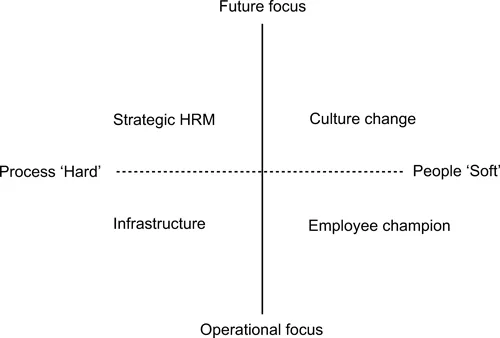
Ulrich’s thinking (1997) was that HR needed to transform itself with a focus on adding value through four key roles, each of which needed to work as a “Business Partner” with a specific outcome or deliverable in focus (Figure 1.1).
Ulrich described the four roles as follows:
Figure 1.1 Ulrich’s matrix.
- Strategic Partners – with a focus on strategy execution and meeting customer needs through aligning HR priorities;
- Administrative Experts – ensuring efficiency in the infrastructure; supporting the business and improving organisational efficiency by reengineering the HR function and other work processes;
- Employee Champions – paying attention to increasing employees commitment and capability through listening and responding to their needs; and
- Change Agents – delivering organisational transformation and culture change.
The aspirational role of the Business Partner since this model was introduced has perhaps been to deliver strategic objectives in line with all of the above. Most would agree that to achieve and maintain this high level of strategic intervention is challenging. Those truly skilled in one or more of the roles can command a high salary and with that goes a high expectation of what they can deliver. Certainly the emerging role over the years has become more, rather than less complex, and in our discussions with HR practitioners it would seem that people are providing a whole host of services without neat boundaries or role distinction.
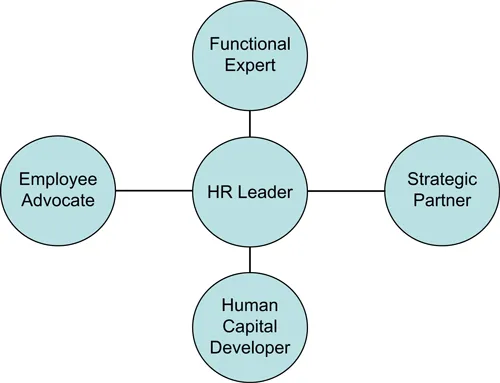
In recognition of the mismatch between theory and practice, Ulrich and Brockbank (2005) revised the roles previously identified and included a new role of “HR Leader” to separate out the responsibilities of more senior HR Partners. The model on the next page (Figure 1.2) shows the separate and connected role of HR Leader signalling the importance of leadership throughout all roles.
Figure 1.2 Revised partner roles.
Ulrich and Brockbank emphasise the need to tailor the model to the needs of the organisation and this would reflect our own views on the importance of working with a model which best fits the requirements.
Although Ulrich is the most quoted of authors on the topic of Business Partnering, many others have compared the traditional role of HR with an emerging need for a more strategic function. The model on the next page (Table 1.1) highlights some of the comparitors between the transactional and strategic functions.
Table 1.1 HR Roles Compared: Transactional vs Strategic
Role of the HR Professional | Transactional Approach | Strategic Approach |
Areas of interest | Recruiting, training, pay, work relations | Strategy and culture of the organisation and policy |
View of the organisation | Micro | Macro |
Client | Employees | Managers and the organisation as a whole |
Status in the organisation | Rather weak | Rather strong |
Educational requirements | Specialist in human resource management | General HR education with management experience or general manager with HR experience |
Time range for activities | Short range | Medium-to long-term range |
Business based on | Transactions | Change/transformations |
M. Green, Public Personnel Management, Spring (2002).
Traditionally, the role of HR has included a fair percentage of administrative work, which in many organisations has now either been outsourced, substituted for advanced IT programmes or in some way re-organised within the overall structure of HR. The purpose of these moves has been to create a more responsive client-centred service, which is proactive in its approach to developing the business. In theory, these changes should also create more space for HR professionals to work at a strategic level within the organisation. So rather than being driven by a need within HR for greater power (although this undoubtedly is a spin off) the changes are needed to keep apace with the fast pace of organisational life and demands now placed on organisations.
These include legislative changes (e.g. equal opportunities legislation, Government modernisation agenda), financial changes and increases in mergers and partnerships across organisations; shifts in employee expectations and needs and increased opportunities from advanced IT capabilities.
Roffey Park Research (2009) highlights the significant factors given by their respondents for implementing HR Business Partnering with 73% (from a research population of 305) citing support of business strategy as a factor. Other factors rated highly by respondents included improving organisational performance and improving ...