![]()
Chapter One
Understanding the Marketing Concept
DEFINING MARKETING
Most people, including professional services providers, have a narrow view of marketing. Yet, in a competitive environment, embracing the marketing concept may be the edge required not only to survive but to prosper. Why is marketing so important? First, it is the only business function that can generate revenue for an organization. More importantly, marketing is not just a business function, it is a philosophy, a state of mind, a way of doing business. Marketing puts the needs of the consumer ahead of the producer. In other words, what differentiates marketing from selling is the focus on consumer needs. Many professionals believe that when they complete their professional training a demand will exist for their services; after all, they are now qualified to deliver those services. If people do not know about the service or do not need the service, however, consumers will not beat a path to the door of the newly minted professional.
The American Marketing Association (1985) defines marketing as “the process of planning and executing the conception, pricing, promotion, and distribution of ideas, goods, and services to create exchanges that satisfy individual and organizational objectives.” Two key words must be highlighted from this definition: exchange and satisfaction. Simply put, marketing is about exchange and achieving satisfaction during and after the exchange process.
In any exchange process, two people are required. In marketing this consists of buyer and seller. For satisfactory exchanges to occur, both parties must receive something of value; there must be equity in the exchange process. During and after the exchange process, both parties must be satisfied. If not, this will negate the prospects of continued and ongoing exchanges. For professional services marketers, as we will see, the concept of consumer satisfaction is central to long-term success.
THE PRODUCTION, SALES, AND MARKETING ERAS
The marketing concept is actually a relatively recent phenomenon. It has been argued that business has evolved from a production era, to a sales era, to the marketing era. Early in North American history, goods were scarce so buyers were willing to accept any goods that were produced. Essentially, production created its own demand. Emphasis was placed on production since the assumption was that products would sell themselves. By the 1920s, however, many businesses were producing more goods than buyers could consume. Competition increased and consumers had greater availability and choice of products. Business then entered the sales era. Salespeople were employed to find markets and consumers for products. This period lasted until 1960 for many organizations. Many are still in the sales era; they continue to produce what they produce best and hope to sell it.
The marketing era was and is characterized by a consumer orientation. Organizations embracing the marketing concept focused on satisfying the needs of consumers while simultaneously achieving organizational objectives. In the marketing era, selling is just one element of marketing. Also, instead of simply producing products and attempting to sell them, organizations actually consider what the market needs before production begins.
THE SIX KEY STEPS IN THE MARKETING PROCESS
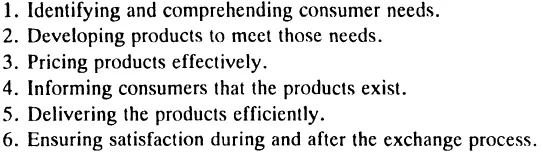
In the marketing era, marketing is viewed as a process and as a way of integrating a broad range of activities. The six key steps in the marketing process are seen in Figure 1-1.
FIGURE 1-1. The Six Steps in the Marketing Process
The marketing concept holds that customer needs are central. Thus, marketing-oriented organizations start at step one of the process seen in Figure 1-1. Others, including professional services providers, often start at step two, or from a production orientation. Unfortunately, this is often a fatal mistake. Organizations using a production orientation find themselves falling into a subsequent sales orientation; they have produced a product and now must sell it. Some marketing theorists suggest that if an organization embraces a true marketing orientation, selling may be superfluous.
The marketing philosophy holds that the consumer is a seeker of solutions to his or her needs. The marketer then takes on the position of problem solver. Effective marketers offer appropriate solutions to the consumers’ problems. Thus, proper identification and comprehension of consumers’ needs is the appropriate starting point for effective marketing to occur.
THE MARKETING MIX
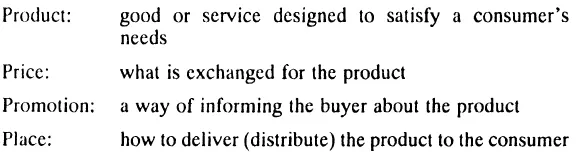
Marketers have a great deal of control over what products to offer the consumer, what price to charge, where to distribute the products, and how to inform the consumer of the products’ availability. This is often referred to as the management of the marketing mix. The controllable marketing mix factors have been termed the Four P’s by McCarthy (1964). Figure 1-2 depicts the Four P’s or marketing mix.
FIGURE 1-2. The Marketing Mix — Four P’s
In Chapter Two we will see how the traditional Four P’s have been expanded for professional services marketing to the Seven P’s.
THE MARKETING ENVIRONMENT
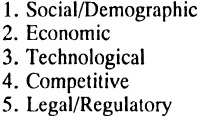
Marketers do not operate in a vacuum. While marketers can exert a great deal of control over the development and execution of the marketing mix, there is an external environment that the marketer must consider and contend with on a continual basis. The factors that are beyond the control of the marketer are commonly referred to as environmental or uncontrollable factors. These factors can be placed into five broad categories as seen in Figure 1-3.
FIGURE 1-3. Five Broad Environmental Factors Affecting Marketing
These environmental factors affect marketers and their decision-making processes. These factors can serve as opportunities or hurdles to the marketer, but either way they must always be considered when planning the marketing mix and a marketing program. In Chapter Three we will see the importance of a proper environmental scan when attempting to develop and execute a professional services marketing plan.
TARGET MARKETING VS. MASS MARKETING
The manipulation and synchronization of the elements of the marketing mix (the Four P’s) is dependent on the market to be served. In general, a market is made up of people with the need and ability to buy a specific product. Since marketers cannot satisfy all consumers, they must select a specific group of consumers and direct their marketing effort toward them. When an organization selects a segment of the entire market to serve, this is the organization’s target market. All too often organizations attempt to be all things to all people; they attempt a mass marketing approach. It is virtually impossible to be successful in business today with a mass marketing mentality.
Target marketing is a must in today’s marketplace. Marketers must select the target market or segment of the market they feel they can best serve. This is where the matching process of marketing comes into play. Marketers must match the needs of the selected target market with an appropriate marketing mix.
MARKET SEGMENTATION
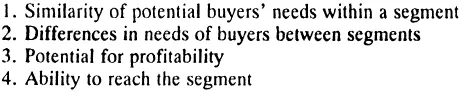
Through market segmentation a professional services firm can select a target market. This process involves dividing the mass market into submarkets or segments containing potential customers. The key to successful segmentation is to group together those consumers who have common needs and who will respond similarly to the marketing mix which will be executed. This is probably one of the most difficult tasks facing a marketer today. Many marketers do not segment the market enough and fail to see the differences between groups of potential customers. On the other hand, there is also the possibility of oversegmenting. Taken to its extreme, segmenting too much can be just as bad as mass marketing. For any market segment to be operationalized it must meet four basic criteria. Figure 1-4 shows the four specific criteria for segmentation.
FIGURE 1-4. Criteria for Market Segmentation
Market segmentation should be seen as only a means to an end. It is carried out to allow a firm to design an appropriate marketing mix and marketing program that will satisfy the target market’s needs. There are a number of variables that can be used to segment a market. Generally, those variables can be grouped into two broad categories:
1. Customer Characteristics — including geographics (where customers live), demographics (age, gender, income, family size) and psychographics (personality and lifestyle).
2. Buying Situations — including benefits sought by consumers and usage rates.
Often marketers focus on demographics as a segmentation variable. While demographics is a useful starting point to profile potential segments, it usually tells us the least about the consumers’ buying behavior. Demographics will tell us who is buying and what they buy but certainly will not tell us why. Thus marketers must try to use several segmentation variables to profile a target market. Essentially, a combination of segmentation variables should answer the following questions:
1. Who buys and where?
2. How do they buy?
3. How much do they buy?
4. Why do they buy?
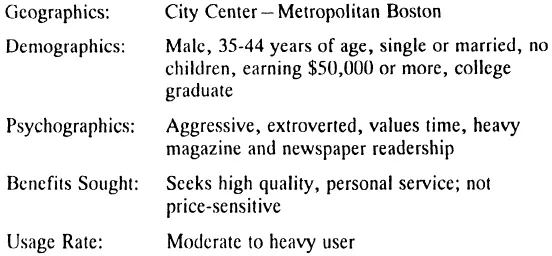
If market segmentation and target market profiling is done correctly, answers to the above questions should be provided. Professional service firms often fail to recognize that there are differences between potential consumers in the market. This creates a problem in adequately designing a marketing mix and marketing program to appeal to a target market. Figure 1-5 illustrates how a professional services client may be profiled using several segmentation variables.
FIGURE 1-5. Profile of a Possible Professional Services Client
Segmentation is an integral part of the marketing process. By segmenting markets effectively, marketers can assess the extent of marketing opportunities that may exist in given markets. It also enables the marketer to tailor the product offering with precision given the nature of the market segment. Finally, segmentation also allows for an effective and efficient marke...