The Review of Adult Learning and Literacy: Connecting Research Policy, and Practice, Volume 4 is the newest addition to a series of annual publications of the National Center for the Study of Adult Learning and Literacy (NCSALL) that address major issues, the latest research, and the best practices in the field of adult literacy and learning.
Volume 4 opens with an overview of significant recent developments in the field. Subsequent chapters cover a wide range of topics critical to the success of adult education and literacy services in the United States:
*issues of race, class, gender, and sexual orientation;
*the role of workplace education in building adults' basic skills;
*the role of new learning technologies in adult education and literacy;
*adult developmental theories and their implications for the teaching of adult basic education and English for speakers of other languages; and
*traditional and contemporary adult learning theories, including an annotated bibliography of key resources.
Intended for policymakers, scholars, and practitioners dedicated to improving the quality of adult basic education, adult English for speakers of other languages, and adult secondary education programs, Review of Adult Learning and Literacy, Volume 4 is an essential resource for the field.
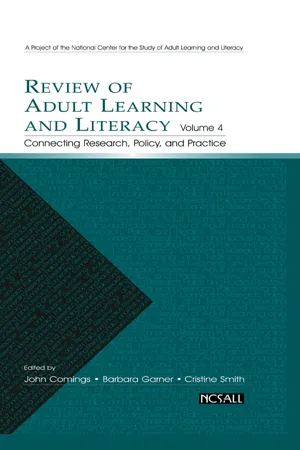
eBook - ePub
Review of Adult Learning and Literacy, Volume 4
Connecting Research, Policy, and Practice: A Project of the National Center for the Study of Adult Learning and Literacy
- 360 pages
- English
- ePUB (mobile friendly)
- Available on iOS & Android
eBook - ePub
Review of Adult Learning and Literacy, Volume 4
Connecting Research, Policy, and Practice: A Project of the National Center for the Study of Adult Learning and Literacy
About this book
Information
1
The Year 2001 in Review
On September 11, 2001, a massive terrorist attack hit New York City and the Pentagon in Washington, DC. Understandably, in the midst of all the carnage and concern for the security of the United States, and in the wake of the huge decline in the nation’s economy that followed the attack, adult education and literacy development took a back seat alongside other domestic interests as the government focused on the need to protect and defend the nation. Although nothing could approach the devastating effects of the terrorist attacks on the nation, the year 2001 was difficult for the adult education and literacy field in other ways too.
CHALLENGES TO THE FIELD
The field encountered three major challenges in 2001. First, a report from the National Center for Education Statistics (NCES) captured the attention of the media by raising questions about the findings of the National Adult Literacy Survey (NALS) and the scale of need for adult literacy education in the United States. Next, the National Reporting System (NRS) revealed major operating problems within the Adult Education and Literacy System (AELS)—that is, with those programs that receive part or all of their funding under the provisions of the Workforce Investment Act of 1998 (Title II of the Adult Education and Family Literacy Act of 1998; U.S. Congress, 1998). Finally, strong advocacy overrode a White House proposal that would have led to an inflation-adjusted decrease in federal funding for the AELS.
NALS Findings Questioned
NALS was a door-to-door survey of information-processing skills involving literacy tasks of a representative sample of adults in the United States in 1992 (Kolstad, 2001). Researchers developed and administered three different literacy scales for the NALS: Prose, Document, and Quantitative. On each scale, adults were assigned to five different literacy levels, with Level 1 indicating a low level of literacy and 5 indicating a high level of literacy. An individual’s assignment to a given level was based on his or her having an 80% (p = .80) chance of being able to perform the average task at that level. According to this guideline, using the prose scale, some 20% of adults were placed in Level 1, and 27% were placed in Level 2—the two levels considered by the researchers to represent adults with poorly developed literacy skills. Similar findings were obtained on the Document and Quantitative scales.
In January 2001, the NCES published a final technical report on the NALS (Kolstad, 2001). In chapter 14, Andrew Kolstad, original project director for the NALS at the NCES, reversed an earlier position that he had supported and challenged the accuracy and hence the validity of the 80% standard, stating that a 50% standard produces the fewest errors when determining the likelihood that people may or may not be able to perform literacy tasks. In an article (Mathews, 2001) in the Washington Post on July 17, 2001, Kolstad confirmed the findings of the NCES final technical report and concluded that large numbers of adults cited as having poor literacy skills and placed in Level 1 or 2 of the NALS had likely been characterized incorrectly by the use of the 80% standard; they could perform more literacy tasks both within and above their assigned level than was previously thought.
The NCES report thus questioned the findings of the NALS and other reports (e.g., the International Adult Literacy Survey [IALS]) that rely on its assumptions about the percentage of the population in each level. Consequently, continued use of NALS or IALS data to indicate the scale of need for literacy education among adults in the United States and other nations poses a challenge: On what basis can the question of how many adults lack adequate literacy skills be answered? Perhaps the National Assessment of Adult Literacy scheduled for 2002 will address the limitations of the NALS identified by Kolstad and provide suitable data to meet the challenge of how to state more accurately the scale of need for adult literacy education.
Enrollment and Quality Assurance in Doubt
The NRS was established by the U.S. Department of Education (DOE), Office of Adult and Vocational Education, Division of Adult Education and Literacy, to collect data required by the Adult Education and Family Literacy Act of 1998. Following extensive technical assistance to the states and valiant efforts by state and local practitioners to implement the requirements of the NRS, data for the first full year of implementation (2000) have revealed two troublesome aspects of AELS operation.
Most troublesome was the continuation in 2000 of a trend in the decline in the numbers of adults enrolled in the AELS. In 1997 enrollments were around 4.1 million. In 1998, when the Adult Education and Family Literacy Act became law and the NRS, with its strong emphasis on the use of standardized tests for measuring learning gains, was implemented, enrollments started to drop. In 1999 they fell by 500,000, to 3.6 million (Sticht, 2002), and in 2000 they fell by an additional 700,000, to around 2.9 million (Pugsley, 2001b). This means that in a period of just 3 years, enrollments in the AELS fell from a high of 4.1 million in 1997 to 2.9 million in 2000, a figure similar to the enrollments of 2.879 million in 1985. If these figures are real and not just the result of more accurate accounting procedures in the NRS, then they represent a loss of more than 1 decade’s worth of progress in encouraging adults to access and enroll in the AELS. At this writing, no official explanation for the decline has been found.
Another troubling aspect of the 2000 data from the NRS concerns quality assurance. Although states and territories made significant efforts to institute the NRS accountability system and most met or exceeded the quality performance targets established with the DOE for the first year of their 5-year goals, the targets were somewhat low. According to Ron Pugsley, director of the DOE’s Division of Adult Education and Literacy, “Many of the performance targets negotiated with the department tended to be at the low end of the spectrum this first year” (Pugsley, 2001a). This may reflect caution on the part of state officials in setting their performance goals, as there was concern that if goals were not reached, reductions in program funding would follow. Whatever the reason, this finding raises important questions about the way that performance targets for the AELS are determined across the country and the way that high-stakes NRS requirements to show continuous improvement may affect the establishment and achievement of these targets.
Marginal Increase in Federal State Grant Funds
As already noted, the AELS includes those programs across the nation that receive funding in the form of state grants (Title II of WIA; U.S. Congress, 1998) authorized by the Adult Education and Family Literacy Act. In April 2001, President George W. Bush, son of Mrs. Barbara Bush, one of America’s greatest advocates and supporters of adult literacy education, submitted a request for fiscal year 2002 funding for the AELS of $540 million, the same amount allocated for fiscal year 2001. This may foreshadow a policy of doing more with the same resources in response to projected deficits for the federal government in the wake of the September 11 attacks. But adjusted for inflation, the president’s request amounted to a proposed decrease in funding, suggesting that the AELS do more with less.
In September, when Congress reconvened after the summer recess, the field initiated lobbying efforts to see if Congress could be persuaded to increase fiscal year 2002 funding over what the president had requested. Given the impact of the terrorist attacks on the federal budget, in which projections of surpluses were transformed into projections of deficits, many adult literacy educators did not expect additional funding.
Thanks to the intensive lobbying efforts of the National Coalition for Literacy (NCL) and others, however, Congress finally approved a $35 million increase in the state grants for the AELS. Although the total budget remains far less than the $1 billion the coalition had been hoping for (National Institute for Literacy, 2000), it nonetheless amounted to an inflation-adjusted increase of some 4% in purchasing power.
Deadline for the Change in the Tests of General Educational Development (GED)
The GED test battery was developed in 1942 to give military personnel whose armed service had prevented them from completing high school an opportunity to demonstrate that they possessed academic skills and knowledge comparable with those who had completed high school. Since their early use by the military, the GED tests have been extended for use by any adult without a high school diploma in the United States and Canada, and more than 15 million adults have used the tests to qualify for secondary education or jobs requiring a high school level of education. (See Online Resources at the end of this chapter for more information on the GED tests.)
To keep the GED tests up-to-date in terms of the changes that take place in secondary school curricula, they are revised from time to time. Most recently, the 1988 series of GED tests was revised to form a new version that became effective on January 1, 2002. This placed a huge strain on the adult secondary education field, as students who had started studying for the 1988 version of the GED needed to complete the tests by the end of 2001. Many state adult education offices across the country took various strategies to get adults to finish the 1988 version of the GED by December 31, 2001. In Ohio an 18-month program called Get Ready, Get Set, Get Your GED brought in more than 2,000 students in the first 6 months of the campaign. The Kentucky legislature provided $2.5 million to promote the GED with the slogan “Education Pays,” and other special activities took place in other states.
The payoff for these extensive efforts to have adults complete the 1988 series of tests came in the form of the more than 1,069,899 adults worldwide who took one or more of the five 1988 GED tests in 2001. This was a 31.1% increase over comparable data for the year 2000. On January 1, 2002, the new GED test battery became operational.
ADVANCES IN THE FIELD
Despite the pervasive uneasiness in the nation and the difficulties just discussed, several activities undertaken by adult students, volunteer literacy organizations, health literacy advocates, adult literacy providers, and new national and international organizations held out hope for the field.
The Voice for Adult Literacy United for Education (VALUE) Leadership Institute
Moving to have a larger impact on adult education policy and practice, VALUE, the nationwide organization of adult literacy students, held a national Adult Learner Leadership Institute in Columbus, Ohio, July 19–21, 2001. The conference provided a forum for recognizing adult learners who had taken leadership positions in various states to advocate for adult literacy education and to train others to take leadership positions in their states. In a post-conference report, Archie Willard, president emeritus of VALUE, noted that of the 140 people attending the meeting, 107 were adult learners from 29 different states (Willard, 2001).
Willard went on to note that the New Readers organization in Iowa had undertaken to meet with Iowa Secretary of State Chet Culver to increase the involvement of his office with adult literacy education and that Rhode Island had put in place a bill of rights for adult learners that could serve as a model for other states. Willard also emphasized how important it is for adult learners to have a say in adult literacy education policy, practice, and advocacy activities, citing the life experiences that only they can bring to the table. He concluded with a call to action for adult learners: “As taxpayers and voters, let’s see that the Adult Education and Literacy System of the United States is properly funded and that it is regarded as an important part of our education system.”
Merger of Laubach Literacy International (LLI) and Literacy Volunteers of America (LVA)
In a move that will have a major impact on adult literacy education practice, two of the oldest and largest volunteer literacy organizations in the United States—LLI, founded by Dr. Frank C. Laubach in 1955, and LVA, founded in 1962 by Ruth Colvin—announced on May 21, 2001, their intention to merge. The combined organization will support programs providing literacy services for some 225,000 adult learners through a national network of approximately 160,000 volunteers and 1,450 local, state, and regional literacy providers.
In May 2001, the boards of each organization signed a Memorandum of Understanding that combined the operations of LLI and LVA and located the new literacy organization at Laubach Literacy’s headquarters in Syracuse, New York. The agreement stipulated that the national governing board of the new organization has a maximum of 26 members and that at least 1 is an adult literacy student. In late 2001, the new organization resulting from the merger was named ProLiteracy Worldwide and was scheduled to begin operation in 2002. (See Online Resources at the end of this chapter for more information on ProLiteracy Worldwide.)
Health Literacy Initiatives
Health literacy is a subspecialty of the adult education and literacy field that has been around for at least a quarter century but grew rapidly in the 1990s. Broadly concerned with communication, health literacy deals with issues such as the readability of written materials conveying health information, alternative media for communicating health information, patient and physician or other health provider communication, special problems of low English proficient adults in health communications, and the provision of language and/or literacy education in the context of health-related information. During 2001, two major activities took place to advance the health literacy field.
The first activity was the symposium called Health Literacy: Implications for Seniors, sponsored by the DOE in August. Its purpose was to develop strategies for helping those older adults and their families with limited basic skills to communicate more effectively with healthcare providers. Contributing to the symposium were federal and state government organizations, including the DOE, the U.S. Department of Health and Human Services, the National Institute for Literacy, and the Georgia State Department of Technical and Adult Education. A number of nonprofit organizations also contributed to the symposium, including the American Medical Association, the National Center for the Study of Adult Learning and Literacy (NCSALL), the National Senior Citizens Education and Research Center, World Education, the Adult Literacy Media Alliance, and the System for Adult Basic Education Support.
The other major activity in health literacy was the celebration of National Health Literacy Month in October. The goal was to help health literacy advocates raise awareness in their communities about the need for understandable health information. Across the United States and Canada, people organized regional health literacy conferences and symposia, contacted local media and political representatives, created new task forces or joined existing partnerships, developed courses on health literacy for professional training, wrote articles for newspapers or in-house newsletters, and organized informational events for the general public to promote the need for understandable health information. (See Online Resources at the end of this chapter for more information on health literacy.)
National Literacy Summit 2001, Year 1 Report
Hoping to influence both policy and practice in adult literacy education, members of the National Coalition for Literacy (NCL) and others convened in Washington, DC, in September 2000 and released the report, From the Margins to the Mainstream: An Action Agenda for Literacy (National Institute for Literacy, 2000). The agenda outlined 76 specific recommendations aimed at achieving the following goal: “By 2010, a system of high quality adult literacy, language, and lifelong learning services will help adults in every community make measurable gains toward achieving their goals as family members, workers, citizens, and lifelong learners” (p. 1).
During the next 12 months, the NCL took the lead in implementing the action agenda. On September 7, 2001, the NCL celebrated the first anniversary of the initiative as part of International Literacy Day in Washington, DC. Another report was released, this one announcing that during the year more than 25,000 copies of the agen...
Table of contents
- Cover
- Half Title
- Title Page
- Copyright Page
- Table of Contents
- Foreword
- Preface
- List of Tables and Figures
- Chapter 1 The Year 2001 in Review
- Chapter 2 Race, Class, Gender, and Sexual Orientation in Adult Literacy: Power, Pedagogy, and Programs
- Chapter 3 Why Do Companies Provide Workplace Education Programs?
- Chapter 4 Implications of New Learning Technologies for Adult Literacy and Learning
- Chapter 5 Applying Constructive–Developmental Theories of Adult Development to ABE and ESOL Practices
- Chapter 6 The Changing Landscape of Adult Learning Theory
- Resources on Adult Learning Theory
- About the Editors
- About the Contributors
- Author Index
- Subject Index
Trusted by 375,005 students
Access to over 1.5 million titles for a fair monthly price.
Study more efficiently using our study tools.
Frequently asked questions
Yes, you can cancel anytime from the Subscription tab in your account settings on the Perlego website. Your subscription will stay active until the end of your current billing period. Learn how to cancel your subscription
No, books cannot be downloaded as external files, such as PDFs, for use outside of Perlego. However, you can download books within the Perlego app for offline reading on mobile or tablet. Learn how to download books offline
Perlego offers two plans: Essential and Complete
- Essential is ideal for learners and professionals who enjoy exploring a wide range of subjects. Access the Essential Library with 800,000+ trusted titles and best-sellers across business, personal growth, and the humanities. Includes unlimited reading time and Standard Read Aloud voice.
- Complete: Perfect for advanced learners and researchers needing full, unrestricted access. Unlock 1.5M+ books across hundreds of subjects, including academic and specialized titles. The Complete Plan also includes advanced features like Premium Read Aloud and Research Assistant.
We are an online textbook subscription service, where you can get access to an entire online library for less than the price of a single book per month. With over 1.5 million books across 990+ topics, we’ve got you covered! Learn about our mission
Look out for the read-aloud symbol on your next book to see if you can listen to it. The read-aloud tool reads text aloud for you, highlighting the text as it is being read. You can pause it, speed it up and slow it down. Learn more about Read Aloud
Yes! You can use the Perlego app on both iOS and Android devices to read anytime, anywhere — even offline. Perfect for commutes or when you’re on the go.
Please note we cannot support devices running on iOS 13 and Android 7 or earlier. Learn more about using the app
Please note we cannot support devices running on iOS 13 and Android 7 or earlier. Learn more about using the app
Yes, you can access Review of Adult Learning and Literacy, Volume 4 by John Comings,Barbara Garner,Cristine Smith in PDF and/or ePUB format, as well as other popular books in Education & Education General. We have over 1.5 million books available in our catalogue for you to explore.