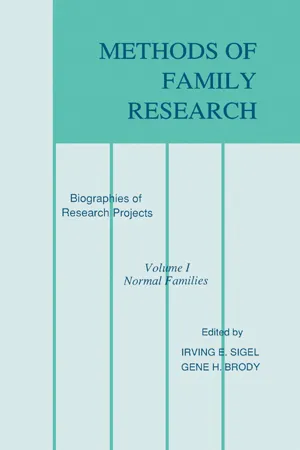
These companion volumes provide a "behind the scenes" look into the personal experiences of researchers in an effort to eliminate the lack of communication surrounding family research methodology. They show how the researchers achieved their results and why they chose particular methodologies over others. These volumes present more than just findings -- they present the real experiences of the authors in their own styles and personalities, exposing the problems, mistakes, and concerns they experienced during their research projects. Volume I presents the experiences of researchers into typical normative populations. Volume II describes work with clinical, atypical populations.
eBook - ePub
Methods of Family Research
Biographies of Research Projects
- 352 pages
- English
- ePUB (mobile friendly)
- Available on iOS & Android
eBook - ePub
Methods of Family Research
Biographies of Research Projects
About this book
Information
| 1 | Becoming a Family: Research and Intervention |
University of California, Berkeley
HOW THE BECOMING A FAMILY PROJECT DEVELOPED
For the past 15 years, we have been studying the marriages of men and women as they are forming their families. The most general question we have been addressing is what happens to a husband and wife, and especially to their relationship as a couple, when they become parents. Because we are concerned about the vulnerability of marriages during this major adult transition, one major focus of our work has been the assessment of an intervention in which psychologists trained to work with couples offer small ongoing groups for parents as they make their way from being a couple to becoming a family.
To date, our longitudinal study encompasses two main phases of family formation: the transition to parenthood from pregnancy to 18 months after birth; and the transition from the preschool years until the first child enters elementary school. Just as the views of the parents and children in our study grow as they maneuver these major family events, so too do our perspectives as researchers and clinicians broaden as we explore the findings and tackle the realities of studying developing families. In some ways, we now realize, our move to expand the focus of our investigation from the transition to parenthood to the relationships of parents and children in a three-generational context parallels recent expansion in the field of family study. Thus, we acknowledge at the outset, that to tell about the growth of our thinking and our study design retrospectively implies more order and grand conceptualization than actually existed at the outset. We shall reconstruct our journey into the study of marital and family relationships as honestly and accurately as we can.
Typically, research reports begin with a review of the literature, a critical evaluation of the work on a specific topic, and a justification for conducting the study to be reported. On the basis of what has and has not been done, the authors formulate a set of hypotheses and a research design, and then develop appropriate methods and measures designed to test them. This is not the way the Becoming a Family Project evolved.
The stimulus for our wanting to study and work with couples becoming first-time parents was the collision of our own professional and personal experiences in the early 1970s. One of us (PAC) was a developmental/clinical psychologist interested in Piagetian approaches to social-emotional development and in preventive intervention with teachers in schools. One of us (CPC) had been an elementary school teacher, was now active as a parent in the schools, and had undertaken graduate work in clinical and developmental psychology, with a special interest in preventing marital distress. With our three children in grades 2, 4, and 6, we were just beginning to come up for air from an enormously stressful period for a decade-old marriage with three young children and two budding careers. We loved the parenting part, and were immensely challenged by the school and career demands, but the toll these years had taken on our relationship as a couple had been totally unexpected. The dangers of serious marital strain were becoming apparent to us as our friends and neighbors began separating and divorcing at a frightening rate. When we had opportunities to talk with couples close to us, we thought we were hearing a similar refrain. Most of us seemed to be describing—although only in retrospect—a period of years when we had simply put our relationship as a couple “on the back burner” while we coped with the extraordinary demands of being parents, workers, and active citizens in our communities. Only recently, as the children moved from center stage in our lives into the formal school systems, had we begun to take stock of what had happened to our marriage.
As we tried to make sense of our lives and those of our friends, we began to think of the transition to parenthood as a vulnerable time for couple relationships. So many things about the ideology of men’s and women’s work and family roles come into play at this major adult transition. Who does what, and who gives up what, when there are children to be raised seemed to be important ingredients of how parents eventually felt about themselves and their marriages. In addition, many of the couples we met appeared to have been dealing with similar conflicts and strains, yet none of us knew that we were part of a “trend” until years later when the separations and divorces became our clues to serious marital strain.
We began to think that the transition to parenthood could be an important time to offer men and women a setting in which mental health professionals might help them focus on strengthening their relationship as a couple while they went about making their dreams of family life a reality. Groups to teach Lamaze and other forms of prepared childbirth had become extremely popular for couples, but they ended when the babies were born—just when the hands-on work of family-making was beginning. We were not interested in creating another “California group” of the kind that seemed to be sweeping the country in the late 1960s and early ‘70s. We set out to pilot test and then systematically evaluate our idea of a couples group intervention by including a sample of no-treatment comparison couples in our study. If we followed couples through their actual transition to parenthood, talking with them before, during, and after, we would have an opportunity to do a full-scale evaluation of what happens to men, women, and their marriages as they became parents for the first time. We also realized that parents’ before-baby reports about themselves and their marriage would be very helpful in understanding the contributions of the prebaby aspects of parents’ individual and marital adaptation to the after-baby quality of their lives.
Our preliminary planning took three forms: talking with expectant and new parents in the larger Bay Area community; searching for previous relevant research; and inviting another couple to work with us on developing a pilot project. Our interviews with couples convinced us that our perception of increased strain in the marriages of new parents was on the mark. The first couples we talked to—recent new parents—were surprisingly open with us about their stress as individuals and as couples. When we discussed our idea of small groups in which couples could talk regularly about these unexpected changes in their lives, they were eager to join, even though they had already made the transition from couple to family.
In the psychological research we first consulted, we found very little work relevant to intervention with couples during the transition to parenthood—or during any other major life change. Caplan (1964) and Rapoport (1963) suggested that major life transitions could be ideal times to provide psychological interventions because they are times of normal crisis that can stimulate development or lead to dysfunction, but we could find no reports of clinical work in that vein. We eventually found Colman and Colman’s (1971) account of discussion groups for expectant mothers and Shereshefsky and Yarrow’s (1973) study providing individual counseling for women during pregnancy, but we were unable to locate any references to services for expectant fathers or couples before we started our own pilot study in 1973.
As for the larger issues surrounding the transition to parenthood, they seemed not to interest psychologists before the mid-1970s. And, while there was a body of research in sociology that had been discussing the transition for almost 2 decades, we were initially unaware of it. This oversight was not so gently pointed out to us by the dean of family sociologists, Reuben Hill, when we presented our preliminary findings at an NIMH-supported conference on the first child and family formation in 1975 (Miller & Newman, 1978). Needless to report, we have become faithful readers of the sociological literature ever since, and we summarize its essential directions later.
Our first interviews and initial reading had convinced us that our project was worth pursuing, but before we could design a large study we had much work to do to become more familiar with the phenomena associated with the transition to parenthood. In addition to our own experiences and those of the people we knew, we needed to understand the elements in the more general natural history of becoming a family. What differentiated couples who adapted well from those who did not? What did adapting well mean for individuals and couples at this particular life stage? And, before we settled on a format for the intervention, we needed to obtain some first-hand experience working with couples who had not come seeking psychological help.1
We invited our friends and colleagues Lynne and John Coie, who were about to spend a sabbatical year at Berkeley, to join us in developing an intervention study of first-time parents. We welcomed their expertise as individuals and as a couple; Lynne’s as an obstetrical nurse, John’s as a clinical psychologist with a special interest in children, and theirs as a couple who had recently become a family. We had four tasks: (1) to design an intervention to help couples focus on their experiences of late pregnancy and the early months of new parenthood; (2) to recruit couples to participate in groups and to serve as a comparison sample; (3) to create research tools adequate to describe individual and marital change; and (4) to evaluate the intervention. With only a few modifications, the format for the couples groups and methods of recruitment that we developed for the pilot study became our method of operation in the larger study that we are conducting now.
As our work on the design and measures proceeded, we developed relationships with several interested obstetricians, and with their cooperation, we interviewed all the expectant parents who would agree to talk with us over a 3- month period. Here too, we were amazed at the outpouring of dreams and anxieties by men and women we were meeting for the first time. They dreamed, first and foremost, of the joys that babies can bring. They worried about the delivery, whether the baby would be healthy, whether they would love their babies the way they expected to, whether they could be the kind of parents they were determined to be. What surprised us most was their unanimous interest in groups for couples becoming new parents. Our questions appeared to tap issues that couples rarely talked about, especially for men. Our sense was that couples were as concerned about the statistics on marital breakup as we were; and if we knew something that would help buffer their marriage from strain during this exciting period in their lives, they were willing to learn more about it.
We describe the intervention procedures, concepts, and measures in more detail later. Here, we simply note the continuing interplay among self-examination, interviews, reading, discussion with colleagues, and active efforts to design an intervention while developing pilot research. At least in retrospect, the shifting of perspectives from one of these modes to another was absolutely necessary for the ultimate design of the larger study.
Our pilot study (Cowan, Cowan, Coie, & Coie, 1978) examined changes in 16 men and women, half of whom agreed to (1) talk with us and complete questionnaires before and after giving birth, and (2) participate in a 6-month-long couples group led by us. The other half of this small sample (four couples) talked with us and completed questionnaires but they were not asked to participate in a couples group. Based on the results of that small study, we designed the current Becoming a Family Project. In retrospect, we are pleased with how many of the trends from this intensively examined but very small sample have been replicated in the larger study.
Phase 1. Our initial plan for the current study was to complete a short-term longitudinal study of the transition to parenthood from late pregnancy to 18 months after birth, focusing on the impact of having a first child on the couple’s marriage. Our first application for research support from NIMH was approved but not funded. The feedback from the reviewers was that we had painted an unnecessarily negative picture of the transition to parenthood. When we rewrote the proposal with what we thought was a more balanced rationale for the proposed study, but with the same research design, the Becoming a Family Project was awarded 3 years of funding beginning in 1979.
Phase 2. As the data and the participants in the study grew, we found ourselves eager to answer a second question: Given that the arrival of the baby affects the relationship between the parents, what impact does the couple relationship have on the early development of the child? We requested further support to follow the couples again, and to add to our ongoing assessment of the marriage an assessment of parent-child interaction and the child’s development when the children were preschoolers (3½).
Phase 3. As the family data began to flesh out our picture of what was happening to parents and children during the family formation period, we became excited by the prospect of following the families through the next transition that most would experience—the first child’s entrance into elementary school. With continued funding from NIMH, we have been able to study the lives of 96 families over a period of 7 years.
CONCEPTUAL ISSUES
The idea of assessing the quality of couple relationships seemed quite straightforward until we actually set about doing it. We knew that we could obtain a global index of each partner’s satisfaction from the widely used Short Marital Adjustment Test (Locke & Wallace, 1959). But what are the essential ingredients of marital satisfaction? How do we divide the concept of marital satisfaction into meaningful, measurable domains, so that we can understand how the transition to parenthood affects marital quality? We knew from both popular books and professional journals that couple communication was important to examine, but how men and women talk to each other did not seem to provide a sufficient explanation of how both spouses feel about their overall marriage. We believed that each partner’s personality style and sense of self could influence the course of discussions between the partners, and that the quality of communication might affect each one’s sense of self.
We slowly began to develop what became our model of couple relationships—all of the aspects of couple relationships that we needed to know about in order to understand both adaptation and distress in couples’ lives. From our own life and from sociological research we knew that the family division of labor—a couple’s arrangements to keep the household running, make the family decisions, care for the children, bring in the family income, and so on—is another critical aspect of how the partners feel about their relationship as a couple. This aspect of marriage seemed to be missing from most psychological and psychiatric accounts of functional and dysfunctional families. Yet, the negotiations, or lack of them, around who takes out the garbage, washes the dishes, prepares the meals, or cares for the child, is the real stuff of most couples’ daily communication. Frustration in these areas clearly takes a toll on the relationship. We were certain that each partner’s ideas about parenting, especially their disagreements about childrearing, would make a difference to the stress experienced by men and women in their role as parents. At first, then, our list of important variables included parents’ self-concept, communication, role arrangements, and parenting ideas and stresses.
During the pilot study, it became apparent that we had left out two important aspects of couple life. As psychoanalysts have long claimed, men’s and women’s relationships with their parents, as they were and as they are, make important contributions to parents’ sense of well-being and to their ability to form satisfying marital and parent-child relationships (Benedek, 1959, 1970). In addition, we realized that we had focused only on events and relationships inside the immediate family; outside-the-family stresses and strains on one hand, and sources of support on the other, also contribute to each partner’s ability to pay attention to small marital and parenting conflicts before they grow too large to handle.
At this point, we had a long list of what we thought were the ingredients of a satisfying or unsatisfying marriage. We began to see that each of the issues we had named referred to a different level of analysis of family life: (1) individual; (2) couple; (3) parent-child; (4) three generations; and (5) outside-the-family. Our assumption was that events in each of these domains, in interaction, determined each partner’s satisfaction with the marriage. How partners feel about themselves may affect the way they play their family roles; conversely, individuals’ satisfaction with their family roles may affect how they feel about themselves. Traumatic relationships in husbands’ and wives’ families of origin make satisfying marriages more difficult to come by (cf. Clulow, 1982), while mutually satisfying marriages have the power to overcome early life difficulties (Rutter, 1983). How smoothly the marital relationship is going can affect men’s and women’s work involvement and stress on the job, just as the atmosphere on the job, positive or negative, can spill over into family life (Crouter, 1984; Seers, McGee, Serey, & Graen, 1983).
These ideas, not always clearly formulated at the beginning of the study, have been influenced ...
Table of contents
- Cover
- Half Title
- Title Page
- Copyright Page
- Table of Contents
- Preface
- 1. Becoming a Family: Research and Intervention
- 2. Parental Beliefs within the Family Context: Development of a Research Program
- 3. Journeys in Serendipity: The Development of the Distancing Model
- 4. The Nature-Nurture Problem Revisited: The Minnesota Adoption Studies
- 5. In Search of Fathers: A Narrative of An Empirical Journey
- 6. Sibling Relationships
- 7. Adolescents as Daughters and as Mothers: A Developmental Perspective
- 8. Finding the Laws of Close Personal Relationships
- 9. Cross-Cultural Collaboration in Studies of Family Effects on School Achievement
- 10. The Family as a System of Reciprocal Relations: Searching for a Developmental Lifespan Perspective
- Author Index
- Subject Index
Trusted by 375,005 students
Access to over 1.5 million titles for a fair monthly price.
Study more efficiently using our study tools.
Frequently asked questions
Yes, you can cancel anytime from the Subscription tab in your account settings on the Perlego website. Your subscription will stay active until the end of your current billing period. Learn how to cancel your subscription
No, books cannot be downloaded as external files, such as PDFs, for use outside of Perlego. However, you can download books within the Perlego app for offline reading on mobile or tablet. Learn how to download books offline
Perlego offers two plans: Essential and Complete
- Essential is ideal for learners and professionals who enjoy exploring a wide range of subjects. Access the Essential Library with 800,000+ trusted titles and best-sellers across business, personal growth, and the humanities. Includes unlimited reading time and Standard Read Aloud voice.
- Complete: Perfect for advanced learners and researchers needing full, unrestricted access. Unlock 1.5M+ books across hundreds of subjects, including academic and specialized titles. The Complete Plan also includes advanced features like Premium Read Aloud and Research Assistant.
We are an online textbook subscription service, where you can get access to an entire online library for less than the price of a single book per month. With over 1.5 million books across 990+ topics, we’ve got you covered! Learn about our mission
Look out for the read-aloud symbol on your next book to see if you can listen to it. The read-aloud tool reads text aloud for you, highlighting the text as it is being read. You can pause it, speed it up and slow it down. Learn more about Read Aloud
Yes! You can use the Perlego app on both iOS and Android devices to read anytime, anywhere — even offline. Perfect for commutes or when you’re on the go.
Please note we cannot support devices running on iOS 13 and Android 7 or earlier. Learn more about using the app
Please note we cannot support devices running on iOS 13 and Android 7 or earlier. Learn more about using the app
Yes, you can access Methods of Family Research by Irving E. Sigel, Gene Brody, Irving E. Sigel,Gene Brody in PDF and/or ePUB format, as well as other popular books in Psychology & Developmental Psychology. We have over 1.5 million books available in our catalogue for you to explore.