![]()
| | 1 | | What, when and where was modernism?1 |
| | |
| | | |
If I’m going to have a past, I prefer it to be multiple choice!2
(The Joker, Batman: the killing joke)
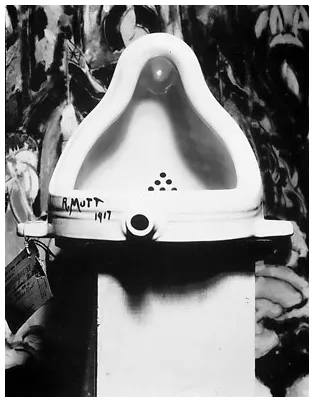
In the 1980s, Sherrie Levine brought together in composition two of the icons of modern art by photographing Alfred Stieglitz’s photograph of Marcel Duchamp’s Fountain, a urinal turned upside down (see Figure 1.1). Levine’s After Stieglitz, a photograph of a photograph, was given an added layer of irony as the ‘original’ fountain, a standard domestic appliance, was banished after its attempted outing as a work of art at the 1917 Independents exhibition in New York, and a record of its existence is now only in Stieglitz’s photograph. The ‘original’ work attained mythic status through its fugitive position in the art world. Duchamp’s irreverent act of sabotage was considered by some as a revelation of the art world’s mystification of selection procedures that led to the status of great art. To present as a work of art a photograph of a photograph of an art work raises critical issues, especially if we are mindful of the ‘status’ of the original: Duchamp’s Fountain is a ‘ready-made’. Levine’s photograph acquires its postmodern credentials through her acknowledgement of (what, not so very long ago, would have been seen as) her flagrant plagiarism. Levine’s photograph is emblematic of modernism’s uneasy relationship with its objects of desire and helps us to locate a disruption in confidence of the modernist trinity – authenticity, autonomy and originality. These three tropes were essential elements that buttressed modernism’s claim to a privileged status for art produced under its aegis: claims that this chapter will explore.
Figure 1.1 Marcel Duchamp, Fountain, 1917, photographed by Alfred Stieglitz. © Succession Marcel Duchamp/ADAGP, Paris, and DACS, London, 2003. Photograph courtesy of the Association for the Protection and Conservation of the Work of Marcel Duchamp, Villiers-sous-Grez. According to Beatrice Wood, Stieglitz, who photographed the urinal (or bathroom fixture as it was delicately referred to) at Duchamp’s request, was ‘greatly amused, but also felt that it was important to fight bigotry in America. He took great pains with the lighting, and did it with such skill that a shadow fell across the urinal suggesting a veil’ (Tomkins 1997: 183).
In the Introduction we introduced the term ‘postmodernism’. The prefix ‘post-’ suggests something that is over, after the event. However, ‘postmodernism’ can mislead if we understand it to act as a style label or to define the current situation, particularly if it suggests a clear break or severance with something called ‘modernism’. As indicated by the case of the ‘modern’ Duchamp and the ‘postmodern’ Levine, many of the defining characteristics of modernism seem to continue as defining conditions of postmodernism. These continuities sometimes make the two designations seem almost indistinguishable. Indeed it is not unusual to find Duchamp conscripted into postmodernism as a precursor of many postmodernist tendencies.
Where was modernism?
If we take another example we can see that modernism has been under attack by another not unrelated consideration – the idea that modernist art is autonomous and therefore resides outside local and specific histories – in short, an attack on modernism’s claim for a form of universal art free of contingencies. In the 1970s the National Gallery of Australia, in a controversial move, purchased Blue Poles: number 11, 1952, a painting by the American abstract expressionist artist Jackson Pollock, for the sum of $Aus 1 million. Containing only oblique references to the ‘real’ world, Pollock’s painting is emblematic of a so-called autonomous art, a designation we will return to at intervals in this book. In 1992 an Australian artist of Aboriginal descent, Gordon Bennett, reworked Pollock’s ‘timeless’ painting in Myth of the Western Man (White Man’s Burden) (see Plate I). Any initial resemblance to Pollock’s work is quickly disrupted by the inclusion of dates: 1788, the date of white colonisation of Australia; 1795, the date of the first legally sanctioned massacre of Aborigines, and so on. Moreover, the inclusion of a figure struggling to control a blue pole in the centre of the work undermines any abstract credentials. The work also alludes to domains of visual art practices beyond the painterly abstraction of Pollock’s original. For instance, the reference to Aboriginal Western Desert art in the application of handmade dots is given a commercial spin not unlike the benday dots of the printing industry. Unlike Blue Poles, Bennett’s work makes no pretensions to universalism, making specific references to his own history by drawing upon histories of settler culture and the fate of indigenous peoples at the same time as questioning the art-historical mythologies and canons that constitute modernism.
The work is also a geographic challenge: modernism was a Western phenomena and, as we will see, traditionally located in two centres: Paris from the mid-nineteenth century to the mid-twentieth century and then, contentiously, New York from the 1950s onwards. It is unsurprising therefore that many of the challenges to modernism’s authority should come from groups and geographic regions that were marginal to modernism’s initial impulses. Artists such as Gordon Bennett disrupt and question the false unity of a linear art history that is geo-politically defined.
The works above may critique modernism but they are also in co-dependency with it. The continuities and disruptions signalled by the works of Sherrie Levine and Gordon Bennett have their political and stylistic origins in social unrest. The postmodern period is often defined in relation to the political turbulence that characterised the late 1960s – 1968, the year of the student civil disobedience in Paris and anti-American demonstrations at Grosvenor Square in London, being seen as the watershed. Student unrest, anti-Vietnam War demonstrations, the civil rights and women’s movements are often cited as the social forces that ushered in postmodernism. Loss of confidence in a single authoritative political voice extended to the arts, where rapid changes led to a questioning of the adequacy of the dominant tradition – modernism – when faced with the competing demands of previously marginalised groups.
The received genealogy of modernism
During the century preceding the tumult of the 1960s, the arts appear to have been engaged in an essentially optimistic project inclined towards progress. Transformed as it was by industrialisation and urbanisation, Western culture since the mid-1800s has been marked by self-consciousness and a restlessness that single it out from the less changeable pre-industrial world. Change, then, a dynamic constant in the modern period, was embraced by those who would be modern as a marker of advancement. This changing set of social, economic and political circumstances is referred to as modernism; that is, a movement or at least a loose confederation, or a set of ideas and beliefs about the modern period. It was, broadly speaking, the cultural outcome of modernity, the social experience of living in the modern world.
Unlike its postmodern progeny, which is considered pluralistic in outlook, modernism, at least in received history, is presented as a more unified response to a changing world. Looking broadly at the arts – at, say, music, dance, the novel, poetry and the theatre – there appears to have been a common motivation in the late nineteenth and twentieth centuries to redefine the boundaries of what constitutes the particular specialism of each discipline. In general terms, what became known as modernism was synonymous with overhaul and change, even abandonment. Artists, musicians and writers renounced traditional art forms during the nineteenth century in what E.H. Gombrich calls a ‘permanent revolution’ (Gombrich 1950: 395) followed by a ‘search for new standards’ (Gombrich 1950: 425). It is not that more ‘conservative’ forms of music, dance, art and so on disappeared, rather that they were not synonymous with the modern and were therefore regressive, although just why remains a contested issue. After all, if something happens during the modern period how can it fail to be modern? These and other questions are fundamental to an understanding of the developments of art generally designated modern.
Leaving aside for a moment the difficulties of definition, examples of what came to count as ‘modern’ in music, to take one art form, included the early experimental works of Eric Satie and Claude Debussy and the work of the Austrian composer Arnold Schoenberg (1874–1951). In searching for new musical forms Schoenberg all but demolished traditional harmonic structures and abandoned what had constituted melody and the eight-note scale to eventually construct twelve-tone (or -note) music.3 In the 1950s the American composer John Cage, one of Schoenberg’s pupils, experimented with ‘chance music’ and even ‘created’ a musical piece that consisted of silence across 4 minutes and 33 seconds – arguably the sonic equivalent of Kasimir Malevich’s White on White paintings. For Malevich, working during the 1917–19 Russian Revolution, abstract works such as White on White, the colour of infinity, and other intuitively produced single-colour canvases had the revolutionary potential to be accessible to all people. Ultimately the authoritarianism that followed the Russian Revolution was at odds with the extreme abstraction of artists such as Malevich, whose work was deemed elitist. The new order put an end to Suprematist experimentation (the consequences for art will be referred to again in Chapter 3). Cage made music of non-musical sounds and ostensibly removed or diminished the traditional role of the composer. Musical notation also did not conform to traditional expectations.
In literature, Gertrude Stein redefined the sentence, constituting a denaturalisation of language, at a time when many were abandoning poetry and literature’s ‘realism’ and traditional narrative structures. Although not in tandem with literary change, architecture abandoned centuries of stylistic tradition and ornamentation. At the same time, there was a tendency to make redundant the traditional notion of dance as the enactment of a story set to a musical score; narrative was purged in preference for purely functional movement. Theatre, meanwhile, abandoned both its traditional role as a vehicle for cathartic release and the conventions of staged illusion to become consciously theatrical and self-referential. From the early avant-garde Russian theatre to the experimental theatre of Weimar Germany and Italy in the 1930s, the discipline underwent radical attempts to make visible, often self-consciously, its form. Exponents of drama such as Bertolt Brecht concentrated on theatre as theatre and employed techniques to remind audiences that they were watching an illusion, an artifice. Using what he called the alienation effect (the A-effect; in German Verfremdungseffekt), Brecht would coerce the audience to engage in the production through the intellect, not the emotions. In some cases this involved the removal of the theatre to non-theatrical spaces such as cafés and streets.
Even the newest art form, film, patented in 1895 by Auguste Lumière, soon split into mainstream and experimental arenas. Early avant-garde cinema of the 1920s, like dance and music, tended to reject literary ideas and conventional narratives and concentrate instead on the possibilities of the medium of film itself, utilising montage to unsettle the audience’s expectation of seeing a ‘slice of real life’ on the screen. Splicing together composite images, filmmakers such as Hans Richter – a member of Zurich’s Dada, an anarchic confederation of writers, musicians and artists – overturned traditional narratives and audience expectation of the ‘real’.
No art form was unchanged by modernism, but the degree and depth of change in the visual arts seems to have been especially extreme, involving abandoning, in some of its manifestations, centuries of craft, technical skill and even knowledge. Modern art is usually measured, in the imagination of the public at least, in terms of how unlike the object depicted it actually is. For example, cubism is very little like its object, and abstract art not at all. Before the modern period artists were praised for their attention to detail and the lifelikeness of their work: apocryphal it may be, but the notion of good practice can be summed up in the tale of the Greek painter who painted on a wall grapes that looked so ‘real’ that birds actually pecked at them. The modern period is marked by a redefinition of art’s function in depicting as ‘real’ a representation of the world of appearances. As we can see from the photograph of Duchamp’s Fountain (see Figure 1.1), it was more than lifelike: indeed, it was actually ‘real’ – a ready-made urinal, but a urinal masquerading as art. Paradoxically, denying the status of a piece as art was one way of guaranteeing that status, as happened, for instance, with Marcel Broodthaers’ 7 This Is Not Art. Like much of Broodthaers’ work, the ensemble piece explored the status and construction of objects designated art by questioning the authority of display. Similarly René Magritte questioned the viewers understanding of the image in This Is Not a Pipe, which is a painting of a pipe with ‘Ceci n’est pas un pipe’ written underneath. This work can be seen as part of modernism’s ambivalent attitude to representation and to forms of mimetic realism. Put simply, the painting is a painting not a pipe.
By the late 1960s, a nascent postmodernism compounded the questioning of earlier modernist artists about what form and function art should take through the conceptual art movement, Ian Burn’s No Object Implies the Existence of Any Other (1967) making explicit the loss of confidence in the ability of art to represent the real by painting the appearance of the world. Burn’s work consists of text placed across a framed mirror, which reflected back the viewer, inviting the viewer to reflect on his or her own subjectivity. This work was part of a powerful impulse by 1966 to make art as ideas rather than mimetic representations of things in the world.
At times it is difficult to see just what it is that characterises ‘art’ in the modern period, especially as the examples cited thus far all seem to question or dispense with the boundaries of the discipline or actively undermine previously highly regarded concepts or beliefs. The skills traditionally associated with sculpting are clearly absent from the work of Duchamp and Broodthaers, yet the repeated reproduction of the works in art books testifies to their importance in art history. Modernism in art seemed to be implicated in a kind of crisis about what the work of a work of art should be, which is also to ask why so many artists fetishised objects perceived to fall outside the traditional categories of art. However, the questioning of what art should be was not the only impulse for the modern artist. In tandem with this questioning arose another, not always compatible, demand for artists to be self-reflexive about the medium that they worked in. Although not embraced by all artists, there was a requirement to self-consciously interrogate art’s own internal, usually formal, functions, as we saw with the rise of formalism in music and dance.
A return to the reworking of sculpture and to ready-made art especially spotlights these issues. As we saw, as early as 1916 Marcel Duchamp had installed ‘ready-made’ objects, such as bottle racks, hatstands and bicycle wheels, in the art gallery. By 1917 the most famous of these ready-mades – Fountain, the urinal – had entered art history as an iconic object. Duchamp asked whether art was merely dependent on the sanction of the artist and its display, when he attempted to exhibit the inverted urinal anonymously, signed ‘R. Mutt’, at a New York Independents’ exhibition. Perversely, it became art precisely because it was rejected, particularly since Duchamp complied with the rules laid down for the open submission of art works. An anti-institutional stance, a climate of spirited opposition and a conscious breaking of boundaries seem to have been prerequisites of modernist art. This tradition was established in the nineteenth century with the Salon des Refusés (Salon of the Rejected) (1863) in Paris when Edouard Manet (1832–83), in a defining moment, defiantly displayed art works rejected by the official Academy. To have one’s work summarily dismissed by an orthodox institution subsequently became the sign of a serious enterprise and a mark of modernism. It is n...