A Preface to H G Wells
eBook - ePub

A Preface to H G Wells

  1. 240 pages
  2. English
  3. ePUB (mobile friendly)
  4. Available on iOS & Android
eBook - ePub

A Preface to H G Wells

About this book

John Hammond offers an introduction to the life and work of H G Wells which is of interest and value to both the student and the general reader.Β  Although Wells is studied at undergradute level there is no introductory text available as yet,Β instead students can onlyΒ consult full length detailed biographies.Β Β  John Hammond provides a concise overview allowing the student to readΒ  Wells with greater critical appreciation and to undertand the main areas of discussion and disagreement concerning the author.

Frequently asked questions

Yes, you can cancel anytime from the Subscription tab in your account settings on the Perlego website. Your subscription will stay active until the end of your current billing period. Learn how to cancel your subscription.
No, books cannot be downloaded as external files, such as PDFs, for use outside of Perlego. However, you can download books within the Perlego app for offline reading on mobile or tablet. Learn more here.
Perlego offers two plans: Essential and Complete
  • Essential is ideal for learners and professionals who enjoy exploring a wide range of subjects. Access the Essential Library with 800,000+ trusted titles and best-sellers across business, personal growth, and the humanities. Includes unlimited reading time and Standard Read Aloud voice.
  • Complete: Perfect for advanced learners and researchers needing full, unrestricted access. Unlock 1.4M+ books across hundreds of subjects, including academic and specialized titles. The Complete Plan also includes advanced features like Premium Read Aloud and Research Assistant.
Both plans are available with monthly, semester, or annual billing cycles.
We are an online textbook subscription service, where you can get access to an entire online library for less than the price of a single book per month. With over 1 million books across 1000+ topics, we’ve got you covered! Learn more here.
Look out for the read-aloud symbol on your next book to see if you can listen to it. The read-aloud tool reads text aloud for you, highlighting the text as it is being read. You can pause it, speed it up and slow it down. Learn more here.
Yes! You can use the Perlego app on both iOS or Android devices to read anytime, anywhere β€” even offline. Perfect for commutes or when you’re on the go.
Please note we cannot support devices running on iOS 13 and Android 7 or earlier. Learn more about using the app.
Yes, you can access A Preface to H G Wells by John R. Hammond in PDF and/or ePUB format, as well as other popular books in Literature & Literary Criticism. We have over one million books available in our catalogue for you to explore.

Information

Part One
The Writer and His Setting
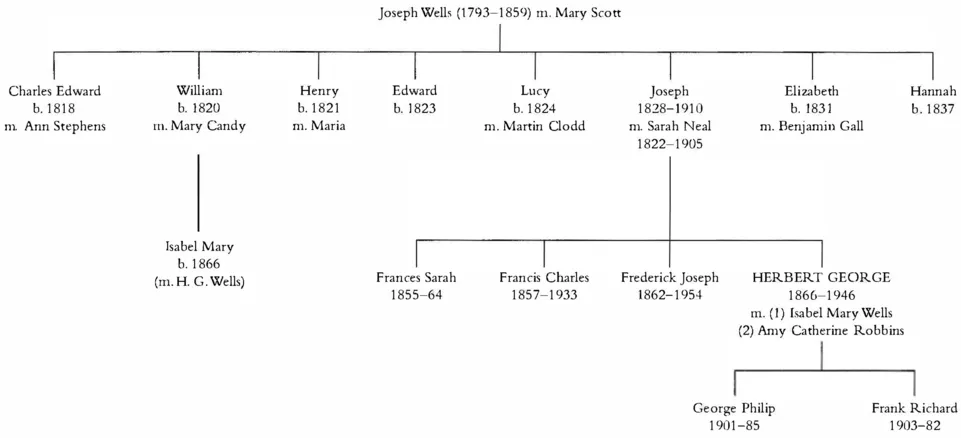
The Wells Family
The Wells Family
Chronological table
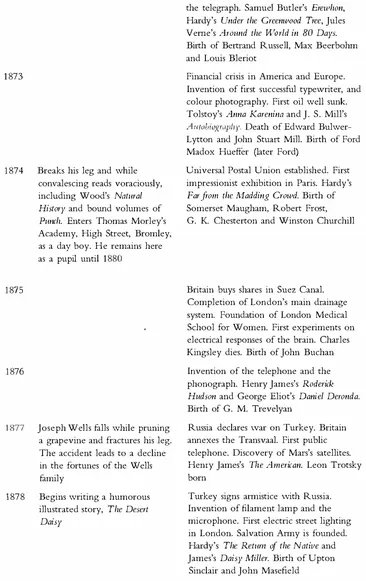
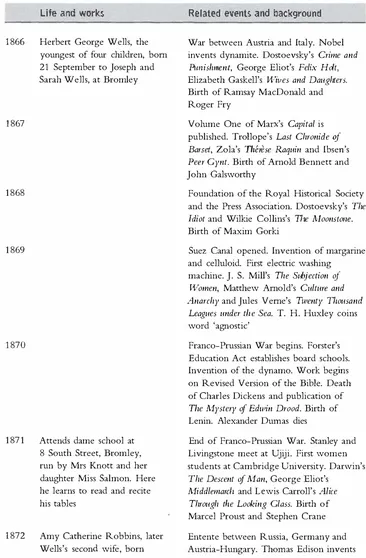
Chronological table Β  Life and works Related events and background 
 1866 Herbert George Wells, the youngest of four children, born 21 September to Joseph and Sarah Wells, at Bromley War between Austria and Italy. Nobel invents dynamite. Dostoevsky’s Crime and Punishment, George Eliot’s Felix Hdt,Elizabeth Gaskell’s Wives and Daughters.Birth of Ramsay MacDonald and Roger Fry 
 1867 Volume One of Marx’s Capital is published. Trollope’s Last Chronide of Barset, Zola’s ThΓ©rΓ¨se Raquin and Ibsen’s Peer Gynt. Birth of Arnold Bennett and John Galsworthy 
 1868 Foundation of the Royal Historical Society and the Press Association. Dostoevsky’s The Idiot and Wilkie Collins’s The Moonstone.Birth of Maxim Gorki 
 1869 Suez Canal opened. Invention of margarine and celluloid. First electric washing machine. J. S. Mill’s The Subjection of Women, Matthew Arnold’s Culture and Anarchy and Jules Verne’s Twenty Thousand Leagues under the Sea. T. H. Huxley coins word β€˜agnostic’ 
 1870 Franco-Prussian War begins. Forster’s Education Act establishes board schools, invention of the dynamo. Work begins on Revised Version of the Bible. Death of Charles Dickens and publication of The Mystery of Edwin Drood. Birth of Lenin. Alexander Dumas dies 
 1871 Attends dame school at 8 South Street, Bromley, run by Mrs Knott and her daughter Miss Salmon. Here he learns to read and recite his tables End of Franco-Prussian War. Stanley and Livingstone meet at Ujiji. First women students at Cambridge University. Darwin’s The Descent of Man, George Eliot’s Middlemarch and Lewis Carroll’s Alice Through the Looking Glass. Birth of Marcel Proust and Stephen Crane 
 1872 Amy Catherine Robbins, later Wells’s second wife, born Entente between Russia, Germany and Austria-Hungary. Thomas Edison invents the telegraph. Samuel Butler’s Erewhon,Hardy’s Under the Greenwood Tree, Jules Verne’s Around the World in 80 Days. Birth of Bertrand Russell, Max Beerbohm and Louis Bleriot 
 1873 Financial crisis in America and Europe. Invention of first successful typewriter, and colour photography. First oil well sunk. Tolstoy’s Anna Karenina and j. S. Mill’s Antobiography. Death of Edward Bulwer-Lytton and John Stuart Mill. Birth of Ford Madox Hueffer (later Ford) 
 1874 Breaks his leg and while convalescing reads voraciously, including Wood’s Natural History and bound volumes of Punch. Enters Thomas Morley’s Academy, High Street, Bromley, as a day boy. He remains here as a pupil until 1880 Universal Postal Union established. First impressionist exhibition in Paris. Hardy’s Far from the Madding Crowd. Birth of Somerset Maugham, Robert Frost, G. K. Chesterton and Winston Churchill 
 1875 Britain buys shares in Suez Canal. Completion of London’s main drainage system. Foundation of London Medical School for Women. First experiments on electrical responses of the brain. Charles Kingsley dies. Birth of John Buchan 
 1876 Invention of the telephone and the phonograph. Henry James’s Roderick Hudson and George Eliot’s Daniel Deronda.Birth of G. M. Trevelyan 
 1877 Joseph Wells falls while pruning a grapevine and fractures his leg. The accident leads to a decline in the fortunes of the Wells family Russia declares war on Turkey. Britain annexes the Transvaal. First public telephone. Discovery of Mars’s satellites. Henry James’s The American. Leon Trotsky born 
 1878 Begins writing a humorous illustrated story, The Desert Daisy Turkey signs armistice with Russia. Invention of filament lamp and the microphone. First electric street lighting in London. Salvation Army is founded. Hardy’s The Return of the Native and James’s Daisy Miller. Birth of Upton Sinclair and John Masefield 
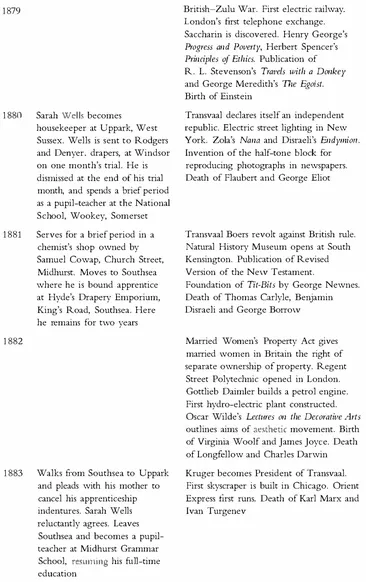
 1879 British-Zulu War. First electric railway. London’s first telephone exchange. Saccharin is discovered. Henry George’s Progress and Poverty, Herbert Spencer’s Principles of Ethics. Publication of R. L. Stevenson’s Travels with a Donkeyand George Meredith’s The Egoist. Birth of Einstein 
 1880 Sarah Wells becomes housekeeper at Uppark, West Sussex. Wells is sent to Rodgers and Denyer, drapers, at Windsor on one month’s trial. He is dismissed at the end of his trial month, and spends a brief period as a pupil-teacher at the National School, Wookey, Somerset Transvaal declares itself an independent republic. Electric street lighting in New York. Zola’s Nana and Disraeli’s Endymion.Invention of the half-tone block for reproducing photographs in newspapers. Death of Flaubert and George Eliot 
 1881 Serves for a brief period in a chemist’s shop owned by Samuel Cowap, Church Street, Midhurst. Moves to Southsea where he is bound apprentice at Hyde’s DraperyΒ· Emporium, King’s Road, Southsea. Here he remains for two years Transvaal Boers revolt against British rule. Natural History Museum opens at South Kensington. Publication of Revised Version of the New Testament. Foundation of Tit-Bits by George Newnes. Death of Thomas Carlyle, Benjamin Disraeli and George Borrow 
 1882 Married Women’s Property Act gives married women in Britain the right of separate ownership of property. Regent Street Polytechnic opened in London. Gottlieb Daimler builds a petrol engine. First hydro-electric plant constructed. Oscar Wilde’s Lectures on the Decorative Artsoutlines aims of aesthetic movement. Birth of Virginia Woolf and James Joyce. Death of Longfellow and Charles Darwin 
 1883 Walks from Southsea to Uppark and pleads with his mother to cancel his apprenticeship indentures. Sarah Wells reluctantly agrees. Leaves Southsea and becomes a pupil-teacher at Midhurst Grammar School, resuming his full-time education Kruger becomes President of Transvaal. First skyscraper is built in Chicago. Orient Express first runs. Death of Karl Marx and Ivan Turgenev 
 1884 Wins scholarship to Normal School of Science, South Kensington. Leaves Midhurst and commences three years as a science student at the Normal School (now part of the Imperial College of Science, Technology and Medicine). In his first year, studies biology under T. H. Huxley Germany occupies S. W. Africa and the Cameroons. Third British Reform Bill. Fabian Society is founded. Discovery of the tetanus bacillus. Oxford English Dictionary published for the first time. Ibsen’s The Wild Duck. Birth of Sean O’Casey 
 1885 In his second year, studies physics under Professor Guthrie Invention of internal combustion engine. Dictionary of National Biography is begun. Meredith’s Diana of the Crossways and Zola’s Germinal. Death of Victor Hugo. Birth of D. H. Lawrence 
 1886 In his final year, studies geology under Professor Judd. Becomes editor of student magazine, the Science Schools Journal, and contributes articles Gladstone introduces Home Rule Bill for Ireland. First English edition of Marx’s Capital. Gissing’s Dams, James’s The Bostonians and Stevenson’s Dr Jekyll and Mr Hyde 
 1887 Fails final examinations. Becomes schoolmaster at Holt Academy, Holt, near Wrexham, North Wales. Badly fouled on the football pitch and suffers haemorrhages; spends several months convalescing at Uppark. Writes a number of short stories. Joseph Wells gives up the shop at Bromley and moves to Liss, Hampshire Queen Victoria’s Golden Jubilee. Britain annexes Zululand. Zamenhof invents Esperanto. Invention of artificial silk. Hertz produces the first radio waves. Birth of Julian Huxley 
 1888 Continues convalescence at Uppark and at Stoke on Trent, where he stays with his friend William Burton. Returns to London in the summer, working as a teacher. The Chronic Argonauts is published in Science Schools Journal. Continues writing short stories and begins work on a novel, later abandoned Invention of the electric motor, the box camera and the pneumatic tyre. Foundation of Answers by Alfred Harms worth. Edward Bellamy’s Looking Backward. T. S. Eliot and T. E. Lawrence are born. Matthew Arnold dies 
 1889 Becomes schoolmaster at Henley House School, Kilburn, Writes occasional contributions for school magazine London dock strike. G. B. Shaw’s Fabian Essays. Brussels conference on abolition of the slave trade. Birth of Adolf Hitler 
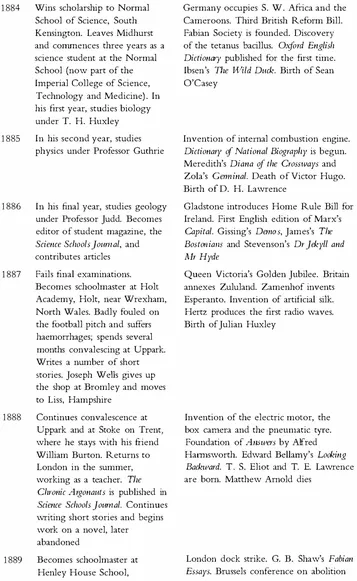
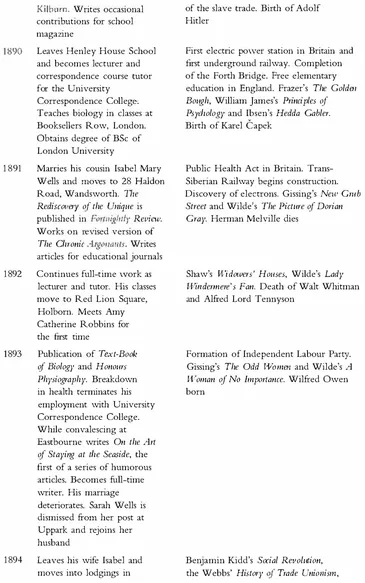
 1890 Leaves Henley House School and becomes lecturer and correspondence course tutor for the University Correspondence College. Teaches biology in classes at Booksellers Row, London. Obtains degree of BSc of London University First electric power station in Britain and first underground railway. Completion of the Forth Bridge. Free elementary education in England. Frazer’s The Golden Bough, William James’s Principles of Psychology and Ibsen’s Hedda Gabler. Birth of Karel Capek 
 1891 Marries his cousin Isabel Mary Wells and moves to 28 Haldon Road, Wandsworth. The Rediscovery, of the Unique is published in Fortuigluly Review.Works on revised version of The Chronic Argonauts. Writes articles for educational journals Public Health Act in Britain. Trans-Siberian Railway begins construction. Discovery of electrons. Gissing’s New Grub Street and Wilde’s The Picture of Dorian Gray. Herman Melville dies 
 1892 Continues full-time work as lecturer and tutor. His classes move to Red Lion Square, Holborn. Meets Amy Catherine Robbins for the first time Shaw’s Widowers’ Houses, Wilde’s Lady Windermere's Fan. Death of Walt Whitman and Alfred Lord Tennyson 
 1893 Publication of Text-Bo ok of Biology and Honours PIlysiography. Breakdown in health terminates his employment with University Correspondence College. While convalescing at Eastbourne writes On the Art of Staying at the Seaside, the first of a series of humorous articles. Becomes full-time writer. His marriage deteriorates. Sarah Wells is dismissed from her post at Uppark and rejoins her husband Formation of Independent Labour Party. Gissing’s The Odd Women and Wilde’s A Woman of No Importance. Wilfred Owen born 
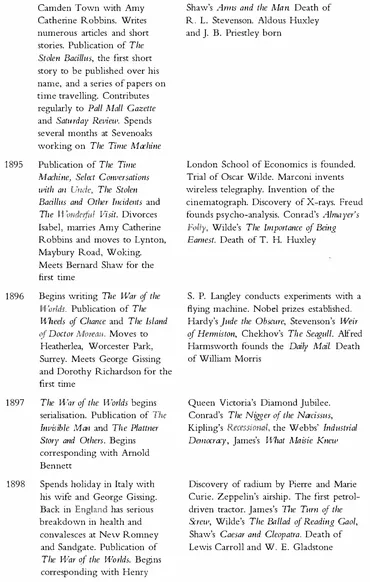
 1894 Leaves his wife Isabel and moves into lodgings in Camden Town with Amy Catherine Robbins. Writes numerous articles and short stories. Publication of The Stolen Bacillus, the first short story to be published over his name, and a series of papers on time travelling. Contributes regularly to Pall Mall Gazetteand Saturday Review. Spends several months at Sevenoaks working on The Time Machine Benjamin Kidd’s Social Revohtiion,the Webbs’ History of Trade Unionism, Shaw’s Arms and the Man Death of R. L. Stevenson. Aldous Huxley and J. B. Priestley born 
 1895 Publication of The Time Machine, Select Conversations with an Unde, The Stolen Bacillus and Other Incidents and The Wonderful Visit. Divorces Isabel, marries Amy Catherine Robbins and moves to Lynton, Maybury Road, Woking. Meets Bernard Shaw for the first time London School of Economics is founded. Trial of Oscar Wilde. Marconi invents wireless telegraphy. Invention of the cinematograph. Discovery of X-rays. Freud founds psycho-analysis. Conrad’s Almeyer’s Folly, Wilde’s The Importance of Being Earnest. Death of T. H. Huxley 
 1896 Begins writing The War of the Worlds. Publication of The Wheels of Chance and The Island of Doctor Moreau, Moves to Heatherlea, Worcester Park, Surrey. Meets George Gissing and Dorothy Richardson for the first time S. P. Langley conducts experiments with a flying machine. Nobel prizes established. Hardy’s Jude the Obscure, Stevenson’s Weir of Hennis ton, Chekhov’s The Seagull. Alfred Harmsworth founds the Daily Mail Death of William Morris 
 1897 The War of the Worlds begins serialisation. Publication of The Invisible Man and The Plattner Story and Others. Begins corresponding with Arnold Bennett Queen Victoria’s Diamond Jubilee. Conrad’s The Nigger of the Narcissus,Kipling’s Recessional, the Webbs’ Industrial Democracy, James’s What Maisie Knew 
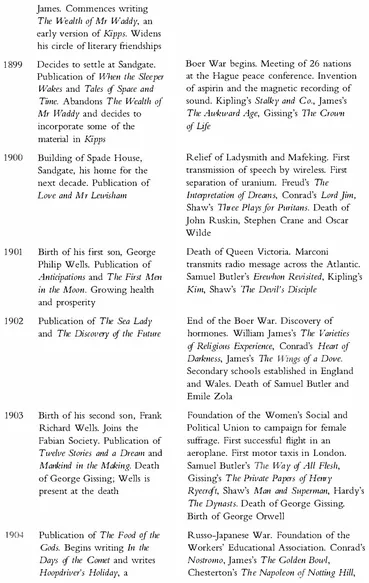
 1898 Spends holiday in Italy with his wife and George Gissing. Back in England has serious breakdown in health and convalesces at New Romney and Sandgate. Publication of The War of the Worlds. Begins corresponding with Henry James. Commences writing The Wealth of Mr Waddy, an early version of Kipps. Widens his circle of literary friendships Discovery of radium by Pierre and Marie Curie. Zeppelin’s airship. The first petrol-driven tractor. James’s The Turn of the Screw, Wilde’s The Ballad of Reading Gaol,Shaw’s Caesar and Cleopatra. Death of Lewis Carroll and W. E. Gladstone 
 1899 Decides to settle at Sandgate. Publication of W\ten the Sleeper Wakes and Tales of Space and Time. Abandons The Wealth of Mr Waddy and decides to incorporate some of the material in Kipps Boer War begins. Meeting of 26 nations at the Hague peace conference. Invention of aspirin and the magnetic recording of sound. Kipling’s Stalky and Co., James’s The Awkward Age, Gissing’s The Crown of Life 
 1900 Building of Spade House, Sandgate, his home for the next decade. Publication of Love and Mr Lewisham Relief of Ladysmith and Mafeking. First transmission of speech by wireless. First separation of uranium. Freud’s The Interpretation of Dreams, Conrad’s Lord Jim,Shaw’s Three Plays for Puritans. Death of John Ruskin, Stephen Crane and Oscar Wilde 
 1901 Birth of his first son, George Philip Wells. Publication of Anticipations and The First Men in the Moon. Growing health and prosperity Death of Queen Victoria. Marconi transmits radio message across the Atlantic. Samuel Butler’s Erewhon Revisited, Kipling’s Kim, Shaw’s The Devil’s Disciple 
 1902 Publication of The Sea Ladyand The Discovery of the Future End of the Boer War. Discovery of hormones. William James’s The Varieties of Religious Experience, Conrad’s Heart of Darkness, James’s The 11 tugs of a Dove.Secondary schools established in England and Wales. Death of Samuel Butler and Emile Zola 
 1903 Birth of his second son, Frank Richard Wells. Joins the Fabian Society. Publication of Twelve Stories and a Dream and Mankind in the Making. Death of George Gissing; Wells is present at the death Foundation of the Women’s Social and Political Union to campaign for female suffrage. First successful flight in an aeroplane. First motor taxis in London. Samuel Butler’s The Way of All Flesh,Gissing’s The Private Papers of Henry Ryecrcft, Shaw’s Man and Superman, Hardy’s The Dynasts. Death of George Gissing. Birth of George Orwell 
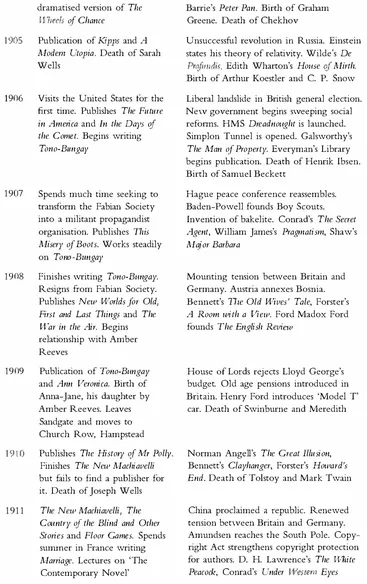
 1904 Publication of The Food of the Gods. Begins writing In the Days of the Comet and writes Hoopdriver’s Holiday, a dramatised version of The Wheels of Chance Russo-Japanese War. Foundation of the Workers’ Educational Association. Conrad’s Nostromo, James’s The Golden Bowl,Chesterton’s The Napoleon of Notting Hill, Barrie’s Peter Pan. Birth of Graham Greene. Death of Chekhov 
 1905 Publication of Kipps and A Modern Utopia. Death of Sarah Wells Unsuccessful revolution in Russia. Einstein states his theory of relativity. Wilde’s De Profundis, Edith Wharton’s House of Mirth.Birth of Arthur Koestler and C. P. Snow 
 1906 Visits the United States for the first time. Publishes The Future in America and In the Days of the Comet. Begins writing Tono-Bungay Liberal landslide in British general election. New government begins sweeping social reforms. HMS Dreadnought is launched. Simplon Tunnel is opened. Galsworthy’s The Man of Property. Everyman’s Library begins publication. Death of Henrik Ibsen. Birth of Samuel Beckett 
 1907 Spends much time seeking to transform the Fabian Society into a militant propagandist organisation. Publishes This Misery of Boots. Works steadily on Tono-Bungay Hague peace conference reassembles. Baden-Powell founds Boy Scouts. Invention of bakelite. Conrad’s The Secret Agent, William James’s Pragmatism, Shaw’s Major Barbara 
 1908 Finishes writing Tono-Bungay.Resigns from Fabian Society. Publishes New Worlds for Old, First and Last Things and The War in the Air. Begins relationship with Amber Reeves Mounting tension between Britain and Germany. Austria annexes Bosnia. Bennett’s The Old Wives’ Tale, Forster’s A Room with a View. Ford Madox Ford founds The English Review 
 1909 Publication of Tono-Bungayand Ann Veronica. Birth of Anna-Jane, his daughter by Amber Reeves. Leaves Sandgate and moves to Church Row, Hampstead House of Lords rejects Lloyd George’s budget Old age pensions introduced in Britain. Henry Ford introduces β€˜Model T’car. Death of Swinburne and Meredith 
 1910 Publishes The History of Mr Polly.Finishes The New Machiavellibut fails to find a publisher for it. Death of Joseph Wells Norman Angell’s The Great Illusion,Bennett’s Clay hanger, Forster’s Howard’s End. Death of Tolstoy and Mark Twain 
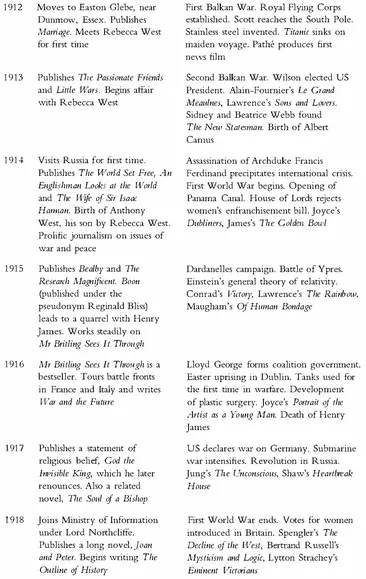
 1911 The New Machiavelli, The Country of the Blind and Other Stories and Floor Games. Spends summer in France writing Marriage. Lectures on β€˜The Contemporary Novel’ China proclaimed a republic. Renewed tension between Britain and Germany. Amundsen reaches the South Pole. Copyright Act strengthens copyright protection for authors. D. H. Lawrence’s The White Peacock, Conrad’s Under Wei tern Eyes 
 1912 Moves to Easton Glebe, near Dunmow, Essex. Publishes Marriage. Meets Rebecca West for first time First Balkan War. Royal Flying Corps established. Scott reaches the South Pole. Stainless steel invented. Titanic sinks on maiden voyage. PathΓ© produces first news film 
 1913 Publishes The Passionate Friendsand Little Wars. Begins affair with Rebecca West Second Balkan War. Wilson elected US President. Alain-Fournier’s Le Grand Meaulnes, Lawrence’s Sons and Laws.Sidney and Beatrice Webb found The New Statesman. Birth of Albert Camus 
 1914 Visits Russia for first time. Publishes The World Set Free, An Englishman Looks at the Worldand The Wife of Sir Isaac Harman. Birth of Anthony West, his son by Rebecca West. Prolific journalism on issues of war and peace Assassination of Archduke Francis Ferdinand precipitates international crisis. First World War begins. Opening of Panama Canal. House of Lords rejects women’s enfranchisement bill. Joyce’s Dubliners, James’s The Golden Bond 
 1915 Publishes Bealby and The Research Magnificent. Boon(published under the pseudonym Reginald Bliss) leads to a quarrel with Henry James. Works steadily on Mr Britling Sees It Through Dardanelles campaign. Battle of Ypres. Einstein’s general theory of relativity. Conrad’s Victory, Lawrence’s The Rainbow,Maugham’s Of Human Bondage 
 1916 Mr Britling Sees It Through is a bestseller. Tours battle fronts in France and Italy and writes War and the Future Lloyd George forms coalition government. Easter uprising in Dublin. Tanks used for the first time in warfare. Development of plastic surgery. Joyce’s Portrait of the Artist as a Young Man. Death of Henry James 
 1917 Publishes a statement of religious belief, God the Invisible King, which he later renounces. Also a related novel, The Soul of a Bishop US declares war on Germany. Submarine war intensifies. Revolution in Russia. Jung’s The Unconscious, Shaw’s Heartbreak House 
 1918 Joins Ministry of Information under Lord Northcliffe. Publishes a long novel, Joan and Peter. Begins writing The Outline of History First World War ends. Votes for women introduced in Britain. Spengler’s The Decline of the West, Bertrand Russell’s Mysticism and Logic, Lytton Strachey’s Eminent Victorians 
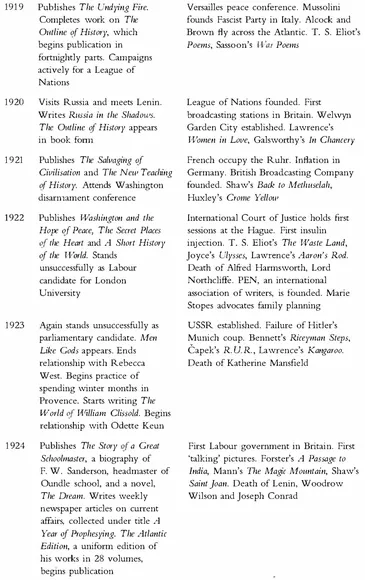
 1919 Publishes The Undying Fire.Completes work on The Outline of History, which begins publication in fortnightly parts. Campaigns actively for a League of Nations Versailles peace conference. Mussolini founds Fascist Party in Italy. Alcock and Brown fly across the Atlantic. T. S. Eliot’s Poems, Sassoon’s War Poems 
 1920 Visits Russia and meets Lenin. Writes Russia in the Shadows. The Outline of History appears in book form League of Nations founded. First broadcasting stations in Britain. Welwyn Garden City established. Lawrence’s Women in Love, Galsworthy’s In Chancery 
 1921 Publishes The Salvaging of Civilisation and The New Teaching of History. Attends Washington disarmament conference French occupy the Ruhr. Inflation in Germany. British Broadcasting Company founded. Shaw’s Back to Methuselah,Huxley’s Crome Yellow 
 1922 Publishes Washington and the Hope of Peace, The Secret Places of the Heart and A Short History of the World. Stands unsuccessfully as Labour candidate for London University International Court of Justice holds first sessions at the Hague. First insulin injection. T. S. Eliot’s The Waste Land,Joyce’s Ulysses, Lawrence’s Aaron's Rod.Death of Alfred Harms worth, Lord Northcliffe. PEN, an international association of writers, is founded. Marie Stopes advocates family planning 
 1923 Again stands unsuccessfully as parliamentary candidate. Men Like Gods appears. Ends relationship with Rebecca West. Begins practice of spending winter months in Provence. Starts writing The World of William Clissold. Begins relationship with Odette Keun USSR established. Failure of Hitler’s Munich coup. Bennett’s Riceyman Steps,Capek’s R. U. R., Lawrence’s Kangaroo.Death of Katherine Mansfield 
 1924 Publishes The Story of a Great Schoolmaster, a biography of F. W. Sanderson, headmaster of Oundle school, and a novel, The Dream. Writes weekly newspaper articles on current affairs, collected under title A Year of Prophesying. The Atlantic Edition, a uniform edition of his works in 28 volumes, begins publication First Labour government in Britain. First β€˜talking’ pictures. Forster’s A Passage to India, Mann’s The Magic Mountain, Shaw’s Saint Joan. Death of Lenin, Woodrow Wilson and Joseph Conrad 
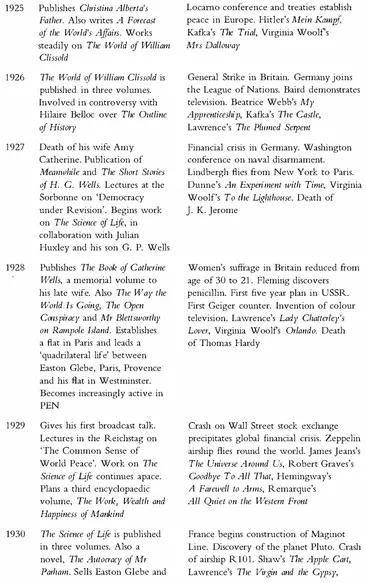
 1925 Publishes Christina Alberta’s Father. Also writes A Forecast of the World’s Affairs. Works steadily on The World of William Clissold Locarno conference and treaties establish peace in Europe. Hitler’s Mein Kampf.Kafka’s The Trial, Virginia Woolfs Mrs Dalloway 
 1926 The World of William Clissold is published in three volumes. Involved in controversy with Hilaire Belloc over The Outline of History General Strike in Britain. Germany joins the League of Nations. Baird demonstrates television. Beatrice Webb’s My Apprenticeship, Kafka’s The Castle,Lawrence’s The Plumed Serpent 
 1927 Death of his wife Amy Catherine. Publication of Meanwhile and The Short Stories of H. G. Wells. Lectures at the Sorbonne on β€˜Democracy under Revision’. Begins work on The Science of Life, in collaboration with Julian Huxley and his son G. P. Wells Financial crisis in Germany. Washington conference on naval disarmament. Lindbergh flies from New York to Paris. Dunne’s An Experiment with Time, Virginia Woolf’s To the Lighthouse. Death of J. K. Jerome 
 1928 Publishes The Book of Catherine Wells, a memorial volume to his late wife. Also The Way the World Is Going, The Open Conspiracy and Mr Blettsworthy on Ram pole Island. Establishes a flat in Paris and leads a β€˜quadrilateral life’ between Easton Glebe, Paris, Provence and his flat in Westminster. Becomes increasingly active in PEN Women’s suffrage in Britain reduced from age of 30 to 21. Fleming discovers penicillin. First five year plan in USSR. First Geiger counter. Invention of colour television. Lawrence’s Lady Chatterley’s Lover, Virginia Woolfs Orlando. Death of Thomas Hardy 
 1929 Gives his first broadcast talk. Lectures in the Reichstag on β€˜The Common Sense of World Peace’. Work on The Scietice of Life continues apace. Plans a third encyclopaedic volume, The Work, Wealth and Happiness of Mankind Crash on Wall Street stock exchange precipitates global financial crisis. Zeppelin airship flies round the world. James Jeans’s The Universe Around Us, Robert Graves’s Goodbye To All That, Hemingway’s A Farewell to Arms, Remarque’s All Quiet on the Western Front 
 1930 The Science of Life is published in three volumes. Also a novel, The Autocracy of Mr Parham. Sells Easton Glebe and moves to 47 Chiltern Court, Clarence Gate, London France begins construction of Maginot Line. Discovery of the planet Pluto. Crash of airship R101. Shaw’s The Apple Cart, Lawrence’s The Virgin and the Gypsy, Leavis’s Mass Civilisation and Minority Culture. Death of D. H. Lawrence 
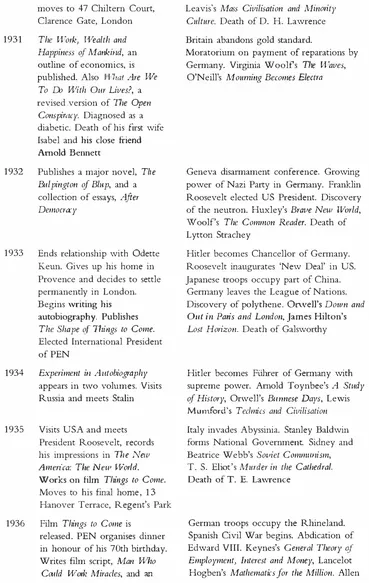
 1931 The Work, Wealth and Happiness of Mankind, an outline of economics, is published. Also What Are We To Do With Our Lives? a revised version of The Open Conspiracy. Diagnosed as a diabetic. Death of his first wife Isabel and his close friend Arnold Bennett Britain abandons gold standard. Moratorium on payment of reparations by Germany. Virginia Woolfs The Waves,O’Neill’s Mourning Becomes Electra 
 1932 Publishes a major novel, The Bulpington of Blup, and a collection of essays, After Democracy Geneva disarmament conference. Growing power of Nazi Party in Germany. Franklin Roosevelt elected US President. Discovery of the neutron. Huxley’s Brave New World,Woolf’s The Common Reader. Death of Lytton Strachey 
 1933 Ends relationship with Odette Keun. Gives up his home in Provence and decides to settle permanently in London. Begins writing his autobiography. Publishes The Shape of Things to Conte.Elected International President of PEN Hitler becomes Chancellor of Germany. Roosevelt inaugurates β€˜New Deal’ in US. Japanese troops occupy part of China. Germany leaves the League of Nations. Discovery of polythene. Orwell's Down and Out in Paris and London, James Hilton’s Lost Horizon. Death of Galsworthy 
 1934 Experiment in Autobiographyappears in two volumes. Visits Russia and meets Stalin Hitler becomes FΓΌhrer of Germany with supreme power. Arnold Toynbee’s A Study of History, Orwell’s Burmese Days, Lewis Mumford's Teclmics and Civilisation 
 1935 Visits USA and meets President Roosevelt, records his impressions in The New America: The New World. Works on film Things to Come.Moves to his final home, 13 Hanover Terrace, Regent’s Park Italy invades Abyssinia. Stanley Baldwin forms National Government Sidney and Beatrice Webb’s Soviet Communism, T. S. Eliot’s Murder in the Cathedral.Death of T. E. Lawrence 
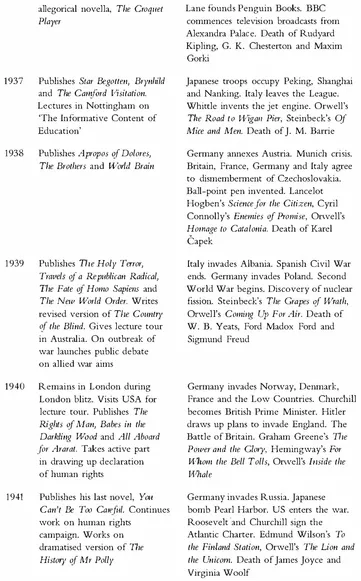
 1936 Film Things to Come is released. PEN organises dinner in honour of his 70th birthday. Writes film script, Man Who Could Work Miracles, and an allegorical novella, The Croquet Player German troops occupy the Rhineland. Spanish Civil War begins. Abdication of Edward VIII. Keynes’s General Theory of Employment, Interest and Money, Lancelot Hogben’s Mathematics for the Million. Allen Lane founds Penguin Books. BBC commences television broadcasts from Alexandra Palace. Death of Rudyard Kipling, G. K. Chesterton and Maxim Gorki 
 1937 Publishes Star Begotten, Brynhildand The Camford Visitation.Lectures in Nottingham on β€˜The Informative Content of Education’ Japanese troops occupy Peking, Shanghai and Nanking. Italy leaves the League. Whittle invents the jet engine. Orwell’s The Road to Wigan Pier, Steinbeck’s Of Mice and Men. Death of J. M. Barrie 
 1938 Publishes Apropos of Dolores, The Brothers and World Brain Germany annexes Austria. Munich crisis. Britain, France, Germany and Italy agree to dismemberment of Czechoslovakia. Ball-point pen invented. Lancelot Hogben’s Science for the Citizen, Cyril Connolly’s Enemies of Promise, Orwell’s Homage to Catalonia. Death of Karel Capek 
 1939 Publishes The Holy Terror, Travels of a Republican Radical, The Fate of Homo Sapiens and The New World Order. Writes revised version of The Country of the Blind. Gives lecture tour in Australia. On outbreak of war launches public debate on allied war aims Italy invades Albania. Spanish Civil War ends. Germany invades Poland. Second World War begins. Discovery of nuclear fission. Steinbeck’s The Grapes of Wrath,Orwell’s Coming Up For Air. Death of W. B. Yeats, Ford Madox Ford and Sigmund Freud 
 1940 Remains in London during London blitz. Visits USA for lecture tour. Publishes The Rights of Man, Babes in the Darkling Wood and All Aboard for Ararat. Takes active part in drawing up declaration of human rights Germany invades Norway, Denmark, France and the Low Countries. Churchill becomes British Prime Minister. Hitler draws up plans to invade England. The Battle of Britain. Graham Greene’s The Power and the Glory,, Hemingway’s For Whom the Bell Tolls, Orwell’s Inside the Whale 
 1941 Publishes his last novel, You Can’t Be Too Careful. Continues work on human rights campaign. Works on dramatised version of The History of Mr Polly Germany invades Russia. Japanese bomb Pearl Harbor. US enters the war. Roosevelt and Churchill sign the Atlantic Charter. Edmund Wilson’s To the Finland Station, Orwell’s The Lion and the Unicorn. Death of James Joyce and Virginia Woolf 
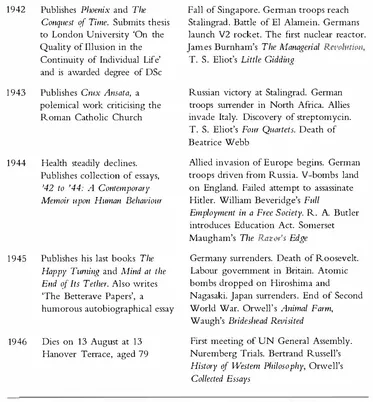
 1942 Publishes Phoenix and The Conquest of Time. Submits thesis to London University On the Quality of Illusion in the Continuity of Individual Life’ and is awarded degree of DSc Fall of Singapore. German troops reach Stalingrad. Battle of El Alamein. Germans launch V2 rocket. The first nuclear reactor. James Burnham’s The Managerial Revolution,T. S. Eliot’s Little Gidding 
 1943 Publishes Crux Ansata, a polemical work criticising the Roman Catholic Church Russian victory at Stalingrad. German troops surrender in North Africa. Allies invade Italy. Discovery of streptomycin. T. S. Eliot’s Four Quartets. Death of Beatrice Webb 
 1944 Health steadily declines. Publishes collection of essays, ’42 to ’44: A Contemporary Memoir upon Human Behaviour Allied invasion of Europe begins. German troops driven from Russia. V-bombs land on England. Failed attempt to assassinate Hitler. William Beveridge’s Full Employment in a Free Society. R. A. Butler introduces Education Act. Somerset Maugham’s The Razor's Edge 
 1945 Publishes his last books The Happy Turning and Mind at the End of Its Tether. Also writes β€˜The Betterave Papers’, a humorous autobiographical essay Germany surrenders. Death of Roosevelt. Labour government in Britain. Atomic bombs dropped on Hiroshima and Nagasaki. Japan surrenders. End of Second World War. Orwell’s Animal Farm,Waugh’s Bride she ad Revisited 
 1946 Dies on 13 August at 13 Hanover Terrace, aged 79 First meeting of UN General Assembly. Nuremberg Trials. Bertrand Russell’s History of Western Philosophy, Orwell’s Collected Essays

Chapter 1
His Life and Times

H.G. Wells was a man of many parts. He was a novelist, a short story writer and the author of a series of scientific romances which are known throughout the world. At the same time he was a popular educator who wrote an Outline of History and A Short History of the World and numerous books on sociology, politics and philosophy. He was a feminist, a humanist and a tireless campaigner for freedom of thought and expression. He produced more than a hundred books and pamphlets in a literary career which extended for more than half a century; several of his works have been continuously in print since their first publication more than a hundred years ago.
The period covered by his lite (1866β€”1946) was one of unprecedented change. He was born into a world before the motor car, the aeroplane, the telephone and television. He lived to see the First and Second World Wars, the first computers and the dawn of the nuclear age. Many of the changes witnessed in his lifetime β€” the invention of the aeroplane and the atomic bomb, the emancipation of women, total warfare and the growth of the world community β€” had been foreseen in his novels and stories long before they came to fruition.
His life is one of many paradoxes. The author of some deeply pessimistic fables including The Time Machine and The Island of Doctor Moreau, his name has become synonymous with a belief in the inevitability of progress and the view that science is a panacea for all human ills. A painstaking craftsman who frequently revised his work before he was satisfied, he is widely regarded as a facile writer who took little trouble over his work. The son of a gardener and a lady's maid, he rose to become a world figure whose novels and journalism commanded an audience of millions.

Early years

Herbert George Wells was born at Bromley, Kent on 21 September 1866. Bromley today is a suburb of London but in mid-Victorian times it was a small market town with an identity of its own. Situated twelve miles from London β€” three or four hours' walking before the advent of the railway β€” Bromley was a rural community, pleasantly situated above the valley of the river Ravensbourne. His parents, Joseph and Sarah Wells, came to live there in 1855 unaware that the town was about to be changed irrevocably by the coming of the railway.
Joseph Wells was born at Penshurst, Kent on 14 July 1828, the son of the head gardener to Lord de Lisle at Penshurst Place. He was trained to his father's profession and held a number of transitory appointments as a gardener between 1847 and 1851. Contemporary photographs show him to have been a jovial-looking man with a short crisp beard, an upright bearing and penetrating eyes. He held decided opinions and was not afraid to voice them; it is this characteristic, one suspects, which did not endear him to his employers. In June 1851 he was engaged as gardener by Miss Featherstonhaugh of Uppark, Sussex and there he remained for two years. It was at Uppark that he met Sarah Neal, a quiet, gentle woman, five years older than himself who was employed at the great house as a lady's maid. Uppark was by no means typical of country houses of that era. It was a microcosm of an earlier age, frozen in a time warp. The house, which was built circa 1690, stands in a commanding position overlooking the village of South Harting and the great ridge of the South Downs. Surrounded by walled gardens, a deer park and undulating countryside it was remote from urbanisation or any intrusive influence.
Sarah Neal was born in 1822, the daughter of George Neal, an innkeeper first at Chichester and then at Midhurst, Sussex. She attended a finishing school for young ladies at Chichester where she learned to write in copperplate handwriting, to read, to do arithmetic and elementary geography. After leaving school she had four years' apprenticeship as a dressmaker, then went into service as a lady's maid in various parts of England and Ireland before being appointed personal maid to Frances Bullock at Uppark in September 1850.
A contemporary of Joseph and Sarah who knew them both records that Joseph was 'a dictatorial, overbearing man, quite overawing his delicately made and lady-like wife. On the face of it, the engagement between this oddly matched couple does seem unusual. Joseph was an out-of-doors man, vigorous, sceptical and unconventional. Sarah was small, quietly spoken and self-effacing, determined to do her duty and to know her place in a rigidly hierarchical world.
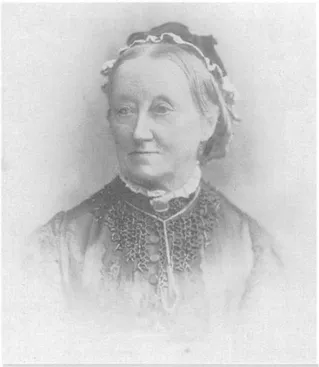
Wells's mother, Sarah Wells, nee Neal, housekeeper at Uppark
In 1853 Sarah's world collapsed about her. She left her post at Uppark to look after her invalid mother; her parents died within a few weeks of each other and she discovered to her horror that her father had been heavily in debt. The inn and all her parents' possessions had to be sold in order to meet the creditors' demands. With no home and no situation Sarah evidently felt she had little alternative but to accept Joe's offer of marriage. They were married at St Stephen's Church, London on 22 November 1853, seventeen days after her mother's death. The marriage certificate records Joseph's occupation simply as 'gardener'.
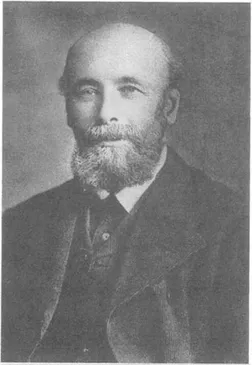
Wells's father, Joseph Wells, shopkeeper at Bromley
In August 1855 Joseph lost his situation and the couple were homeless for a time. At this point George Wells (a cousin of Joseph's father) offered what seemed to be a solution to their crisis. He owned a china and glassware shop at 47 High Street, Bromley (pretentiously named Atlas House) which they could purchase, if they wished, on attractively easy terms. Joseph took little time to consider. He spent all his savings and reserves on acquiring the business and, together with his wife and infant daughter, moved into the shop. For the first time in his life he was master of his destiny.
It seems clear that the shop survived only in the most precarious way, for Joseph was no businessman. Had he had more business acumen and drive the venture would probably have succeeded. As it was, the shop simply ticked over, drifting on from year to year until Joseph was finally sold up (May 1887) for failing to pay his quarterly rent. Wells recorded of his father: 'he had a light and cheerful disposition, and a large part of his waking energy was spent in evading disagreeable realisations'. Much of the work of running the shop and managing the home fell to Sarah, for Joseph was frequently absent, but Sarah was a woman of some determination and did her utmost to keep up appearances. It was into this home that Frank (1857) and Fred (1862) were born, and finally Herbert George.
H. G. (or Bert as he was usually called) was thus the youngest of their four children. Sarah's beloved daughter Fanny died suddenly and tragically of appendicitis in 1864, whereupon she heaped all her devotion on her youngest son in the hope that he would grow up, like Fanny, a model of infant piety. In this she was to be cruelly disappointed. Bert inherited much of his father's scepticism and wilfulness, and displayed little interest in the religious beliefs which were so important to her. At the same time he inevitably spent much time in her company and his early vision of the world derived largely from her teachings. Throughout her life the relationship between mother and son was a complex mixture of exasperation and love.
Young Bert was sent to a dame school at 8 South Street, Bromley (1871β€”2) where he learned to read and do simple arithmetic, and then became a pupil at Mr Thomas Morley's Academy situated further up the High Street. Here he remained for 6 years (1874β€”80). Between leaving the dame school and becoming a day boy at Morley's Academy there occurred an interregnum of crucial importance to his life. In 1874, when he was aged 7, he sustained a fractured leg (the bone was badly set by the local doctor and had to be rebroken and set again). This necessitated a lengthy convalescence and his absence from all active games. During these months of enforced idleness he discovered the pleasures of reading and would let his imagination soar over Wood's Natural History, the works of Washington Irving and bound volumes of Punch and Fun. Joseph Wells had a taste for reading and would bring books home from sales' or from the Bromley Literary Institute. Thomas Morley, an irascible Scot, was a strict disciplinarian with little patience with dullards. With pupils who showed promise he was however prepared to make an effort and he soon singled out Wells as a boy of exceptional gifts, encouraging him in the solution of mathematical and grammatical problems. By the time he had left the school at the age of 13 Wells had acquired the basis of an education but was still intensely curious about the world of science and discovery unfolding all about him. Throughout his school years he supplemented his daytime learning with perfervid reading at home. Among the books he recalled particularly was the poetry of Sir Walter Scott. Chaucer, Humboldt's Cosmos, George Eliot's Middlemarch, Captain Cook's Travels and Grote's History of Greece. He was also dipping eagerly into Dickens's novels and imbibing a fascination with literature which remained with him throughout his life. A humorous story of some 100 pages, The Desert Daisy, written and illustrated by Wells at the age of 12 or 13, survived among his papers and was published in facsimile in 1957.
In 1877 disaster came to the Wells family and necessitated the breakup of the household. Joseph fell one Sunday morning and broke his leg while attempting to prune a grapevine which grew against the back of the house. It soon became clear that from now on, though he could walk, he would be permanently and heavily lame. His lameness meant that his days as a cricketer and coach were over and thus the shop's income, at best a meagre one, was severely reduced. Frank and Fred were by this time apprenticed to the drapery trade, for Sarah's overriding ambition for her sons was that they should be drapers β€” this she considered to be a gentlemanly and respectable occupation. It was decided that Bert must follow in his brothers' footsteps as soon as his schooling could be terminated. At this point, Wells recalled later, 'the heavens opened and a great light shone on Mrs Sarah Wells'. Sarah's former employer, Frances Bullock, had inherited Uppark on the death of Lady Featherstonhaugh. She was in need of a housekeeper and wrote to her former maid offering her the post. This seemed to be the solution to all Sarah's worries. She had always hated Bromley and her life of drudgery in the shop, and the chance of leaving all this behind her and returning to Uppark where she had been so happy must have come to her like the answer to her dreams. She decided to accept the offer, having little compunction in leaving Joe behind to run the shop on his own and thrusting Bert out into the world (June 1880) to become a draper's apprentice at Windsor. Sarah became housekeeper at Uppark in the summer of 1880 and continued in that capacity until February 1893.
Young Wells's arrival at Windsor as a shop assistant 'on trial' was the first of a series of false starts in life. Shop assistants at that time had to work a thirteen-hour day, from 7.30 am to 8.30 pm (the Shop Hours Act limiting the working week to seventy-four hours was not introduced until 1892, and weekly half-day holidays for employees did not become compulsory until 1911). To the 13-year-old Wells, cut off from his schooling just when his curiosity and imagination had been most aroused, the days must have seemed endless. On his own admission, however, he was clearly a misfit as a draper, displaying little or no aptitude for the work and making it all too clear that his interests lay elsewhere. He proved so unsuitable as a draper that at the end of the trial month his employers rejected him, finding him 'untidy and troublesome'.
His next false start was to be sent to Wookey in Somerset, where a distant relative of his mother's, Alfred Williams, was the only schoolmaster at the National School. The plan was that Wells would live at the school house while his 'Uncle' Williams coached him to be an usher (or pupil-teacher as they were then termed). This plan also came to grief after only three months. An inspector discovered that Williams's certificates were suspect. The Schoolmaster was dismissed and Bert had to pack his bags once more.
For a while his mother was at a loss what to do with him and he spent some weeks at Uppark, reading voraciously, going for long walks, exploring the house and building a miniature theatre to entertain the maids with a shadow play in the housekeeper's room. A snowstorm kept him housebound for a fortnight and he produced a facetious newspaper, The Uppark Alarmist, to keep the servants entertained. Uppark possessed a fine eclectic library, once the property of Sir Harry Featherstonhaugh who had been a freethinker. Many of his books had been relegated to an attic and Wells was allowed to rout among these abandoned volumes. Here he discovered Paine's Rights of Man, an unexpurgated edition of Gulliver's Travels, Johnson's Rasselas and William Beckford's Vathek. He dipped into Gibbon and Plutarch's Lives, and improved his French by reading Voltaire's Candide in the original. Here he also discovered a forgotten Gregorian telescope, pieced it together through a process of trial and error, and was found by his mother in the small hours studying the craters of the moon. It would be difficult to exaggerate the impact of Uppark on Wells's imagination, indeed it would not be too much to say that it was the greatest single influence on his early life. The great house with its deer park and woodlands, its library and paintings, its air of leisured civilisation, affected him enormously and played a considerable part in stimulating his imagination. The house also made a deep impression on him because of its rigid hierarchical structure of staff and servants, and the sharp contrast between life above and below stairs. In the basement is a series of underground passages constructed in 1810 to link the kitchen with the service stairs. These tunnels are ventilated by deep shafts letting in light from the surface. As a boy he would have been very familiar with this system of tunnels and may well have derived the idea of the Morlocks with their underground passages from this eerie below-stairs world.
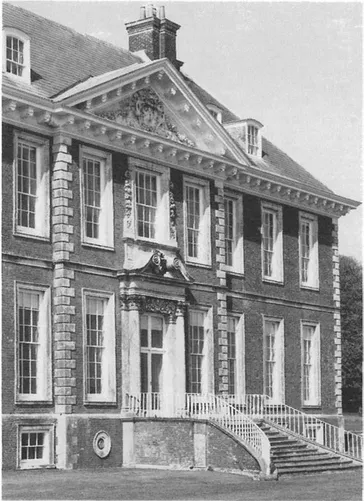
Uppark, West Sussex, the 'Bladesover House' of Tono-Bungay
Later he was to portray Uppark as Bladesover House in Tono-Bungay, Burnmore Park in The Passionate Friends and Mowbray in The World of William Clissold. Its effect on a 14-year-old boy who had spent all his life in Bromley had the force of a revelation. It awakened him to the importance of social relationships and led him to speculate about the country house and its role in English history. Throughout his mother's tenure as housekeeper he spent many of his holidays at the house, familiarising himself more and more with...

Table of contents

  1. Cover
  2. Title
  3. Copyright
  4. Series Title
  5. Contents
  6. List of illustrations
  7. Preface
  8. Acknowledgements
  9. Introduction
  10. PART ONE: THE WRITER AND HIS SETTING
  11. PART TWO: CRITICAL COMMENTARY
  12. PART THREE: REFERENCE SECTION
  13. Further reading and reference
  14. Index
  15. Index of Well's Works