The Literature of Terror: the Modern Gothic is the second volume in David Punter's impressive survey of gothic writing covering over two centuries. This long awaited second edition has been expanded to take into account the latest critical research, and is now published in two volumes. Volume One covers the period from 1765 to the Edwardian age while Volume Two discusses modern gothic, starting with the 'decadent' gothic writing of Oscar Wilde and continuing through the twentieth century.
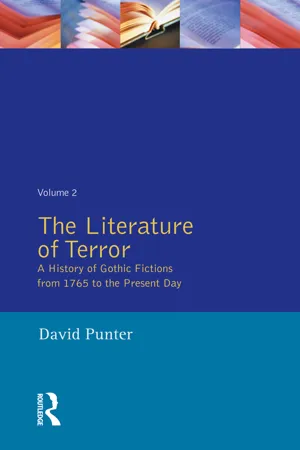
- 248 pages
- English
- ePUB (mobile friendly)
- Available on iOS & Android
eBook - ePub
About this book
Information
Chapter 1
Gothic and decadence
What is remarkable about the ‘decadent Gothic’ of the 1890s is that out of a cross-genre with only doubtfully auspicious antecedents should have proceeded, in the space of eleven years, four of the most potent of modern literary myths, those articulated in Robert Louis Stevenson’s Dr Jekyll and Mr Hyde (1886), Oscar Wilde’s Picture of Dorian Gray (1891), H. G. Wells’s Island of Dr Moreau (1896) and Bram Stoker’s Dracula (1897). Here again we have a burst of symbolic energy as powerful as that of the original Gothic: alongside Frankenstein’s monster, the Wandering Jew and the Byronic vampire we can set the Doppelganger, the mask of innocence, the maker of human beings and the new, improved vampire of Dracula. As we look at these books, we shall see certain interconnections – at any rate in terms of theme, even where authorial stances may be quite different – but one thing can be said at the outset which underlines the meaning of decadence in connection with these texts, and that is that they are all concerned in one way or another with the problem of degeneration, and thus of the essence of the human. They each pose, from very different angles, the same question, which can readily be seen as a question appropriate to an age of imperial decline: how much, they ask, can one lose – individually, socially, nationally – and still remain a ‘man’? One could put the question much more brutally: to what extent can one be ‘infected’ and still remain British?
The text in which these questions are least on the surface is also the earliest of them, Dr Jekyll and Mr Hyde, which needs no introduction as the best-known Doppelganger story of them all. It follows on from an easily identifiable Gothic tradition, including James Hogg’s Confessions of a Justified Sinner (1824) and Edgar Allan Poe’s ‘William Wilson’ (1839), both of which influenced Stevenson, yet it has captured the popular imagination more strongly than any of the others, feasibly partly because of its ‘contemporary’, metropolitan setting and detective-story trappings, but feasibly also because of a stranger phenomenon, its obvious connection with actual late Victorian fears about similarly untraceable murders, centred on the archetype of Jack the Ripper. It is interesting in passing to note that, while Jekyll and Hyde itself is not in any overt way concerned with the Gothic problem of the aristocracy, popular imagination nevertheless has had its way by tying the text in with this body of semi-legendary history which unmistakably is aristocracy-oriented: the one thing nobody ever seems to have thought about Jack the Ripper was that, when unmasked, he might be someone working class or unknown.
Jekyll and Hyde is, from one aspect, the record of a split personality, and the nature of the split is in its general outline one now familiar to a post-Freudian age, although one which Stevenson outlines with particular sensitivity: ‘the worst of my faults’, says Jekyll, describing his youth,
was a certain impatient gaiety of disposition, such as has made the happiness of many, but such as I found it hard to reconcile with my imperious desire to carry my head high, and wear a more than commonly grave countenance before the public. Hence it came about that I concealed my pleasures; and that when I reached years of reflection, and began to look round me, and take stock of my progress and position in the world, I stood already committed to a profound duplicity of life. Many a man would have even blazoned such irregularities as I was guilty of; but from the high views that I had set before me, I regarded and hid them with an almost morbid sense of shame. It was thus rather the exacting nature of my aspirations, than any particular degradation in my faults, that made me what I was, and, with even a deeper trench than in the majority of men, severed in me those provinces of good and ill which divide and compound man’s dual nature.1
This is a very rich passage. One must, of course, be careful not to interpret it as the narrative voice, since it is part of Jekyll’s own statement, and Jekyll is certainly remarkably pompous and possibly a self-deceiver. However, Jekyll’s view seems to be that the split in his being has derived much less from the presence within his psyche of an uncontrollable, passionate self than from the force with which that self has been repressed according to the dictates of social convention. The original tendency of Jekyll’s alter ego, so he claims, was by no means towards the vicious, but rather towards the ‘loose’, a neutral desire for certain kinds of personal freedom which has been repressed by the ‘imperious’ need not only to conform to, but also to stand as a public example of, strict virtue. Jekyll’s problem, surely, is largely put as a social one, and one can interpret it in two connected ways: literally, as the problem of a member of a ‘respectable’, professional upper middle class, who is supposed to ‘body forth’ social virtue in his person and to eschew any behaviour, however harmless, which might tend to degrade that stance, and also metaphorically as the problem of a member of a ‘master-race’. Jekyll’s difficulties are those of the benevolent imperialist: they are not at all to do with the political problem of sanctioning brute force, but with the maintenance of dignity under adverse circumstances. It is strongly suggested that Hyde’s behaviour is an urban version of ‘going native’. The particular difficulties encountered by English imperialism in its decline were conditioned by the nature of the supremacy which had been asserted: not a simple racial supremacy, but one constantly seen as founded on moral superiority. If an empire based on a morality declines, what are the implications for the particular morality concerned? It is precisely Jekyll’s ‘high views’ which produce morbidity in his relations with his own desires. Thus, of course, the name of his alter ego: it is the degree to which the doctor takes seriously his public responsibilities which determines the ‘hidden-ness’ of his desire for pleasure. Since the public man must be seen to be blameless, he must ‘hide’ his private nature, even to the extent of denying it be any part of himself. And although this is in one sense a problem locatable within a particular historical development, we can also sense in it echoes of older Gothic problems: it is, Jekyll claims, his ‘aspirations’ which render him particularly liable to psychic fragmentation, just as the younger Wringhim’s aspirations towards total purity caused his breakdown.
But Jekyll’s aspirations are of two kinds: they are moral and social aspirations, but they are also scientific aspirations, as in the case of Frankenstein. The great strength of Jekyll and Hyde lies in its attempt to connect the two more clearly even than Mary Shelley had done, and to show that Jekyll’s familiar desire to ‘make another man’ stems from problems in the organisation of his own personality. Like Frankenstein (1818) and The Island of Dr Moreau, Jekyll and Hyde relies upon and even exploits public anxieties about scientific progress and about the direction of this progress if undertaken in the absence of moral guidance, but this aspect seems to be largely metaphorical. The scientific emphasis is very perfunctory; Jekyll himself slides over it, suggesting that details would only bore. What he does not slide over is his series of attempts to comprehend the precise nature of the relation between himself and Hyde, which Stevenson carefully avoids describing merely as a relation of opposites. Hyde is not Jekyll’s opposite, but something within him: the fact that he is smaller than the doctor, a ‘dwarf, demonstrates that he is only a part whereas Jekyll is a complex whole, and this is underlined in one of Stevenson’s more startling insights: ‘Jekyll had more than a father’s interest; Hyde had more than a son’s indifference’ (Works, IV, 75). This, of course, was precisely the aspect of relationship which Mary Shelley suppressed in connection with Frankenstein and his monster, probably because such ‘unnatural’ creativity seemed too close to a parody of the divine. Stevenson admits to Hyde’s status as a parodic ‘son of God’, but only at the expense of certain other authorial repressions, principally sexual. Not only does the relation between Jekyll and Hyde exclude women, the whole tale moves – like Dorian Gray and Dr Moreau – in a world substantially composed of leisured bachelors, and even when Stevenson ostensibly tries to portray Hyde’s tendency towards sexual excess and deviance, which could hardly not be at the root of Jekyll’s fastidious disgust, he can get almost nothing on paper.
Most of Hyde’s nastiness is withheld: Stevenson deals with it merely in generalities, and whether this is because of Jekyll’s revulsion or of a poverty in Stevenson’s ability to imagine the sexually criminal remains obscure: ‘into the details of the infamy at which I thus connived (for even now I can scarce grant that I committed it)’, Jekyll says, ‘I have no design of entering; I mean but to point out the warnings and the successive steps with which my chastisement approached’ (Works, IV, 72). He does then proceed, however, to allude to one incident, which we have already been told about, when Hyde has been seen to meet a child at a street corner, and to have ‘trampled calmly over the child’s body and left her screaming on the ground’. ‘It sounds nothing to hear’, says Enfield, who is telling Utterson the story, ‘but it was hellish to see’ (Works, IV, 6). He is right: it does sound nothing to hear, and it is not even very easy to imagine. It lingers in the memory, but only because of its strangeness, which may have been Stevenson’s purpose. It is, of course, symbolic: it is designed to show the inhumanity of Hyde where a more purposive crime would not. Hyde is described here as a kind of Juggernaut, and it is his ‘thing-ness’ which finally appals Jekyll: ‘this was the shocking thing; that the slime of the pit seemed to utter cries and voices; that the amorphous dust gesticulated and sinned; that what was dead, and had no shape, should usurp the offices of life’ (Works, IV, 83).
Again, there is a problem here, a further reticulation of the Doppelganger structure, about the relation between Stevenson and Jekyll. It is reasonable that Jekyll should not want, or be able, to acknowledge Hyde as in any way human, and indeed that onlookers like Enfield should hold whatever opinion they please, but Stevenson himself appears to stop short of certain realisations. If it is indeed repression which has produced the Hyde personality, further denial of Hyde’s claims can only result in an ascending scale of violence. And this, of course, is exactly what happens, but Stevenson shows no clear signs of knowing why. Jekyll’s later attempts at repression compound Hyde’s fury: ‘my devil had been long caged, he came out roaring’ (Works, IV, 76). There is an underlying pessimism in the book which results from Stevenson’s difficulty in seeing any alternative structure for the psyche: once the beast is loose, it can resolve itself only in death. Jekyll rather feebly suggests at one point that, if he had been in a different frame of mind when he first took the drug, the second self thus released might have been very different: the prospect of an alternative Hyde, constructed of sweetness and light, is attractive but perhaps somewhat unrealistic.
Julia Briggs’s work suggests that the issue of the relations between the human and the bestial which occurs in Stevenson, Wells, Stoker and later in such writers as Forster and Lawrence springs largely from the attempt to deal with Darwinian revelations about the nature of evolution.2 Thus Jekyll’s transformation is a change of state of the most extreme kind: when he takes the drug, ‘the most racking pangs succeeded: a grinding in the bones, deadly nausea, and a horror of the spirit that cannot be exceeded at the hour of birth or death’ (Works, IV, 68). This is the reversion of the species, the ever-present threat that, if evolution is a ladder, it may be possible to start moving down it. Not surprisingly, this threat cannot be named in the text: Jekyll says that he has brought on himself ‘a punishment and a danger that I cannot name’ (Works, IV, 37), and Hyde is constantly spoken of as possessing unexpressed deformities. As in much Gothic, there is a dialectical interplay here between the unspeakable and the methods of verification evidenced in the complexity of narrative structure, but post-Darwinian fears have given a new twist to the concept of degeneration. Early in the story, Utterson suggests that something unspoken from the past may be coming to claim Jekyll:
He was wild when he was young; a long while ago, to be sure; but in the law of God, there is no statute of limitations. Ah, it must be that; the ghost of some old sin, the cancer of some concealed disgrace; punishment coming, pede claudo, years after memory has forgotten and self-love condoned the fault.
(Works, IV, 19)
But in the context of the tale, Utterson is, despite the encouraging pun in his name, an old-fashioned moralist, and his attempt to impose a conventional ‘sins of the fathers’ explanation fails. If Hyde represents a ‘ghost’ and a ‘cancer’, it is a general one: the absence of just limitations goes farther than Utterson cares to think. The human being may be the product of a primal miscegenation, a fundamentally unstable blending, which scientific or psychological accident may be able to part.
And this problem of the double self is, of course, also central to The Picture of Dorian Gray, the record, as Wilde puts it in Radcliffean terms, of the ‘terrible pleasure’ of ‘a double life’. The gilded Dorian
used to wonder at the shallow psychology of those who conceive the Ego in man as a thing simple, permanent, reliable, and of one essence. To him, man was a being with myriad lives and myriad sensations, a complex multiform creature that bore within itself strange legacies of thought and passion, and whose very flesh was tainted with the monstrous maladies of the dead.3
A casual wish on Dorian’s part severs the links, and he becomes free to live a life of vice and self-indulgence without losing his looks or his youth, while his portrait records his depravity in terms of physical decay.
The problem of distinguishing narrator from character is very great in Wilde, particularly because of his aphoristic habits: it is not easy to know what to make of the multiple resonances of Dorian’s opinion that
It was the passions about whose origin we deceived ourselves that tyrannised most strongly over us. Our weakest motives were those of whose nature we were conscious. It often happened that when we thought we were experimenting on others we were really experimenting on ourselves.
(Dorian, p. 59)
Here, as elsewhere, Dorian Gray incorporates the problems of the 1890s in a jewelled nutshell. We have a burgeoning awareness of the existence of the unconscious, of that fountain from which spring desires and needs a thousand times stronger than those to which we can admit; a sense of the dire situations which result from the liberation of those passions; and the complicated metaphor of experimentation, which runs through all four of these texts. In Dorian Gray, it is perfectly clear that one cannot restrict the concept of experimentation to science: Dr Jekyll and Dr Moreau experiment on malleable flesh, Sir Henry Wotton and Dorian – in different ways, but there are Doppelganger complexities here too – artificially mould the mind.
Artifice is perhaps the key term: how much, if at all, ...
Table of contents
- Cover
- Half Title
- Title Page
- Copyright Page
- Table of Contents
- Preface to the first edition
- Preface to the second edition
- Acknowledgements
- 1. Gothic and decadence
- 2. Later American Gothic
- 3. The ambivalence of memory
- 4. Formalism and meaning in the ghost story
- 5. Gothic in the horror film 1930–1980
- 6. Modern perceptions of the barbaric
- 7. Contemporary Gothic transformations
- 8. Mutations of terror: theory and the Gothic
- Bibliography
- Index
Trusted by 375,005 students
Access to over 1.5 million titles for a fair monthly price.
Study more efficiently using our study tools.
Frequently asked questions
Yes, you can cancel anytime from the Subscription tab in your account settings on the Perlego website. Your subscription will stay active until the end of your current billing period. Learn how to cancel your subscription
No, books cannot be downloaded as external files, such as PDFs, for use outside of Perlego. However, you can download books within the Perlego app for offline reading on mobile or tablet. Learn how to download books offline
We are an online textbook subscription service, where you can get access to an entire online library for less than the price of a single book per month. With over 1.5 million books across 990+ topics, we’ve got you covered! Learn about our mission
Look out for the read-aloud symbol on your next book to see if you can listen to it. The read-aloud tool reads text aloud for you, highlighting the text as it is being read. You can pause it, speed it up and slow it down. Learn more about Read Aloud
Yes! You can use the Perlego app on both iOS and Android devices to read anytime, anywhere — even offline. Perfect for commutes or when you’re on the go.
Please note we cannot support devices running on iOS 13 and Android 7 or earlier. Learn more about using the app
Please note we cannot support devices running on iOS 13 and Android 7 or earlier. Learn more about using the app
Yes, you can access The Literature of Terror: Volume 2 by David Punter in PDF and/or ePUB format, as well as other popular books in Literature & Gothic, Romance, & Horror Literary Criticism. We have over 1.5 million books available in our catalogue for you to explore.