eBook - ePub
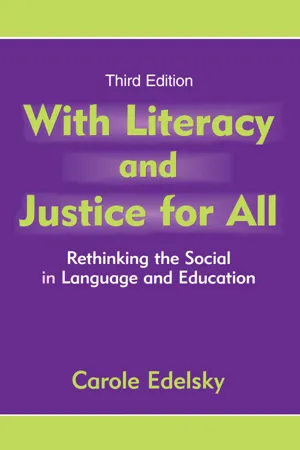
With Literacy and Justice for All
Rethinking the Social in Language and Education
- 330 pages
- English
- ePUB (mobile friendly)
- Available on iOS & Android
eBook - ePub
About this book
The third edition of With Literacy and Justice for All: Rethinking the Social in Language and Education continues to document Carole Edelsky's long involvement with socially critical, holistic approaches to the everyday problems and possibilities facing teachers of language and literacy. This book helps education professionals understand the educational/societal situations they are dealing with, and literacy instruction and second language learning in particular contexts. Edelsky does not offer simplistic pedagogical formulas, but rather, progressively works through differences and tensions in the discourses and practices of sociolinguistics, bilingual education, whole language, and critical pedagogy--fields whose practitioners and advocates too often work in isolation from each other and, at times, at cross purposes.
In this edition, what Edelsky means by rethinking is improving and extending her own views, while at the same time demonstrating that such rethinking always occurs in the light of history. The volume includes a completely new Introduction and two entirely new chapters: one on reconceptualizing literacy learning as second language learning, and another on taking a historical view of responses to standardized testing. Throughout, in updating the volume, Edelsky uses a variety of structural styles to note contrasts in her views across time and to make the distinction clear between the original material and the current additions. This edition is a rare example of a scholarly owning-up to changes in thinking, and a much needed demonstration of the historically grounded nature of knowledge. As a whole, the third edition emphasizes recursiveness and questioning within a deliberately political framework.
Information
Chapter 1
Not Acquiring Spanish as a Second Language: The Politics of Second Language Acquisition
This chapter is the original with a few editorial changes. It is followed by a long postscript written in 2005.
Language is political—nothing new in that statement. Yet I must admit that when my colleague Sarah Hudelson and I began the studies I will discuss in this chapter, we both did and did not understand just how political it is.
To begin at the beginning: In studies of “naturalistic” second language acquisition (as opposed to studies of the learning of foreign languages in school, for instance), the political nature of the second language learning situation is largely ignored. Almost always, researchers investigate the “spontaneous” acquisition of a target language that dominates the native language of the learner—English in the United States or the United Kingdom or the local majority language in a community where linguist parents doing fieldwork study their children acquiring the local language. We had been sensitized by Hymes (1970, 1972b) to always consider situational particularities in language use. Certainly, learning a second language would be included in language use. And the relative political positions of native and target languages—and of speakers of those languages—would be an important “situational particularity.” Thus, we wondered if second language learning would look different if we investigated a situation in which the usual relationship of more powerful target language/less powerful native language were reversed. Perhaps what had been presented in other research as characteristics of second language acquisition in general were, in fact, only characteristics of the acquisition of a dominant language by minority language speakers. Perhaps the acquisition of a minority language by dominant language speakers entailed different strategies, followed different trajectories, or had different meanings.
We were delighted with our own reasoning, and we carried out a study to investigate this relatively uncharted territory. Unfortunately, we had neglected to consider the larger consequences for second language learning of gross political inequality between two languages. That is, by and large, majority language speakers do not acquire the minority languages in their midst. And that, of course, is what happened (or, rather, didn’t happen) in the two bilingual classrooms in which we kept trying to study second language acquisition of a nondominant language. But more interesting than the nonacquisition of Spanish, in this case, is what we came to understand about how the various actors in the classroom played out the larger political conditions of nonacquisition.
HOW WE STARTED
We began with a school-year long study of three Anglo first-graders supposedly acquiring Spanish as a second language in a bilingual classroom near Phoenix, Arizona. Although the goals of that school district did not include explicit attention to mutual second language learning on the part of both Anglos and Chicanos, the teacher expressed that desire. We did limited classroom observations in order to find out who was addressing Spanish to the English speakers, for what purposes, and under what conditions. Every 2 weeks, with one of us posing as a monolingual Spanish speaker, we audiotaped three children, each paired with a bilingual peer, in language testing and play sessions. We left the room for about 10 minutes during those half-hour sessions, leaving the tape recorder on, in order to have samples of completely child–child interaction. Our findings were as follows:
• Spanish was not addressed individually to these children by anyone except us during our biweekly sessions (i.e., neither Spanishspeaking adults nor Spanish-speaking children took the language teacher role).
• When Spanish was used in total-group activities in the classroom and in our taping sessions, the three Anglo children “tuned Spanish out” (i.e., they did not take the language learner role).
• Except for a few color and number words, no Spanish was acquired (Hudelson & Edelsky, 1980).
Despite what seemed to be a clear “message,” we hoped we were wrong; we hoped that genuine, mutual second language learning could occur if the conditions were optimal. After all, in that first study, school conditions were not optimal. No policy and no person, except for this one teacher, wanted to have the Anglos learn Spanish. And even given this teacher’s goal, she used Spanish as the vehicle of instruction for much less of the time than she used English. Of course, such a state of affairs stemmed from a larger “condition”—the relative political position of the two languages. While, on the one hand, we were sensitive to that condition (it was, in fact, what prompted the study in the first place), on the other, we were naïve about it, thinking it could be overridden by local classroom arrangements. Thus, we began a second study the next year, in what we thought would be a more effective setting for problematic second language acquisition, still searching for strategies used by dominant language speakers in the acquisition of a subordinate language. It was finally through this second study that we were able to see non-acquisition as an activity engaged in by many social actors, rather than as an absence or an individual failure.
THE SECOND STUDY
This time we chose a “better” first grade classroom. It was in a district in which one of the explicit goals of the bilingual program was to produce bilinguals among both Spanish and English speaking children. To that end, the district had instituted systematic, “pullout” second language instruction in each language, and it assessed second language proficiency in each language.1
In this classroom, an Alternate Days model prevailed, continuing the presentation of content rather than translating it—one day was English Day, the next was Spanish Day. We assumed there would be more Spanish in this Alternate Days allocation than there had been the preceding year.2 There were 22 children in the class: Ten were bilinguals or monolingual Spanish speakers who were bussed in from a barrio. Twelve lived in the neighborhood and were English monolinguals or English dominant children with some limited ability to produce Spanish. Of the neighborhood children, 5 were Anglos; 7 were Latinos.
Again, my colleague Sarah Hudelson (SH) posed as a monolingual Spanish speaker. Contrived though it was, la Señora Spanish (as one bilingual child named her) assured the Anglophiles of occasionally getting at least some Spanish directed to them on a one-to-one basis. Moreover, if they wanted to interact with SH, the English-speaking children would have to attempt to understand her and to accommodate to her “monolinguality.”
We were classroom volunteers and observers for one-half to a full school day at least three times each month from October through early April. We took special note of code choice, functions of language, and any instances of engagement or withdrawal by Anglophiles in relation to Spanish interactions. We targeted three of the Anglo children (Kathy, Katie, and Nathan) and two Latinos (Vince and Anita) for close observation. Although Vince and Anita were very close to being monolingual in English, the teacher knew that Spanish was used around them at home occasionally. We reasoned (hoped) that occasional exposure to Spanish at home might provide an extra push toward significant second language acquisition for these two children.
As in the previous study, we took each of these five children with a Spanish-speaking peer to a separate room, where we gave them a short comprehension and repetition task (they were asked to show SH the picture of the big boy/little boy, etc., and to repeat sentences such as es un muchacho grande/this is a big boy). After SH tested them, she played with them using playdough, puppets, magic slates, and so on, while I observed. Again, during the playtime, we left the children alone for several minutes. The sessions were conducted entirely in Spanish and were audiotape recorded, with one child wearing a lapel microphone.
THE SECOND LANGUAGE LEARNING CONTEXT
Functions of the Use of Spanish and English
Children used “Public Spanish” (the use of Spanish to one or more people in front of an audience) for a wide range of functions—directing, predicting, informing, teasing, threatening, explaining, consoling, and so forth, but only if all present were bilingual. Adults used Public Spanish only for teacher-ish functions: directing, reprimanding, explaining, entertaining (storytelling), keeping order, providing transitions between activities, establishing social contact, and conducting classroom routines (taking attendance, collecting lunch money).
Spanish directed individually to our target children or to other English-dominant children was more rare than Public Spanish and more limited in function. Adults used Spanish to individual English speakers for social routines (buenos días), reprimands, and directions that could also be signaled nonverbally. Though English was used by adults for explaining, joking, warning, or making conversation, Spanish was not. With almost no exceptions, children did not address Spanish to individual English speakers. The rare exceptions were produced by two Mexican immigrants (Elena and Lily) who were monolingual in Spanish at the start of the school year. Once, Elena gave Anita a short direction in Spanish that she followed without pause with an English paraphrase. During a test session, Lily and Kathy provided the only evidence of any explicit argument over code choice.
(1)
Kathy (K): | What’s she doing? |
Lily (L): | Dice tú[She says you] … |
K: | Don’t say in Spanish. English. |
L: | Que te digo español. [That I tell you Spanish] |
K: | English. |
L: | No. |
K: | Say it in English. |
L: | No. [the argument was ended as we resumed testing] |
Language “Intrusion” Into the Other Language’s “Day”
In an Alternate Days bilingual program, the rule is one language per day. Nevertheless, loudspeaker announcements were made daily in English, and Spanish speakers spoke to each other in Spanish no matter the day—in other words, no day was “language pure.” However, the frequency and extent of the other language’s intrusion was not symmetrical. Spanish was used very infrequently on English Days. Except for Spanish reading time for Spanish speakers, adults used no Public Spanish on English Day, though they did use Spanish individually to Spanish dominant children only.
The intrusion of English into Spanish Day was another story. English was used publicly to all (not merely to English-dominant children) and for the same functions as Public Spanish. Additionally, it was used for insuring the understanding of the Anglophiles. There was no comparable checking with the Spanish-dominant children on English Day. When adults referred to something on Spanish Day that could not be pointed to or acted out, they switched to English. No matter the day, when nonbilingual outsiders came in to make announcements, adults used English. Even the Spanish-dominant children addressed SH, the “monolingual” researcher, in English.
Children’s Perceptions of Second Language Instruction
As part of its two-way bilingual program, the school provided both English as a second language (ESL) and Spanish as a second language (SSL) taught through the audio-lingual method, and an English “booster” program for those who were weakest in English.3 The children were aware of which children went to which pullout class. They referred to “the kids who come on the bus”; they could name who went to SSL, to ESL, and to Special English; they knew which children could be used as translators; they sometimes commented on which children were potential after-school playmates—for logistical reasons, at least, for the English speakers it was not those who took the bus.
Their perception of the special second language lessons also became part of the context. To the children, the lessons were to be used as games or performances. Kathy occasionally approached SH with cards showing fruit, articles of clothing, and so on, pointed to the cards while repeating spañol, and tried to elicit Spanish card naming as a game. The children perceived both SSL and ESL lessons as equally artificial and communicatively useless. Nathan bragged that though he could not speak Spanish, he had learned to say es un (sic) abrelata (it’s a can opener). In one taping session, Kathy told us that what she talked about in the Spanish class was “es un’s” (/itsa’s/—as in it’s a sweater, it’s a book). And Lily, Kathy’s taping session partner, responded to SH’s question about what they talked about in ESL with dicen “I’m a fireman.” Dicen así. (They say, I’m a fireman. They talk like that.)
Presence of “Monolingual” SH
“Monolingual” SH, persisting in her monolinguality, provided Englishspeaking children who wanted to interact with her with a demand to accommodate. Moreover, since SH was not responsible for directing activities or maintaining order, she could do what the other adults never did: engage children in casual conversation in Spanish. “Shooting the breeze,” in turn, enabled SH to use Spanish both publicly and individually in order to get information, make social contact and open a conversation, elicit translations, joke, compliment; that is, to expand the language functions in Spanish. Because she was “monolingual,” SH could avoid switching to English when her addressee showed a lack of comprehension. In these language “showdowns,” it was Spanish speaking SH’s language choice that prevailed, an anomaly to be discussed later.
LANGUAGE ACQUISITION (?) IN THIS CONTEXT
Even if they did not become Spanish speakers, the Anglo children did respond to the second language learning context. And their responses are instructive as we think about the roles of all concerned in second language learning. Their responses can be grouped into four categories: (a) display of metalinguistic awareness, (b) taking the learner role, (c) not taking the learner role, and (d) producing Spanish.
Metalinguistic Awareness
Even after only 2 months in first grade, the children appeared to have developed a striking awareness of language as an entity. Sometimes, this awareness was stated neutrally; sometimes with feeling. In class, Kathy and Katie were engaged in a bit of competition.
(2)
Kathy: | I can speak three languages—English and Spanish and Indian. |
Katie: | Well I can speak four—English and Spanish and Scotland and Jewish! |
Kathy: | So! I’m gonna learn Flagstaff! (a city about 150 miles away) |
Some children thought synonyms might really be translations (“Pony” in English is “horse,” Anita told us). On several occasions, after we had left the room during a taping session, children echoed Vince’s view (Finally, we can speak English. I hate Spanish). While school pe...
Table of contents
- Cover
- Half Title
- Title Page
- Copyright Page
- Dedication
- Table of Contents
- Preface
- Acknowledgments
- Introduction
- 1 Not Acquiring Spanish as a Second Language: The Politics of Second Language Acquisition
- 2 Writing in a Bilingual Program: It All Depends
- 3 Contextual Complexities: Written Language Policies for Bilingual Programs
- 4 The Effect of “Theory” on Several Versions, Over a Quarter Century, of a Popular Theory: Plus Ça Change, Plus C’est la Même Chose
- 5 Literacy: Some Purposeful Distinctions
- 6 On Second Thought
- 7 Whole Language: What’s New?
- 8 Hookin’ ’Em in at the Start of School in a Whole Language Classroom
- 9 Risky Literacy
- 10 Criticism and Self-Criticism
- 11 Resisting (Professional) Arrest
- 12 Sorely Tested
- References
- Author Index
- Subject Index
Trusted by 375,005 students
Access to over 1.5 million titles for a fair monthly price.
Study more efficiently using our study tools.
Frequently asked questions
Yes, you can cancel anytime from the Subscription tab in your account settings on the Perlego website. Your subscription will stay active until the end of your current billing period. Learn how to cancel your subscription
No, books cannot be downloaded as external files, such as PDFs, for use outside of Perlego. However, you can download books within the Perlego app for offline reading on mobile or tablet. Learn how to download books offline
Perlego offers two plans: Essential and Complete
- Essential is ideal for learners and professionals who enjoy exploring a wide range of subjects. Access the Essential Library with 800,000+ trusted titles and best-sellers across business, personal growth, and the humanities. Includes unlimited reading time and Standard Read Aloud voice.
- Complete: Perfect for advanced learners and researchers needing full, unrestricted access. Unlock 1.5M+ books across hundreds of subjects, including academic and specialized titles. The Complete Plan also includes advanced features like Premium Read Aloud and Research Assistant.
We are an online textbook subscription service, where you can get access to an entire online library for less than the price of a single book per month. With over 1.5 million books across 990+ topics, we’ve got you covered! Learn about our mission
Look out for the read-aloud symbol on your next book to see if you can listen to it. The read-aloud tool reads text aloud for you, highlighting the text as it is being read. You can pause it, speed it up and slow it down. Learn more about Read Aloud
Yes! You can use the Perlego app on both iOS and Android devices to read anytime, anywhere — even offline. Perfect for commutes or when you’re on the go.
Please note we cannot support devices running on iOS 13 and Android 7 or earlier. Learn more about using the app
Please note we cannot support devices running on iOS 13 and Android 7 or earlier. Learn more about using the app
Yes, you can access With Literacy and Justice for All by Carole Edelsky in PDF and/or ePUB format, as well as other popular books in Education & Education General. We have over 1.5 million books available in our catalogue for you to explore.