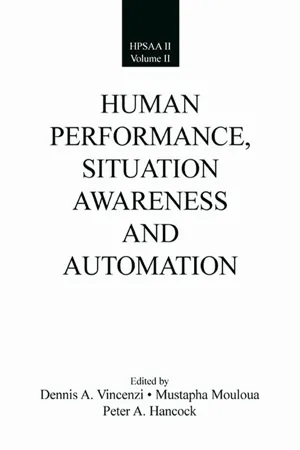
In 2000, the Conference on Automation joined forces with a partner group on situation awareness (SA). The rising complexity of systems demands that one can be aware of a large range of environmental and task-based stimulation in order to match what is done with what has to be done. Thus, SA and automation-based interaction fall naturally together and this conference is the second embodiment of this union. Moving into the 21st century, further diversification of the applications of automation will continue--for example, the revolution in genetic technology. Given the broad nature of this form of human-machine interaction, it is vital to apply past lessons to map a future for the symbiotic relationship between humans and the artifacts they create. It is as part of this ongoing endeavor that the present volume is offered.
eBook - ePub
Human Performance, Situation Awareness, and Automation
Current Research and Trends HPSAA II, Volumes I and II
- 336 pages
- English
- ePUB (mobile friendly)
- Available on iOS & Android
eBook - ePub
Human Performance, Situation Awareness, and Automation
Current Research and Trends HPSAA II, Volumes I and II
About this book
Information
Situation Awareness: An Actor Network Theory Perspective
University of Leicester, UK
Abstract
Maintaining a high level of Situation Awareness (SA) is considered one of the most essential elements for safe and effective flight operations. In a study of accidents among major air carriers, 88% of those involving human error could be attributed to problems associated with situation awareness, similarly problems with SA were found to be the leading casual factor in a review of military aviation mishaps (Endsley, 1999). Given the problems and consequences associated with human error in aviation, current strategies to address SA often focus on aircraft systems design and training programs in order to improve the efficacy and safety of flight operations. In complex domains such as aviation, situation awareness is inherently distributed over multiple people and groups and over human and machine agents. Sociology offers an interesting approach to looking at the socio-technical elements of systems through the application of Actor Network Theory (ANT). “By advocating a seamless web composed of actors, the Actor Network approach dissolves the dichotomous relationship between humans and machines and society and technology into a non-anthropocentric framework” (Sommerville, 1997). It facilitates the perspective that looks at the inter-connectedness of the heterogeneous elements characterized by the technological and non-technological (human, social, organizational) elements. “Complex systems cannot be understood by studying parts in isolation. The very essence of the system lies in the interaction between parts and the overall behaviour that emerges from the interactions” (Ottino,2003). This paper introduces ANT as an approach to examining situation awareness in aviation and proposes the perspective that situation awareness is a systemic attribute, a construct resident within a network of heterogeneous elements.
| Keywords: Actor Network Theory, Situation Awareness, Human Error |
Introduction
Maintaining SA is a fundamental requirement in operating complex socio-technical systems such as those found in aviation, medicine, and nuclear industry. In fact, the challenges associated with the introduction of new technology are one of the main factors that contributed to the growth in interest in SA (Endsley,2000). The hegemony of the cognitive approach within the field of Human Factors is being enriched by innovative applications from sociology such as symbolic interactionism, ethnomethodology, cultural-historical theory and phenomenology. These perspectives encourage us to re-examine the ontological and epistemological foundations of the traditional paradigm (Bannon,1998). Actor Network Theory (ANT) facilitates a systemic perspective of SA in complex domains such as aviation. The ontological perspective of ANT enables an analysis of the spatial and temporal dimensions of complex socio-technical systems. It suggests that to understand SA in complex systems is to look at the relationality inherent within the network of heterogeneous elements. Building on the foundation of Situation Awareness as proposed by Endsley (1999), Actor Network Theory (ANT) is introduced as a systemic approach providing an ontological framework that shows the complex interconnectivity of heterogeneous elements characterized by the technological and non-technological (human, social, organizational) that contribute to the development and maintenance of SA.
Situation Awareness
Operating complex systems requires a high level of decision-making, and performance that is predicated on achieving and maintaining a certain level of SA. To address the consequences associated with human error resulting from poor situation awareness, a significant amount of research and contributions have been made to the understanding and modeling of SA by researchers such as Endsley (2000). The cognitive approach to SA, dominant within the literature, has facilitated the conceptualization of models using such frameworks as Information Processing theory (Wickens: 1992) and the applications from a Mental Models perspective (Endsley,2000). Applications of these models and others exist throughout a wide range of complex systems. Of particular interest is the SA associated with complex socio-technical systems such as aviation. “Clearly understanding SA in the aviation environment rest on a clear elucidation of its elements (at each of the three levels of SA), identifying which things the aircrew needs to perceive, understand and project” (Endsley,1999).
Actor Network Theory
ANT is an approach to structuring and explaining the links between society and technology and focuses on the way the technological and non-technological (human, social, organizational) elements link together to form a seamless web. Originating from the study of technology, ANT “itself can be transferred into a sociological tool of analysis. It enlarges the methodological range of the social sciences and facilitates the understanding of technological development. From the start technical, scientific, social, economic or political considerations are inextricably bound up (heterogeneity and complexity)” (Bijker,1987). The application of Actor Network Theory terms and concepts have worked their way into organization theory, geography, medical anthropology and psychology (Brown,1999). Through its application, both human and machine (non-human) elements are treated in a symmetrical manner. The strength of ANT rests on its ability to analyze situations where it is difficult to separate humans and non-humans, and in which the actors have variable forms and competencies (Callon,1999). A fundamentally relationary worldview, “ANT builds explicitly on semiotics, where objects are seen as simply relational contingencies.”(Law,1999)
Fundamental concepts of ANT are the conceptualization of the Actor and the Network. Latour describes the actor in ANT as “a semiotic definition – an actant – that is, something that acts or to which activity is granted by others” (Noe and Alroe, 2003). The notion of an actor- actant- “is not linked to the quality of the entity as such, but to the quality of the entity in the frame of the network into which the entity is mobilised: … For the semiotic approach tells us that entities achieve their form as a consequence of the relations in which they are located. But this means that it also tells us that they are performed in, by, and through those relations.” (Law, 1999) The heterogeneous elements that make up the network are not fixed but are defined in relation to the other elements in the system. The network, from an ANT perspective may not have the characteristics idealized by the technical perspective. “An Actor network may have no compulsory paths, no strategically positioned nodes.”(Latour,1998) Fundamental processes within ANT are inscription and translation. Inscription refers to the way technical artifacts embody patterns of use: Technical objects thus simultaneously embody and measure a set of relations between heterogeneous elements.
Consider the human factors of cockpit design:
In such a translation, or design, process, the designer works out a scenario for how the system will be used. This scenario is inscribed into the system. The inscription includes programs of action for the users, and it defines roles to be played by users and the system. In doing this, she is also making implicit or explicit assumptions about what competencies are required by the users as well as the system. In ANT terminology, she delegates roles and competencies to the components of the socio-technical network, including users as well as the components of the system (Latour 1991). By inscribing programs of actions into a piece of technology, the technology becomes an actor imposing its inscribed program of action on its users. The inscribed patterns of use may not succeed because the actual use deviates from it. Rather than following its assigned program of action, a user may use the system in an unanticipated way, she may follow an anti-program (Latour 1991). When studying the use of technical artifacts one necessarily shifts back and forth “between the designer’s projected user and the real user” in order to describe this dynamic negotiation process of design (Akrich 1992, p. 209). (www.ifi.uio.no)
The process of translation has been described as pivotal in any analysis of how different elements in an actor network interact (Somerville,1997). Translation rests on the idea that actors within a network will try to enroll (manipulate or force) the other actors into positions that suit their purposes. When an actor’s strategy is successful and it has organized other actors for its own benefit it can be said to have translated them. Automation is one such factor that organizes the other actors, such as pilots, to perform in a monitoring role vice an active role. The relational effect of automation resonates throughout the aviation industry including not only the cockpit and flight crew but also the Air Traffic Control (ATC) services as discussed in detail in Endsley (1999).
From an ANT perspective, the translation and inscription that is resident within a system such as an avionics system (including the designs, motivations and organizational strategies) reverberate throughout the network of heterogeneous elements. These effects can have positive and negative consequences during flight operations and thereby become contributing or precipitating factors for human error through the degradation of SA, a construct of the actor network.
Discussion
ANT, through its processes of translation and inscription, facilitates a methodology that looks at the external artifacts as actors and relational effects within the network. This highlights the key focus areas for discussion:
• Actors ⇒ Heterogeneous elements
• Relationality
• Networks
• Systems Design
Actors ⇒ Heterogeneous elements
Recall that the notion of an actor- actant- “is not linked to the quality of the entity as such, but to the quality of the entity in the frame of the network into which the entity is mobilised” (Law, 1999).
An actor is defined by its relationality within the network. For example, a Global Positioning Satellite (GPS) unit should not be seen as an entity in itself but rather is identified by its functionality within the network where it is performed on and performs as a heterogeneous element. It ceases to be a GPS system when it is not connected to its functional network. By itself, where someone sees an object, the ANT perspective facilitates the perception of the GPS as itself a network of heterogeneous elements comprised of such elements as the supporting systems, power sources, engineers, designers, and military infrastructure that supports the integrated GPS. The socio-technical nature of the GPS system, for example, becomes evident from the ANT perspective. It can therefore only participate in the SA construct through its relationary connection to the other heterogeneous elements of the network. The functional and dysfunctional relations between the GPS system and the other actors permeate beyond the ’local’ and are resident within a ‘system space’ characterized by spatial and temporal heterogeneity. Thus, the actors (human or nonhuman) are defined by their relationality. Their participation in the SA construct is a function of the inscription and translation processes.
Relationality
The nature of relational effects between the actors in an actor network characterizes the SA. These relational effects cross-spatial and temporal dimensions thereby allowing ANT to work in a ‘system space’. In terms of a loss of SA, the system space responds to the question about where things went wrong by delocalizing these geographically. Instead, location is treated as a reference of links and relations in a system (Law,2000).
The attributes of particular elements in the system, any particular node in the network, are entirely defined in relation to other elements in the system, to other nodes in the network (Law,2000). From this perspective, SA is not resident in any actor (human or technical) but is rather an attribute of the network. For example, when engineers work, they are typically involved in designing and building projects that have both technical and social content and implications (Law, Callon, 1988). Technical manuals or designs for nuclear power stations imply conclusions about the proper structure of society, the nature of social roles, and how these roles should be distributed (Law,Callon,1988). A similar argument can be made for the aviation industry. Aviation is governed by technical design parameters, standard operating procedures, rules and regulations. These factors imply conclusions about the nature of social roles and distribution of them within the aviation industry. It includes a network of actors from the engineering design team to the pilots and maintenance team. All have relational effects that permeate the network. We have to understand the content of the engineering work because it is in this content th...
Table of contents
- Cover
- Full Title
- Copyright
- Contents
- Foreword
- Acknowledgements
- Conference Keynote Address
- Situation Awareness
- Air Traffic Control
- Stress, Workload and Fatigue
- Decision Making
- Driver Performance and Distraction
Trusted by 375,005 students
Access to over 1.5 million titles for a fair monthly price.
Study more efficiently using our study tools.
Frequently asked questions
Yes, you can cancel anytime from the Subscription tab in your account settings on the Perlego website. Your subscription will stay active until the end of your current billing period. Learn how to cancel your subscription
No, books cannot be downloaded as external files, such as PDFs, for use outside of Perlego. However, you can download books within the Perlego app for offline reading on mobile or tablet. Learn how to download books offline
Perlego offers two plans: Essential and Complete
- Essential is ideal for learners and professionals who enjoy exploring a wide range of subjects. Access the Essential Library with 800,000+ trusted titles and best-sellers across business, personal growth, and the humanities. Includes unlimited reading time and Standard Read Aloud voice.
- Complete: Perfect for advanced learners and researchers needing full, unrestricted access. Unlock 1.5M+ books across hundreds of subjects, including academic and specialized titles. The Complete Plan also includes advanced features like Premium Read Aloud and Research Assistant.
We are an online textbook subscription service, where you can get access to an entire online library for less than the price of a single book per month. With over 1.5 million books across 990+ topics, we’ve got you covered! Learn about our mission
Look out for the read-aloud symbol on your next book to see if you can listen to it. The read-aloud tool reads text aloud for you, highlighting the text as it is being read. You can pause it, speed it up and slow it down. Learn more about Read Aloud
Yes! You can use the Perlego app on both iOS and Android devices to read anytime, anywhere — even offline. Perfect for commutes or when you’re on the go.
Please note we cannot support devices running on iOS 13 and Android 7 or earlier. Learn more about using the app
Please note we cannot support devices running on iOS 13 and Android 7 or earlier. Learn more about using the app
Yes, you can access Human Performance, Situation Awareness, and Automation by Dennis A. Vincenzi,Mustapha Mouloua,Peter A. Hancock in PDF and/or ePUB format, as well as other popular books in Psychology & Cognitive Psychology & Cognition. We have over 1.5 million books available in our catalogue for you to explore.