Assessing the future is vital in informing public policy decisions. One of the most widespread approaches is the development of scenarios, which are alternative hypothetical futures. Research has indicated, however, that the reality of how professionals go about employing scenarios is often starkly at odds with the theory - a finding that has important ramifications for how the resulting images of the future should be interpreted. It also shows the need for rewriting and updating theory.
This book, based on an intensive five year study of how experts actually go about assessing the future, provides a groundbreaking examination of foresighting in action. Obtained via ethnographic techniques, the results lay bare for the first time the real processes by which scenarios are made. It is also the first book to examine foresighting for public policy, which is so often overlooked in favour of business practice. From handling of discontinuity to historical determinism, the analysis reveals and explains why foresight is difficult and what the major pitfalls are. Each chapter ends with a toolkit of recommendations for practice. The book aims to help readers to reflect on their own practices of public-oriented foresight and thus to foster a deeper understanding of the key principles and challenges. Ultimately, this will lead to better informed decision making.
eBook - ePub
Foresight in Action
Developing Policy-Oriented Scenarios
- 192 pages
- English
- ePUB (mobile friendly)
- Available on iOS & Android
eBook - ePub
Foresight in Action
Developing Policy-Oriented Scenarios
About this book
Information
1
Researching Policy-Oriented
Foresight in Action
Scientific research is grounded in data-gathering and analysis. Data about the future (see Box 1.1), however, cannot be gathered or analysed in classical ways. Nevertheless, society demands systematic assessments of the future, and in scholarly circles calls are made for serious study of the future (e.g. Sardar, 1999a; Slaughter, 2002; van der Duin et al, 2004; see also the peer-reviewed journals Futures, Foresight and Technological Forecasting & Social Change). H. G. Wells's article ‘The discovery of the future’ in Nature (1902), in which he explored the possibilities of the study of the future as a scientific activity, can be considered an early point of reference. Nowadays, different national and international, public and private organizations around the world have the assignment or ambition to explore the long term. Numerous professionals employed by these organizations produce statements about prospective conditions, actions that have not yet occurred, events that have not yet happened, processes that are not yet manifest, states not yet in existence and policies not yet in force. The intriguing question is: how do these experts produce such assessments of the future?
Policy-oriented foresight came into vogue during the 1960s and 1970s. With the term ‘policy-oriented foresight’, we refer to assessments of the future in a public policy context.1 Early studies sketched long-term societal developments, with the aim of raising awareness among politicians and the general public. Famous examples involve The Year 2000 by Kahn and Wiener (1967) and the Club of Rome's Limits to Growth report (Meadows et al, 1972). The French governmental organization for spatial planning, Délégation à l'Aménagement du Territoire et à l'Action Régionale (DATAR), founded in 1963, is another early example of an institute engaged in policy-oriented foresight. Recent renowned examples of policy-oriented foresight endeavours (see also Ringland, 2002b) involve the UK foresight programme (www.foresight.gov.uk) (Berkhout et al, 2001; Berkhout and Hertin, 2002; Department of Trade and Industry, 2002), the UN's Global Environment Outlooks (UNEP, 1997, 1999, 2002, 2007), the climate change scenarios produced by the Intergovernmental Panel on Climate Change (www.ipcc.ch), the activities of the Forward Studies Unit of the European Commission (established in 1989 and incorporated in the Bureau for European Policy Advisers (BEPA) in 2001) and the Organisation for Economic Co-operation and Development (OECD) future trends reports and foresight activities in areas as diverse as education, transport, agriculture, technology and creative society (www.oecd.org). The famous Shell scenarios (www.shell.com/scenarios) are examples of scenarios developed in business contexts; but at the same time, they aim at influencing public policy. So they can be considered a special case.
BOX 1.1 FUTURE
The use of ‘future’ in the English language dates back to the 14th century. It derives from the Latin notion ‘futurus’, meaning ‘about to be’, which became assimilated in French as ‘futur’. Broadly speaking, future and its translations refer to the time that is to be or come hereafter. It is not clearly delineated in terms of time horizon: it may mean tomorrow, next year, the coming decade, the next 20, 30 or 50 years, or even forthcoming centuries (Brier, 2005). In the context of foresight, future usually refers to the long term – namely, beyond the next ten years.
Aims
In this book, we describe how experts assess the future in the practice of policy-oriented foresight. To that end, we conducted empirical research in foresight practice. Our observations enable us to understand how policy-oriented foresight is carried out. As a result, this book is about policy-oriented foresight in action. Different authors (see, for example, van der Staal and van Vught, 1987a,b; Ester et al, 1997; Bell, 2000; Brown et al, 2000; Dammers, 2000; WRR, 2000; van der Meulen, 2002; and Adam and Groves, 2007) have argued that reflection on foresight in action is both lacking and needed. Ester et al (1997) explicitly advise gaining more insights into the ‘logics in use’. A similar plea is made by Brown et al (2000, p4), who argue that it is necessary to look at ‘the “real time” activities of actors’ in order to understand ‘how the future ... is constructed ... by whom and under what conditions’.
We describe foresight in action. We explain what people actually do when they explore the future. We aim to ‘inscribe’2 real-time mechanisms at work 3 by means of so-called thick descriptions, which are informative stories attentive to details. What does it mean to inscribe? The researcher ‘writes it down. In so doing, he turns it from a passing event, which exists only in its own moment of occurrence, into an account, which exists in its inscriptions and can be reconsulted’ (Geertz, 1973/1999, p19). Empirical research in foresight practice enabled us to produce detailed descriptions of what futurists active in the context of public policy do. Through the stories told in this book, we aim to inscribe and explicate how professional futurists tell the future.
The stories themselves do not answer the question of how to do foresight. First and foremost, they present to a broader audience how practitioners do foresight. With this book we aim to provide an account of foresight practice that is new to futurists and that is of interest to newcomers and to policy actors, as targeted users of policy-oriented foresight. This book is an attempt to provide a re-consultable, empirically informed reflection on foresight practice in order to enable futurists to look in the mirror. We aim to disclose manners, activities, pitfalls and challenges that usually become concealed or overlooked in stylized self-accounts and methodological-epistemological discussions.4 Our empirically informed reflection on action aims to help futurists better reflect in action. It is supposed to be a resource for self-reflexivity. To that end, in each of the core chapters, we compare what textbooks say with what we saw futurists doing in practice. We describe how futurists struggle with policy (Chapter 3), how they employ a particular tool (the scenario matrix) (Chapter 4), how they cope with uncertainty (Chapter 5) and how they deal with time (Chapter 6). By confronting theory and practice we aim to provide insights into problems, practical solutions, lessons to be learned and leads for quality improvement (Chapter 7). With our examination of foresight in action we want to contribute to a quality improvement, both in the practice of policy-oriented foresight and in the actual use of foresights for policy purposes.
Introduction to foresight
Humankind did not always contemplate the future as a realm of action (for a comprehensive treatment, see Adam and Groves, 2007; see also, Morgan, 2002, with reference to Bury, 1932, and Polak, 1971). In early times, the future was considered a sacred domain ruled by the gods. Only in modern times did the idea arise that humans could influence or even shape the future (Adam and Groves, 2007; Nowotny, 2008). This view of the future as a realm of action encouraged interest in contemplating the future. This has been and is done in a variety of ways, including:
• | Utopian novels, such as Utopia (1516) by Thomas Moore, New Atlantis (1627) by Francis Bacon, Walden (1854) by Henry David Thoreau and Island (1962) by Aldous Huxley, and their counterparts, the dystopian novels – for example, The Time Machine (1895) by H. G. Wells, Brave New World (1932) by Aldous Huxley and 1984 (1949) by George Orwell, constitute a particular literary genre in which possible, preferable or dreaded futures are explored. |
• | Science fiction (Clute et al, 1993) can be portrayed as laboratories for exploring alternative futures (Rose, 2000).5 Classics include Mary Shelley's Frankenstein (1818) and the work of Jules Verne (1828 to 1905) and Isaac Asimov (1920 to 1992). |
• | The future is also explored in popular trend-watching endeavours, such as Marshall McLuhan's Understanding Media (1964), Alvin Toffler's Future Shock (1970), John Naisbitt's Megatrends books (1982, 1990, 1992, 1996) and the trend-watching by Faith Popcorn (www.faithpopcorn.com). The images of the future drawn by trend watchers usually promise technology-driven prosperity (de Wilde, 2000). |
In such a broader perspective, foresight is just another attempt to make sense of the time ahead. Most experts involved in foresight whom we encountered, however, do not want to be associated with utopian and dystopian novel writing, science fiction and trend-watching, arguably to avoid a ‘pulp image’ (Miles, 1993) and with the aim of constructing or sustaining a status as ‘authorised experts’ (Galtung, 2003). Scholars and practitioners involved in foresight assume that the foresight approach to exploration of the future is different.
To a certain extent, the aspiration of foresight resembles the ambition of scholarly historians. Like historians, futurists6 try to portray a spirit of a different time through systematic inquiry, but with different means, as they lack the equivalent of sources and traces of previous civilizations that provide the resources for historians. Futurists present foresight in different ways: as the skill of making meaning in looking ahead (Fuller, 1999), as ‘the process of developing a range of ... possible ways in which the future could develop and understanding these sufficiently well to be able to decide what decisions can be taken today’ (Horton, 1999, p5), and as the act of inventing, examining, evaluating and proposing possible, probable and preferable futures (Bell, 2003, p73). The aim of foresight is presented as the ambition to reframe the familiar and to anticipate events before they occur (Burt and Wright, 2006, with reference to Shepherd and Tsoukas, 2004). Instead of attempting to define foresight, we prefer to introduce policy-oriented foresight by means of three scenes: two stories and one picture from Dutch policy-oriented foresight practice.
Scene 1
Two men and three computers in an office. Both men are working on a computer. One of them, let's call him John, turns to his roommate and asks: ‘Martin, shall we do another iteration with Paulus?’ Paulus is a computer model. Martin answers: ‘That's of no use because Rick (another person in the office next door) is busy with sustainable technology.’ Martin assumes that they have to wait until Tuesday before they can ‘iterate with Paulus’. John asks whether it would nevertheless be ‘illustrative’ to do an iteration. Martin doesn't agree: ‘I can't do it before Tuesday.’ John is concerned about the time schedule for the calculations: ‘That'll be cutting things too fine.’ Martin reacts: ‘If Rick would've given me something, but he is still busy puzzling. We should've done this months ago, but ...’. John interrupts. Martin responds: ‘I agree that Rick has probably done it more thoroughly than Steve (another colleague who used to be involved in their endeavour), who didn't have time either. Let's assume that Rick will deliver something on Monday. Wind is most important. I'll try to extrapolate biomass. So if you want to see it, I may be able to do some iterations on Monday.’ Martin turns to the stranger in the room: ‘The last time, we were also delayed by months due to maternity leave, a world trip and because the client changed his mind with regard to transport.’ Martin talks to John again: ‘OK, John, we'll do it Monday morning, unless Sam (another collaborator) says that he wants it now.’
Scene 2
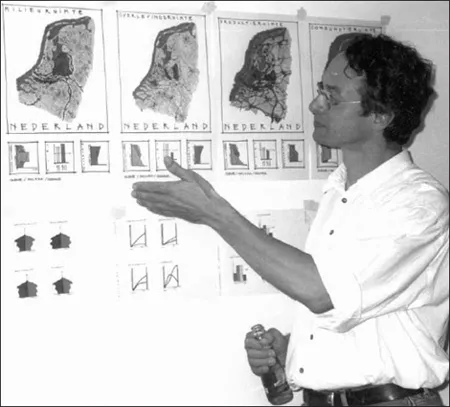
Figure 1.1 Futurist in action
Source: Susan van ’t Klooster
Scene 3
Seven people, three men and four women, of different ages between 30 and 50 years, have gathered together in a meeting room. They have an ‘agenda’ and a ‘script’. Both have been distributed in advance by email. The agenda of this so-called ‘integration session’ reads:
10.00 am | Opening |
10.05 am | Announcements |
10.15 am | Report of the previous meeting |
10.30 am | Balance and knowledge questions |
13.00 pm | Lunch break |
13.30 pm | Balance and knowledge questions |
16.30 pm | Appointments |
17.00 pm | Closure |
It turns out that the label ‘balance and knowledge questions’ refers to an activity to be carried out in two subgroups. In the ‘script’, the subgroups’ assignment is described in more detail. Before breaking into subgroups, the participants discuss how to feed the results of the subgroup discussions back to the plenary session. The ‘script’ author proposes that they write down a lot on flip-over sheets and that they read each other's sheets. Informed by the excha...
Table of contents
- Front Cover
- Half Title
- Title Page
- Copyright
- Dedication
- Contents
- List of Figures, Tables and Boxes
- Acknowledgements
- List of Acronyms and Abbreviations
- 1 Researching Policy-Oriented Foresight in Action
- 2 First Impressions of Foresight Practice
- 3 Dealing with Policy
- 4 Practising the Scenario Matrix
- 5 Dealing with Prospective Uncertainty
- 6 The Past, the Present and the Future
- 7 Reflection on Action
- References
- Appendix
- Index
Trusted by 375,005 students
Access to over 1.5 million titles for a fair monthly price.
Study more efficiently using our study tools.
Frequently asked questions
Yes, you can cancel anytime from the Subscription tab in your account settings on the Perlego website. Your subscription will stay active until the end of your current billing period. Learn how to cancel your subscription
No, books cannot be downloaded as external files, such as PDFs, for use outside of Perlego. However, you can download books within the Perlego app for offline reading on mobile or tablet. Learn how to download books offline
Perlego offers two plans: Essential and Complete
- Essential is ideal for learners and professionals who enjoy exploring a wide range of subjects. Access the Essential Library with 800,000+ trusted titles and best-sellers across business, personal growth, and the humanities. Includes unlimited reading time and Standard Read Aloud voice.
- Complete: Perfect for advanced learners and researchers needing full, unrestricted access. Unlock 1.5M+ books across hundreds of subjects, including academic and specialized titles. The Complete Plan also includes advanced features like Premium Read Aloud and Research Assistant.
We are an online textbook subscription service, where you can get access to an entire online library for less than the price of a single book per month. With over 1.5 million books across 990+ topics, we’ve got you covered! Learn about our mission
Look out for the read-aloud symbol on your next book to see if you can listen to it. The read-aloud tool reads text aloud for you, highlighting the text as it is being read. You can pause it, speed it up and slow it down. Learn more about Read Aloud
Yes! You can use the Perlego app on both iOS and Android devices to read anytime, anywhere — even offline. Perfect for commutes or when you’re on the go.
Please note we cannot support devices running on iOS 13 and Android 7 or earlier. Learn more about using the app
Please note we cannot support devices running on iOS 13 and Android 7 or earlier. Learn more about using the app
Yes, you can access Foresight in Action by Marjolein van Asselt, Marjolein van Asselt,Susan van 't Klooster,Philip van Notten,Livia A. Smits in PDF and/or ePUB format, as well as other popular books in Politics & International Relations & Insurance. We have over 1.5 million books available in our catalogue for you to explore.