This book takes a unique look at the first Boer war by concentrating on the events and battles of the First Boer War. Due attention is also given to the 2nd Boer War - it's origins, key players and significance for the future of South Africa. The personal stories of heroism and sacrifice, sieges, rebellions and battles, make for an enthralling and dramatic tale - a classic of military history that will find a ready audience amongst military enthusiasts.
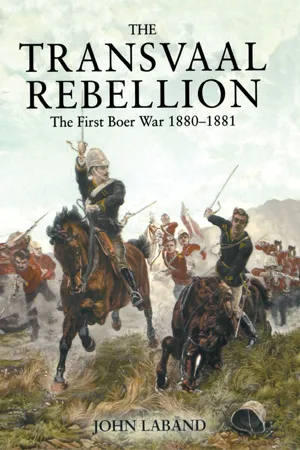
- 280 pages
- English
- ePUB (mobile friendly)
- Available on iOS & Android
eBook - ePub
About this book
chapter 1
The Imperial factor and the Transvaal
Successive British cabinets throughout the nineteenth century debated the merits of formal and informal empire in southern Africa, sometimes seeking to assert political paramountcy over the region, only then to withdraw from direct involvement. The decision in 1899 to go to war with the two Boer republics of the Transvaal and Orange Free State for South African supremacy was thus the culmination of this fluctuating process, and has spawned an on-going debate concerning the motives behind nineteenth-century British imperialism in the sub-continent. Interpretations have waxed and waned in accordance with the dictates of scholarly fashion. The emphasis has swung between economic arguments for empire which have focused on the search for markets, labour and control of mineral resources; through the imperatives of grand strategy and the need to safeguard the route to India; to the contradictory desire to institute imperial administrative and military economies; from the pressure from the humanitarian lobby concerned by the treatment of Africans by Boers and British settlers alike; to the often maverick role of individual local colonial officials and the parochial agendas of white settlers in search of land and economic advantage.1 Currently, the more monocausal of these explanations have yielded to an integrated, synthetic approach. This is invaluable in unravelling the motives behind the British annexation of the Transvaal in 1877, and in laying out the reasons for the British government’s acquiescence in the new colony’s humiliating retrocession only four years later after a disastrous, but by no means irretrievable military campaign.2
In considering British policy in southern Africa, it is well to remember that cabinets were dependent on the knowledge of the permanent official in the Colonial Office who advised the Colonial Secretary, as well as on imperial officials in South Africa, notably the High Commissioner. The government was also sensitive to public opinion expressed through the press, the clubs and parliament, and through the pressure groups with South African interests like missionary and anti-slavery organisations and commercial and shipping houses. Nor must it be forgotten that the remoteness of South Africa half a world away from Britain, poor communications and the sub-continent’s unique problems meant that members of the government were usually ill-informed of its affairs. Consequently, in cabinet a great deal of latitude was allowed by default to the Colonial Secretary who was better informed than most. He, in turn, permitted considerable powers of discretion to his officials in southern Africa. All too often decisions concerning the distant region were simply reactions to events, mere fire-fighting. Yet at other times, when Colonial Secretaries and the local proconsuls of empire were men of vision and determination, Britain would take the initiative in South Africa.3
When Britain formally annexed the Cape of Good Hope from the Dutch in 1814 to secure its sea route to the east, some 27,000 white colonists already lived there. These Cape Dutch were derived from Dutch, Flemish, German and French Huguenot settlers and were already beginning to develop a sense of their own ‘Afrikaner’ identity. British rule did not sit well with many of them, and by 1836 an organised migration of thousands of farmers, or Boers, was under way north across the Orange River and into the interior of southern Africa. Individual pastoral farmers (or trekboers) in the Cape Colony had long been pushing forward the frontier of white settlement into the interior, but this so-called ‘Great Trek’ was of another order, and by 1845 perhaps 14,000 Emigrant Farmers (or Voortrekkers) had left the Cape in a series of parties, taking with them not only all their livestock and goods and chattels, but also their black dependants and servants to a number as great as their own.
The Great Trek has naturally been subject ever since to a host of interpretations, though an enduring consensus has held that while it was not unique among the various nineteenth-century migrations of white settlers, it was of enormous import for southern Africa in that it set the historical stage for all that was to follow.4 Currently, the influential writings of Tim Keegan and Norman Etherington have broken with this more established historiography. In refusing to dignify the Boer exodus with a unique status, Etherington has set out to show that it was but one of many treks during the early nineteenth century by other indigenous peoples of southern Africa, such as the Ndebele, Rolong and Griqua. When all of these migrants set up their new states on the highveld they displaced or incorporated others living there before them and transformed the face of the interior.5 Keegan is with Etherington in arguing that the Boer emigration was not primarily motivated by some self-conscious sense of national mission as later Afrikaner nationalists might suggest, and that their chief purpose in leaving the Cape was not to establish their republican nationhood as far away as possible from hated aspects of British administration. Keegan prefers to emphasise more positive motives for emigration, primarily an eagerness for new economic possibilities following the extension of the frontier.6 Having escaped from the authority of the colonial government they replicated their loose-knit, patriarchal and plural society as it had been before the relatively liberal British had interfered with their dominance over the African majority and their well established ideas of proper master–servant relationships. Most emigrants had the skills necessary to maintain their wagons and firearms, but depended on travelling traders (or smouse) to supply the vital commodities they could not produce: gunpowder, clothing materials, tea, coffee and sugar. Their hope was always that they could free themselves of the colonial commercial network by gaining access to traders and ports on the east coast of Africa beyond the sphere of British control.7
The Great Trek (which the Cape authorities had failed to impede) threatened to create instability and warfare in the interior with likely repercussions on the Cape. But it was difficult to decide how best to assert British control beyond its frontiers. Until German activities in the 1880s, Britain was the only colonial power with an interest in the region, and it seemed that British paramountcy could be exerted without the cost and liabilities of formal rule.8 One attempt to do just that was the Cape of Good Hope Punishment Act of 1836, passed by Lord Melbourne’s Whig government, which proclaimed the extension of British jurisdiction (but not sovereignty) as far north as latitude 25° S. This law became the basis for British involvement during the 1840s and early 1850s in the affairs of trans-Orangia where the emigrant Boers were in constant conflict with the Sotho and Griqua people already living there. Earl Grey, the Colonial Secretary in Lord John Russell’s Whig administration, added a further means in 1846 of lending protection to any chief harassed by the Boers through the appointment of Sir Henry Pottinger, the Governor of the Cape, to the new post of High Commissioner for southern Africa. This imperial officer’s brief was to exercise an at first extremely vaguely defined authority beyond the Cape’s frontiers but, over time, the high commissioner developed into the chief imperial agent in the region and the instrument of British paramountcy.9
The British forward engagement with trans-Orangia reached a climax in February 1848 with the assertion of paramountcy and the setting up of the Orange River Sovereignty in the territories between the Orange and Vaal rivers and the Drakensberg Mountains to the east. But difficult military involvements elsewhere along the Cape frontiers and the fractiousness of the new territory caused Russell’s government to rethink its troublesome commitment. The first step in the imperial retreat was a settlement with the Boers living north across the Vaal River. From 1838 they had begun to establish a number of widely dispersed settlements (such as Potchefstroom, Heidelberg, Pretoria, Rustenburg and Zeerust) around which they had concentrated, and had set up several volatile and short-lived little republics.10 These trans-Vaal Boers were in the habit of intervening in the affairs of trans-Oranje, and the British had been forced to cut short their interference in the new Orange River Sovereignty at the battle of Boomplaats on 29 August 1848. But the trans-Vaalers were undeterred, and within only a few years they were again preparing to destabilise the Orange River Sovereignty. To preclude this, the British representatives cut a deal with them. By the Sand River Convention of 17 January 1852, the trans-Vaal Boers stood back from affairs south of the Orange in return for British recognition of their independence. In September 1853 the ‘emigrant Boers North of the Vaal River’ officially adopted the name Zuid-Afrikaansche Republiek (or South African Republic) for their new state, though it is often referred to as the Transvaal.11
The terms of their independence are important for understanding what the Transvaal Boers forfeited in 1877 and hoped to regain in 1881. The British agreed to allow the Boers across the Vaal ‘the right to manage their own affairs and govern themselves according to their own laws, without any interference on the part of the British Government’. The British undertook to disclaim all alliances with ‘the coloured nations’ across the Vaal, in return for which the Transvalers agreed to abolish slavery. They were guaranteed access to supplies of ammunition (so important to their very survival in a hostile environment) which were denied to the Africans they feared. Crucially for future development, they were granted the right to receive immigrants from British territory.12 On the face of it, the Transvalers clearly secured a favourable deal. From the British perspective they were rid of a peripheral nuisance. At this juncture, the advantages of informal empire were being preferred over formal. So Lord Aberdeen’s coalition administration British renounced sovereignty over the Orange River Sovereignty which, by the Bloemfontein Convention of 23 February 1854, became the republic of the Orange Free State and independent without qualification under much the same terms as the Transvaal.13 The British retreat was completed in 1863 when the repeal of the Punishment Act freed British subjects north of the Orange from the jurisdiction of the Crown.14 The British policy of trying to exert direct control over the Voortrekkers had failed, and the two conventions amounted to its substitution by a system of alliances.
Non-intervention north of the Orange may have become the new orthodoxy, but Sir George Grey, who held the High Commissionership from 1854 to 1861, brought to South Africa his experiences while Governor of New Zealand (1845–1853) in drawing that colony closer together in a semi-federal system.15 He urged Lord Derby’s Tory government to support, in the interests of trade and defence, a federation of the British Cape and Natal colonies with the Orange Free State. The latter, beset by debilitating war with the Sotho and attempts by the Transvalers to force a merger of the Boer states, was willing to agree to such a plan. But the British government baulked at the price of a commitment to federation, and Grey’s scheme foundered. However, while Sir Philip Wodehouse was High Commissioner (1861–1870), the idea of federalism was revived, as was the possibility of incorporating the two Boer republics. Though the Orange Free State had made an immediate, if shaky, start as a single state in 1854, it was not until 1860 that all the Transvaal communities accepted a single constitution – which did not prevent a period of civil war in 1860–1864. While the Transvaal developed in cantankerous isolation, however, the Orange Free State retained closer links with the Cape and acted as the bridge to the north for British influence.16
New economic and philanthropic pressures were behind the revival of this federationist thinking. Cape and Natal merchants, who had been agitating for re-annexation north of the Orange to open up the area to trade, renewed their efforts with the portentous discovery in 1867 of diamonds at the confluence of the Orange and Vaal Rivers. By 1872 20,000 whites and 30,000 blacks had converged at what had become the Kimberley diamond diggings.17 Such extensive exploitation of diamonds had all the potential to transform the economy and society of the sub-continent in a ‘mineral revolution’, and was quickly consolidated by gold-strikes. The finding in 1873 of alluvial gold in the eastern Transvaal at Lydenburg, Pilgrim’s Rest and De Kaap started South Africa’s first gold rush, though it amounted only to 0.03 per cent of total world production. It was not until the uncovering of the vast seam of gold-bearing ore on the Witwatersrand in 1886 that the Transvaal would develop by the 1890s into the world’s single biggest gold producer.18 Concurrent with the mineral revolution, philanthropist agitation for British intervention was growing as a consequence of repeated reports of Transvaal slave-raiding and ownership in contravention of the Sand River Convention.
Meanwhile, Wodehouse actively intervened to bring an end to the Orange Free State’s interminable wars with the Sotho by annexing the mountain kingdom in 1868. He also put the brakes on the Transvaal’s attempts to expand west across the traders’ route to the north, as well as east towards Delagoa Bay, Zululand and a seaport which would reduce the landlocked republic’s economic dependency on British controlled territory. Such active imperial intervention north of the Orange provoked Boer resentment because it was not incorrectly seen as tacitly subverting the British commitment to non-in...
Table of contents
- Cover
- Half Title
- Title Page
- Copyright Page
- Table of Contents
- List of maps and plates
- Acknowledgements
- Publisher’s acknowledgements
- Abbreviations
- Map of the Transvaal
- Introduction: A clash of military cultures
- 1 The Imperial factor and the Transvaal
- 2 The situation in the Transvaal Territory in 1880 and the outbreak of rebellion
- 3 The Boer and British military systems
- 4 In open rebellion: the Boers seize the military initiative
- 5 ‘Cribbed, cabined, confined, bound-in’: the blockaded garrisons
- 6 The Natal Field Force
- 7 Laing’s Nek
- 8 Ingogo
- 9 Seeking a way out of the war
- 10 Majuba
- 11 Peace and betrayal
- Conclusion: ‘Remember Majuba!’
- Select bibliography
- Index
Frequently asked questions
Yes, you can cancel anytime from the Subscription tab in your account settings on the Perlego website. Your subscription will stay active until the end of your current billing period. Learn how to cancel your subscription
No, books cannot be downloaded as external files, such as PDFs, for use outside of Perlego. However, you can download books within the Perlego app for offline reading on mobile or tablet. Learn how to download books offline
Perlego offers two plans: Essential and Complete
- Essential is ideal for learners and professionals who enjoy exploring a wide range of subjects. Access the Essential Library with 800,000+ trusted titles and best-sellers across business, personal growth, and the humanities. Includes unlimited reading time and Standard Read Aloud voice.
- Complete: Perfect for advanced learners and researchers needing full, unrestricted access. Unlock 1.5M+ books across hundreds of subjects, including academic and specialized titles. The Complete Plan also includes advanced features like Premium Read Aloud and Research Assistant.
We are an online textbook subscription service, where you can get access to an entire online library for less than the price of a single book per month. With over 1.5 million books across 990+ topics, we’ve got you covered! Learn about our mission
Look out for the read-aloud symbol on your next book to see if you can listen to it. The read-aloud tool reads text aloud for you, highlighting the text as it is being read. You can pause it, speed it up and slow it down. Learn more about Read Aloud
Yes! You can use the Perlego app on both iOS and Android devices to read anytime, anywhere — even offline. Perfect for commutes or when you’re on the go.
Please note we cannot support devices running on iOS 13 and Android 7 or earlier. Learn more about using the app
Please note we cannot support devices running on iOS 13 and Android 7 or earlier. Learn more about using the app
Yes, you can access The Transvaal Rebellion by John Laband in PDF and/or ePUB format, as well as other popular books in History & African History. We have over 1.5 million books available in our catalogue for you to explore.