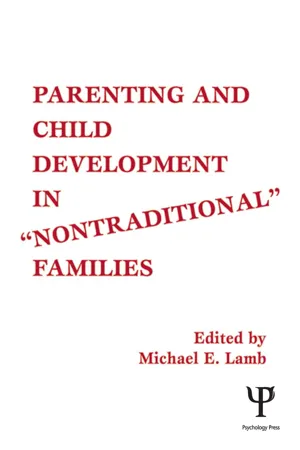
The goal of this volume is to discuss--in depth--the ways in which various "deviations" from "traditional" family styles affect childrearing practices and child development. Each of the contributors illustrates the dynamic developmental processes that characterize parenting and child development in contexts that can be deemed "nontraditional" because they do not reflect the demographic characteristics of the traditional families on which social scientists have largely focused. The contributors deal with the dynamics and possible effects of dual-career families, families with unusually involved fathers, families characterized by the occurrence of divorce, single parenthood, remarriage, poverty, adoption, reliance on nonparental childcare, ethnic membership, parents with lesbian or gay sexual orientations, as well as violent and/or neglectful parents. By doing so, the authors provide thoughtful, literate, and up-to-date accounts of a diverse array of "nontraditional" or traditionally understudied family types. All the chapters offer answers to a common question: How do these patterns of childcare affect children, their experiences, and their developmental processes? The answers to these questions are of practical importance, relevant to a growing proportion of the families and children in the United States, but also have significant implications for the understanding of developmental processes in general. As a result, the book will be of value to basic social scientists, as well as those professionals concerned with guiding and advising clients and public policy.
- 374 pages
- English
- ePUB (mobile friendly)
- Available on iOS & Android
eBook - ePub
Parenting and Child Development in Nontraditional Families
About this book
Information
Publisher
Psychology PressYear
1998Print ISBN
9780805827484
9780805827477
Edition
1eBook ISBN
9781135683009
Chapter 1
Parental Behavior, Family Processes, and Child Development in Nontraditional and Traditionally Understudied Families
Parental influences on children’s development have been the topic of speculation for centuries and the focus of theory and research for decades. Although efforts in this area continue to vary in the degree of sophistication, one consistent similarity has been the preoccupation with the superiority of “traditional” family styles and “traditional” parental roles. Thus, social scientists have lauded family dynamics, parental behavior, and child development in two-parent families in which mothers are full-time homemakers and care providers, while fathers are primary breadwinners with minimal direct involvement in child care. Although less often remarked, scholars and researchers have also focused largely on middle-class White families in North America—in part, perhaps, because these families are most familiar to the majority of researchers and social scientists themselves. The exclusive focus on (and evaluative preference for) families of this type has become increasingly anachronistic in the face of demographic changes that have made traditional families less and less characteristic of the environments in which most children are raised, and that have made, even in the United States, the White, affluent, educated families that are widely studied increasingly unrepresentative of the population.
The goal of this volume is to discuss in depth the ways in which various deviations from traditional family styles affect childrearing practices and child development. I use the term deviations advisedly, because it implies deviation from some established norm, and there is scant evidence that traditional families represent a pattern of family life that has been normative historically or cross-culturally. As many commentators have observed, the traditional norm is somewhat illusory, existing primarily in the conceptual models and assumptions of social scientists rather than in the societies and communities they observe and study. Instead of dwelling on their deviance, therefore, contributors to this volume attempt to illustrate the dynamic developmental processes that characterize parenting and child development in the various ecological niches that can be deemed nontraditional because they do not reflect the demographic characteristics of the traditional families on which social scientists have largely focused. With these considerations and implicit definitions in mind, in this introductory chapter I review the principal issues raised in the study of nontraditional families and their impact on child development.
Many discussions regarding familial influences on early socioemotional development implicitly assume that the traditional family constellation is normative and thus the most adaptive for parents and children. Consequently, most considerations of nontraditional families begin with the assumption that these families are deviant and are likely to have adverse effects—especially on young children growing up in them. Fortunately, some of these deviant forms of family organization such as maternal employment and extrafamilial child care have been in evidence long enough for researchers to assess empirically the validity of the assumption that “nontraditional is necessarily harmful.” However, other deviant styles and practices are of such recent origin or have been studied so little that empirical research remains limited. In addition, evaluative judgments about traditional and nontraditional family forms abound, making it difficult to separate opinions from facts.
In this introductory chapter, I first explore some myths about the origins and history of the traditional family. Then I define the five principal assumptions that appear to form the basis of prevalent beliefs about the inherent superiority of traditional over nontraditional family forms. Finally, I present an outline of the volume, discussing the relationships between the individual chapters and the propositions mentioned in the second section.
Origins of the Traditional Family
The belief that traditional two-parent families are more likely to preserve marital harmony and raise psychologically healthy children has achieved widespread and almost unquestioned acceptance, even though this belief reflects an unwarranted equation between what was (briefly) common and what should be the case. Ironically, it also involves misunderstanding of both the origins of the traditional family organization and the social adaptability of the human species.
Contrary to the claims of its contemporary defenders, the traditional family is of relatively recent origin. Although it is true that women have always and everywhere assumed primary responsibility for the care of very young children, this responsibility has seldom precluded either their major involvement in subsistence provision or a substantial reliance upon other caretakers (Lamb, 1998). Consider, for example, the !Kung Bushmen, whose habitat and hunting-and-gathering ways constitute a modern representation of the ecological niche for which we probably evolved. Among the !Kung, gathering by women accounts for about 60% of the group’s nutritional needs, and toddlers or preschool-age children are frequently left in the care of older children and siblings (Lee, 1979). The same occurs in a variety of other societies, whether they have hunting, gathering, pastoral, or agricultural economic bases. In many such “primitive” societies, furthermore, men are expected to assume a role in socialization (especially of boys) and so are more directly involved in childrearing than are most Western fathers.
Shared responsibility for economic provision and (to a lesser extent) childrearing appears to have been common throughout most of our history. It was the industrial revolution that brought it to an end. Instead of working in fields or workshops close to their homes, men now had to travel to mines or factories located some distance away, and instead of perfecting skills they could proudly pass on to their sons, men found that their only salable commodity was unskilled labor. Concomitantly, the subsistence economy gave way to a monetary economy, and thus the fathers’ yield in the form of wages increased in importance while the ability of their wives to contribute significantly declined. Nevertheless, most women (only the well-to-do were exempt) entered the paid labor force and remained employed except for a brief interruption for childbearing and childrearing. Only when general increases in wage levels occurred around the turn of the century did it become unnecessary for some women to work. It was at this point that the traditional family form emerged—less than a century ago.
On the other hand, certain aspects of traditional family organization that are now being questioned by the proponents of alternative family style have been with us far longer. As noted earlier, first of all, women have always and everywhere assumed primary responsibility for early child care. Until the invention of the nursing bottle, only the availability of wet-nurses could free mothers of caretaking responsibilities, and this expensive option was available to relatively few. On the other hand, respect for the sanctity of childhood was limited, and so children were forced into paid employment at very young ages (Aries, 1962; Kessen, 1965). Child care was simply not accorded much consideration by either men or women. Similarly, single parenthood is considered deviant in Anglo-American and Western cultures, although the number of illegitimate children born to unwed mothers in the past appears to have been considerable, especially in medieval cities and towns, and the stigma attached to illegitimacy and divorce appears to have developed only in the Victorian era. Curiously, until the middle of the 1800s, children were customarily placed in the custody of their fathers (not their mothers) when marital dissolution occurred. Under common law, children were viewed as their fathers’ possessions, and it was assumed that men could make satisfactory arrangements for their children’s care until they remarried or their children reached adulthood. The traditional belief that custody should be awarded to mothers can be traced to judicial decisions in the 1830s, which gradually gained acceptance over the succeeding decades. In all, therefore, the belief that women should assume primary responsibility for childrearing has been with us for little more than a few generations.
The preceding paragraphs also reveal that human social behavior is highly adaptable in the face of changing ecological demands. To an extent unequaled in any other species, our behavior is highly flexible. Relatively few of our behavior patterns appear to be innately and immutably organized, and the evolutionary success of our species is attributable to our enormous adaptability. Furthermore, even when biologically based predispositions exist, they are usually tendencies that bias behavior in certain directions subject to environmental demands; seldom do we find humans biologically impelled to behave in one way or another. This realization appears not to have occurred to contemporary advocates of natural family organization. Presumably, beliefs in the superiority of traditional family forms reflect the limited perspective of many social scientists, as does their narrow focus on White and middle class families. Unfortunately, attempts to understand such families were seldom constrained by efforts to limit generalization. Instead, social scientists either assumed that all families functioned like those they studied or, when this assumption was untenable, that alternate family forms represented deficient processes with predictably detrimental effects on child development. As the contributors to this volume make clear, many nontraditional family forms have unique characteristics, strengths, and weaknesses that make them worthy of study in their own right and defy simplistic efforts to view them simply by disparaging comparisons with traditional families.
The Assumed Strengths of Traditional Families
The assumption that the traditional ways of allocating family responsibilities and raising children are necessarily preferable is itself based on five principal axioms or beliefs, namely:
- children need two parents, one of each sex;
- family responsibilities should be divided between the parents, with fathers as economic providers and mothers as homemakers and caretakers;
- mothers are better suited for childrearing and caretaking than fathers are;
- young children should be cared for primarily by family members; and
- White middle-class parents have superior parenting skills and have children who are more likely to excel.
Each of these assumptions are subject to scrutiny in the chapters that follow.
In the first three chapters, the focus is on two-parent families in which the two parents do not divide provisioning and child care roles in the traditional fashion. There are three sources of concern here. The traditional within-family division of parental responsibilities is altered when fathers share the responsibility for bread-winning, and so (it is argued) lose authority and status. In addition, some of the responsibility for child care is frequently shifted in such families to persons outside the family. These persons are said to be less reliable and consistent and to lack the commitment that parents manifest. As far as child development is concerned, harm is likely to result both because the developing relationships between parents and children are weakened and because children are offered substitute care of lower quality than they would receive at home. These issues have been investigated in two partially overlapping literatures, one focused on the effects of maternal employment (Gottfried, Gottfried, Bathurst, and Killian, chap. 2) and the other on the effects of nonparental care (Lamb, chap. 3).
One source of concern about maternal employment is that it may blur the roles of husbands and wives to the detriment of harmonious interaction within the family. This concern has its origins in the notion that male and female roles complement one another and permit couples to capitalize on these complementary areas of expertise. According to Parsons (Parsons & Bales, 1955), for example, women are more expressive, nurturant, and emotionally sensitive and thus should take responsibility for the management of relationships, child care, and so forth. By contrast, because men exhibit instrumental competence, they are suited for executive leadership of the family and for using their instrumental skills in the employment area. However, the Parsonian assumption that heterosexual interaction is more harmonious when the parties are “appropriately” gender typed has not received empirical support (Ickes, 1985) and the reviews by both Gottfried and her colleagues (chap. 2) and Lamb (chap. 3) reveal little empirical support for concerns about the inevitably harmful effects on children of maternal employment and extrafamilial care.
Studies of dual-earner families reveal that a traditional division of roles and responsibilities within the family often persists, even when both parents are equally involved in the paid labor force (Pleck, 1985). It could be argued, therefore, that the maintenance of traditional roles and responsibilities helps to protect children from the harmful consequences of their mothers’ employment. Similar claims cannot be made about those cases in which fathers share in, or are primarily responsible for, child care, while their wives share in, or are primarily responsible for, the economic support of their family. The concerns expressed about role-sharing and role-reversing families are multiple, but two dominate: the belief that men are simply inferior to women in childrearing abilities and the fear that children will be confused about gender related social roles when they are not provided with gender differentiated parental models. The first of these concerns derives from the premise that women are biologically destined to be childbearers and childrearers. Proponents often point to the evidence that the female hormones (prolactin, progesterone, estrogen) potentiate parental behavior in nonhuman species and suggest that these hormones play a similar role in humans. Actually, there is no empirical support for this claim (Lamb & Goldberg, 1982) and the few relevant studies show that men and women are equivalently responsive to their own infants at least initially, although differential experiences over time seem to make fathers on average less sensitive than mothers (Lamb, 1997). The second concern depends on assumptions that the gender appropriate quality of parental behavior will be lost when men become primary caretakers and women become primary breadwinners, and that the psychological adjustment of children requires the acquisition of a traditional sex role. The first of these assumptions is challenged by the research reviewed by Russell (see chap. 4) on highly involved fathers as well as by evidence concerning the benign impact of growing up with two parents of the same gender (Patterson & Chan, chap. 10). The second assumption is faulty both because it implies a confusion between gender identity and gender role (the acquisition of a secure gender identity is developmentally important, but it need not involve conformity to a traditional gender role) and because it equates conformity to a traditional gender role with psychological adjustment. There is no justification for this assumed congruence; in fact, less traditionally gender-typed children are arguably better prepared should the future involve more egalitarian societies.
Despite the shaky bases on which they are founded, concerns about role-sharing and role-reversal remain. Until recently, unfortunately, no attempts were made to study role-sharing and role-reversing families and document the effects of parental role sharing on children and parents. These findings are discussed by Russell (chap. 4), who attempts to place parental role sharing in context by examining the motivations, the stresses, the effects on parental behavior, and the effects on child development. Patterson and Chan (chap. 10), meanwhile, explore the implicit assumption that children need parents of both sexes, noting that children raised by lesbian and gay couples seem to develop quite normally, with variations in their outcomes dependent on variations in the parents’ behavior and circumstances.
Although concerns about maternal employment, extrafamilial child care, an...
Table of contents
- Cover
- Half Title
- Title
- Copyright
- Contents
- Preface
- 1. Parental Behavior, Family Processes, and Child Development in Nontraditional and Traditionally Understudied Families
- 2. Maternal and Dual-Earner Employment: Family Environment, Adaptations, and the Developmental Impingement Perspective
- 3. Nonparental Child Care
- 4. Primary Caregiving Fathers
- 5. The Consequences of Father Absence
- 6. Noncustodial Parents
- 7. The Effects of Divorce and Custody Arrangements on Children’s Behavior, Development, and Adjustment
- 8. Stepfamilies
- 9. Adoptive Families
- 10. Families Headed by Lesbian and Gay Parents
- 11. Black Families in Intergenerational and Cultural Perspective
- 12. Latino Families
- 13. Multiracial Families
- 14. Struggling to Make Ends Meet: Poverty and Child Development
- 15. Violent Families
- 16. The Families of Neglected Children
- Author Index
- Subject Index
Trusted by 375,005 students
Access to over 1.5 million titles for a fair monthly price.
Study more efficiently using our study tools.
Frequently asked questions
Yes, you can cancel anytime from the Subscription tab in your account settings on the Perlego website. Your subscription will stay active until the end of your current billing period. Learn how to cancel your subscription
No, books cannot be downloaded as external files, such as PDFs, for use outside of Perlego. However, you can download books within the Perlego app for offline reading on mobile or tablet. Learn how to download books offline
Perlego offers two plans: Essential and Complete
- Essential is ideal for learners and professionals who enjoy exploring a wide range of subjects. Access the Essential Library with 800,000+ trusted titles and best-sellers across business, personal growth, and the humanities. Includes unlimited reading time and Standard Read Aloud voice.
- Complete: Perfect for advanced learners and researchers needing full, unrestricted access. Unlock 1.5M+ books across hundreds of subjects, including academic and specialized titles. The Complete Plan also includes advanced features like Premium Read Aloud and Research Assistant.
We are an online textbook subscription service, where you can get access to an entire online library for less than the price of a single book per month. With over 1.5 million books across 990+ topics, we’ve got you covered! Learn about our mission
Look out for the read-aloud symbol on your next book to see if you can listen to it. The read-aloud tool reads text aloud for you, highlighting the text as it is being read. You can pause it, speed it up and slow it down. Learn more about Read Aloud
Yes! You can use the Perlego app on both iOS and Android devices to read anytime, anywhere — even offline. Perfect for commutes or when you’re on the go.
Please note we cannot support devices running on iOS 13 and Android 7 or earlier. Learn more about using the app
Please note we cannot support devices running on iOS 13 and Android 7 or earlier. Learn more about using the app
Yes, you can access Parenting and Child Development in Nontraditional Families by Michael E. Lamb in PDF and/or ePUB format, as well as other popular books in Psychology & Developmental Psychology. We have over 1.5 million books available in our catalogue for you to explore.