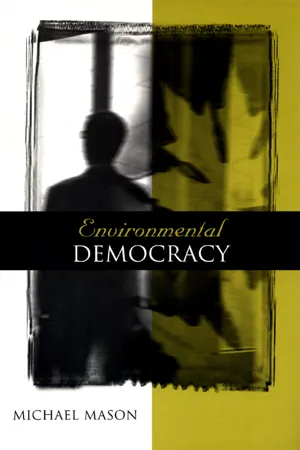
Through a wide range of case studies, Mason reveals just how sensitive we all must be to styles of power, vulnerability and resilience in any democratic transition to sustainability. This is a fine book.'Timothy O'Riordan, Professor of Environmental Science, University of East Anglia, and Associate Director, Centre for Social and Economic Research on the Global Environment. Civic self-determination and ecological sustainability are widely accepted as two of the most important public goals. This book explains how they can be combined. Using vivid and telling case studies from around the world, it shows how liberal rights can include both ecological and social conditions for collective decision-making - environmentalist goals and social justice can be achieved together.Integrating theory and original case studies, the book makes a very significant contribution to the fundamentals of how environmental democracy can be advanced at all levels. Cogently argued and engaged, Environmental Democracy provides a superb teaching text and a source of ideas and persuasive arguments for the politically and environmentally engaged. It will be essential reading for students, teachers and researchers in politics, policy studies, environmental studies, geography and social science.
- 272 pages
- English
- ePUB (mobile friendly)
- Available on iOS & Android
eBook - ePub
About this book
Information
1 CONCEPTUALIZING ENVIRONMENTAL DEMOCRACY
DEMOCRACY AND ENVIRONMENTALISM
Let us begin with a minimal but widely accepted definition of democracy – as a political system in which the opportunity to participate in decisions is widely shared among all adult citizens (Dahl, 1991, p 6). The more significant and comprehensive these opportunities are, the greater the level of democracy attached to a political system: political theorists discuss, in these terms, the ‘widening’ or ‘deepening’ of democratic decision-making. Ultimately, this extension of the democratic principle can lead to the questioning of the ‘political’ category itself and its insulation from social choices determined by a market economy. However, within prevailing conceptions of liberal democracy, this division between the polity and the economy is firmly defended: liberalism, after all, supports the rights of individuals and property holders against the state. The characteristic concern is thus with the political decision-making of representatives elected by a form of majority voting among the population. Representative liberal democracy describes the overwhelming majority of political systems in the world today, in which the central institutions of governance claim to provide equitable opportunities for citizens to shape the exercise of power, and where that influence is facilitated by a plurality of competing parties. Representative democracy is also the modern form of democracy, expressed firstly in the late 18th century founding statements of the American and French republics, where it emerged as the moral justification for the lawful authority of the state over large populations (Pitkin, 1967, pp 196–208).
The contrast is thus set up with the classical idea of direct democracy associated, of course, with the power (kratos) of the people (demos) in ancient Greece. Here in the poleis, there is no corresponding division between ruling and being ruled, in the way modern elected representatives govern a citizen body (Arendt, 1958, pp 32–33). Citizen assemblies and committees exercising power, making laws and implementing policies preceded the creation of a separate state apparatus, although the restriction of citizenship to a privileged minority – excluding, in the well-known example of the Athenian polis, women, slaves and those of non-Athenian origin – obviously runs counter to our inclusive notions of democratic self-determination. As will be noted in the next section, this has not prevented some radical green philosophers from appealing to the participatory ethos attributed to Athenian citizenship as a model virtue for direct democracy, and also from extolling the smallness of scale implied by face-to-face deliberations.
The distinction between representative and direct democracy highlights a central dilemma of modern governance: the functional need for effective political decision-making – achieved in increasingly complex societies through representative, often remote, structures – threatens to undermine the accepted conditions for democratic justification: that affected interests have had a fair opportunity to influence the relevant decisions, giving them good reasons to support democratic norms. John Dunn expresses this paradox bluntly: ‘We have all become democrats in theory at just that stage in history at which it has become impossible for us in practice to organize our social life in a democratic fashion any longer’ (1993, p 29).
In the first place, democracy announces that a state has good intentions, a tried and tested crowd pleaser in the marketplace of political ideas. Furthermore, such is the elasticity of the concept – short of blatant violations of universal suffrage, effective party competition and rights of free speech – the claim of a state to being democratic immediately suggests that it is responsive to the needs of its citizens. According to Fukuyama’s (1992) popular ‘end of history’ thesis, there are no alternatives left anyway: the world historical triumph of representative forms of liberal democracy represents the exhaustion or moral bankruptcy of other political ideologies. As Dunn observes, though, there is actually very little indication of meaningful civic self-determination within liberal democracies. The alarming levels of social and economic inequality in individual democracies and across the world seem to make a mockery of notions of political equality; the global reach of capitalist economic processes weakens the sovereignty of nation states; and even these states themselves, with their complex, alienating bureaucratic forms, offer little for the individual to identify with, let alone support (1993, pp 13–23). The lack of opportunities for individuals to influence the decisions affecting their interests is reflected in the consistently high levels of political apathy recorded across the liberal democracies. And then, of course, there is the ‘ecological crisis’.
The narrative here is well worn but sadly remains relevant. In the list of problems attesting to the continuing deterioration of ecological conditions of life, particular issues jostle for attention and those that come to prominence reflect cultural presuppositions and shifting social priorities. However, the collective evidence for human-induced environmental degradation seems overwhelming – stratospheric ozone depletion, global warming, acidified lakes, species depletion and extinction, deforestation and soil degradation (Goudie, 1997; Middleton, 1995). To map out the full historical geography of environmental degradation in the second half of the 20th century is to record the consequences of an ever-expanding extractive demand on nonrenewable and renewable resources, coupled with an increasing output of toxic substances, many of which – heavy metals, synthetic insecticides, chloroflurocarbons (CFCs), dioxins, radioactive waste, etc – are alien to the normal functioning of ecological cycles.
To be sure, the high levels of complexity and uncertainty characterizing these environmental risks render incomplete our current understanding of biological systems. Within the discipline of ecology some observers have recently noted a conceptual reorientation in keeping with a necessary scientific humility. This ‘ecology of chaos’ identifies fields of study that claim there is no determinate direction governing such ecological processes as succession, speciation and biomass productivity. Sophisticated computer modelling has allowed the ability to observe nature as an expression of chaotic dynamics, overturning classical ideas of ecological equilibrium and order (Pahl-Wostl, 1995; Botkin, 1990). It is perhaps more accurate to claim that, as for most of this century, ecology remains torn between different conceptions of biology (McIntosh, 1985, pp 21–27) – notably the contrast between the mechanistic nature of population ecology, informed by the individualistic notions of neo-Darwinian evolutionary theory, and the more purposeful homeostatic nature of systems ecology, including, on the disciplinary margins of the latter, the global Gaia hypothesis of James Lovelock and Lynn Margulis (Bowler, 1992, pp 535–546).
These divisions within ecology alert us to the fact that even in the academic arena, where we might expect consensus on the objective assessments of ecological problems, there remain debates and disagreements. Not surprisingly, there are also divergent metaphors of nature – nature as fractal geometry, as resource stock, as organism, and so on. In the mirror of nature, what we see reflects the society we live in and the values we live by. The relevance here is that ecology has had a remarkable cultural resonance through the seepage of its naturalistic concepts into the public self-understanding of ecological problems; but this popular impact has not included an appreciation of the discipline’s self-doubts and institutional reflections. The end result is the dominance of a ‘value-free’ naturalistic framework in the public discussion of environmental problems that has actually prevented, until very recently, a serious investigation of their social and political nature. This applies, ironically, to the major political movement responsible for popularizing the message for ecological responsibility – environmentalism.
At its broadest, environmentalism refers to the diverse set of philosophies and practices informing a concern with protecting (natural and human) environmental quality. Lynton Caldwell has succinctly characterized the ethical challenge presented by the environmental movement (1990, p 86):
The movement is life centred, distinguished by a sense of moral imperative regarding human behaviour in relation to other life forms within the biosphere… Environmentalist values are species oriented and transgenerational, emphasizing personal and social responsibility.
The birth of modern environmentalism is conventionally related to the ten years following 1962, between the publication of Silent Spring – the clarion call on pesticides poisoning from Rachel Carson (1962) – and the 1972 Stockholm Conference on the Human Environment, which led to the founding of the United Nations Environment Programme (UNEP) (McCormick, 1989, pp 88–105). In that formative decade several catalysts warrant historical attention, such as the countercultural backlash against materialist values, the influence of other social movements (notably the peace movement), and a sensitivity in the popular media to anxieties about resource scarcity and environmental pollution (McCormick, 1989, pp 47–68). Commentators attach different weight to the immediate causes, yet there is a shared recognition that the environmental movement is a truly global phenomenon, cutting across social, political and religious divides. There is also a common acknowledgment that, for all the organizational variety of the environmental movement, environmentalism represents a challenge – whether reformist or radical – to the Promethean belief that current patterns of economic growth can motor on regardless of their accumulating social and ecological costs.
The key ideological distinction within environmentalism relates to the valuation of nonhuman nature. Tim O’Riordan (1981, 1989b) remains the most helpful guide to the complex and competing strands of thought making up the two modern worldviews of environmentalism – technocentrism and ecocentrism. The division is ideal-typical because individuals may well favour elements from both modes according to the institutional setting, the nature of the issue, and the socio-economic context (O’Riordan, 1981, p 2). Moreover, the two ideological themes both have autonomous and inter-related dynamics of conceptual change warranting detailed historico-geographical exposition (Pepper, 1996, provides an excellent overview). It is sufficient here to outline their broadest characteristics.
The reformist worldview, technocentrism, recognizes the challenge posed by environmental degradation but, on account of its technological optimism regarding the problem-solving ability of modern society and the rationing efficiency of market-based social choice, addresses ecological problems through managerial means. Chapter 2 discusses an influential contemporary manifestation of technocentrism – ecological modernization – which is associated with policy shifts to anticipatory environmental management. Within technocentrism, O’Riordan differentiates a confident ‘interventionist’ credo from a more cautious ‘accommodative’ strain: the contrast also lies in the willingness of proponents of the latter to entertain proposals for institutional reform to incorporate environmental interests.
However, while such proposals may endorse increased democratic accountability in political decision-making, there is no appetite for recasting existing structures of political and economic power (O’Riordan, 1989b, pp 85–89). Overall, the efficiency-oriented agenda of technocentrism leaves unexamined prevailing notions of the good life in advanced capitalist societies. By accepting the dominant instrumentalist metaphor of nonhuman nature as a storehouse of resources, technocentric environmentalism is more concerned with means than with ends. In this worldview, environmental problems belong to the domain of professional expertise; given their prominence in high managerial or executive positions, this strata of environmentalists – for all their participatory rhetoric – are determined to maintain their technical authority when negotiating environmental risks. The political problem is that accommodative moves to open up environmental decision-making are inadequate to keep in touch with the global scale of many current environmental problems and insufficient to satisfy the persistent demands for public empowerment coming from the ecocentric heart of the environmental movement.
Ecocentrism rejects the political reformism of technocentric environmentalism, outlining instead a range of radical demands for redistributing power. These projects all share a ‘nurturing’ or ‘nature-regarding’ view of society-nature relationships, and are profoundly sceptical of large-scale technology, corporate commitments to environmental management and existing systems of professional expertise (O’Riordan, 1989b, pp 82–86). Their underlying philosophy of nature is informed by an ecological model of internal relatedness in which the dividing lines between the human and the nonhuman are dissolved: humankind is embedded in biophysical relationships and, like any other species, subject to ecological laws (Eckersley, 1992, pp 49–55). This results in two defining features of ecocentrism – a practical concern with limits to material and demographic growth coupled with ethical concerns about the nonhuman world (Dobson, 1990, p 205). The latter encompasses a variety of ‘natural attributes-based’ value theories (Goodin, 1992, pp 24–25). and Chapter 3 discusses the challenging ethical ideas of deep ecology and bioregionalism. More generally, ecocentrism can be subdivided into a left-inclined communalism and a more conservative Gaianism: both tend to favour decentralized political structures and economically self-contained communities; however, anarchist and socialist influences on communalism have given it a participatory democratic flavour. As is often the case at the radical end of an ideological spectrum, there are numerous nuances of deep green thinking and no lack of agitated disagreements – something that applies, as we shall shortly see, to their competing notions of green democracy.
In his overview of environmentalist ideologies, O’Riordan identifies ‘a picture of contradictions and tensions dominated by a failure to agree over cause, symptom, and action’ (1989b, p 93). This accounts for the imaginative dynamism of the environmental movement. Nevertheless, both technocentric and ecocentric strains, informed by ecological concepts, share a naturalistic understanding of environmental problems. Both presume that the environmental risks generated by modern life are ‘external’ threats to our well-being, while the impacts of our productive and consumptive processes render vulnerable a realm of independent, nonhuman nature. This is not to deny that there are competing representations of natural science at stake. The international policy currency of technocentric environmentalism has established the modelling of human environmental impacts as a leading research priority – for example, through the scientific working groups of the Intergovernmental Panel on Climate Change (IPCC). These attempts to make sense of environmental degradation reflect a managerial confidence in the predictive capacity of natural science, but leave unexamined crucial links between the generation of environmental knowledge and social structures of scientific authority and credibility (Wynne, 1994). From ecocentric environmentalism, the Gaia hypothesis – that life on Earth provides a cybernetic, homeostatic feedback system – would seem to present a more radical challenge to the observations, models and methodologies of environmental science (Schneider and Boston, 1991); but for all its interdisciplinary ambitions, scientific discussion of the Gaia concept has yet to include any significant sociological input.
Why should this ‘loss of social thinking’ (Beck, 1992, p 25) concern us? An immediate reason is that it misconstrues even the natural scientific understanding of environmental problems. The development of environmental knowledge, like science generally, has not cumulatively converged on a permanent or fixed truth, but been forged in volatile conditions of historical change and intellectual struggle (Kuhn, 1970). The fact that scientific change is shaped by institutional allegiances, and wider social and economic power relations, is to recognize the underdetermination of any theory by empirical data. Science may be instrumentally progressive, increasing the practical possibilities of predicating and controlling natural processes through technological applications; but the scientific statements rendered truthful through such technical utilization are always relative to limited data and local phenomena (Hesse, 1980, p xi). Joseph Rouse claims that our laboratory-oriented natural scientific methods have actually encouraged, in their application, the damaging simplification of natural environmental processes, as is evident from the ‘Green Revolution’ in agriculture (1987, pp 322–323). Others push this claim further still to consider the ways in which scientific knowledge of environmental problems naturalizes and reinforces particular cultural and moral values or identities (Wynne, 1994, p 186); they even construe natural science as no more than a story-telling practice governed by a particular aesthetic realism and ethic of progress (Haraway, 1989, pp 4–5).
It is not necessary to agree with the more relativistic perspectives in order to accept a general political point here – that the conventional natural scientific understanding of environmental problems displaces a necessary role for democratic negotiation over claims to the truth of scientific knowledge, making explicit underlying social interests and moral norms (Wynne, 1994, p 188). This is a self-evident objection to technocentric environmentalism, perhaps; but ecocentric notions fall prey to the same criticism. The preoccupation of ecocentric environmentalism with ‘objective’ ecological limits to growth erases the practical character of natural scientific practices. By accepting that the determination of ecological interests in the case of ‘limits’ is a technical project, ecocentrism undermines its participatory democratic claims elsewhere. The more that environmental interests are defined as objective, the less reason there is to enable people to determine these according to collective debate and decision-making: the task is for expert policy prescriptions as guided by our political representatives (in line with the liberal democratic tradition of civic passivity). If, on the other hand, we accept that natural science has shaped the world we live in and the terms in which we might come to understand ourselves (Rouse, 1987, p 265), environmental knowledge becomes no different from any other social space where the norms of democratic participation are applicable.
The absence of social thinking in conventional environmentalist understanding is all the more remarkable given that environmentalism is, above all, a social movement. Indeed, with its emphasis on post-material values and personal lifestyle choices, environmentalism shares similarities with other so-called ‘new social movements’ – for example, feminism and the peace movement – that have emerged in advanced capitalist countries since the 1960s. Placed in contrast to older forms of protest groupings, such as organized labour, new social movements lack formal organization and ideological unity, expressing diffuse concerns with quality of life, human rights, individual self-realization and participatory democracy (Habermas, 1987, pp 392–396; Dalton and Kuelcher, 1990). In this academic literature, environmentalism is conceptualized in terms of value change, notably with reference to Ronald Inglehart’s (1977) identification of a ‘silent revolution’ – a long-term shift to post-material values among the Western public, especially in the younger and more educated groups of the new middle classes. Cotgrove and Duff (1981) have further narrowed the highest environmental value propensity to public welfare and educational occupational categories. From this focus on changing values comes the cultural characterization of environmentalism, articulating aesthetic and ethical issues traditionally excluded from mainstream political debate, and doing so through noninstitutional means of political action – typically unconventional means of collective protest – which are themselves often expressions of lifestyle choices: for example, the 1990s anti-roads protests in Britain.
Influ...
Table of contents
- Cover
- Title
- Copyright
- CONTENTS
- ACRONYMS AND ABBREVIATIONS
- ACKNOWLEDGEMENTS
- INTRODUCTION
- 1 CONCEPTUALIZING ENVIRONMENTAL DEMOCRACY
- 2 ENVIRONMENTAL DECISION-MAKING IN WESTERN EUROPE AND NORTH AMERICA: DEMOCRATIC CAPACITY-BUILDING?
- 3 ADMINISTRATIVE FAIRNESS AND FOREST LAND DECISION-MAKING: A CANADIAN EXPERIMENT IN PARTICIPATORY ENVIRONMENTAL PLANNING
- 4 DEMOCRATIZING NATURE? THE POLITICAL MORALITY OF WILDERNESS PRESERVATIONISTS
- 5 TRADE UNIONS AND ENVIRONMENTAL DEMOCRACY: A STUDY OF THE UK TRANSPORT AND GENERAL WORKERS’ UNION
- 6 AGENDA 21 AND LOCAL DEMOCRACY: A BRITISH SEARCH FOR NEW PARTICIPATORY FORMS
- CONCLUSIONS: GLOBAL ENVIRONMENTAL DEMOCRACY
- NOTES
- REFERENCES
- INDEX
Trusted by 375,005 students
Access to over 1.5 million titles for a fair monthly price.
Study more efficiently using our study tools.
Frequently asked questions
Yes, you can cancel anytime from the Subscription tab in your account settings on the Perlego website. Your subscription will stay active until the end of your current billing period. Learn how to cancel your subscription
No, books cannot be downloaded as external files, such as PDFs, for use outside of Perlego. However, you can download books within the Perlego app for offline reading on mobile or tablet. Learn how to download books offline
Perlego offers two plans: Essential and Complete
- Essential is ideal for learners and professionals who enjoy exploring a wide range of subjects. Access the Essential Library with 800,000+ trusted titles and best-sellers across business, personal growth, and the humanities. Includes unlimited reading time and Standard Read Aloud voice.
- Complete: Perfect for advanced learners and researchers needing full, unrestricted access. Unlock 1.5M+ books across hundreds of subjects, including academic and specialized titles. The Complete Plan also includes advanced features like Premium Read Aloud and Research Assistant.
We are an online textbook subscription service, where you can get access to an entire online library for less than the price of a single book per month. With over 1.5 million books across 990+ topics, we’ve got you covered! Learn about our mission
Look out for the read-aloud symbol on your next book to see if you can listen to it. The read-aloud tool reads text aloud for you, highlighting the text as it is being read. You can pause it, speed it up and slow it down. Learn more about Read Aloud
Yes! You can use the Perlego app on both iOS and Android devices to read anytime, anywhere — even offline. Perfect for commutes or when you’re on the go.
Please note we cannot support devices running on iOS 13 and Android 7 or earlier. Learn more about using the app
Please note we cannot support devices running on iOS 13 and Android 7 or earlier. Learn more about using the app
Yes, you can access Environmental Democracy by Michael Mason in PDF and/or ePUB format, as well as other popular books in Biological Sciences & Ecology. We have over 1.5 million books available in our catalogue for you to explore.