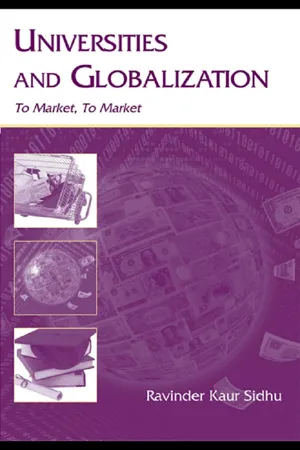
Universities and Globalization: To Market, To Market examines the operations of power and knowledge in international education under conditions of globalization, with a focus on the three biggest exporters of higher education--the United States, Australia, and the United Kingdom. An interdisciplinary approach based on the core social sciences is used to explore the power relations that shape global education networks. The role of nation-states in creating the conditions for education markets and the desire for a Westernized template of international education in the postcolonial world is discussed. The volume offers a sophisticated attempt to recast international education as a series of geopolitical and geoeconomic engagements that transcend simple supply and demand dynamics.
Engaging with the theoretical debates about education and globalization, this book examines global cultural "flows" and boundary crossings, the cultural economy of education networks, and the possibilities for supra-territorial subjectivities. International education markets are examined from the perspectives of both first world producers and postcolonial consumers. By investigating how first world universities imagine and enact the global in their marketing practices, the expressions of cultural diversity valued by education markets, and the types of individual and institutional subjectivities merging from markets, Universities and Globalization: To Market, To Market offers students, faculty, administrators, marketing consultants, and others who work in the area a highly nuanced account of the global relations fostered by education markets. This original, critical examination of the forms and cultural politics of international education is a significant contribution to the field.
- 400 pages
- English
- ePUB (mobile friendly)
- Available on iOS & Android
eBook - ePub
About this book
Chapter 1
Rethinking International Education: Place/Space and Politics
What Is International Education?
In the aftermath of the terrorist attacks of September 11, 2001, international education has acquired a varied set of meanings. The U.S.-based Institute of International Education (IIE) linked international education with a “safer and more secure world” and with a certain type of understanding:
The aim of the terrorists who attacked this country on September 11 is not to change American foreign policy but to close our markets, minds and doors. … When more international students are given the chance for meaningful study and opportunities to gain an appreciation of our society, there will be less hatred of America and misunderstanding of our values and way of life. (Kaufman & Goodman, 2001)
In contrast, Australian-based education broker IDP Education charged international education with the responsibility of “making a critical contribution in developing global peace and understanding” (IDP, 2001). Echoing this view, a Vice-Chancellor1 of an Australian university declared:
I can think of no better antidote to international terrorism to international education. It helps us to develop the international perspective and cross cultural sensitivity that are essential attributes of the effective citizen of the 21st century, and which gives us the skills and personal capacity to respond positively to globalization. (Yerbury, 2001; see also Yerbury, 2004)
Who has membership in this group, who is the collective “we” and “us”? What constitutes “our values” and “our society”? This introductory snapshot draws attention to the arresting complexities and contradictions surrounding the discursive realm of international education. Reflected in terms as diverse as export services, national income, and global peace, international education is associated with such processes and outcomes such as “opening markets, minds, and doors,” producing “effective 21st-century citizenship,” while creating “less hatred and more understanding of our values.”
There is no consensus about what an international education means. Neither is there a commonly agreed set of criteria for what makes a university international. How international education is defined and imagined, what is thinkable and sayable about both international education and the international university, is ultimately shaped by relations of power and knowledge as evident in both of the preceding sets of quotes.
It is obvious, too, from a review of the literature that international education is defined in contradictory ways. International education is most commonly associated with the recruitment and enrollment of international students (Bennell & Pearce, 1998, p. 2). International education is also used to refer to transnational education, the broad range of educational activities that cross national borders (Clyne, Marginson, & Woock, 2001, p. 111). When used interchangeably with global education, international education includes any number of fields from peace studies to studies on ecological sustainability. During the ‘dot.com’ boom, international education was also used to refer to various online education initiatives (Farquhar, 1999, p. 6).
The term internationalization, on the other hand, usually appears in institutional mission statements and policies. The Australian Vice-Chancellor’s Committee (AVCC)2 offered this vague definition in its International Relations Strategic Plan, “Internationalisation is the complex of processes that gives universities an international dimension” (Hamilton, 1998). Within the context of Australian higher education, the Organization for Economic Cooperation and Development (OECD) definition of internationalization has been widely adopted: “the process of integrating an international/intercultural dimension in the teaching, research and service of the institution” (Knight & de Wit, 1995, p. 15).
On its surface, the OECD definition appears adequate: It is open-ended and conceptualizes internationalization as a process that is unfinished and ongoing rather than having a discernible endpoint (de Wit, 1999). However, its weaknesses lie in its inherent generality and ambiguity. It is unclear just what constitutes an international/intercultural dimension, which is as likely to include the trite and superficial as the profound and complex. It does not, for example, preclude a largely one-way transmission of knowledge from West–North to East–South. Similarly, European calls for an internationalization at home are informed by a service approach to education and the desire to position European higher education “to survive and succeed in international competition” (Wachter, 2000, p. 11).
A more comprehensive definition of internationalization is offered by Francis (1993), “Internationalization is a process where education prepares the community for successful participation in an increasingly interdependent world … fosters global understanding and develops skills for effective living and working in a diverse world.” Here, too, our understandings of what might constitute “effective living and working in a diverse world” impinges on our needs and aspirations, and our ethical, political, social, and cultural values.
As Patrick (1997) cautions, if universities view other expanding economies and societies largely as markets for their knowledge and their graduates, they establish the potential for a market-driven internationalization, which stands to resurrect the links between neoimperialism and internationalization. Internationalization, according to Patrick, requires engagement with interdisciplinarity in the teaching and research mission, but most important, it requires universities to develop in their graduates the capacity to “solve problems in a variety of locations with cultural and environmental sensitivity” (Aulakh, as cited in Patrick, 1997). Sadiki (2001) offers a similar understanding of internationalization: It must prepare recipients for ‘global community’ and it must feature ‘curricular plurality’, which he translates as engagement with non-Western epistemologies.
What is the history underlying international education, and how does this history shape the normative expressions of international education? What problems are institutions and governments hoping to solve through the international education market? Given that earlier expressions of what we now call international education were forged in spatialized relations of power, a brief overview of the enterprise of empire in education, and its successors the Cold War–inspired educational aid schemes, is useful.
Educating for “Empire”
A historical analysis of the movement of scholars and students would show that cross-cultural and interregional exchanges are neither a novel nor a recent phenomenon. As empires and civilizations have risen and fallen, the locations of teaching and learning centers have shifted accordingly. Today, with the centers of teaching and research clustered around the North Atlantic Rim, it is almost inconceivable for many to imagine an era when the Arabic centers of Baghdad, Damascus, Cordoba, and Byzantium attracted Western European scholar students (see La Goff, 1993, as cited in Ma Rhea, 2002). These premodern educational exchanges were arguably different in quality from those that took place during modernity. Their scope and diffusion were limited by the absence of sophisticated disseminating technologies such as the Internet and networks of academic journals. However, some similarities can also be assumed with contemporary educational exchanges: They produced hybrid outcomes. Said’s (1993) salutary comment on the permeability of cultures and the inevitability of cross-cultural exchanges is worth keeping in mind:
Far from being unitary or monolithic or autonomous things, cultures actually assume more foreign elements, differences … than they consciously exclude. (p. 15)
Intercultural education exchanges in the early and late modern eras took place against a background of colonization and imperialism, first and predominantly by the European states and from the 19th century onward by the United States.3 Where the first wave of colonization in the 16th and 17th centuries—the era of “bandit kings”—had involved unfettered economic and human exploitation, the second wave of colonization, dubbed the era of philosopher kings, which extended for most of the 19th and early 20th centuries, oversaw the use of a set of altogether different tactics that were intended to create the conditions for a “colonization of the educated mind” (Nandy, 1983, pp. x–xi). Education was regarded as an investment to consolidate colonial power and subsequently exported by colonial centers to their colonies. The expectations underpinning these early education exchanges were captured in pronouncements such as the celebrated Macaulay Minute: “to create a class of persons Indian in looks and colour but English in tastes and opinions, in morals and intellects” (Macaulay, as cited in Loombia, 1998, p. 85; see also Willinsky, 1998, p. 89).
The colonial universities in the British colonies were developed to provide a Western training for native administrators. They were not expected to be academically prestigious; “the colonial state produced a colonial university which did not have the psychological, economic, social or legal potential to confront the powers that be” (Rahman, 2000, p. 127). The legislation that established the University of Calcutta, the first university in India, installed a governing structure that was politicized at the onset—the Governor General would be the Chancellor and the Chief Justice of the Supreme Court would be the Vice-Chancellor.
Similarly, Brazil’s colonial relationship with Portugal delayed the development of a vibrant Brazilian university sector until the 20th century. Requests to develop a university in the 17th and 18th centuries were made by the local governments of Bahia and Minas Gerais to Portugal, but these were refused, and local aspirants traveled to the Portuguese metropolis (Figueiredo-Cowen, 2002, p. 471). By contrast, the Spanish crown was aware of the important role universities might play, not only in transferring Spanish culture and Catholicism from the imperial center to the colonies but also in instituting an appropriate political order. It established the University of Cordoba in Argentina in 1613 and by the 19th century there were 26 universities in Spanish-speaking Latin America (Figueiredo-Cowen, 2002).
The tenacious hold of a colonial imagination in education was sustained by a desire on the parts of postindependence politicians and intellectuals to modernize and to “beat the West at its own game” (Nandy, 1983, pp. xi–xiii). On achieving political independence, they steered education institutions to reproduce, disseminate, and legitimate key ideas of colonial modernity, under the aegis of modernization.4 Universities became silent partners in relentless drives by postcolonial governments to modernize, in some cases, at the cost of violating civil liberties, and subjugating local knowledge systems while entrenching the privileges of local elites (Davies, Nandy, & Sardar, 1993, pp. 83–84; Nandy, 2000, pp. 118–120; Rahman, 2000, pp. 126–127). The influence of political and economic elites in Brazilian society, for example, laid the foundation for a higher education system that would stay aloof of radical sociocultural and political changes in the country (Figueiredo-Cowen, 2002, p. 475). They were first and foremost institutions run by and for the elite. The same observations can be made of the predecessors of the Commonwealth universities in the Indian subcontinent, Africa, and Southeast Asia.
Foremost in postcolonial theory is the injunction against reproducing the discursive logic of the colonial project, with its ritualized binaries and its essentialization of difference (see Pieterse & Parekh, 1995). It is more productive to accept contradiction and disjuncture as pervasive elements of the transcultural, transnational encounter. From a postcolonial perspective, then, various forms of postcolonial education were responsible for perpetuating a faulty politicoeconomic template premised on an insatiable demand for growth, an uncritical engagement with science and technology, and a privileging of the hypermasculine subject (Nandy, 1983, p. xv). The educated subject was not a “gullible, simple-hearted victim” but as a participant in the profoundly complex “moral and cognitive venture” that underpinned direct and indirect colonization efforts (p. xv).
The continuing hold of the colonial imagination, expressed in a collective desire for colonial education forms, cannot be understood as a form of brute domination imposed by the North/West. Western-style education provided a symbolism of nationhood, while postcolonial education systems harnessed modernity’s ideas and ideals in a bid to prove their nation’s intellectual, economic, and technological capacities (see Loombia, 1998; Nandy, 1983; Pieterse & Parekh, 1995; Tikly, 1999; Tuhiwai-Smith, 1999; Venn, 2002; Willinsky, 1998).
Today, the power relations of realpolitik continue to shape the desire for a ‘First World’ university education from non-Western countries. The standard conceptualization of the global education market as a level playing field, featuring the business-savvy, ‘First World’ international university that is simply responding to demand from other markets is the story we all know. In contrast, this study is concerned with understanding how the spatialities of power—the relations between power and space—shape international student flows. In the non-English-speaking world, the acquisition of a higher education credential from an English-speaking country has assumed greater and greater importance with the dominance of Atlantic capitalism (‘Anglo-Globalization’). What does this mean for self–other relations as they are lived out through the production, transmission, and use of knowledge systems at this historical moment?
The Fulbright Program: Establishing a “Democratic Empire”
From the start of the 20th century, the United States began a series of educational aid programs, which officially were intended to assist other countries to modernize. The United States contrasted its intentions and engagements from European imperialism, which it argued was based on outright exploitation and premised on an explicit racial ideology of superiority, with its own commitment to provide other nations with resources to progress through modernization (C. Klein, 2003; N. Singh, 1998). To this end, the United States refracted its own expansionist persuasions by providing opportunities for economic development through free trade and supporting political liberalization.
The exercise of military, political and economic power is always more productive if hinged onto cultural mechanisms (see C. Klein, 2003; Saunders, 1999). Educational aid schemes provided one of the best mediums for building influence. After the Boxer Rebellion of 1900, America set up a scholarship fund to...
Table of contents
- Cover
- Half Title
- Title Page
- Copyright
- Contents
- Preface
- Acknowledgments
- Prologue: Personal and Political Influences
- 1. Rethinking International Education: Place/Space and Politics
- 2. Discursive Power and Subjectivity
- 3. Globalization: Ways of Knowing
- 4. “In America’s Interest”
- 5. Education@UK
- 6. Australia: “Diversity” ma non troppo
- 7. Singapore: East Meets West
- 8. Brazil: “Priority Market”
- 9. To Market, To Market
- References
- Index
Trusted by 375,005 students
Access to over 1.5 million titles for a fair monthly price.
Study more efficiently using our study tools.
Frequently asked questions
Yes, you can cancel anytime from the Subscription tab in your account settings on the Perlego website. Your subscription will stay active until the end of your current billing period. Learn how to cancel your subscription
No, books cannot be downloaded as external files, such as PDFs, for use outside of Perlego. However, you can download books within the Perlego app for offline reading on mobile or tablet. Learn how to download books offline
Perlego offers two plans: Essential and Complete
- Essential is ideal for learners and professionals who enjoy exploring a wide range of subjects. Access the Essential Library with 800,000+ trusted titles and best-sellers across business, personal growth, and the humanities. Includes unlimited reading time and Standard Read Aloud voice.
- Complete: Perfect for advanced learners and researchers needing full, unrestricted access. Unlock 1.5M+ books across hundreds of subjects, including academic and specialized titles. The Complete Plan also includes advanced features like Premium Read Aloud and Research Assistant.
We are an online textbook subscription service, where you can get access to an entire online library for less than the price of a single book per month. With over 1.5 million books across 990+ topics, we’ve got you covered! Learn about our mission
Look out for the read-aloud symbol on your next book to see if you can listen to it. The read-aloud tool reads text aloud for you, highlighting the text as it is being read. You can pause it, speed it up and slow it down. Learn more about Read Aloud
Yes! You can use the Perlego app on both iOS and Android devices to read anytime, anywhere — even offline. Perfect for commutes or when you’re on the go.
Please note we cannot support devices running on iOS 13 and Android 7 or earlier. Learn more about using the app
Please note we cannot support devices running on iOS 13 and Android 7 or earlier. Learn more about using the app
Yes, you can access Universities and Globalization by Ravinder Kaur Sidhu in PDF and/or ePUB format, as well as other popular books in Business & Business Education. We have over 1.5 million books available in our catalogue for you to explore.